7 Proven Organic Search Tactics for Independent Airline Travel Agents

How Can SEO Help Airline Travel Agents Win Direct Bookings?
SEO for airline travel agents starts with the searches your customers make. Create useful pages for the routes and travel services you sell, make those pages fast and easy to use on a phone, and give visitors a clear way to request a quote or book. If you serve customers in person, keep your Google Business Profile accurate, too.
This helps travelers find your agency before they choose a large booking site. The goal is not just more visits. It is more qualified inquiries and bookings through your own website.
I’m Clayton Johnson, founder of SmallBizSEO. My work in technical SEO, content strategy, and digital PR shapes this practical guide to SEO for airline travel agents.
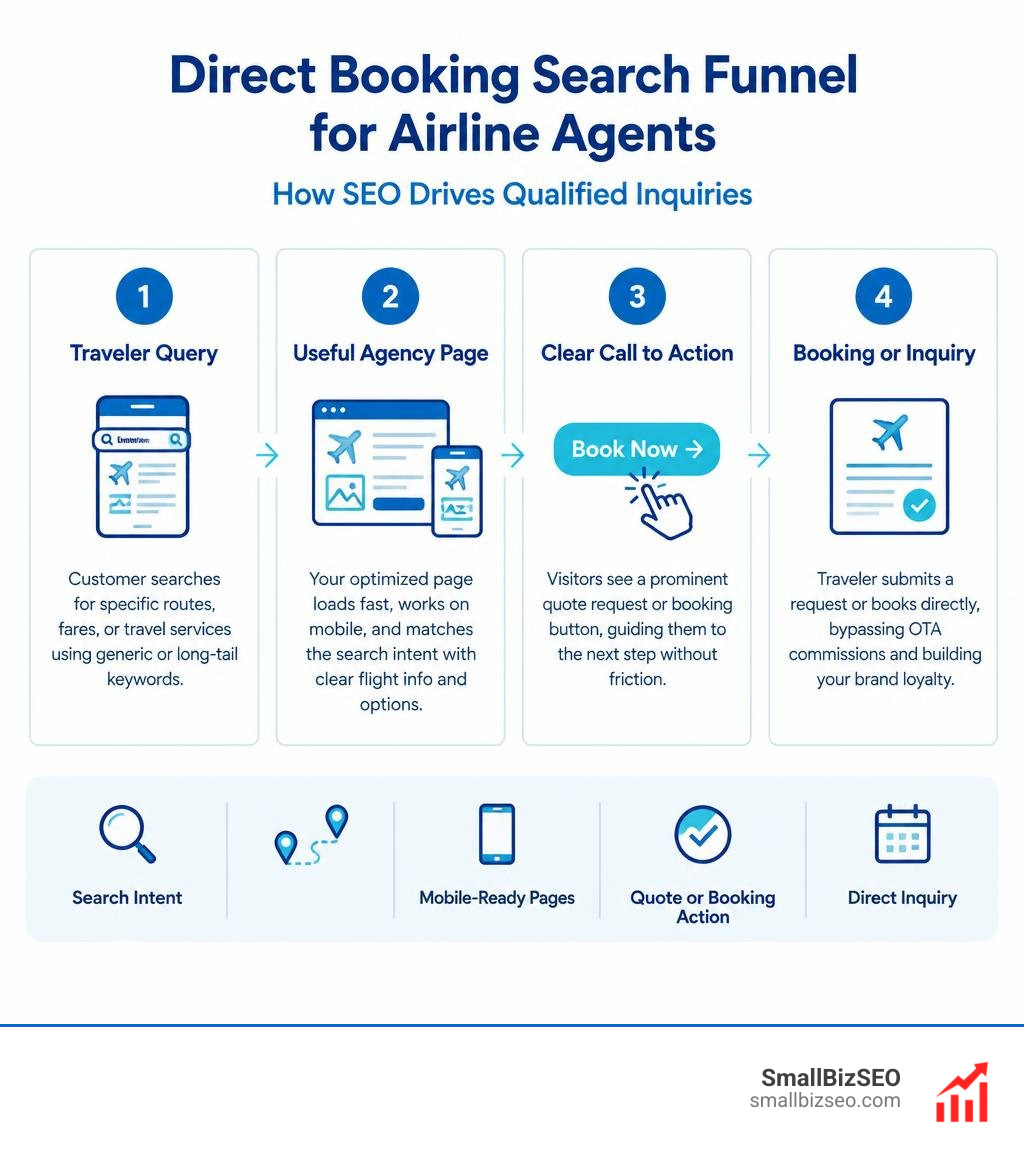
SEO for airline travel agents terms you need:
Core Pillars of SEO for Airline Travel Agents: Technical, Local, and Content Strategy
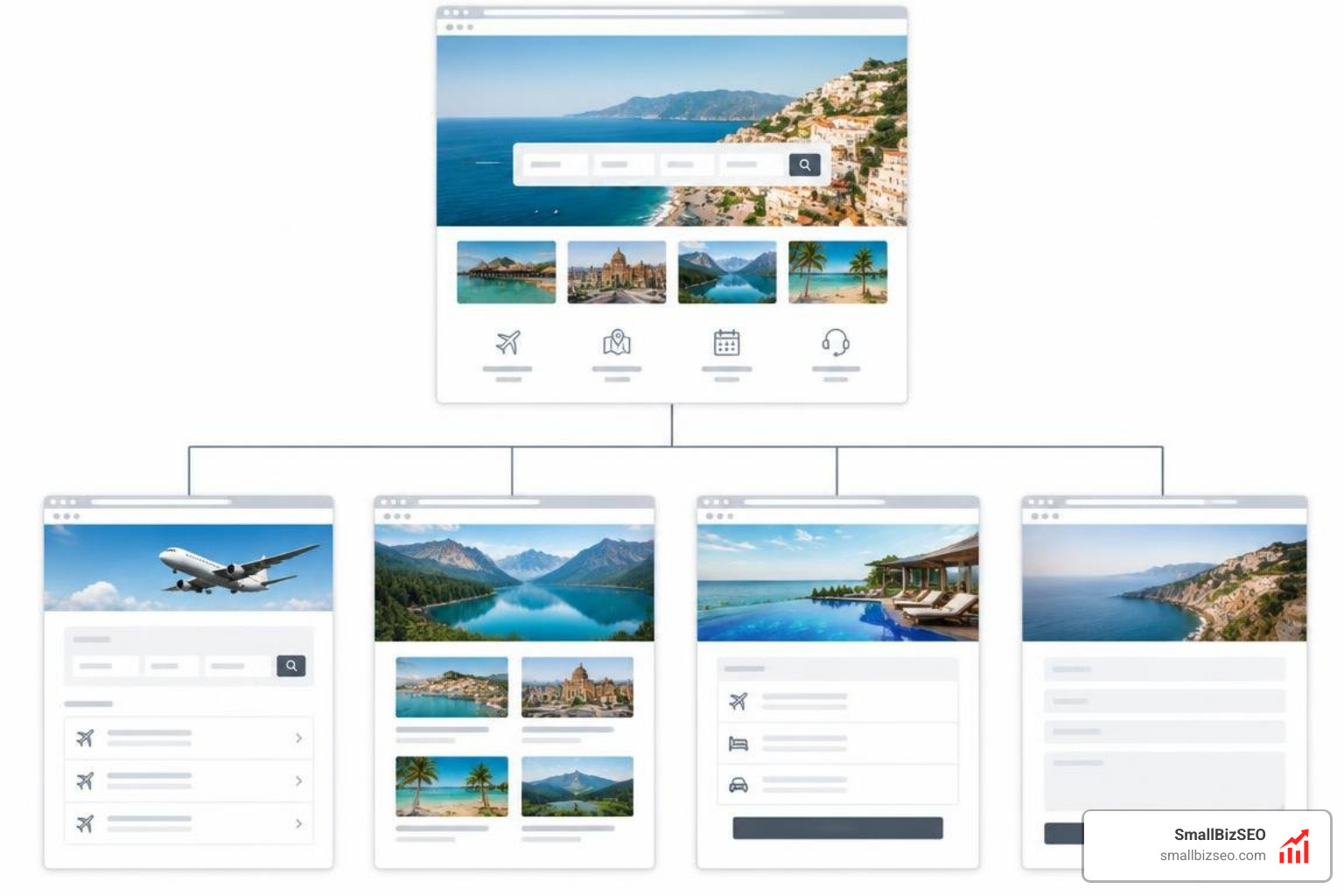
Direct airline bookings rely on three technical elements working together: clean website architecture, local search prominence, and authoritative route content. When these pillars operate in harmony, search engines crawl your flight options easily and present your agency as the trusted primary choice over costly aggregators.
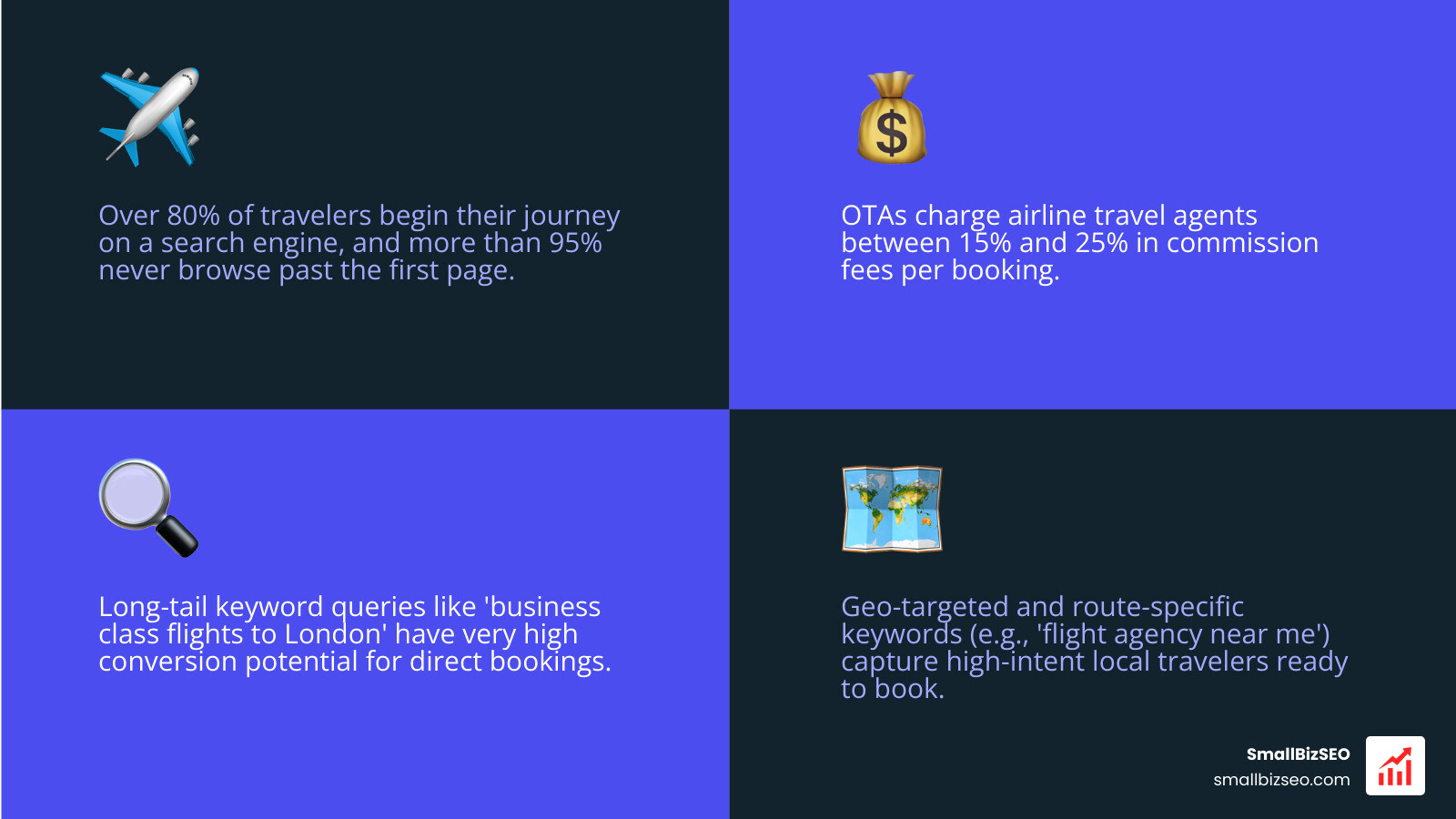
Over 80% of travelers begin their journey on a search engine, and more than 95% never browse past the first page of search results. When a customer searches for flights, third-party online travel agencies (OTAs) often capture their attention, charging your agency between 15% and 25% in commission fees. By investing in dedicated SEO for travel agencies, you reclaim those margins and turn your website into an around-the-clock booking machine.
To make this transition successful, your technical setup must ensure that web crawlers understand your route offerings. Following official guidelines on Google Crawling and Indexing allows search engines to discover and index your flight inventory efficiently.
What Keyword Strategy Works Best in SEO for Airline Travel Agents?
The best keyword strategy focuses on high-intent transactional queries, route-specific city pairs, cabin classes, and seasonal travel demands rather than broad, competitive generic phrases.
Generic terms like "flights" are dominated by mega-aggregators, but long-tail queries connect you directly with travelers ready to make a reservation. By mapping intent across every stage of the traveler’s path, we capture clients who want immediate booking assistance or specialized routing. Integrating custom passport and visa support guides into your site also captures travelers researching necessary international travel documentation before finalizing their tickets.
| Search Query Type | Primary Traveler Intent | Example Search Phrases | Conversion Potential |
|---|---|---|---|
| Generic | Top-of-funnel discovery | "travel agency", "airline tickets" | Low to Moderate |
| Geo-Targeted | High-intent local service | "flight agency near me", "ticket booking office" | High |
| Route & Cabin Class | Specific booking intent | "business class flights to London", "direct tickets to Tokyo" | Very High |
| Pay-Per-Call & Urgent | Immediate booking assistance | "last minute flight booking agent phone number" | Immediate Conversion |
Why Is Technical Site Structure and Navigation Crucial for Booking Conversions?
A streamlined site architecture with single-bar navigation and server-side rendering ensures search engines index your flight routes without diluting link equity or hiding crucial fare data behind JavaScript.
Research on the SEO case for a single-bar navigation in airline retailing proves that lean header menus dramatically improve crawlability while keeping travelers focused on flight search forms. Mega-menus often scatter link authority across hundreds of low-value links. In contrast, a simple layout funnels page authority directly to your core destination hubs.
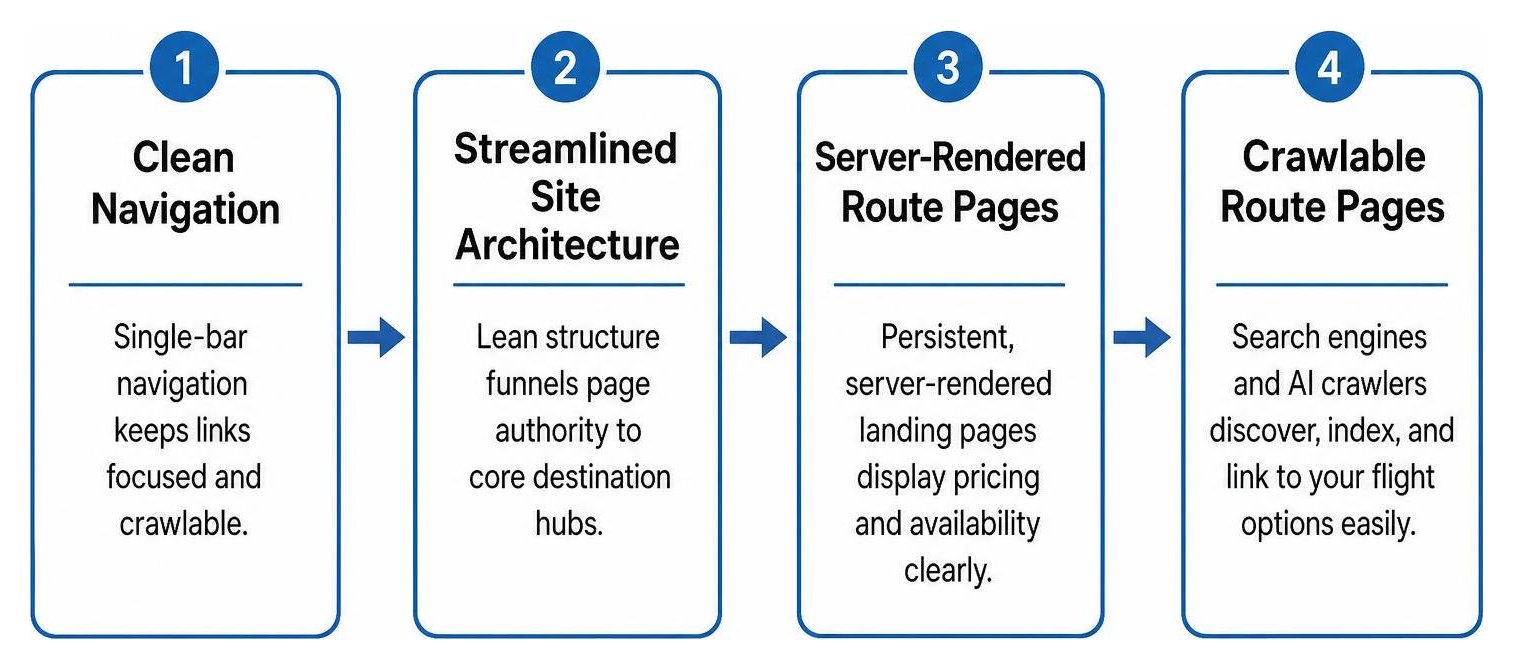
Furthermore, persistent server-rendered landing pages for specific route pairs allow search bots and AI assistants to read your pricing information instantly. Studies demonstrating that ChatGPT is a higher-intent channel than Google reveal that AI crawlers demand stable, structured data without client-side rendering roadblocks to properly link to your booking engine.
How Does Local SEO Help Regional Flight Agents Capture Nearby Travelers?
Local SEO attracts nearby clients by optimizing your Google Business Profile, maintaining consistent Name, Address, and Phone (NAP) details, and creating dedicated regional landing pages.
Travelers seeking complex multi-city trips or corporate travel support frequently look for local professionals who provide personalized assistance. When your Google Business Profile is fully optimized with verified business categories, updated operating hours, and genuine customer reviews, your business earns prime placement in the local map pack.
Managing your reputation through customer reviews adds fresh, natural keyword content to your profiles. This social proof signals high reliability to search algorithms and builds immediate trust with first-time flyers.
Step-by-Step Execution: How Airline Travel Agents Outrank Major OTAs
To outrank massive booking aggregators, airline travel agents must target hyper-specific route landing pages, publish deep destination expertise, and optimize the booking path for seamless conversions.

While massive OTAs rely on generic databases, boutique agencies win organic visibility by offering authentic insights and specialized packages. By adopting tailored private flight and travel marketing, agents can highlight exclusive route perks, personalized baggage handling, and tailored customer support that automated platforms cannot match.
What Content and Link-Building Strategies Deliver Measurable SEO for Airline Travel Agents?
High-performing content strategies combine first-hand experiential destination guides with targeted digital PR campaigns that earn authoritative backlinks from tourism boards, aviation publications, and local lifestyle media.
Search engines place heavy emphasis on Experience, Expertise, Authoritativeness, and Trustworthiness (E-E-A-T). Creating detailed itineraries, layover guides, and airport navigation tips showcases genuine travel knowledge that automated sites lack. Aligning your website with advanced tourism and hospitality search optimization reinforces your topical authority across the wider travel sector.
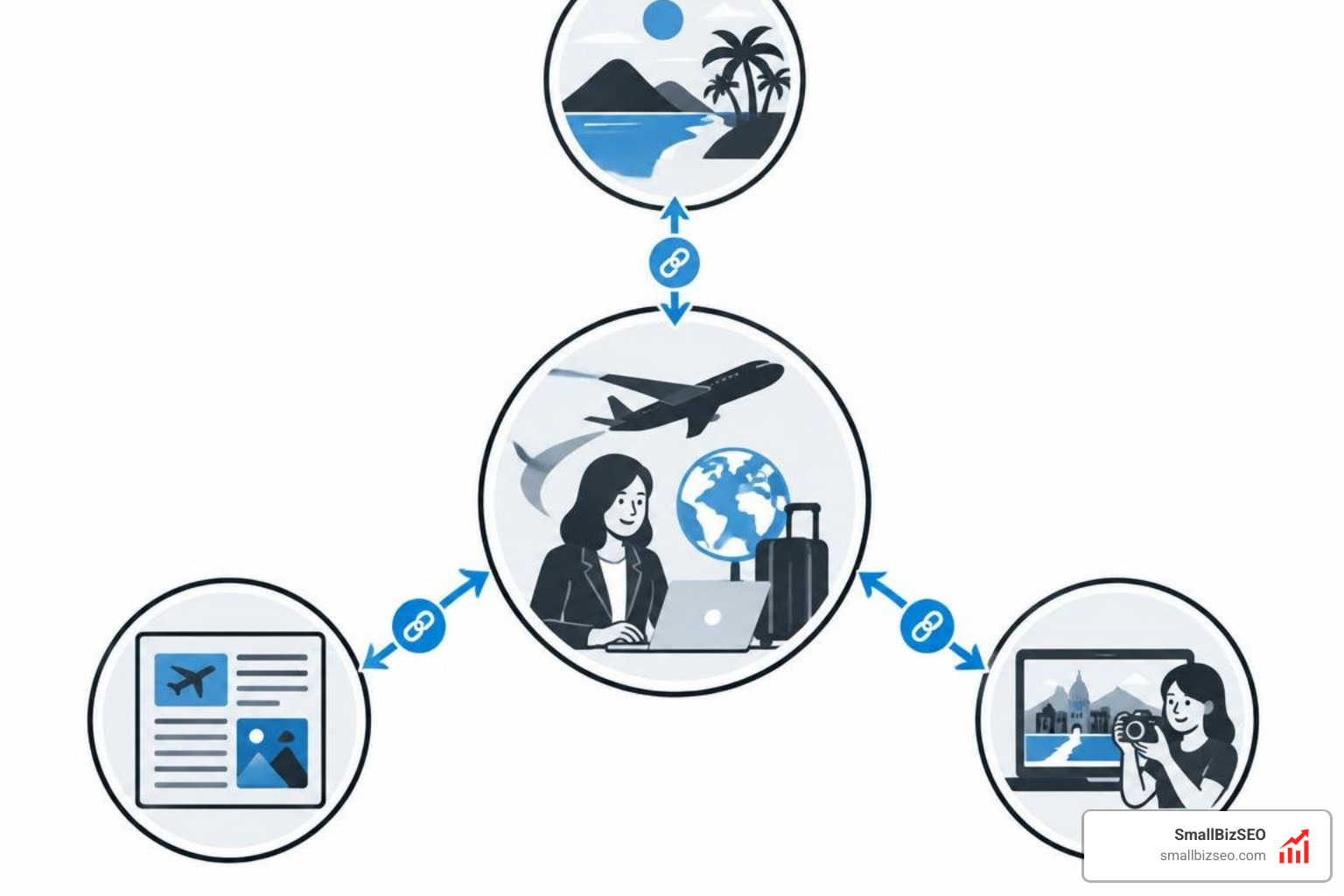
Earned media through strategic partnerships, guest contributions on reputable travel blogs, and mentions from regional chambers of commerce build the domain authority required to climb search engine result pages.
How Do You Optimize for AI Search, SGE, and Generative Engine Discovery?
Optimizing for Generative Engine Optimization (GEO) requires structuring factual flight data, implementing schema markup, and answering specific traveler questions so AI search engines cite your agency directly.
Modern travelers increasingly use voice search and generative AI tools to plan entire trips. According to comprehensive industry insights on the best AI optimization for the travel industry, search engines prioritize authoritative data sources that offer clean, machine-readable flight facts.
- Add Flight and FAQ schema markup to provide structured answers for search engines.
- Write direct, concise answers to common travel questions to win featured snippets and zero-click answer boxes.
- Create conversational content that aligns with natural-language voice searches across smart devices.
- Produce short-form, informative video assets to capture younger demographics who utilize social platforms for travel discovery.
How Should Flight Agents Track SEO ROI and Avoid Costly Mistakes?
Track search performance by monitoring non-branded organic traffic, keyword ranking growth, and Flight Search Initiation (FSI) rates within Google Analytics 4 and Google Search Console.
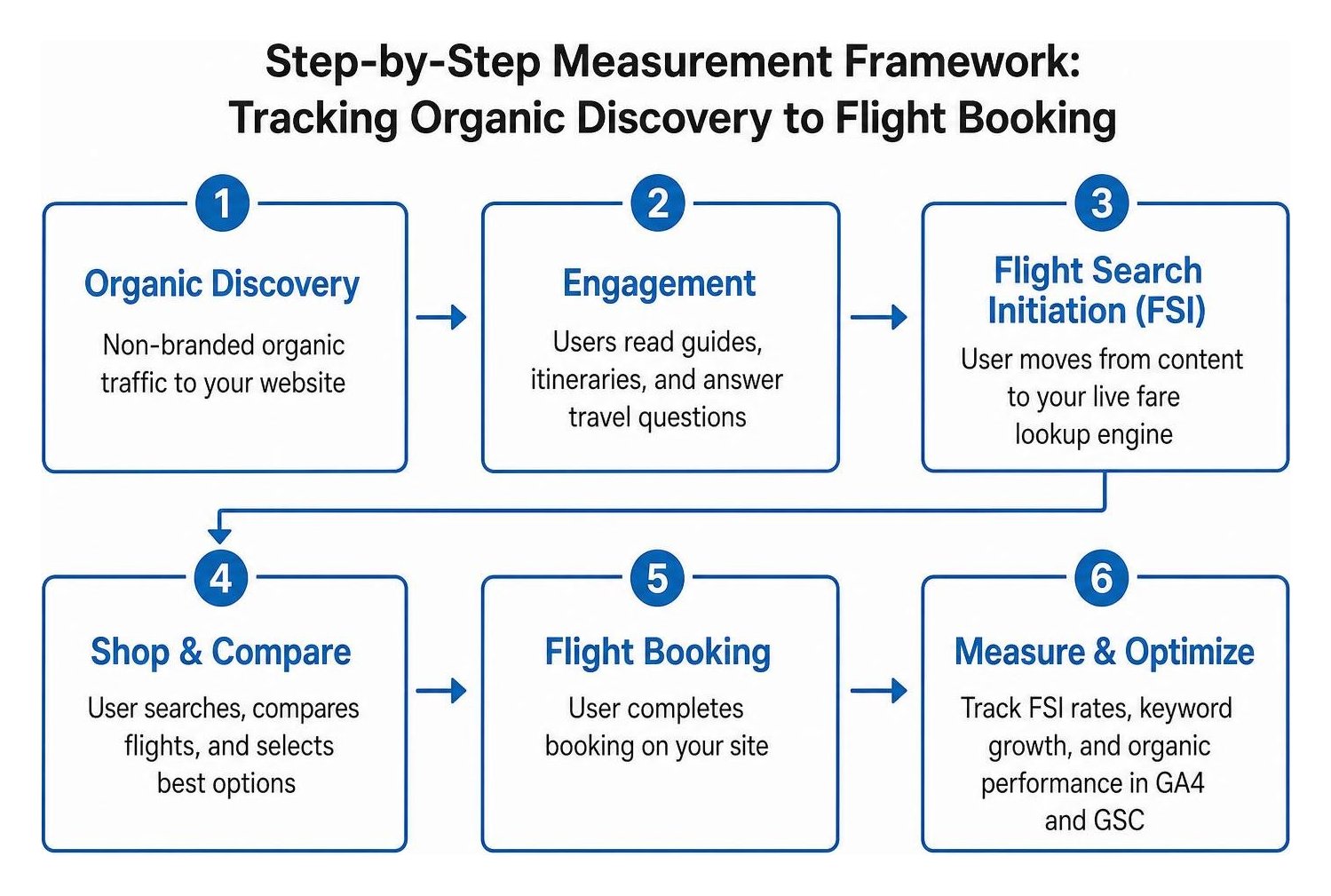
Flight Search Initiation represents the moment a user moves from an informational article to your live fare lookup engine. Because FSI correlates strongly with finalized ticket sales, measuring this metric helps identify which content drives real commercial value.
Avoid critical mistakes like building complex mega-menus, duplicating flight itinerary descriptions, or burying fare data behind slow scripts. Working with a dedicated airline travel agent SEO partner gives you access to SmallBizSEO's data-driven "Velocity" framework, delivering steady ranking gains and transparent, automated reporting that proves your return on investment.
Ready to Elevate Your Flight Bookings?
Winning direct airline bookings requires a deliberate balance of technical speed, focused local visibility, and rich destination content. By targeting high-intent long-tail routes, structuring your pages for AI visibility, and delivering a clean mobile booking experience, your agency can bypass third-party middleman fees and build sustainable direct revenue. Explore our proven case studies to see how our data-driven frameworks help small businesses scale, or claim a comprehensive SEO visibility audit today to unlock your website's true booking potential.