How to Choose an Affordable NYC SEO Agency for Your Small Business

How to Choose an Affordable NYC SEO Agency for a Small Business
The best affordable NYC SEO agency is the one that can show a clear scope, name the people doing the work, explain what the business owns, and connect reporting to qualified leads rather than rankings alone.
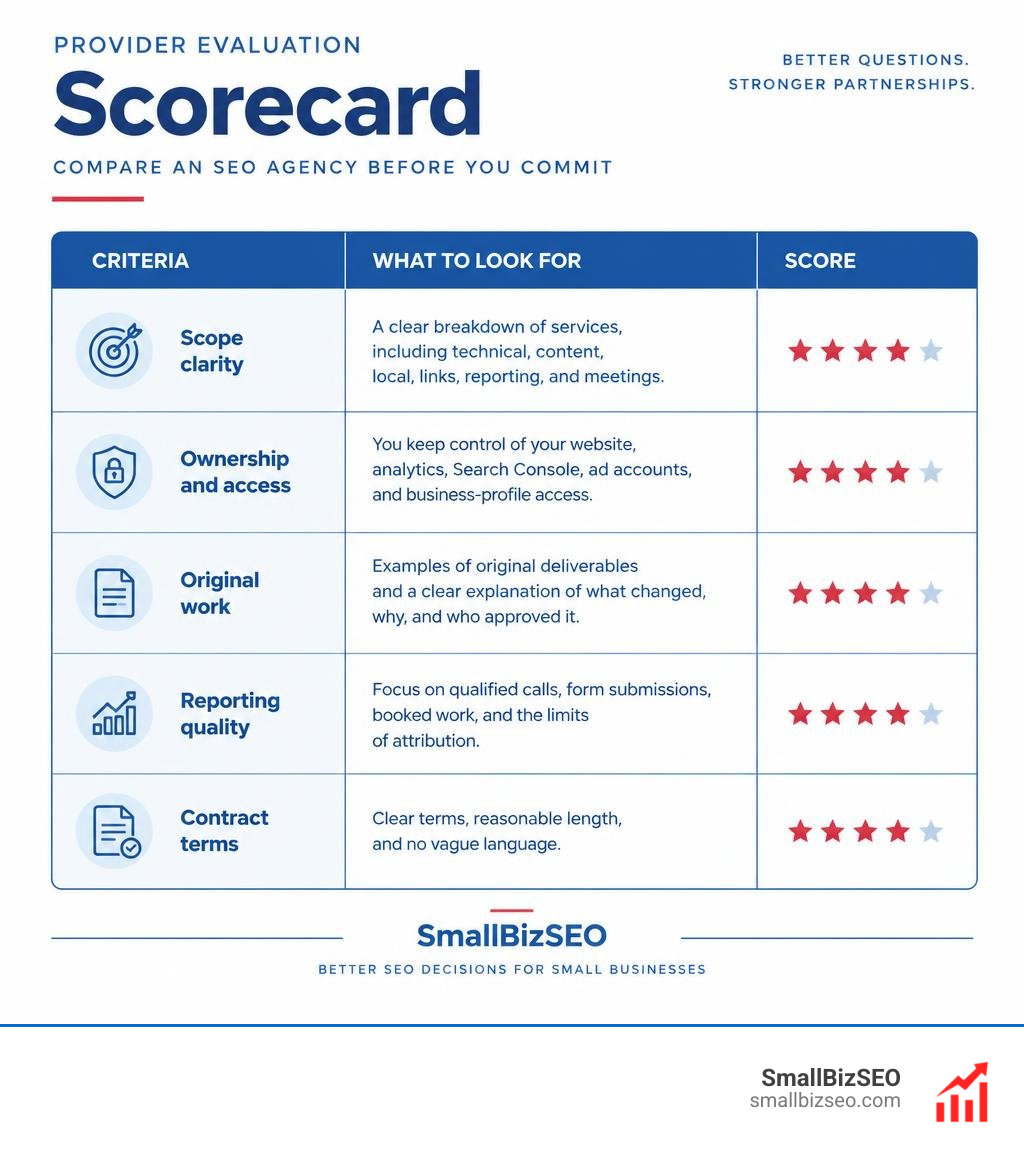
Start with a short comparison before booking a consultation:
| What to compare | What a useful answer looks like |
|---|---|
| Business goals | The agency asks which services, customers, and lead types matter most. |
| Scope of work | The proposal separates technical fixes, content, local-profile work, links, reporting, and meetings. |
| Ownership | The business keeps control of its website, analytics, Search Console, ad accounts, and business-profile access. |
| Proof of work | The agency can show examples of original deliverables and explain what changed, why, and who approved it. |
| Measurement | Reporting identifies qualified calls, form submissions, booked work, and the limits of attribution. |
New York is a crowded market, and it is a buyer’s guide for comparing providers, reviewing a quote, and deciding whether a proposed scope fits the business.
Google advises businesses hiring an SEO to understand what the provider will do, avoid guarantees, and keep control of important site access. Review Google’s guidance on hiring an SEO alongside every proposal.
A good consultation should end with practical next steps, a clear owner for each task, and no pressure to accept a vague package.
What Should an NYC Small-Business SEO Scope Include?
A useful scope explains the work before it promises an outcome. It should identify the pages, technical issues, local listings, content priorities, outreach activity, and reporting tasks the agency will address, plus how often the plan will be reviewed and revised.
Technical and on-page work
Ask for a prioritized audit and an ongoing maintenance plan, not a generic statement that the site will be optimized. A practical plan identifies crawl and indexing issues, page experience problems, duplicate or thin content, internal-link gaps, and the pages that need clearer service information. It should also explain how technical fixes will be implemented, monitored, and revisited as the site changes.
Local eligibility and real-world accuracy
Local visibility starts with honest business information. Google’s local ranking guidance explains that local results are influenced by relevance, distance, and prominence; no provider can guarantee placement. A business should use its actual eligible setup, accurate contact details, and service information that reflects where it can genuinely operate. For a broader overview, see Local SEO Optimization and Small Business Growth.
Useful location content, not doorway pages
A neighborhood page earns its place only when it answers a distinct customer need. That may include a genuinely different service process, building-access requirement, service boundary, or local proof the business can substantiate. Repeating the same page while swapping neighborhood names creates little value for buyers and can create quality risk.
AI search work without promises
Clear, accurate, well-structured content can help search systems and AI-assisted features understand a business. It cannot guarantee indexing, rankings, a brand mention, or inclusion in a particular AI answer. Google’s AI features guidance similarly emphasizes helpful content and does not offer a special shortcut for appearing in AI results.
How to Compare SEO Quotes and Scope

Do not compare proposals by price alone. Compare the work, the capacity behind it, the business responsibilities, and the evidence each provider will deliver. SmallBizSEO lists current package details on its SEO packages page; request a current written quote before treating any package or scope as final.
Quote-comparison worksheet
| Quote item | Questions to ask before approving |
|---|---|
| Starting point | What audit findings, pages, and business goals informed this recommendation? Compare the scope with the current SEO Packages. |
| Deliverables | Which recurring research, technical maintenance, content creation or page refreshes, internal-link improvements, local-profile tasks, and editorial outreach are proposed? |
| Monthly work discussion | Which specific deliverables will be discussed for the next review period, who owns each item, and what could change if priorities shift? |
| Implementation | Who makes the changes, and what access or approval is needed from the business? |
| Original work | Which items are custom research or writing, and which are templates or software outputs? |
| Reporting | How will qualified calls, forms, booked work, lead quality, and costs be reviewed? |
| Contract terms | What is the term, renewal process, cancellation process, and handoff plan? |
| Ownership | Who owns accounts, content, reporting data, and completed work if the engagement ends? |
What commonly changes the cost of ongoing SEO
Ongoing costs and scope usually reflect the starting condition of the site, the number of services or pages that need work, the amount of original content and technical implementation required, local-profile complexity, competitive pressure, and the depth of reporting or strategic support. A transparent provider explains which of those factors apply instead of labeling a quote as a standard market rate.
Low cost is not proof of poor work, and a higher quote is not proof of better work. The decision should rest on documented scope, realistic capacity, clear ownership, and work that can be reviewed.
Questions to Ask Before Hiring an NYC SEO Agency
Use the sales conversation to test whether the provider can explain its process in plain language. A strong agency should welcome specific questions and document the answers in the proposal or statement of work.
Provider-evaluation questions and Best SEO Companies in New York
- What will happen in the first stage of work, and what will wait until later?
- Which team members or partners will perform technical work, writing, local-profile updates, and link outreach?
- Which accounts must remain under business ownership, and which access levels does the provider need?
- What original pages, research, or recommendations will be delivered, and how will their quality be reviewed?
- How will the work be approved before it goes live?
- How are qualified calls, forms, booked consultations, lead quality, and costs reported?
- What cannot be reliably attributed to SEO alone?
- What happens to access, files, content, and unfinished work if the engagement is cancelled?
Claims that deserve a closer look
Be cautious when a proposal guarantees rankings, indexing, traffic, leads, local-pack placement, or placement in AI answers. Search results change, competitors change, and technical or business constraints can affect progress. Ask the provider to explain the evidence behind each claim, the work it controls, and the factors it does not.
A useful proposal makes room for uncertainty while still committing to observable work, decision points, and reporting.
What to Expect From Ongoing SEO and Reporting
SEO is ongoing because websites, competitors, search features, and business priorities change. The right plan should identify the first priorities, review what changed, and adjust the next set of work instead of promising a fixed ranking date.
What a realistic working cycle can include
- Recurring customer and search-query research to identify the questions and services that deserve attention.
- A prioritized plan for technical maintenance, existing-page refreshes, and approval steps.
- Original articles, service-page improvements, and SEO content services that answer real customer questions.
- Contextual internal-link improvements that help readers and search engines find related service information.
- Earned editorial outreach and link-building services discussed in terms of relevant opportunities and completed work, not promised placements.
- Regular review of qualified leads, lead quality, visibility, completed work, and the next priorities.
These are concrete deliverables to discuss during each review period, not a statement that every item is included in every package.
Attribution has limits
Analytics can connect calls, forms, and bookings to landing pages or campaigns, but it cannot always prove every reason a customer chose a business. Useful reporting should pair lead data with the research, content, technical maintenance, outreach, and page-refresh work completed, then use that evidence to revise priorities. Phone conversations, repeat visitors, referrals, offline marketing, and delayed decisions can all affect results. Ask the provider to explain which data is measured directly, which data is estimated, and what decisions the report will support.
SEO and paid ads can work together
SEO and paid ads solve different parts of the buyer journey. Ads can help test demand, support time-sensitive offers, or maintain visibility while organic improvements develop. SEO can build durable pages that answer customer questions and attract unpaid search visits over time. A thoughtful plan considers both rather than treating either channel as a guaranteed replacement for the other.
Review local coverage before expanding
Before a business adds a borough or neighborhood to a profile or builds a page for it, confirm that it can serve that area honestly and consistently. The goal is useful information for real customers, not a large set of near-identical geographic pages.
Frequently Asked Questions About Affordable NYC SEO Services
How long does SEO take for a small business?
There is no reliable universal timeline. The pace depends on the site’s condition, the work approved and completed, the competitive landscape, search-engine processing, and the business’s ability to respond to leads. Ask for a staged plan with review points rather than a fixed ranking promise.
Can an agency guarantee Google rankings, indexing, or AI visibility?
No. An agency can commit to clear, high-quality work and transparent reporting, but it cannot guarantee how Google will rank or index pages or whether an AI feature will include a business. Review the provider’s proposed work, reporting approach, and the limits it acknowledges before accepting guarantees.
Should a local business create a page for every NYC neighborhood?
Only when each page offers distinct, honest value. A page should reflect real services, actual operating capability, and local details that help a customer decide. Repetitive pages that simply change a neighborhood name are not a sound content strategy.
Can SEO replace paid ads?
Sometimes SEO can reduce reliance on paid traffic for certain searches, but it is not a guaranteed replacement. Paid campaigns and SEO can complement one another when they are measured against lead quality, cost, and business capacity.
Choose a Clear SEO Scope Before You Commit
An affordable SEO engagement should make the work easy to inspect: what will be done, who will do it, what the business owns, how approvals work, and how qualified leads will be discussed. That clarity matters more than a sweeping promise.
If the scope is still unclear, ask for a consultation and a written proposal that answers the comparison questions on this page. SmallBizSEO can help businesses review priorities, define a realistic scope, and discuss the current package options without promising rankings, indexing, or AI inclusion. For a fuller overview of SmallBizSEO’s commercial service offering, review New York SEO.
Request a consultation to compare the work before making a decision, or review the current SEO packages.