Capture High-Intent Buyers with Smart Search Engine Marketing

How Can Search Engine Marketing Help Your Business Grow?
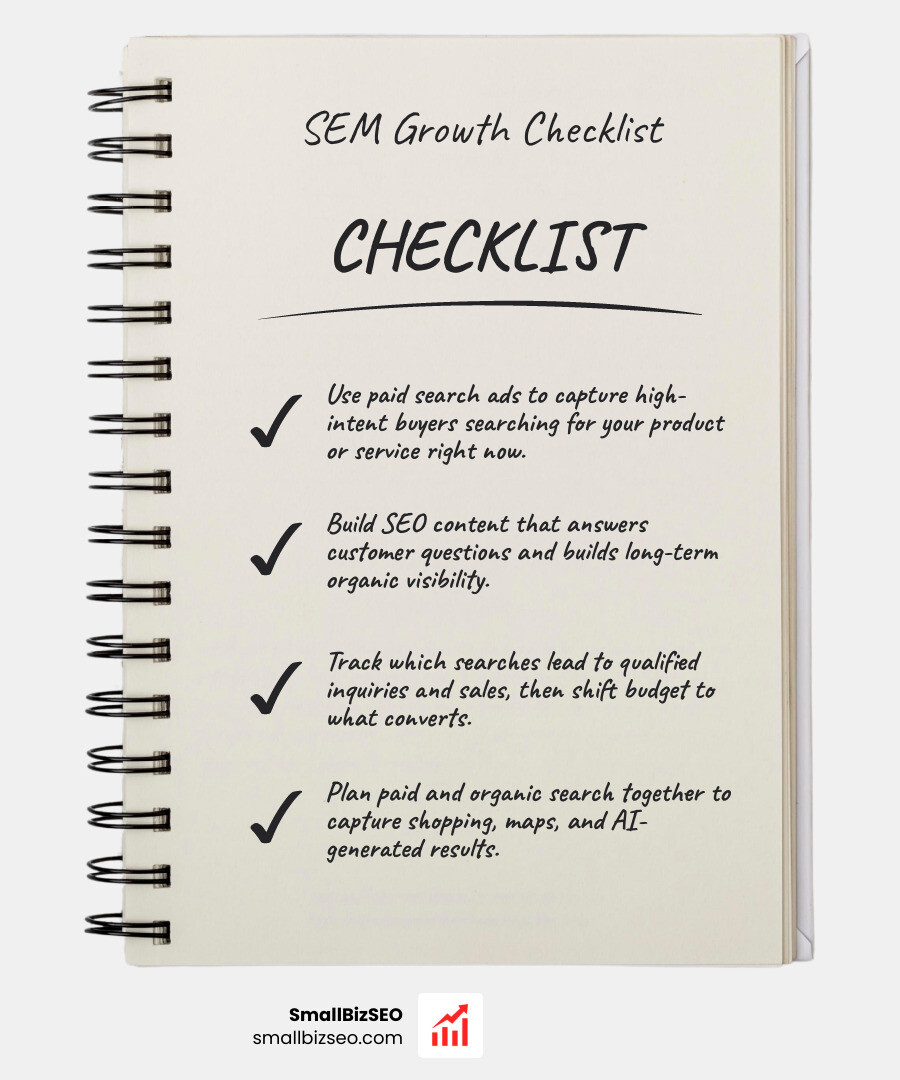
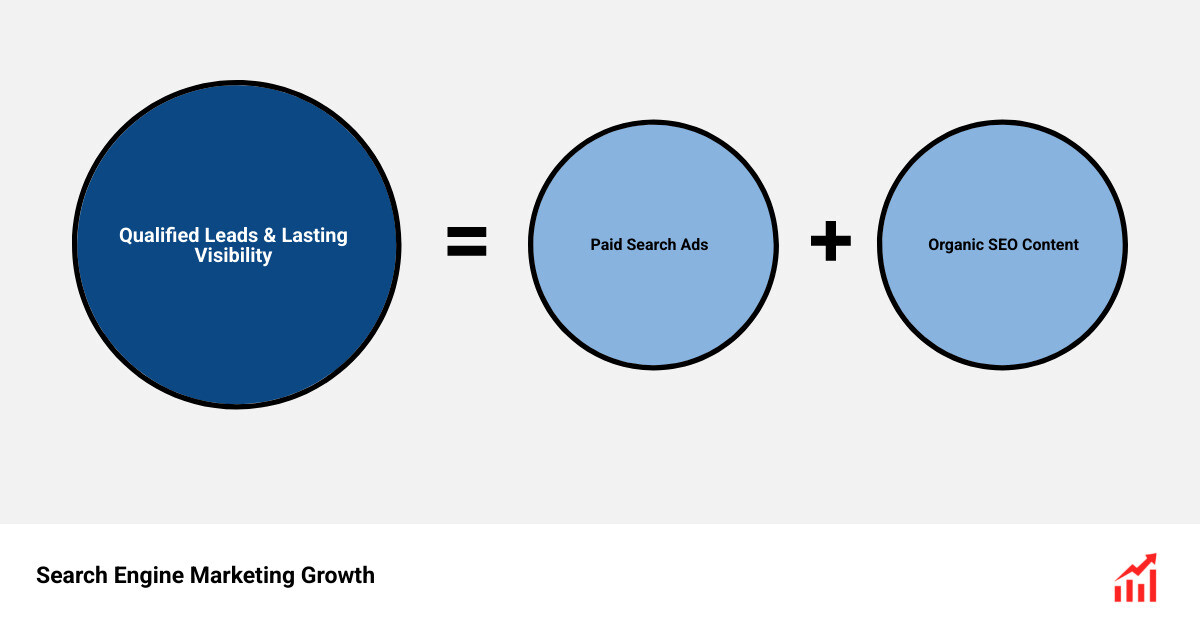
A search engine marketing business strategy starts with the searches most likely to bring in customers. Use paid search ads to reach people looking for what you sell now. Build SEO content that answers their questions and helps your business stay visible over time. Track which searches lead to qualified inquiries or sales, then put more effort into what works.
Search results now include shopping listings, maps, and AI-generated answers alongside ads and organic pages. That makes it useful to plan paid and organic visibility together, rather than judging success by clicks alone.
I’m Clayton Johnson, founder of SmallBizSEO. I help small businesses connect SEO, content, and digital PR to their search engine marketing business goals, with a focus on qualified leads and lasting visibility.
Search engine marketing business vocab to learn:
Introduction to Search Engine Marketing Fundamentals
Search engine marketing (SEM) is the practice of promoting a website on search engine results pages (SERPs) primarily through paid ads, often coordinated alongside organic optimization. While the term originally described any activity designed to improve search visibility, modern marketers treat SEM predominantly as paid search advertising (pay-per-click or PPC).
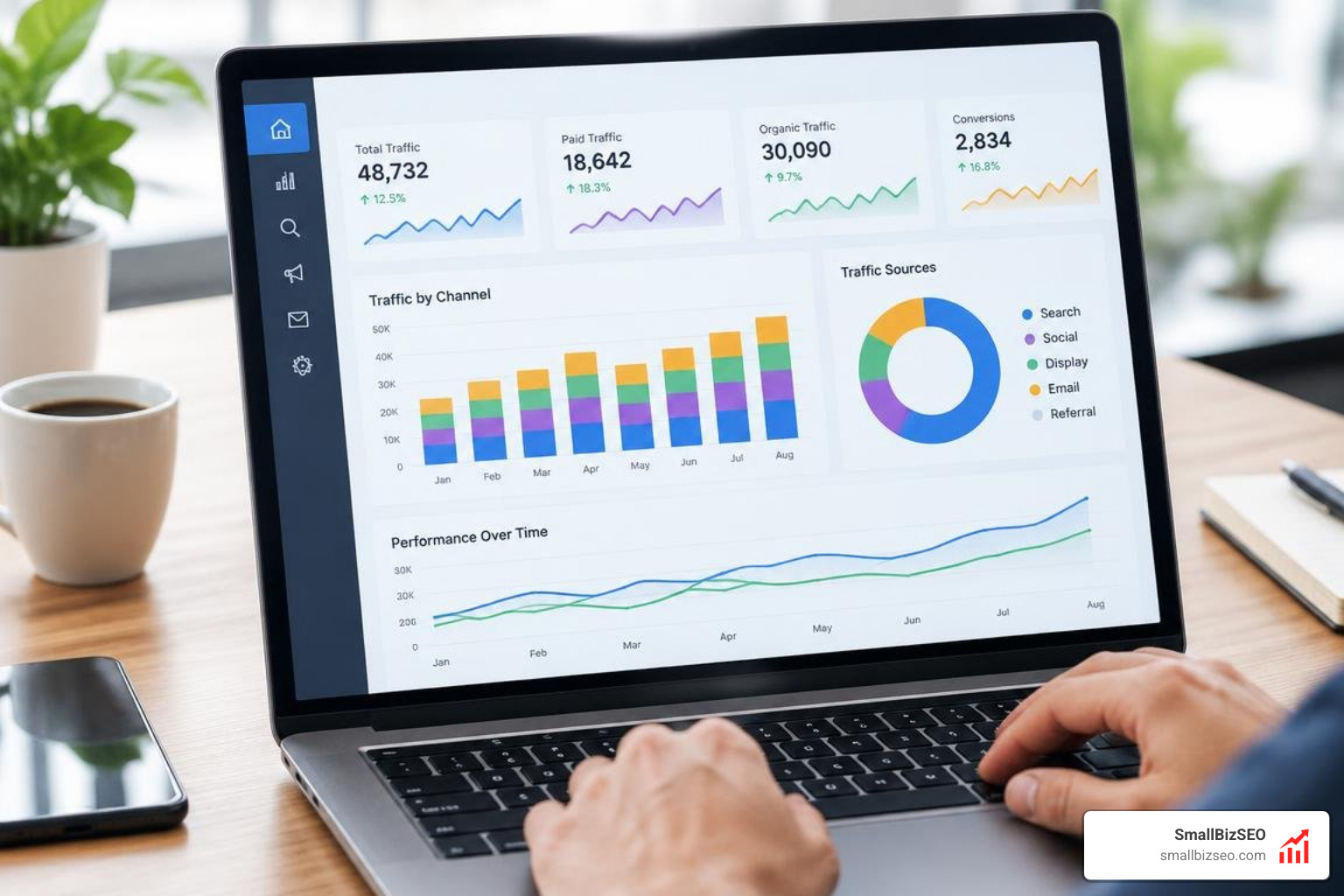
Search behavior has transformed dramatically. Google maintains over 90% of global search engine market share, while competitors like Bing capture smaller segments. Today, searchers do not just browse lists of blue links—they interact with generative AI overviews, visual shopping carousels, and local map packs. When potential customers enter high-intent queries looking for products or services, paid search ads place your brand directly at the top of their discovery journey, delivering immediate traffic while your long-term organic authority builds.
How Does a Search Engine Marketing Business Strategy Drive Scalable Growth?
A search engine marketing strategy drives growth by targeting active consumer demand rather than passive awareness. Unlike traditional interruption marketing, search advertising connects your business with buyers at the exact moment they express commercial intent.
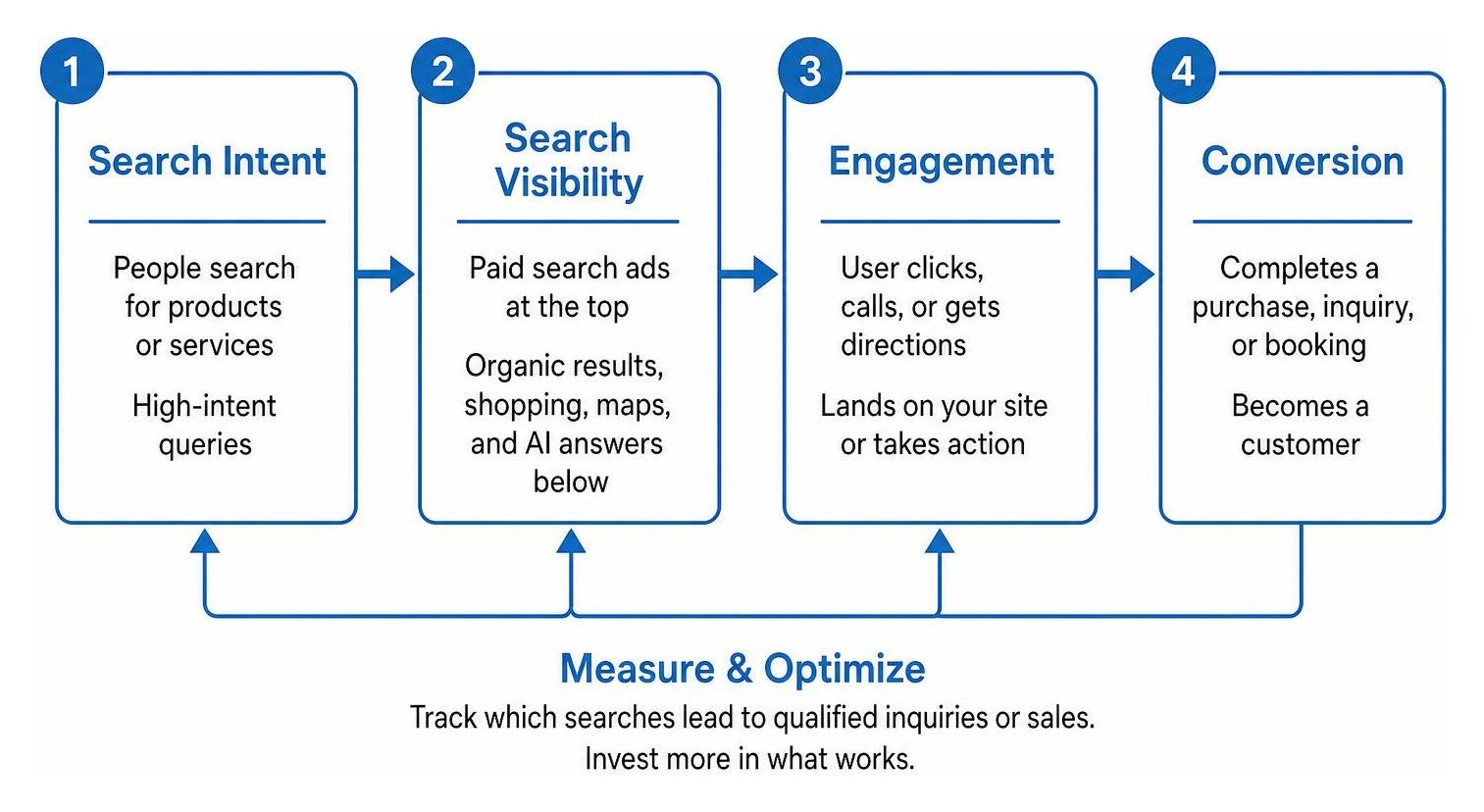
When running a search engine marketing business initiative, success depends on connecting clicks to real revenue. By understanding audience targeting, commercial search queries, and multi-channel attribution, you ensure your marketing dollars support measurable customer acquisition rather than vanity impressions.
What Is the Difference Between SEM and SEO in Search Engine Marketing for Businesses?
SEM provides instant, paid visibility at the top of search pages, while SEO focuses on earning organic rankings over time through content, technical optimization, and authority building.
Understanding what SEO stands for in business is essential for balancing both channels. Paid search guarantees quick placement for commercial queries, but you pay for every single click. Organic SEO takes longer to gain traction, but it establishes durable credibility and delivers compounding traffic without ongoing ad spend.
| Feature | Paid Search (SEM) | Organic SEO |
|---|---|---|
| Primary Cost | Pay-per-click ad budget | Upfront strategy, content, and optimization |
| Speed to Results | Immediate (hours to days) | Gradual (months of steady growth) |
| SERP Placement | Top/bottom sponsored ad blocks | Organic search listings, local packs, snippets |
| Longevity | Stops when ad spend ends | Endures long after publication |
Smart growth requires coordinating both. Using our guide to SEO business growth, businesses can use paid search data to identify high-converting keywords, then build organic assets around those terms to eliminate costly keyword cannibalization and reduce acquisition costs over time.
How Do Ad Auctions, Quality Score, and Smart Bidding Function in a Search Engine Marketing Business Campaign?
Search ad placement is determined by an instant auction that evaluates an advertiser's maximum bid alongside their Quality Score.

Quality Score evaluates three primary factors: expected click-through rate (CTR), ad relevance to the search query, and landing page experience. An ad with a stellar Quality Score can win the top position at a lower cost than a competitor who bids more but directs users to a slow, irrelevant page.
Cost per click (CPC) varies widely by industry. While the national average across all sectors sits around $2.13, highly competitive fields like marketing services average $7.66 per click, and the insurance sector often reaches $16.54 per click.
To manage these costs, campaigns use specific keyword match types:
- Exact Match: Shows ads only for searches with the exact meaning or intent.
- Phrase Match: Matches searches that include the core meaning of your keyword.
- Broad Match: Reaches the widest audience by matching related searches and semantic variations.
- Negative Keywords: Excludes unwanted search terms to prevent wasted budget on irrelevant traffic.
Modern campaigns rely on automated Smart Bidding strategies like Target CPA (Cost Per Acquisition) and Target ROAS (Return On Ad Spend), where machine learning algorithms adjust bids in real time across hundreds of contextual signals.
What Role Do AI Overviews, Performance Max, and Semantic Search Play Today?
Artificial intelligence has reshaped the search results page. Sponsored ads appear alongside AI Overviews on roughly 40% of relevant search result pages, creating new discovery opportunities for brands.

Modern campaign structures rely heavily on automated systems:
- Responsive Search Ads (RSAs): Advertisers provide up to 15 headlines and 4 descriptions. Machine learning tests combinations dynamically to display the most effective message for each query.
- Performance Max & Demand Gen: Unified campaigns that automatically allocate budget across search, display, maps, and video using first-party audience signals.
- Semantic Intent Matching: Search engines analyze user context and meaning rather than rigid keyword strings, allowing broad match targeting to capture relevant customer queries accurately.
You can explore directory listings such as top search advertising firms to see how modern providers manage these automated ad environments.
Which Core Metrics and Tracking Frameworks Optimize Multi-Channel ROI?
Maximizing return on ad spend requires looking beyond basic click counts to evaluate post-click user behavior and revenue contribution.
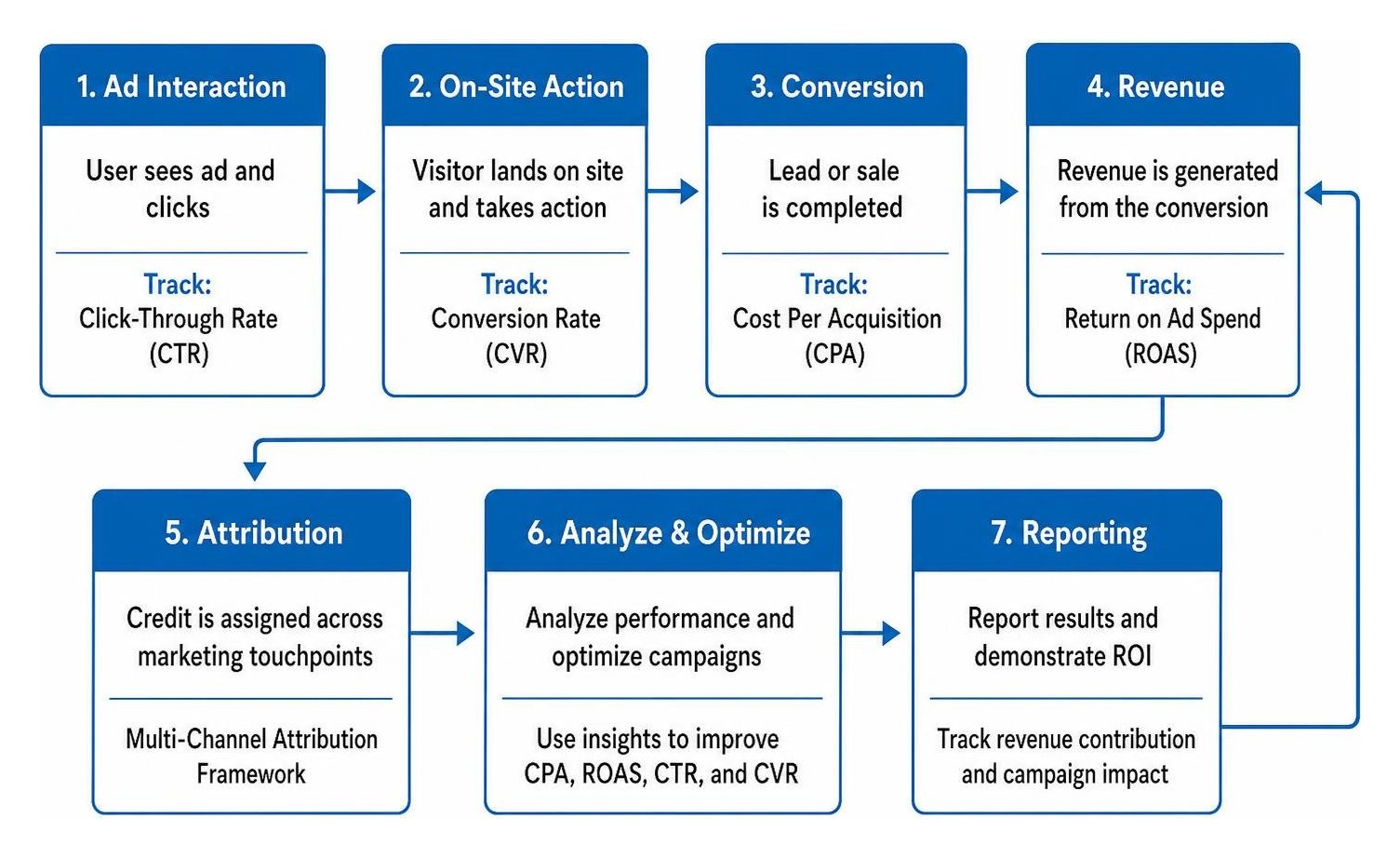
To optimize performance, focus on these essential metrics:
- Click-Through Rate (CTR): Measures ad appeal and keyword alignment.
- Cost Per Acquisition (CPA): Tracks how much ad spend is required to win a qualified lead or sale.
- Return on Ad Spend (ROAS): Calculates total revenue generated for every dollar spent on ads.
- Conversion Rate (CVR): Highlights how well your landing page converts visitors into paying customers.
Reviewing clear monthly SEO and search metrics helps you spot conversion drop-offs and refine user journeys across both paid and organic landing pages.
How to Choose the Right Search Engine Marketing Partner for Long-Term Success
Choosing a search marketing partner requires finding a team that understands how paid campaigns and organic authority support one another.

At SmallBizSEO, we provide data-driven technical SEO, content strategy, and link-building services built specifically for small businesses. Our proprietary "Velocity" framework delivers sustainable search engine rankings and E-E-A-T-compliant authority. By uniting clean data, fast indexation, and automated, transparent reporting, we help businesses build lasting search visibility that reduces dependence on high-cost paid clicks.
What Should You Look for When Evaluating Agency Performance and Vetting Partners?
When vetting search marketing providers or researching options through platforms like New York search marketing service listings, look for clear communication and transparent account access.
Ask these key questions before hiring an agency:
- Account Ownership: Will our business retain direct administrative ownership of our ad accounts and analytics properties?
- Data Sharing: How does your team use paid search conversion data to inform our organic content strategy?
- Pricing Structure: Do you charge a flat management fee, a percentage of ad spend, or a performance-based retainer?
- Attribution & Reporting: How do you track qualified business revenue rather than simple click volume?
Review our trusted SEO agency guide for an objective framework to assess candidate experience and reporting practices.
Fueling Lasting Search Visibility for Your Brand
Search marketing succeeds when immediate paid campaigns and long-term organic authority work in harmony. By capturing high-intent buyers today through targeted ads while steadily growing your organic search presence, your business builds an efficient, sustainable customer acquisition engine.
To turn search demand into consistent business growth, explore our data-backed professional SEO services and start building lasting search authority today.