How to Hire an SEO Content Writing Service for Ongoing Editorial Support
The Scope of a Managed Content Partnership
An ongoing SEO content writing service should do more than deliver individual articles. The right partner plans, creates, reviews, publishes, and improves content around the questions that matter to your customers and business.
A managed editorial service begins with search intent, existing-page overlap, and the questions prospects ask before making a decision. It turns that research into briefs, drafts, source checks, expert input, brand-consistent edits, accessible visuals, metadata, internal links, publishing support, and refreshes. The goal is useful, well-supported content, not a one-off word quota.
Strong editorial work still needs sound on-page SEO so readers and search engines can understand the page. Google’s people-first content guidance emphasizes helpful, reliable content with clear sourcing, original value, and demonstrable expertise rather than pages made mainly to manipulate rankings.
Start With Audience Questions, Search Intent, and Existing Content
Before approving a content plan, ask how the provider distinguishes a new opportunity from a page that already serves the same intent. This research should consider customer questions, the decision a reader needs to make, competing pages, and whether a new page would duplicate or cannibalize useful existing content.
For example, a local plumbing company may need different pages for “water heater repair” and “water heater replacement” because customers face different decisions. A useful brief defines each audience, the decision at stake, the original expert input needed, credible sources, safety boundaries, the call to action, related internal links, and the person responsible for final review.
Ask prospective providers to show how their research becomes a decision-ready brief, not just a keyword list. The brief should give the writer enough context to add useful examples and avoid repeating pages already on the site. For a practical research workflow, see How to Use Ahrefs for Keyword Research Without Losing Your Mind.
What You Are Actually Hiring an Editorial Service to Do
You are hiring an editorial operating system, not simply a writer. That system should connect research, subject-matter knowledge, content production, quality review, publication, and improvement work to the business problems your website needs to solve.
A capable team researches what prospects need to know, gathers original input from knowledgeable people, verifies claims and sources, and maintains a consistent brand voice. It also coordinates titles, meta descriptions, internal links, accessible image alt text, publishing, updates, and—when relevant—earned outreach that helps useful pages reach the right audiences.
What a Managed Editorial Engagement Should Include
A managed engagement should have clear ownership at every stage: who supplies business knowledge, who approves claims, who owns drafts and image licenses, who handles revisions, and who publishes or refreshes the finished work. Those details are more useful than broad promises about rankings.
Look for a service that can explain its working scope in practical terms:
- Research and planning: intent analysis, content overlap checks, customer questions, and editorial priorities.
- Production and review: briefs, drafts, expert interviews, original examples, source verification, revisions, and brand-voice editing.
- On-page completion: helpful images, descriptive alt text, metadata, internal links, and publication coordination.
- Ongoing improvement: refresh decisions based on changing information, page performance, customer feedback, and qualified inquiry quality.
Content works best when it is coordinated with technical and on-page work instead of treated as an isolated deliverable. Before signing, ask how the provider’s process fits the wider SEO Services Guide.
How a Managed Editorial Workflow Should Run
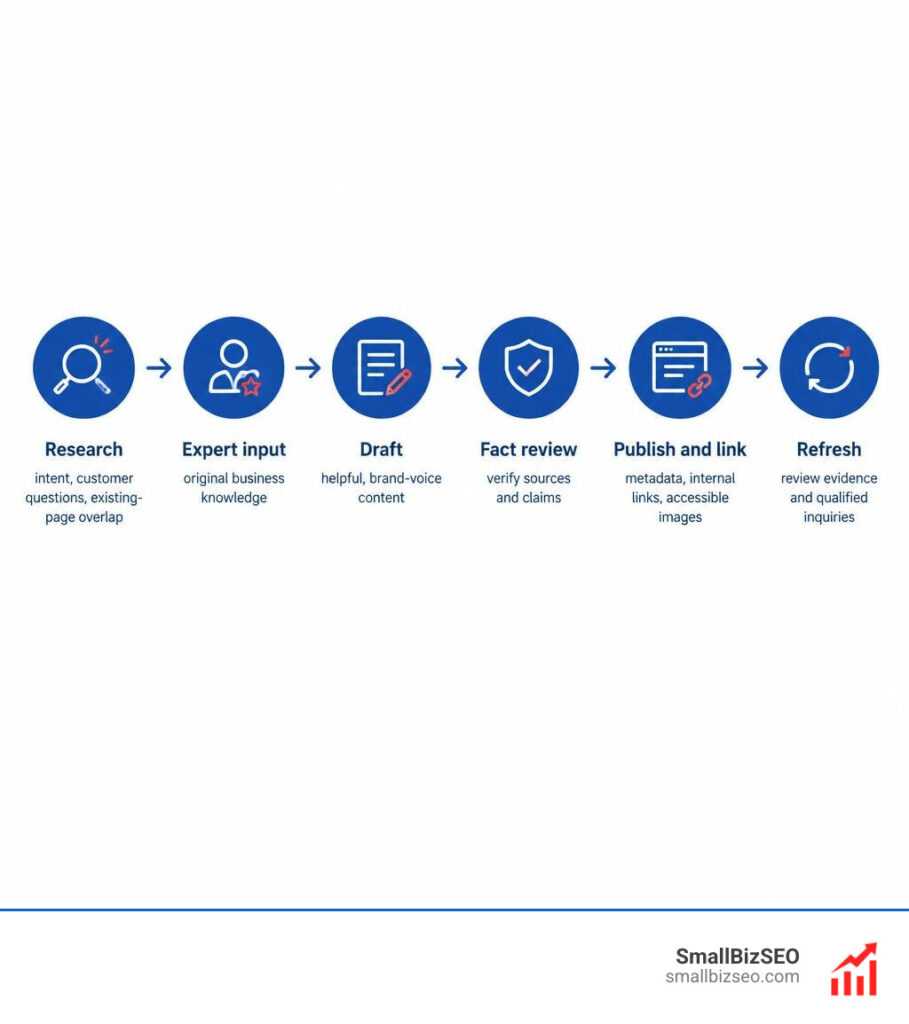
A dependable editorial workflow makes research, review, and ownership visible before drafting begins. It should be repeatable enough for ongoing work while leaving room for subject-matter insight and useful examples.
The cycle starts by defining the customer question, intended audience, decision to support, and related pages already on the site. Then the team gathers expert input and reputable sources before drafting. A keyword gap analysis can reveal questions competitors address and topics the site still needs to cover, but the brief must also explain what the new page adds beyond existing pages.
What Does a Worked Editorial Brief Look Like?
A provider should be able to show how business knowledge becomes editorial direction. This illustrative brief is for a plumbing company creating a page for homeowners deciding between water-heater repair and replacement:
| Brief element | Worked example |
|---|---|
| Customer decision | Help a homeowner understand whether repair or replacement is the more appropriate next step for their situation. |
| Technician interview evidence | Ask a qualified technician about the unit's age, condition, repair history, and remaining warranty, plus the questions homeowners most often raise during an inspection. Do not invent replacement thresholds. |
| Sources to verify | Use relevant manufacturer manuals and applicable local code sources to verify technical claims. |
| Safety boundary | Explain when to arrange professional help. Do not provide do-it-yourself gas or electrical instructions. |
| Related-page destinations | Link to the company's existing water-heater repair and replacement service pages, where those pages exist. These are hypothetical destinations for the brief, not invented URLs. |
| Call to action | Invite the homeowner to schedule a qualified inspection. |
| Reviewer and distinct angle | A qualified reviewer approves the final page. The page focuses on the homeowner's decision and documented inspection considerations, rather than duplicating the existing repair or replacement service pages. |
Sample acceptance criteria can make the handoff measurable: a source log is complete, interview evidence is recorded, the qualified reviewer has approved claims, image and content rights are documented, and every link has been tested. Set a refresh trigger for changes to manufacturer guidance, relevant code, service offerings, recurring customer questions, or page evidence.
Draft, Review, Publish, and Refresh
Drafting should be followed by factual review, editorial revision, and a final check for clarity, source support, brand voice, accessibility, metadata, and internal links. The reviewer should have enough business knowledge to flag unsupported claims and missing context.
A strong review process prioritizes:
- Source-backed accuracy: claims are supported, current, and appropriately qualified.
- Original usefulness: the page adds practical decisions, real examples, or expert context beyond a surface summary.
- Business knowledge and voice: the wording reflects how the team actually serves customers.
- Reader-ready execution: clear structure, accessible visuals, useful internal links, and a relevant next step.
After publication, the service should monitor whether the page remains accurate and helpful, then recommend refreshes when evidence, offerings, questions, or page performance change. That work goes beyond content optimization because it considers whether the page still serves the business and its readers. If a page merits promotion, relevant link-building services can support earned outreach without substituting for a useful page.
How to Evaluate Source Quality, Review, and Trust
Trust is built through the work behind the page: clear sourcing, accurate claims, real knowledge of the subject, original information, and careful review. These are not a fixed checklist or a standalone certification score, and no provider should present them that way.
Google encourages creators to assess whether a page offers original information or analysis, substantial value beyond other results, clear sourcing, and evidence that knowledgeable people created or reviewed it. Use those questions when evaluating a provider’s process, not as a formula that guarantees visibility.
Questions to Ask Before You Approve a Provider
Ask how the provider finds and verifies sources, records expert interviews, handles factual corrections, and identifies who has authority to approve a page. Also ask for examples of original insights or evidence they helped a business surface.
Use this provider-acceptance checklist:
- Can they explain the research, review, revision, and publishing steps?
- Do they define ownership of drafts, image licenses, source files, and final approvals?
- Do they document what is excluded, including specialist review, photography, paid promotion, or outreach?
- Do they provide a practical revision process and name the person accountable for quality?
- Can they show how they will keep important pages current after publication?
The best fit is a partner whose process helps your team publish reliable, useful pages consistently—not one that promises a score, a shortcut, or a guaranteed rank.
Compare Service Models, Not Just a Price Per Word
Pricing alone does not tell you what you are buying. Compare the level of research, editorial ownership, revisions, licensing, and ongoing support included in each model before you compare fees.
| Service model | Usually owns | Confirm before signing |
|---|---|---|
| Writer-only | Drafting from your instructions | Research depth, fact checking, revisions, image rights, publishing, and refreshes may be excluded. |
| Managed editorial | Research, briefs, drafting, editorial review, on-page completion, and ongoing planning | Who approves claims, what is included in the monthly scope, and how content ownership and licenses transfer. |
| Hybrid team | Your subject-matter experts plus an external editorial team | Interview access, review turnaround, responsibilities, and the handoff between internal and external owners. |
Do not use a person’s native language or a production-method label as a shortcut for quality. Evaluate the output and process: Is the information sourced? Does it include original business knowledge? Is it reviewed by someone qualified to catch errors? Does it answer the reader’s decision clearly?
Questions That Clarify the Real Scope
Ask what the proposed fee covers: intent research, overlap checks, interviews, source verification, drafts, revisions, images, metadata, internal linking, publishing coordination, and refresh planning. The contract scope, not a general service label, controls what work is included and what is excluded.
Confirm who owns the final copy, working files, visual licenses, and source materials. A clear agreement should also define revision rounds, approval deadlines, and how new evidence or business changes are handled after publication.
What an Ongoing Editorial Plan Can Deliver
The right mix depends on your customer journey and existing content. A practical plan may include:
- Decision-supporting service and category pages.
- Educational articles that answer recurring customer questions.
- Case studies, guides, or comparison pages supported by real business evidence.
- Refreshes to pages that need updated facts, clearer guidance, or stronger internal connections.
- Relevant earned-outreach support for genuinely useful pages, when it aligns with the wider strategy.
For a broader view of coordinated deliverables, explore SEO packages.
Choose a Provider You Can Work With Over Time
The strongest provider relationship is collaborative. Your team supplies business context and review access; the editorial partner turns that knowledge into useful, well-structured pages and keeps the work organized over time.
Ask to see a sample brief, an annotated draft, and an example of how the provider handled a factual correction or refresh. You should also understand how they learn your brand voice, obtain expert input, manage approvals, and document what changed. If local intent matters to your business, review the Local SEO Guide together.
Measure the Ongoing Cycle, Not a Single Deliverable
Editorial work is iterative. Review new customer questions, changes to your services, source updates, content overlap, and page evidence on a regular cadence. That gives the team a defensible reason to publish, improve, consolidate, or retire content.
Measure the evidence that fits your business: qualified inquiries, booked consultations, assisted conversions, engagement with decision-supporting pages, and feedback from sales or service teams. Attribution has limits, so treat reports as decision support rather than proof that one page alone caused every outcome.
Frequently Asked Questions about SEO Content Writing
Should an SEO content writing service guarantee rankings?
No. A reliable provider can explain its editorial process, deliverables, review standards, and reporting approach, but it should not guarantee a particular ranking. Search performance is influenced by many factors, including the usefulness of the page, competition, technical conditions, and how well the page serves the searcher’s need.
How should I evaluate content quality, regardless of the tools used?
Evaluate whether the page is accurate, original, useful to the intended audience, and reviewed by someone with relevant business or subject knowledge. Ask how claims are sourced, how factual errors are corrected, and what original evidence or examples the page contributes.
How often should editorial content be reviewed?
Review timing should follow the topic and evidence. Update pages when information changes, services evolve, customer questions shift, or performance and sales feedback show that the page needs clearer support. Your provider should explain how refresh decisions are made and who signs off.
Build an Editorial Partnership That Stays Useful
Choose an SEO content writing service that can run an accountable editorial process over time. Look for clear research, original business input, careful source verification, practical review, accessible publishing, and a plan for meaningful refreshes.
SmallBizSEO can help you plan and manage content that supports real customer decisions. Explore SEO content services or book a conversation to discuss your editorial priorities.