The Definitive Guide to Shopify SEO Services
The Definitive Guide to Shopify SEO Services
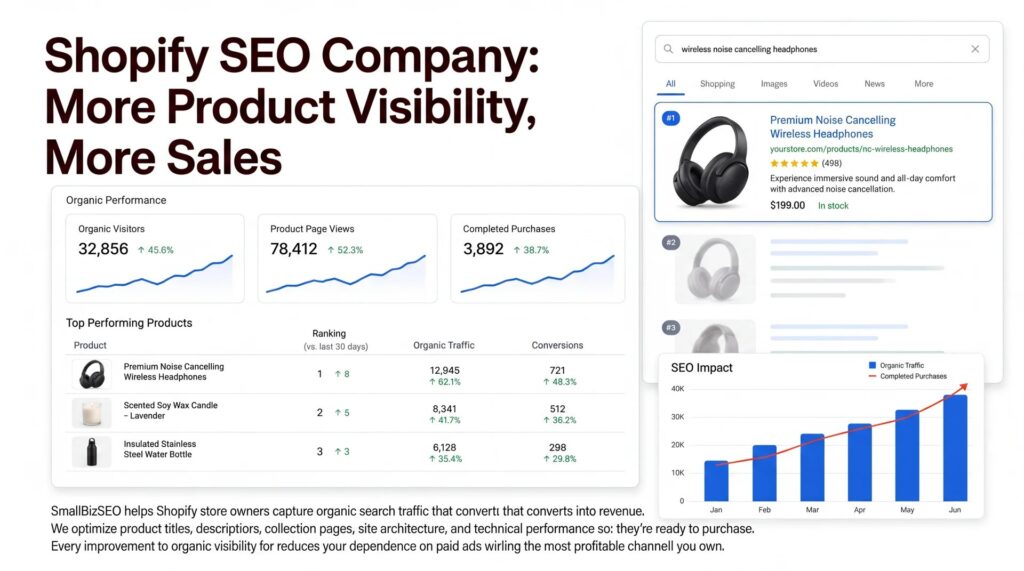
Choose a Shopify SEO Company That Can Prove Revenue Impact
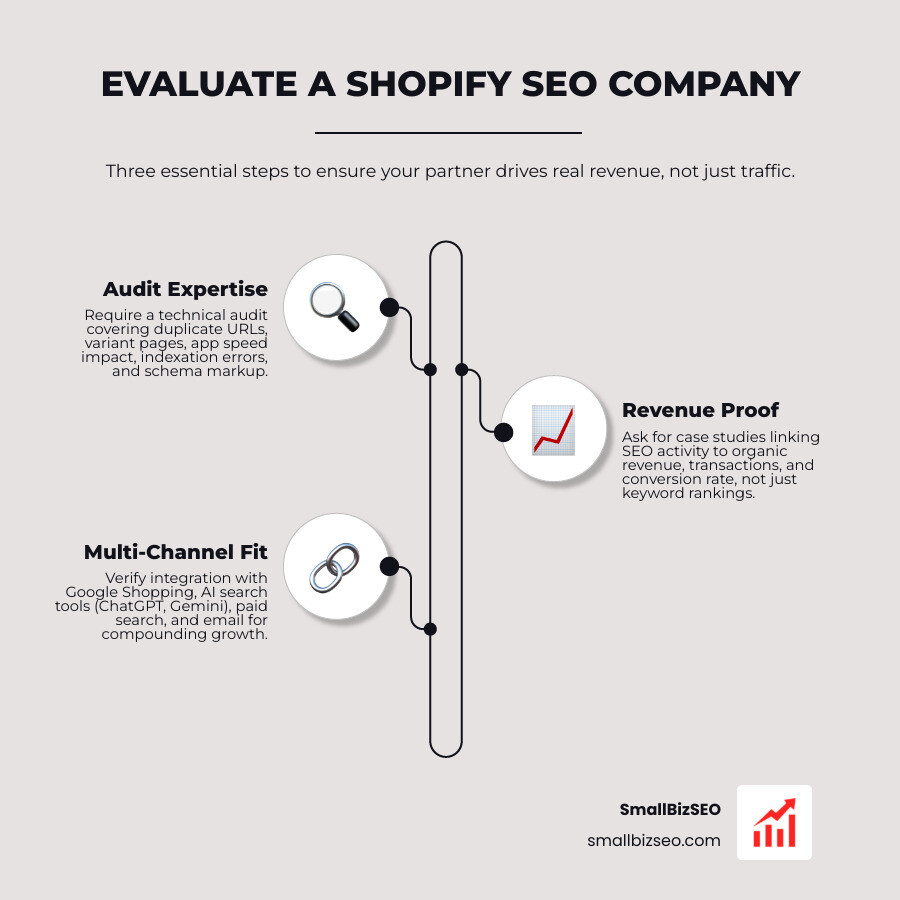
A good Shopify SEO company should do more than raise keyword rankings. Look for a team that can fix Shopify-specific technical issues, map high-intent searches to collection and product pages, improve site speed, build useful content and links, and report on organic revenue, transactions, and conversion rate.
Before hiring, ask to see:
- Shopify case studies tied to business outcomes, not traffic alone.
- A clear technical audit covering duplicate URLs, app-related speed issues, schema, and indexation.
- A monthly plan with defined deliverables, owners, and reporting.
- A practical approach to Google, shopping results, and AI-driven discovery tools such as ChatGPT and Gemini.
- Flexible terms and honest expectations. Technical gains can appear first, while meaningful organic growth usually builds over several months.
Shopify is a strong ecommerce platform, but its URL rules, variant pages, collection structure, Liquid themes, and third-party apps can create SEO problems a general agency may miss. The right partner connects technical cleanup with content, conversion optimization, paid search insights, email campaigns, and product feed quality so each marketing channel supports the others.
I am Clayton Johnson, a digital PR and SEO strategist focused on building campaigns that improve search visibility and meaningful engagement. In this guide, I will explain how to evaluate a Shopify SEO company and find a partner that can turn organic discovery into dependable sales.
Core Services Delivered by a Dedicated Shopify SEO Company
Hiring a general digital marketing team often leaves store owners wondering why their rankings stall despite continuous blog posting. A specialized ecommerce SEO company approaches optimization through the lens of transaction volume, platform mechanics, and technical architecture rather than vanity traffic metrics.
When we evaluate a store's growth ceiling, we deploy targeted solutions addressing structural crawl efficiency, commercial keyword intent, faceted navigation, and platform-specific architecture. Shopify requires a distinct approach because its internal templating system and default product routing can cause severe crawl bloat if left unmanaged.
| Feature | Generic SEO Agency | Specialized Shopify SEO Agency |
|---|---|---|
| URL Architecture | Treats all subfolders identically | Fixes /collections/ and /products/ duplicate paths |
| Speed Optimization | Basic image compression | Liquid code pruning, app script removal, and Core Web Vitals fixes |
| Catalog Mapping | Focuses heavily on informational blogs | Focuses on high-intent collection hierarchy and facets |
| Structured Data | Standard website JSON-LD | Metafield-driven Product, OfferCatalog, and Review schema graphs |
| AI Readiness | Traditional keyword targeting | Generative Engine Optimization (GEO) and llms.txt deployment |
Our approach incorporates full-funnel SEO content marketing to capture high-value buyer journeys from research to checkout, ensuring that product discovery transforms seamlessly into customer conversions.
Overcoming Shopify Platform Constraints
Shopify provides incredible platform stability, but its rigid URL structures and default settings present unique hurdles. For instance, Shopify generates multiple paths to the same product page (such as /collections/.*/products/.* versus the canonical /products/.*). Without theme-level code adjustments, search engines waste crawl budget processing duplicate versions of identical catalog items.
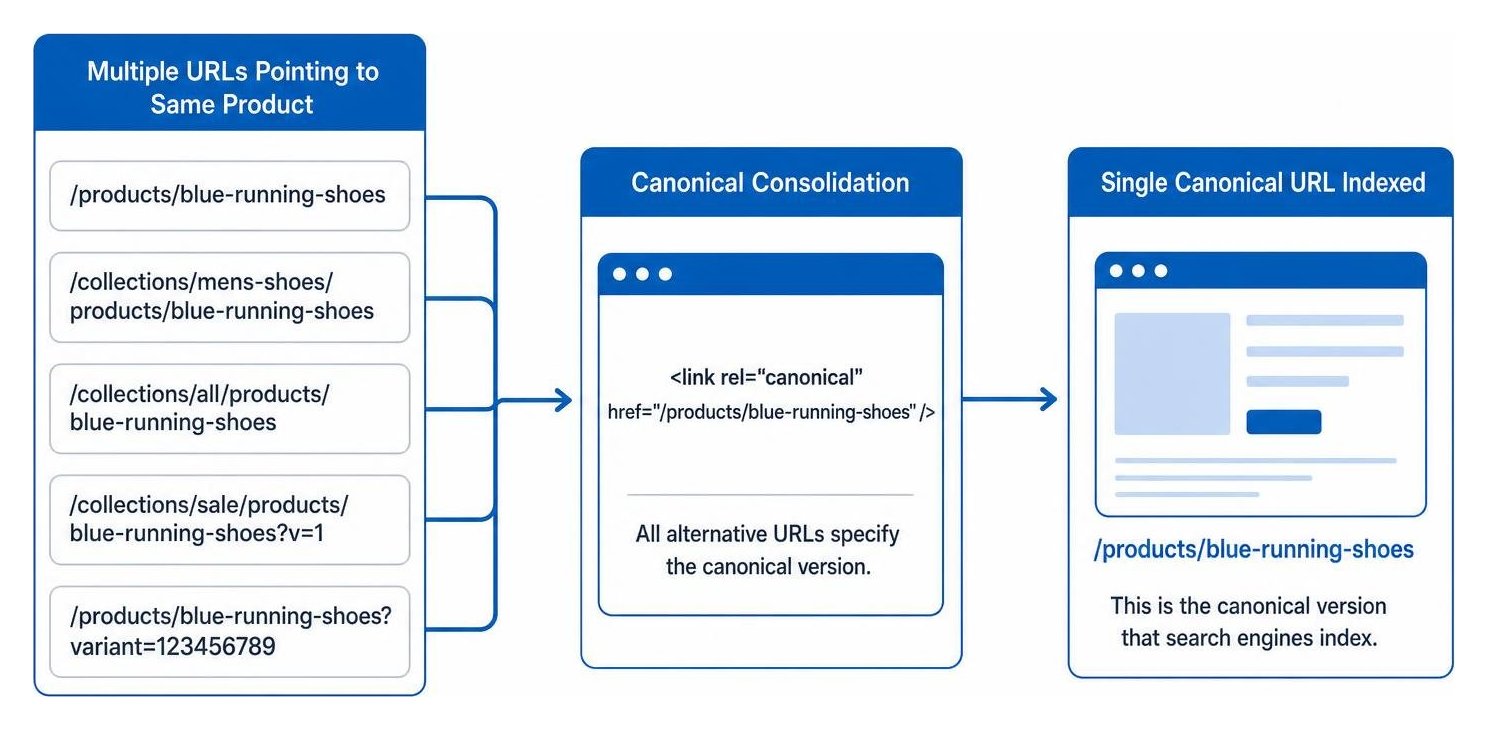
A dedicated team ensures custom robots.txt rules prevent thin search and tag pages from indexation, governs pagination loops across large product catalogs, and sets up localized multi-currency subfolders correctly using hreflang markup to prevent international duplicate content penalties.
Revenue-Driven Keyword and Collection Architecture
The highest-leverage asset on any ecommerce store is the collection page. Capturing search volume requires grouping transactional keywords into logical hierarchies that mirror shopper intent and product taxonomy.
Using structured SEO content services, we build keyword-mapped collection headers, clear facet navigation, and contextual internal breadcrumbs. This structure ensures search bots understand parent-child category relationships instantly while funneling internal link equity directly to high-margin products.
Technical Architecture and Core Performance Optimization
Technical health dictates whether search engines can index your catalog efficiently and rank your product pages ahead of competitors. If your theme is bogged down by uninstalled app artifacts, bloated tracking scripts, or excessive DOM nodes, your organic reach and conversion rates will plummet. Our team relies on An Essential Guide to Fixing Shopify SEO Issues to systematically eliminate performance bottlenecks and ensure smooth crawling across every catalog tier.
Theme Speed and JavaScript Overhead Reduction
Page experience directly impacts search engine visibility and checkout conversion rates. Many store owners find that installing dozens of marketing and conversion apps leaves their storefront sluggish and unresponsive on mobile devices.
We optimize Liquid templates, defer non-critical JavaScript, compress visual assets into modern WebP formats, and prune legacy app code to satisfy Google Core Web Vitals requirements:
- Largest Contentful Paint (LCP): Loading primary hero elements and product imagery rapidly to establish immediate visual stability.
- Interaction to Next Paint (INP): Eliminating script execution lag when shoppers tap filters, toggle variants, or add items to their carts.
- Cumulative Layout Shift (CLS): Stabilizing layout banners, promotional bars, and lazy-loaded elements so buttons do not shift during rendering.
Structured Data and Rich Result Deployment
Search engines rely on structured data markup to surface star ratings, pricing, in-stock status, and shipping badges directly inside organic listings. We implement enterprise-grade JSON-LD schema graphs containing detailed Product, AggregateRating, OfferCatalog, and BreadcrumbList parameters. This rich markup ensures your listings stand out against standard organic snippets, dramatically improving click-through rates from search results.
Modern Search Integration: AI Engines and Generative Discovery
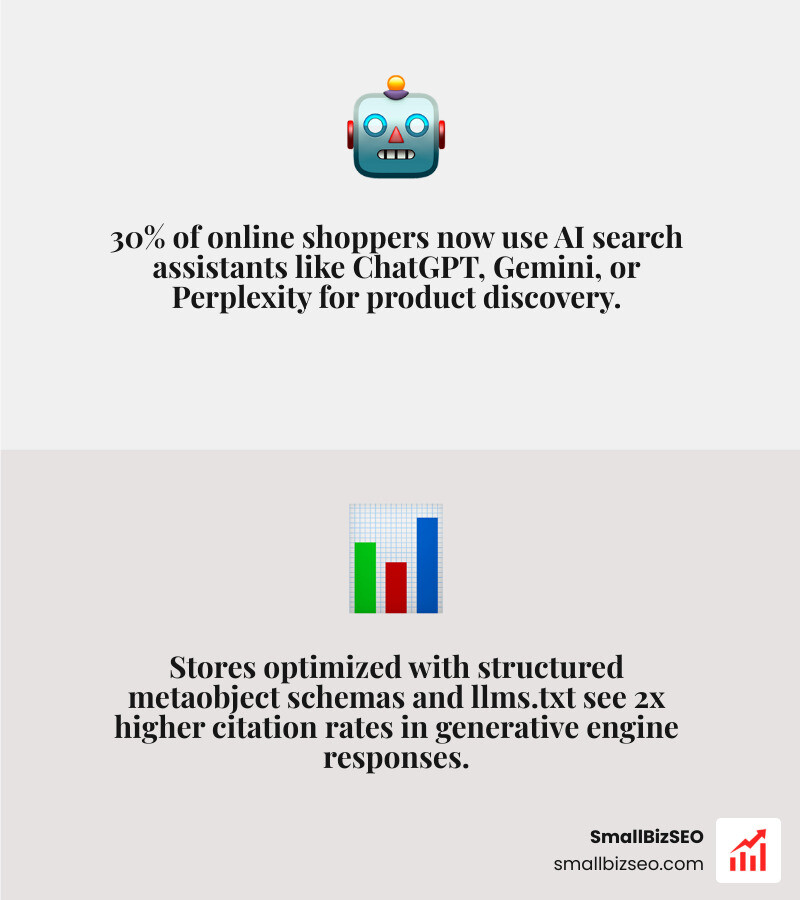
Search discovery is evolving at a rapid pace. Shoppers increasingly use AI search assistants like ChatGPT, Gemini, and Perplexity alongside traditional search engines to research products, compare brands, and find immediate purchasing recommendations. Leading industry directories, including curated selections of Top Shopify SEO Agencies, emphasize agencies that combine traditional organic indexing with Generative Engine Optimization (GEO).
Structured Data Metafields and Generative Engine Optimization
To help language models understand and recommend your store, catalog data must be clearly structured, logically organized, and easily extracted by crawlers. We configure metaobject schemas and concise, passage-level product copy that answers specific customer inquiries directly. Deploying a structured llms.txt manifest provides AI crawlers with clean pathways to your key product specifications, brand entities, return policies, and structured FAQ modules.
How a Shopify SEO Company Drives ChatGPT and Gemini Visibility
AI shopping assistants pull product recommendations from clear entity graphs, active review footprints, authoritative industry citations, and precise attribute data. By establishing high topical authority, refining product specifications, and maintaining consistent brand mentions across authoritative external publications, we ensure AI assistants highlight your products when users ask for category recommendations or specific problem-solving products.
Agency Evaluation, Pricing Models, and ROI Timelines
Selecting an agency requires balancing proven technical capabilities with a clear, sustainable investment model. When evaluating SEO packages, merchants should focus on transparent deliverables, dedicated communication, and actionable performance milestones over locked-in long-term commitments.
Reviewing industry listings like the Best Shopify SEO Companies can provide clear context on typical market deliverables, technical scope, and performance expectations across the ecommerce industry.
How to Evaluate and Hire the Right Shopify SEO Company
Before signing an agreement, evaluate potential partners using these criteria:
- Demonstrated Case Studies: Look for verified ecommerce performance showing lifts in revenue, transactions, and conversion rates across competitive niches.
- Platform Specialization: Ensure their developers write Liquid code and configure theme schemas directly rather than outsourcing technical tasks to unvetted third parties.
- Reporting Standards: Insist on clear visibility into key metrics and commercial impact, backed by resources like The Ultimate Guide to SEO Reporting for Beginners.
- Contract Flexibility: Favor agencies offering month-to-month terms that earn your business through ongoing performance and measurable ROI.
Project Retainers, Deliverables, and Compound ROI
Monthly retainers for specialized ecommerce optimization generally range from $1,800 to $5,000+ per month, depending on catalog size, competitive landscape, and technical scope. When managed by a growth-oriented ecommerce growth SEO company, search optimization functions as an appreciating asset that yields compounding returns, consistently lowering overall customer acquisition costs over time.
Frequently Asked Questions about Shopify SEO Services
How long does it typically take to see measurable revenue growth from Shopify SEO?
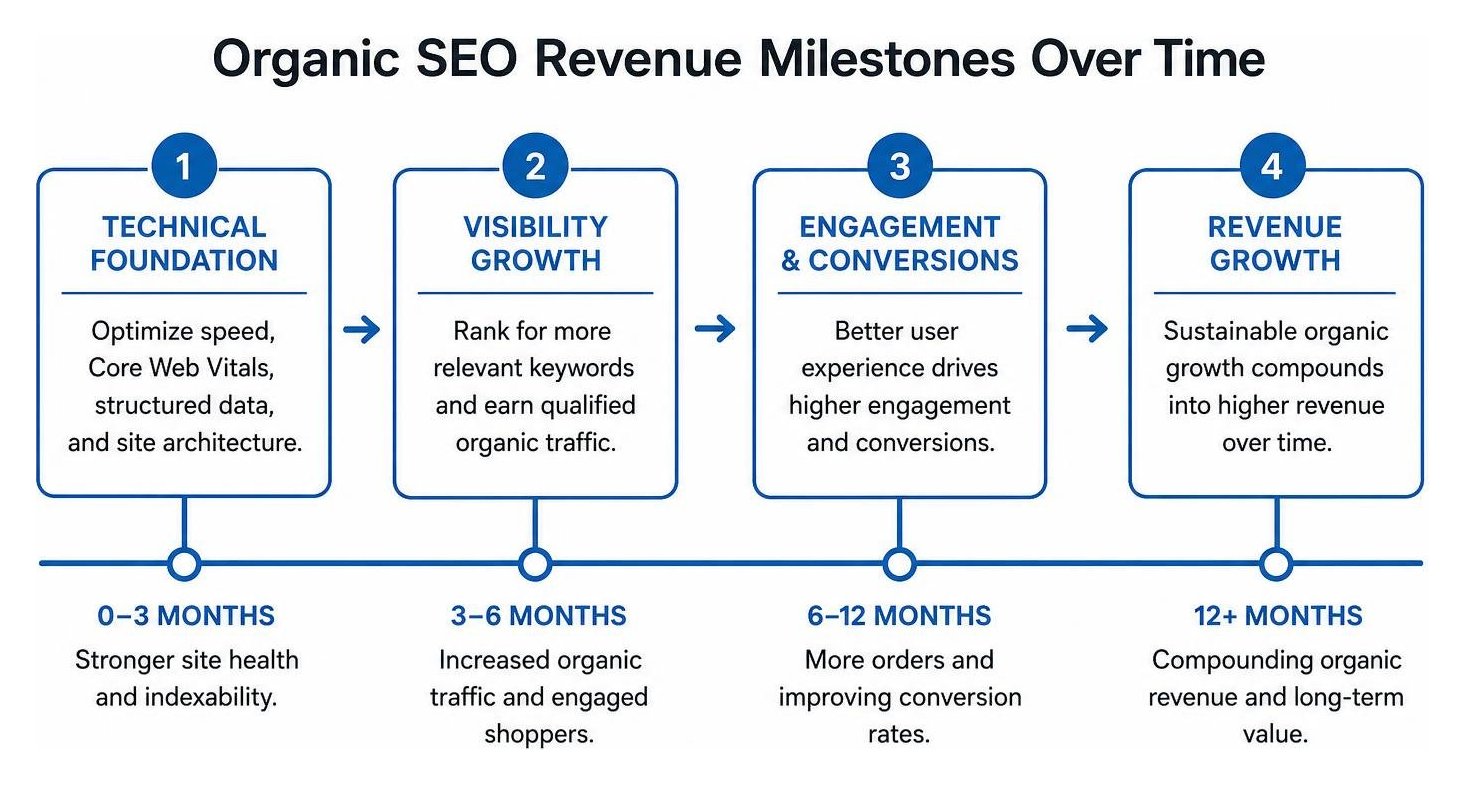
Technical crawl fixes, schema implementation, and indexing improvements typically take effect within the first thirty days. High-intent collection rankings generally build momentum over two to four months, with substantial organic revenue growth and compound ROI materializing across six to twelve months as catalog authority matures and internal link equity solidifies.
How does Shopify SEO integrate with PPC and other marketing channels?
Organic search optimization directly enhances paid channels and overall marketing efficiency. Optimizing product titles, attributes, and structured data feeds improves Google Shopping feed quality scores, lowering your cost-per-click. Furthermore, identifying high-converting organic search queries allows paid search teams to allocate ad spend more efficiently, creating a unified acquisition strategy.
What are the most common technical SEO mistakes Shopify store owners make?
The most common issues include unmanaged duplicate collection URLs, residual code from uninstalled apps, uncompressed visual media, missing schema markup, and unoptimized faceted navigation. Correcting these foundation errors enables your catalog pages to rank at their true commercial potential.
Accelerate Your Store Performance
Scaling an ecommerce brand requires deep technical precision, clear content architecture, and transparent execution. At SmallBizSEO, our data-driven "Velocity" framework delivers E-E-A-T-compliant rankings and sustainable revenue growth through automated, plain-English reporting.
Explore how our dedicated Shopify SEO Company services can turn your store into an organic revenue engine.