How to Compare SEO Services in the USA: A Buyer’s Shortlist
How to Compare SEO Services in the USA
A useful SEO-provider shortlist starts with the work you need done, who will do it, and how progress will be evidenced. Rather than treating this as a ranking of “best” agencies, use it to build a short list of providers whose published services and operating model merit a conversation.
Disclosure: SmallBizSEO provides SEO services and therefore competes in this category. The examples below are neutral starting points, not endorsements or performance rankings.
A shortlist of provider examples to research
| Provider | Published scope to review | Buyer-fit questions to ask | Ownership, reporting, and access |
|---|---|---|---|
| WebFX | Its published SEO services describe technical, content, and off-page work. | Which services are included for this site, and which are optional? | Who owns implementation, and which analytics, search, and work-tracking accounts will remain accessible? |
| Loopex Digital | Its SEO-services page describes SEO support for businesses across markets. | Does the team have relevant US-market experience, and what working hours will apply? | Ask how data is handled, where work is performed, and how implementation decisions are documented. |
| Ignite Visibility | Its SEO-services page presents technical SEO, content, and broader search marketing support. | Which specialists will be assigned, and how will priorities be chosen? | Confirm approval paths, reporting cadence, and direct access to source data. |
Loopex Digital should be evaluated for its stated service capability and operating fit, not assumed to be a US-based provider. Ask directly about team location, time-zone coverage, US-market experience, and data-handling practices.
A provider’s website is only a starting point. Ask each shortlisted team to map its published services to the actual website, audience, technical constraints, and approval process.
What Should an SEO Proposal Include?
A comparable proposal explains the work, the limits of that work, and the evidence the provider will share. Packages can be useful when their scope is transparent; a custom plan can be useful when the site has unusual needs. The decision should rest on clear deliverables and accountability, not the label on the offer.
RFP shortlist worksheet
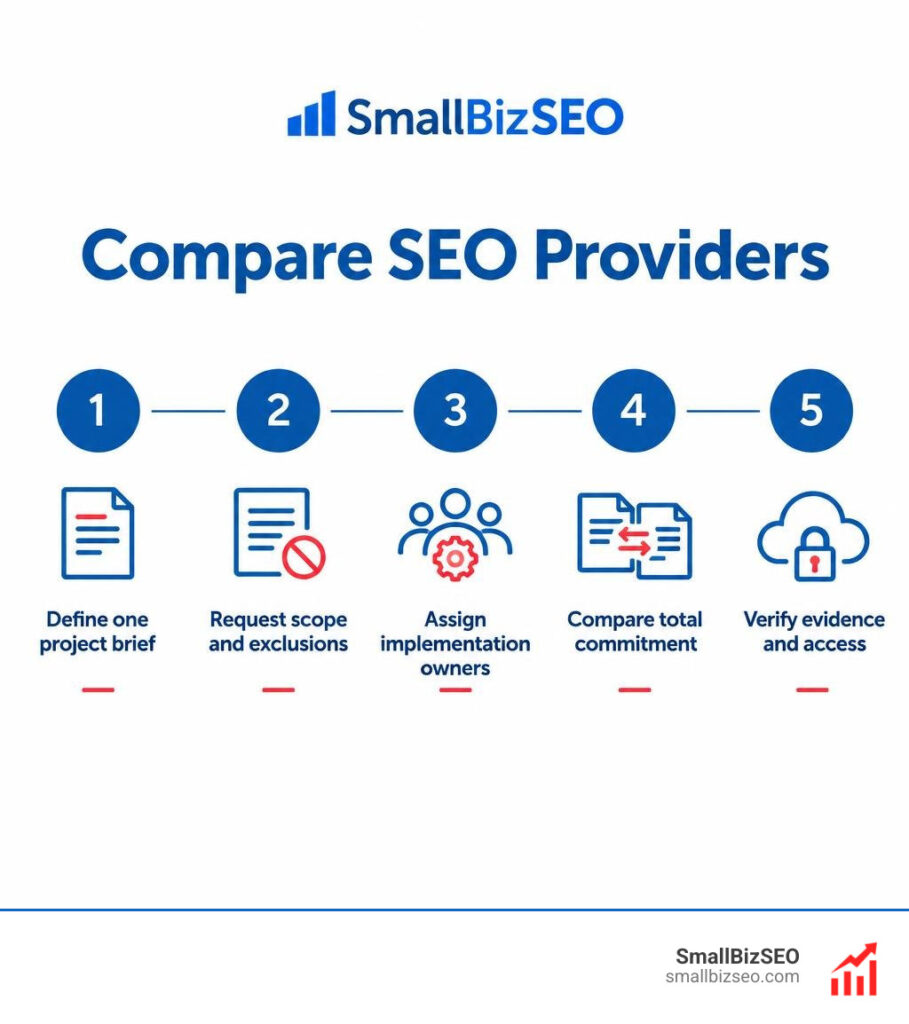
Start with a detailed SEO analysis of the site, then use the same questions for every provider:
- Scope: Which technical fixes, content deliverables, internal-link work, digital PR or outreach tasks, and strategic meetings are included?
- Exclusions: Which work is outside the agreement, including development, design, paid media, content approvals, or platform fees?
- Implementation owner: Which tasks will the provider complete, which require your team, and which need a developer or another vendor?
- Evidence: What will show that work occurred, such as issue logs, content briefs, published URLs, outreach records, link placements, or change histories?
- Reporting and access: Will you retain access to analytics, Search Console, dashboards, task records, and the underlying data?
- Operating fit: How will time zones, response times, US-market experience, security, privacy, and data handling be managed?
- Approval capacity: Who on each side can approve content, technical changes, and budget adjustments, and how quickly?
Copy-and-fill comparison worksheet
The blank cells are intentional: use this worksheet to record each provider’s response to the same project brief.
| Comparison area | Proposal A | Proposal B | Proposal C |
|---|---|---|---|
| Included work and delivery cadence | |||
| Exclusions and dependencies | |||
| Total cost and billing terms | |||
| Implementation owner by task | |||
| Reporting access and proof of work | |||
| Client approval capacity and timelines |
Worked same-project example (hypothetical)
Use the same project brief when comparing delivery models. This illustration does not represent a price, timeline, or expected result.
| Comparison area | Advisory engagement | Managed execution engagement |
|---|---|---|
| Project scope | Audit findings, priorities, implementation guidance, and review of completed work | Agreed technical, content, internal-link, or outreach work carried out by the provider |
| Primary owner | Your internal team, developer, or other vendors complete the recommended changes | The provider completes the agreed tasks; your team supplies access, approvals, and subject-matter input |
| Client capacity required | Capacity to translate recommendations into tickets, content, and releases | Capacity to approve priorities, provide information, and unblock required access or decisions |
| Typical exclusions to confirm | Hands-on implementation, content production, development, or outreach unless specifically included | Work outside the agreed scope, third-party platform costs, delayed approvals, and tasks assigned to your team or developer |
| Evidence to request | Prioritized recommendations, review notes, and records showing which changes were completed | Completed-work records, published URLs, change history, outreach evidence where relevant, and reporting access |
For a deeper walkthrough of proposal comparison, see this detailed guide to comparing SEO services.
Which SEO Services Matter for a Sustainable Program?
A sustainable SEO program usually combines technical foundations, original expert content, internal linking, and earned editorial outreach. The right mix depends on the site, market, resources, and constraints, but each area should have an owner and a clear way to verify completed work.
Technical SEO and implementation
Technical SEO can include crawlability, indexation, rendering, page experience, structured data where it accurately represents the page, and site architecture. Ask a provider to identify the issues it will investigate, what it can implement directly, and what requires your developer.
Original content, refreshes, and internal links
Strong content programs turn real subject-matter expertise into useful pages, refresh material when facts or intent change, and connect related pages with purposeful internal links. At SmallBizSEO, original expert-led content, content refreshes, internal-link planning, and proof of published work are core services, not an audit-only recommendation. Explore SEO content services and SEO services for the workstreams to discuss in a proposal.
Earned editorial outreach and link building
Earned editorial outreach should be evaluated by relevance, editorial standards, ownership, and proof. SmallBizSEO treats this as an ongoing service with named work owners, outreach records, and evidence of placements where applicable. Review its link-building services when comparing that scope.
AI search: keep the fundamentals primary
Google’s guidance for AI features in Search says that established SEO best practices remain relevant and that no additional requirements or special optimizations are needed to appear in AI Overviews or AI Mode. Ask how a provider will improve clarity, evidence, entity accuracy, and crawlability. Do not accept a promise that a special schema type or any single tactic will guarantee inclusion or citation in an AI answer.
How Should You Evaluate Cost, Timeline, and Proof?
SEO proposals should be compared using the same scope, exclusions, total cost, approval capacity, and proof requirements. Published prices and delivery timelines can be useful context, but they do not establish what a specific site needs or what a provider will deliver.
Compare the full commitment, not a headline price
Ask each provider to state the total cost for the proposed scope, billing terms, included deliverables, optional work, dependencies, and renewal assumptions. If the provider offers standardized options, review the deliverables before comparing them with a custom engagement. SmallBizSEO’s SEO packages can help frame those questions.
Set review points around completed work
Instead of accepting a fixed outcome or timeline, agree on review points that show completed work and learning: technical findings, approved priorities, content publication, internal-link updates, outreach activity, and accessible reporting. Search performance can move for many reasons, so use the evidence of work alongside relevant search and conversion data.
Ask what happens when the plan changes
A useful partner explains how new constraints, delayed approvals, site releases, changing business priorities, or resource gaps affect the plan. The clearest proposals identify the decision-maker for each change and the information needed to make that decision.
Frequently Asked Questions About Hiring an SEO Provider
Should location determine which SEO provider to hire?
Location can affect working hours, market familiarity, legal requirements, and communication, but it is not a substitute for capability. Ask where the team works, how it covers your time zone, whether it has experience with your market, and how it protects access to your data.
What proof should an SEO provider share?
Ask for a proposal with named owners, a task plan, agreed deliverables, access to reporting, and records of completed work. Useful evidence can include technical issue logs, content briefs, published pages, internal-link updates, outreach activity, and placement records where relevant.
Can a provider promise rankings, traffic, or AI citations?
No provider can responsibly guarantee a specific search position, traffic outcome, or AI citation. A stronger commitment is a transparent process: documented priorities, careful implementation, clear evidence, and regular review of results.
How should a small business start comparing providers?
Start with a short RFP that describes the business goals, existing site, internal resources, approval process, and required access. Then compare every response using the same worksheet so a polished sales narrative does not hide missing scope or unclear ownership.
Build a Shortlist You Can Defend
The right SEO provider is the one whose proposed work, ownership model, access practices, and evidence standards fit your business. A transparent shortlist is more useful than a generic ranking because it makes the decision criteria visible.
SmallBizSEO offers ongoing technical SEO, original expert content, content refreshes, internal-link planning, and earned editorial outreach, with work owners and proof aligned to the agreed scope. To discuss a tailored program, book a consultation.
Bring the same RFP worksheet to every conversation, compare like with like, and retain access to the data and records needed to evaluate the work.