Winning Consumer Search Demands More Than Just Keywords

How Do You Win With SEO for B2C Marketing?
To make SEO for B2C marketing work, start with the questions shoppers ask before they buy. Build useful pages for those searches, make them fast and easy to use on a phone, and give visitors a clear next step. Then track which pages bring in sales or qualified inquiries, not just traffic.
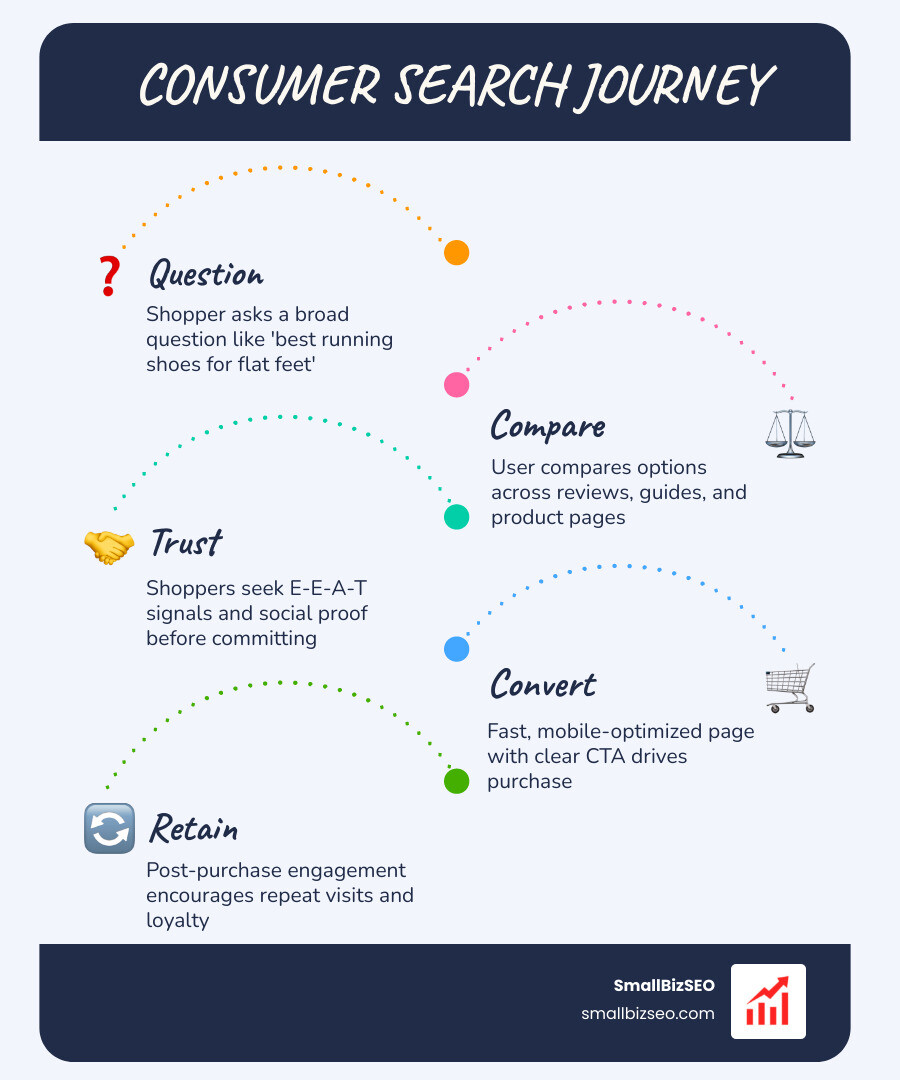
Consumer search is rarely a straight path from keyword to purchase. People compare options, check reviews, and look for quick answers. Your content needs to help at each point.
I’m Clayton Johnson, founder of SmallBizSEO. My work in SEO B2C marketing connects content, technical SEO, and digital PR to help small businesses earn trust and attract qualified customers.
What Makes SEO B2C Marketing Effective?
Effective B2C search optimization requires an omnichannel approach that captures shoppers at emotional and transactional touchpoints. Modern search engines prioritize direct, high-trust answers that deliver an immediate solution to the user's intent.
Today, organic search drives substantial commercial volume, with organic traffic accounting for 23.6% of all eCommerce orders. At the same time, search engine result pages (SERPs) feature AI Overviews, rich product carousels, and local packs that demand structured, authoritative data.
Consumers search with specific motivations: fixing an urgent problem, finding a gift, or comparing prices. Capturing this demand requires aligning your technical foundation with authoritative Experience, Expertise, Authoritativeness, and Trustworthiness (E-E-A-T) signals. When you establish transparent policies, authentic reviews, and authoritative content, search engines recognize your site as a credible solution for shoppers.
How Does B2C Search Differ From B2B Search?
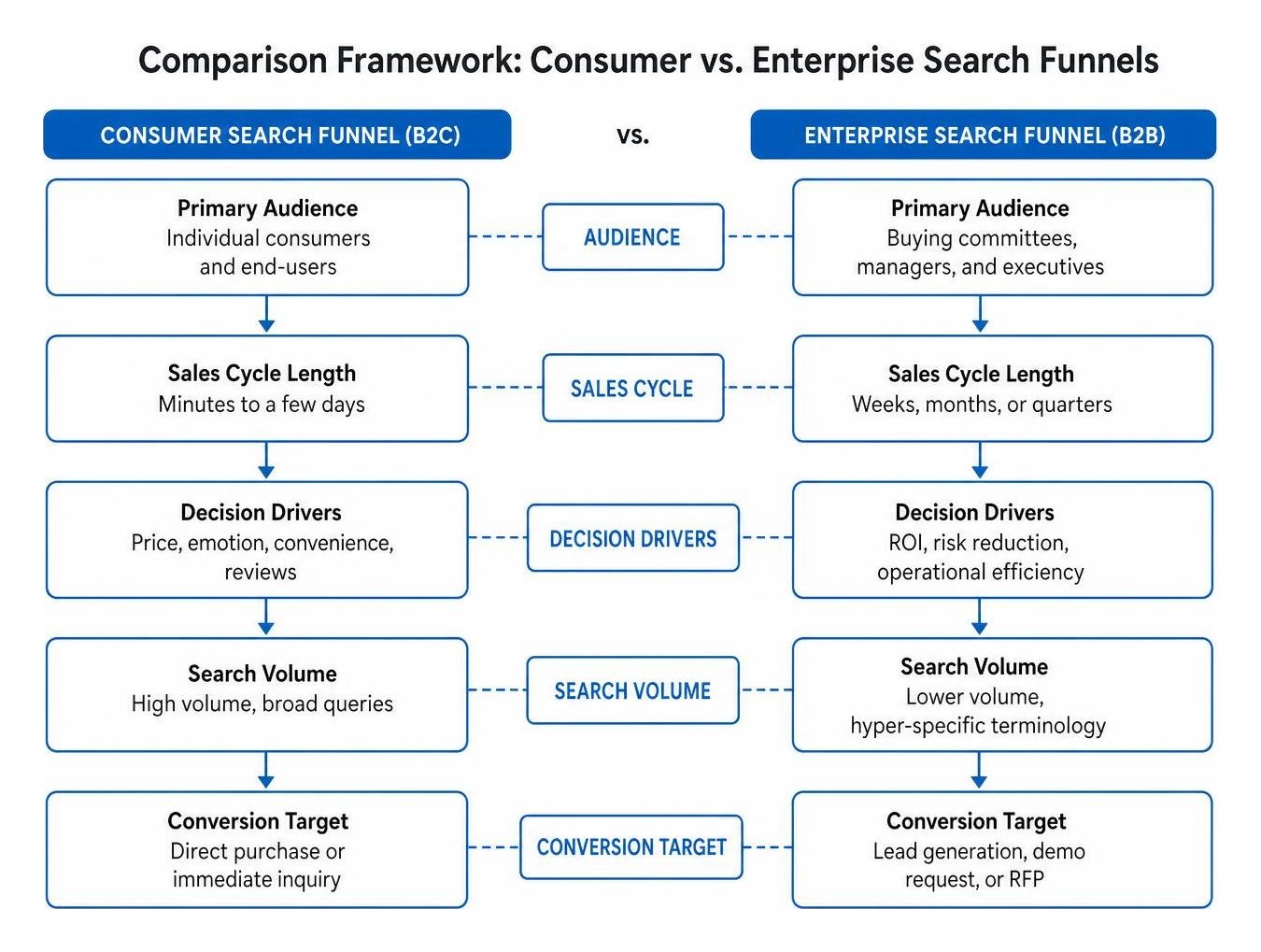
B2C search targets individual consumers who make rapid, emotionally driven purchases, whereas B2B search addresses multi-stakeholder buying committees with extended sales cycles.
Understanding these structural differences is vital when deciding which tactics to prioritize across the 4 types of SEO. A consumer purchasing running shoes often moves from search to checkout in minutes. Conversely, a corporate buyer researching enterprise software requires weeks of product comparisons, compliance reviews, and team approvals.
| Characteristic | B2C Search Optimization | B2B Search Optimization |
|---|---|---|
| Primary Audience | Individual consumers and end-users | Buying committees, managers, and executives |
| Sales Cycle Length | Minutes to a few days | Weeks, months, or quarters |
| Decision Drivers | Price, emotion, convenience, reviews | ROI, risk reduction, operational efficiency |
| Search Volume | High volume, broad queries | Lower volume, hyper-specific terminology |
| Conversion Target | Direct purchase or immediate inquiry | Lead generation, demo request, or RFP |
In practice, B2C search strategies must optimize for speed, instant clarity, and emotional resonance.
How Do You Master Keyword Research for SEO B2C Marketing?
Mastering B2C keyword research requires identifying high-intent consumer phrases, uncovering competitor keyword gaps, and structuring search terms into semantic topic clusters.
Begin by segmenting your keywords according to search intent:
- Informational Queries: Shoppers seeking answers (e.g., "how to fix a leaking kitchen faucet").
- Commercial Investigation: Shoppers evaluating options (e.g., "best eco-friendly running shoes").
- Transactional Queries: Ready-to-buy consumers (e.g., "buy stainless steel water bottle online").

Traditional high-volume head terms are often dominated by marketplace giants. To capture ready-to-buy traffic, target long-tail variations that reflect conversational search behavior and voice queries. Applying SEO friendly content writing ensures that your copy naturally answers specific consumer questions without unnatural phrasing.
What Role Does Content and Technical Optimization Play in Converting Shoppers?
Content educates and persuades shoppers, while technical SEO ensures your pages load quickly, display properly on mobile devices, and feed structured data to search crawlers.
Only 3.45% of all web pages receive search traffic from Google, making technical excellence non-negotiable. E-commerce and direct-to-consumer stores must eliminate duplicate variant URLs, fix broken canonicals, and maintain optimal Core Web Vitals-keeping Largest Contentful Paint (LCP) under 2.5 seconds and Interaction to Next Paint (INP) under 200 milliseconds.
Key on-page and technical strategies include:
- Structured Data Markup: Implement Schema.org Product, AggregateRating, and FAQPage JSON-LD markup to earn rich snippets in search results. Google's product structured data guidance explains how eligible product details can appear in search features.
- Review Integration: Display authentic customer feedback. Modern shoppers rely heavily on social proof; in fact, 33% of consumers believe an average business needs at least 20 reviews to justify its rating.
- Optimized Digital Assets: Compress images below 500 KB and convert them to modern formats like WebP to maintain fast load times.
Working with an experienced ecommerce SEO company can help resolve complex technical issues such as faceted navigation. Pairing these technical fixes with systematic SEO content marketing helps build the topical depth search engines reward.
Advanced Execution, Local Reach, and Performance Tracking
Modern search marketing combines localized visibility, personalized user experiences, and rigorous multi-touch analytics to sustain organic revenue growth.
How Can Brands Optimize for Local Search and Mobile Shoppers?
B2C brands optimize for local and mobile search by maintaining an accurate Google Business Profile, targeting geo-specific keywords, and ensuring rapid mobile site performance.
Mobile devices generate 62.54% of global online traffic, making mobile usability the baseline standard for rankings. Furthermore, local search directly drives store visits: 50% of people who search for brick-and-mortar businesses online visit a store they discover.
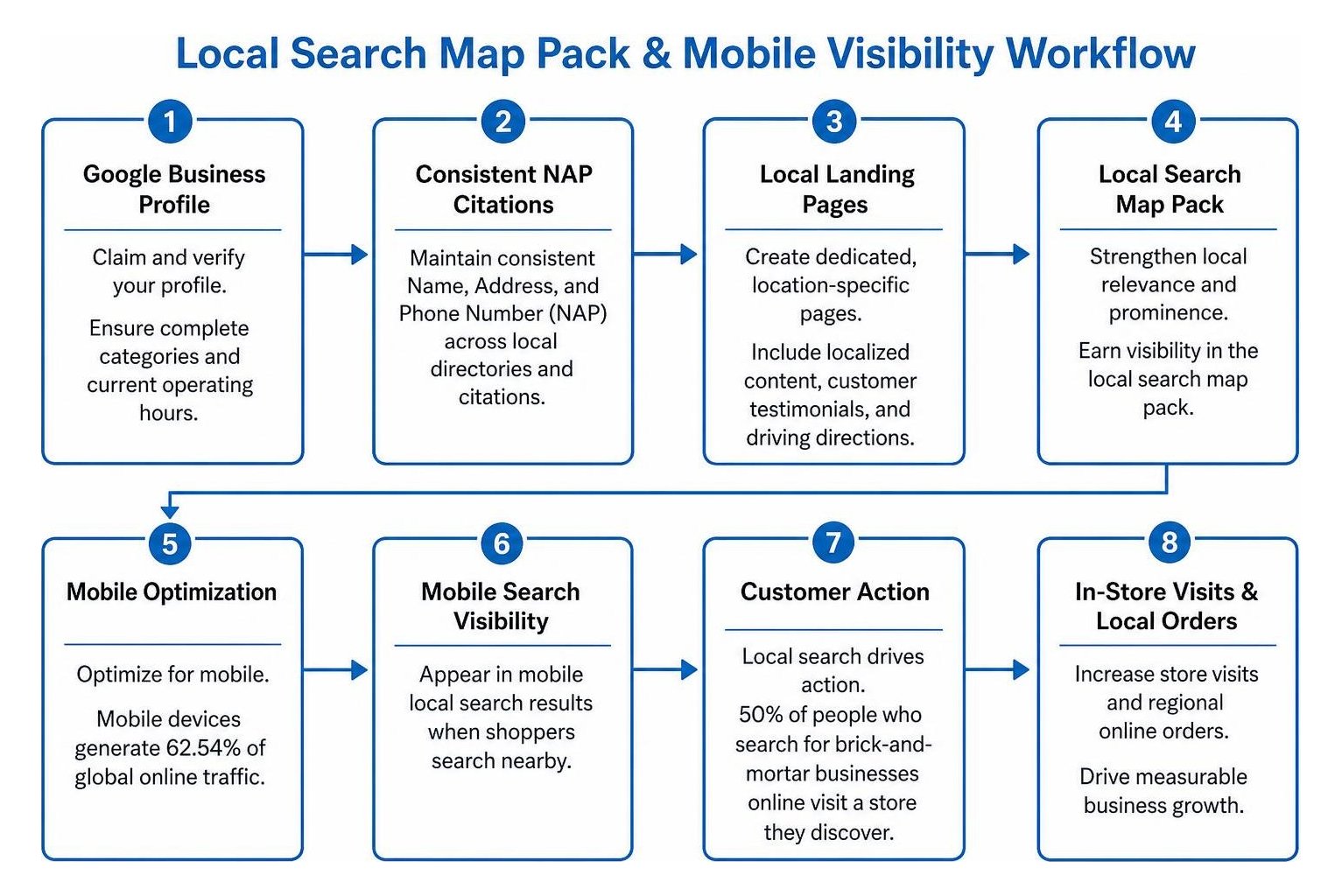
To maximize local foot traffic and regional online orders:
- Claim and verify your Google Business Profile, ensuring complete category selections and current operating hours.
- Maintain consistent Name, Address, and Phone Number (NAP) information across local directories and citations.
- Create dedicated, location-specific landing pages with localized content, customer testimonials, and driving directions as outlined in our comprehensive local SEO guide.
- Encourage satisfied customers to post regular reviews and respond to them promptly to reinforce local trust signals.
How Do You Measure ROI and Overcome Common Challenges in SEO B2C Marketing?
You measure B2C search ROI by tracking organic revenue, average order value, conversion rates, and customer acquisition costs against total campaign investment.
For example, if your search campaign generates $60,000 in revenue from a $15,000 investment, your ROI is ($60,000 - $15,000) / $15,000 = 300%.

B2C brands frequently encounter distinct operational challenges:
- Marketplace Dominance: Aggregators and retail marketplaces dominate high-volume queries. Counter this by dominating long-tail, problem-solving, and ingredient-level search themes.
- Thin Product Content: Manufacturer descriptions create duplicate content issues. Write unique, feature-benefit product copy for every key SKU.
- Crawl Waste on Large Catalogs: Dynamic filtering generates millions of uncrawlable URLs. Use canonical tags, robots.txt exclusions, and clean sitemap structures.
Using our structured guide to SEO reporting helps marketing teams connect organic rankings directly to bottom-line profitability rather than relying solely on vanity metrics.
How Should You Choose the Right Agency Partner for Your Brand?
Choose an SEO agency partner that provides transparent, automated reporting, demonstrates deep technical capabilities, and aligns organic search strategies with your commercial revenue goals.
An effective partner should evaluate your entire consumer buying journey—from discovery through conversion—rather than merely tracking keyword positions. At SmallBizSEO, we utilize our proprietary data-driven "Velocity" framework to deliver rapid ranking gains, robust technical health, and E-E-A-T-compliant growth across every digital channel.
Before committing to a long-term strategy, evaluate your current search presence by requesting an actionable SEO visibility audit to identify technical bottlenecks, keyword opportunities, and revenue pathways.
Accelerate Your Consumer Search Growth
Winning consumer search requires moving beyond keyword stuffing to build a fast, user-friendly digital experience that answers shopper questions at every stage. By integrating technical hygiene, intent-focused content clustering, local optimization, and transparent revenue tracking, your brand creates a compounding organic growth engine that outlasts rising advertising costs.