A Practical Guide to Finding Valuable Low-Volume Questions

How do you find valuable low-volume customer questions?
The simplest way to find valuable low volume customer questions is to look where customers already ask for help: support tickets, sales calls, and searches on your site. Save their exact wording. Then group questions by the decision a customer is trying to make, not just by shared words. Prioritize questions that block a purchase, reveal a costly problem, or come from customers you most want to serve.
A question does not need thousands of searches to matter. If answering it helps the right customer take the next step, it may be more useful than a popular topic with little buying intent.
I'm Clayton Johnson, founder of SmallBizSEO. My work in SEO and content strategy focuses on how to find valuable low volume customer questions and turn clear, well-supported answers into content that helps small businesses attract qualified leads.
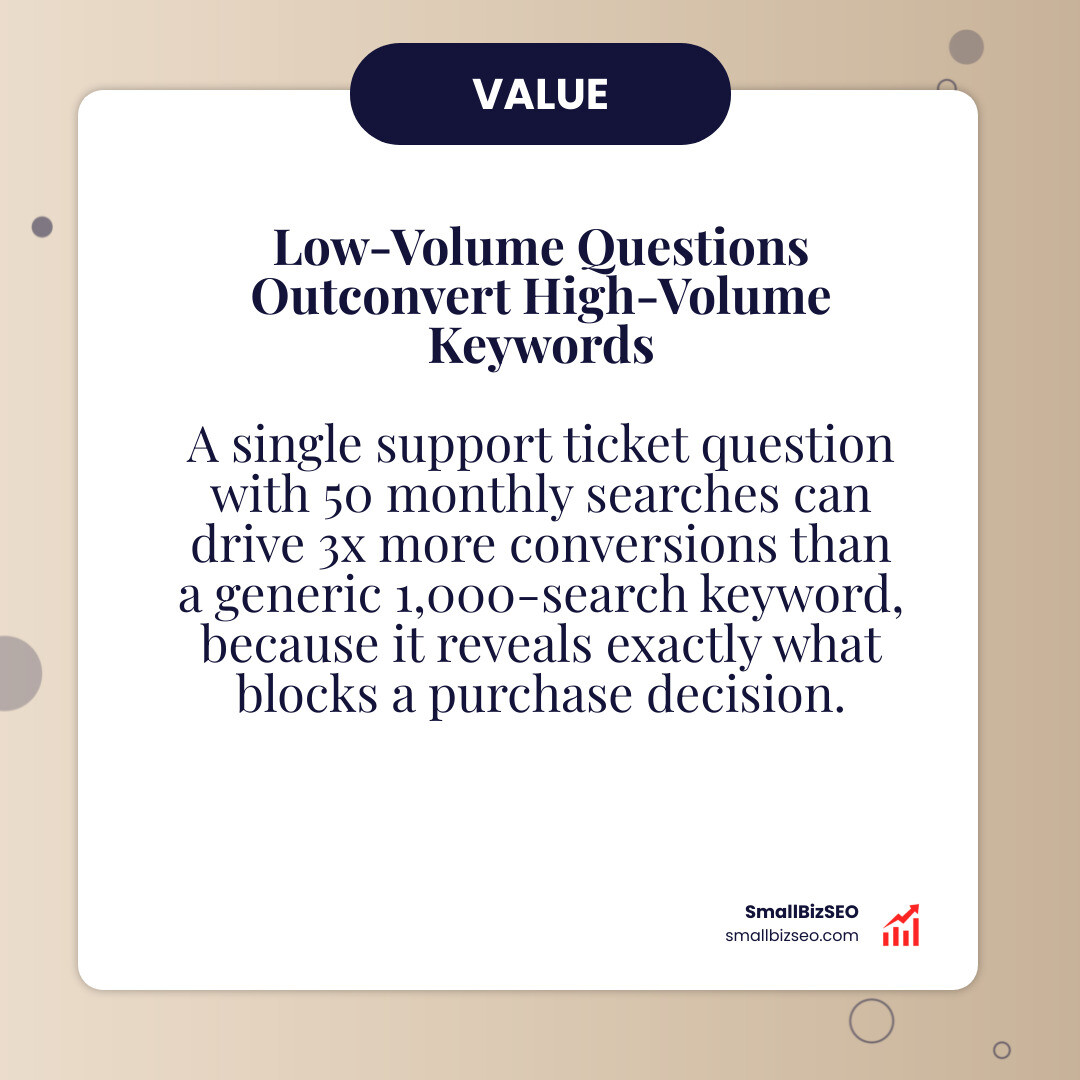
How to Find Valuable Low Volume Customer Questions Across High-Signal Channels
Finding high-value, low-volume customer questions requires looking past broad monthly search metrics and extracting specific conversational data from direct customer touchpoints. The highest-converting inquiries reflect urgent purchasing criteria, unexpected implementation roadblocks, and detailed comparison evaluations.
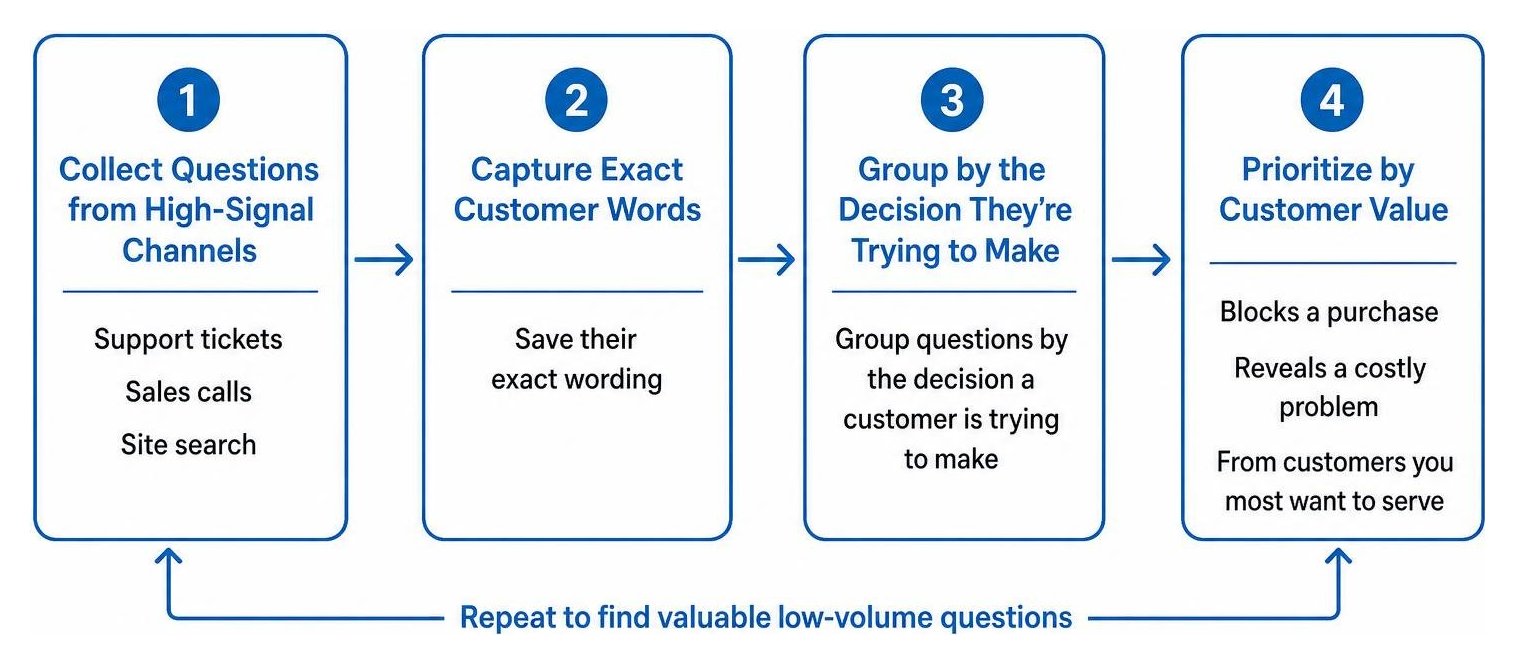
When we analyze raw customer language, we immediately see that traditional head keywords fail to capture the nuances of actual buyer objections. While broad terms offer high visibility, low-volume questions pinpoint the exact moment of decision.
| Search Metric / Dimension | High-Volume Head Keywords | Low-Volume Customer Questions |
|---|---|---|
| Average Search Demand | 1,000 to 50,000+ monthly searches | 0 to 150 monthly searches |
| Primary User Intent | Surface-level exploration or browsing | Bottom-of-funnel decision or technical evaluation |
| Conversion Likelihood | Low to moderate | Exceptionally high |
| Data Origin | Public keyword databases and tool scrapers | Direct customer support, sales calls, and answer engines |
| Competitive Density | Dominated by aggregators and high-authority domains | Uncontested; immediate opportunity for first-page ranking |
What Makes Low-Volume Queries from Valued Customers More Profitable Than High-Volume Search Terms?
Low-volume queries from valued customers are more profitable because they come from high-margin buyers with complex needs, clear intent, and a strong willingness to buy.
To understand why this distinction matters, we must separate two types of buyers:
- Valued customers: Loyal brand advocates who generate significant lifetime value, require tailored solutions, have low price sensitivity, and ask detailed questions about integration, workflow fit, and reliability.
- Volume customers: Transactional users who purchase lower-margin products or services based purely on price or convenience and typically generate repetitive, basic inquiries.
Targeting buyer intent keywords asked by valued customers prevents your team from chasing vanity metrics. Relying solely on third-party estimates for search volume often causes businesses to ignore questions that convert at double-digit rates. Industry research shows that 81% of customers prefer direct, meaningful brand interactions over impersonal self-service channels when making significant buying decisions. Furthermore, enterprise research shows that organizations routinely prioritize inquiries based on buyer value because resolving a single complex problem for a high-value client delivers a far greater return on investment than answering hundreds of basic transactional queries.
How to Find Valuable Low Volume Customer Questions in Support Tickets, Sales Transcripts, and Site Search
The most reliable method for uncovering hidden customer questions is auditing internal communication archives: support tickets, sales call recordings, and on-site search queries.
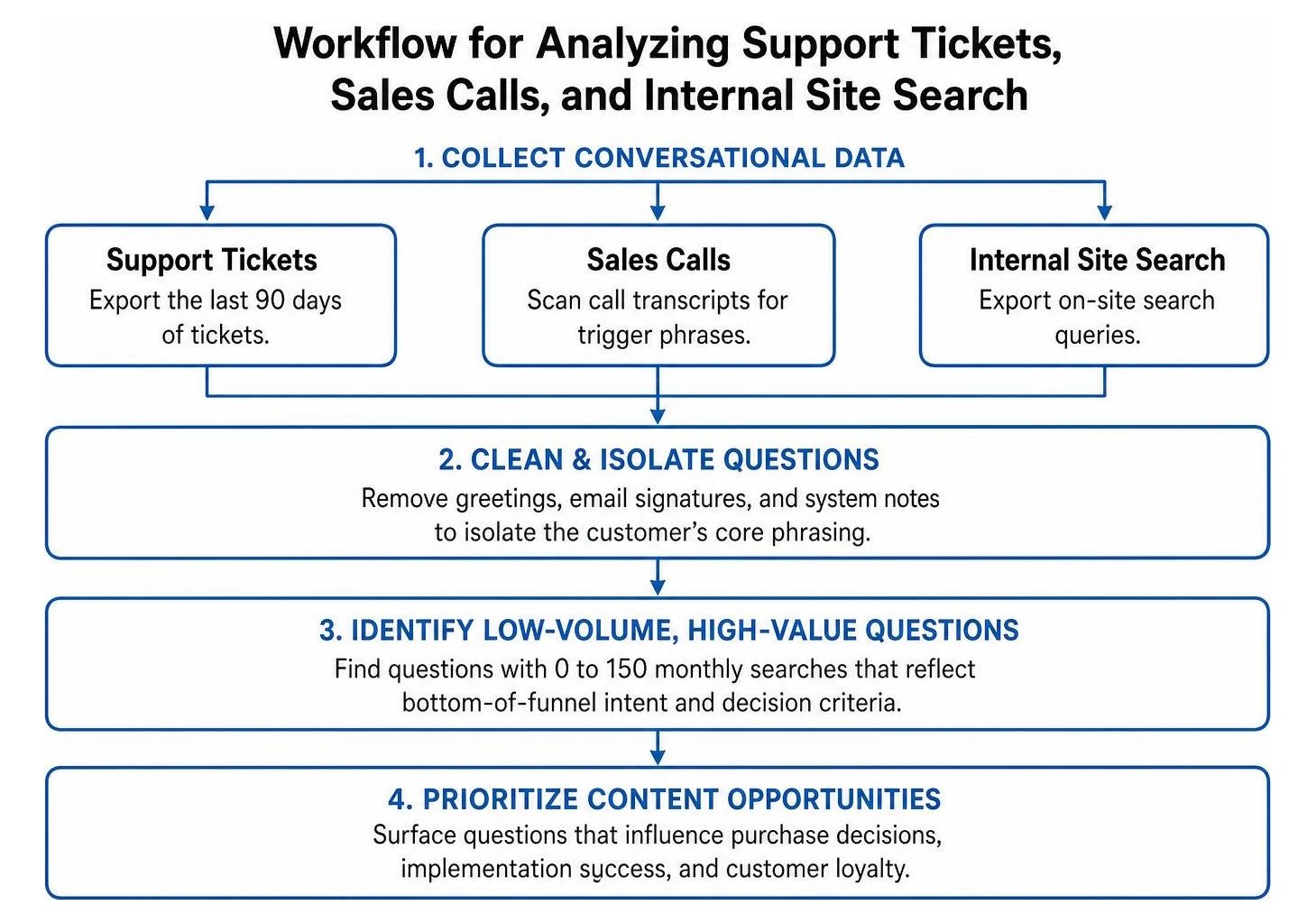
Operational data reveals that 40% of customers contact support multiple times for the exact same unresolved issue, with each repeat loop adding 3 to 5 days to resolution. In contact centers, 32% of inbound calls come from repeat callers seeking clarification. Analyzing these friction points helps you identify overlooked content gaps and eliminate customer confusion before it costs you revenue. The questions customers ask support teams can serve as your primary SEO roadmap.
We recommend extracting raw customer questions using these four steps:
- Export support ticket archives: Pull the last 90 days of tickets from your helpdesk platform. Strip away greetings, email signatures, and system notes to isolate the customer's core phrasing.
- Mine recorded sales conversations: Use conversational intelligence software to scan sales call transcripts for explicit trigger phrases such as "How do I connect...", "What happens if...", or "Can your software handle..."
- Audit internal site search logs: Extract zero-result queries from your website search bar to see what visitors expect to find but cannot locate.
- Review interactive voice response (IVR) drop-offs: Identify navigation menus where callers frequently abandon self-service options to speak with a representative.
How to Find Valuable Low-Volume Customer Questions Using the AEO Query Pyramid and Prompt Mining
To capture visibility in modern answer engines, businesses must organize low-volume queries using a structured framework: the AEO Query Pyramid. This model maps the entire question web, starting from a high-level topic and expanding into specific follow-ups and adjacent concerns.
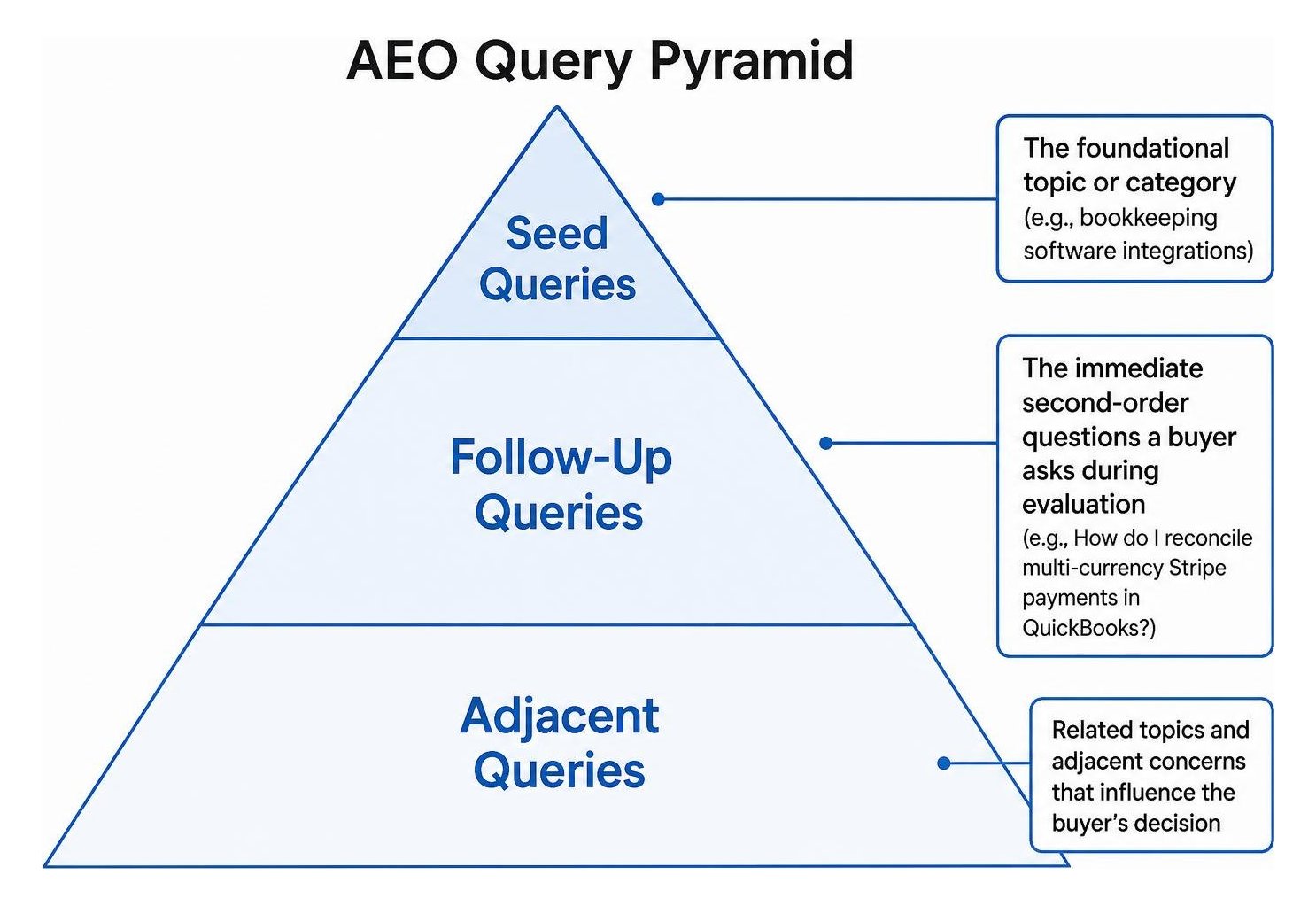
Traditional SEO focuses on a single seed keyword, but answer engines rely on query fan-out algorithms that retrieve multiple related sources to answer conversational prompts. By targeting conversational long-tail keywords within the question web, you position your content directly in AI overviews and answer-engine citations.
The AEO Query Pyramid consists of three distinct layers:
- Seed queries: The foundational topic or category (e.g., "bookkeeping software integrations").
- Follow-up queries: The immediate second-order questions a buyer asks during evaluation (e.g., "How do I reconcile multi-currency Stripe payments in QuickBooks?").
- Adjacent queries: Contextual edge cases, operational limits, or contingency concerns (e.g., "What happens if a contractor payment fails after fiscal year-end?").
You can expand this pyramid by mining Perplexity related-question rails, exploring niche Reddit threads, and studying prompt research strategies to observe what real users ask conversational assistants. Mapping these question networks allows small businesses to earn citations where competitors relying solely on classic keyword tools remain invisible.
Building a Scalable System to Cluster, Validate, and Maintain Low-Volume Questions
Finding questions is only the first half of the process; the second half is organizing them into an actionable, maintainable content workflow. Without a system to group and update low-volume queries, teams risk creating redundant pages or publishing thin content.

How Do You Cluster Customer Questions by Decision Intent and Test Coherence?
Customer questions must be clustered by decision intent—the underlying business choice the user needs to make—rather than superficial keyword syntax. Grouping by keyword similarity often leads to keyword cannibalization and fragmented answers.
When creating comprehensive guides around informational keywords, clustering by decision intent prevents search intent drift. To ensure each content piece remains unified, we apply the one-sentence answer test.
By utilizing structured prompt engineering within AI tagging tools, you can batch-process hundreds of raw customer messages, group them by customer journey stage, and build logical FAQ ladders that solve real problems.
| Grouping Attribute | Traditional Keyword Similarity Clustering | Decision-Intent Clustering (Recommended) |
|---|---|---|
| Grouping Principle | Shared text strings and root phrases | Shared customer objective or operational decision |
| Typical Failure Mode | Creates thin, repetitive duplicate pages | Consolidates varied phrasing into a single, high-impact asset |
| Validation Metric | Shared search result pages (SERP overlap) | The One-Sentence Answer Test |
| Content Structure | Disconnected individual blog posts | Structured FAQ ladders and comprehensive guides |
| AEO Visibility | Weak context for AI answer engines | Strong semantic relevance for conversational AI citation |
How Can You Maintain a Living Query Set and Balance Valued vs Volume Customers?
A living query set is a continuously updated repository of real customer questions, organized by topic, decision stage, and revenue impact. Rather than treating question research as an annual project, companies should maintain this asset with a regular operating rhythm.
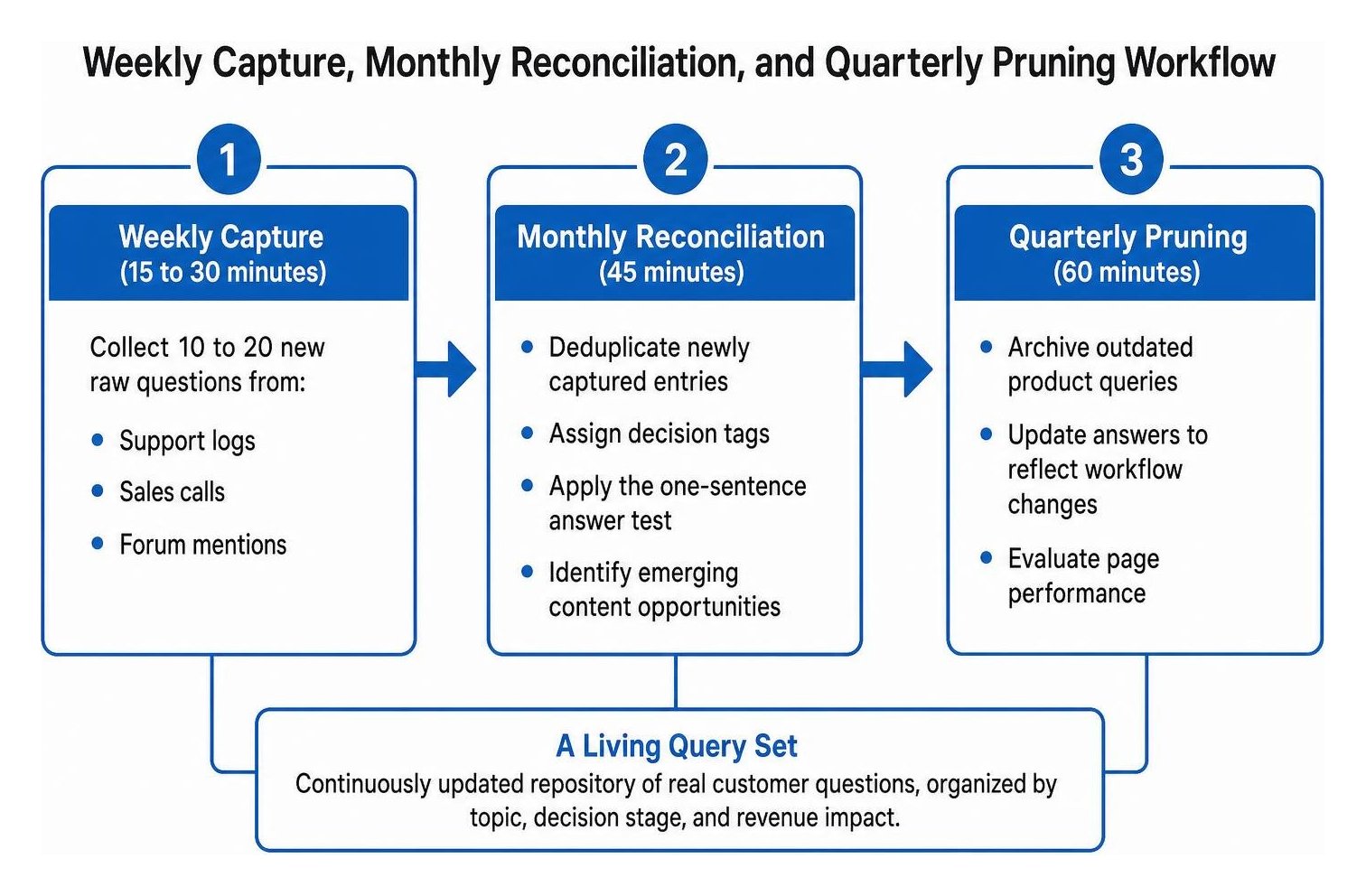
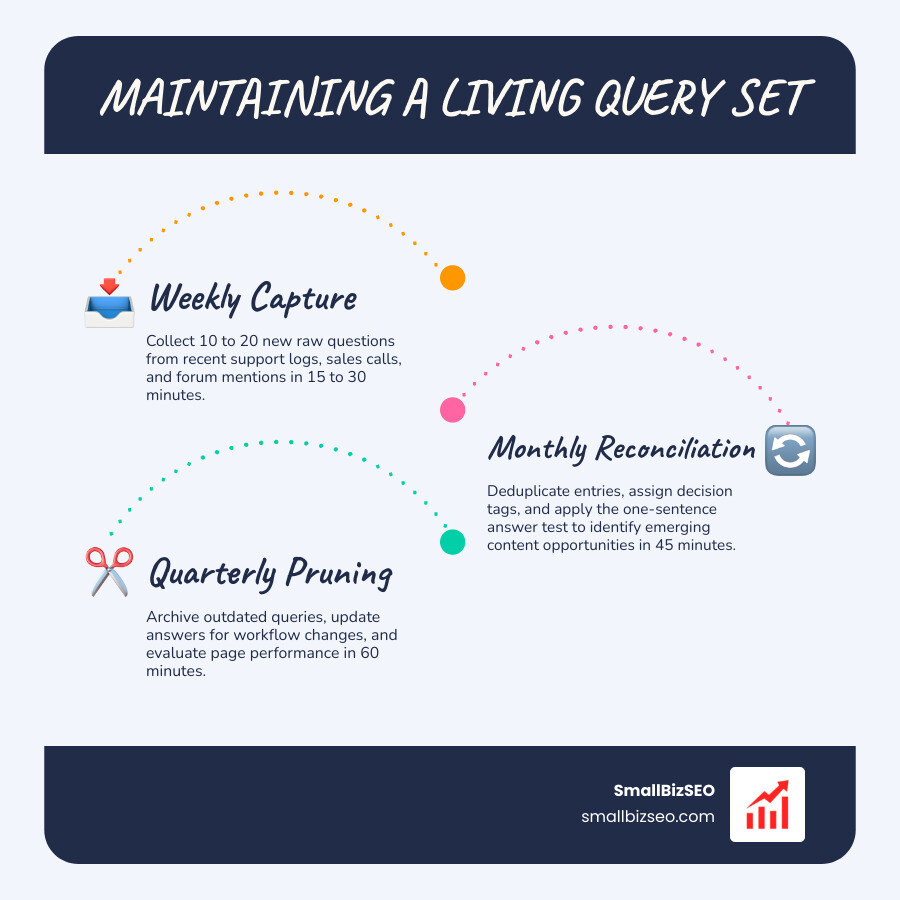
A healthy question-management workflow requires three ongoing habits:
- Weekly capture (15 to 30 minutes): Collect 10 to 20 new raw questions from recent support logs, sales calls, and forum mentions.
- Monthly reconciliation (45 minutes): Deduplicate newly captured entries, assign decision tags, and apply the one-sentence answer test to identify emerging content opportunities.
- Quarterly pruning (60 minutes): Archive outdated product queries, update answers to reflect workflow changes, and evaluate page performance.
Maintaining this system balances service efficiency for both customer segments:
Chatbots and automated knowledge bases can resolve up to 80% of routine questions, cutting customer support costs by 30%. This frees up your subject-matter experts to answer high-stakes questions from valued clients. Integrating this process into a modern keyword research strategy ensures that your editorial calendar reflects real-world market demand.
Our team implements this structure through the SmallBizSEO Velocity framework, delivering rapid search visibility and reliable organic growth. To discover how our structured workflows can transform your organic performance, explore our dedicated SmallBizSEO SEO content services.
Turn Real Customer Questions into Your Competitive Advantage
Uncovering valuable, low-volume customer questions gives small businesses a major competitive advantage. While large competitors chase generic, high-volume keywords with expensive campaigns, your business can build deep authority by directly answering the high-intent questions that drive real buying decisions.
When you consistently extract raw language from support channels, organize questions using the AEO Query Pyramid, cluster inquiries by decision intent, and maintain a living query repository, you create an efficient content engine. Every clear answer you publish eliminates friction for high-value prospects, reduces repeat support volume, and positions your business as the definitive authority in both traditional search engines and emerging AI answer platforms.