A Practical Guide to Multi-Step AI Comparison Research

How do you prepare service information for multi-step AI comparison research?
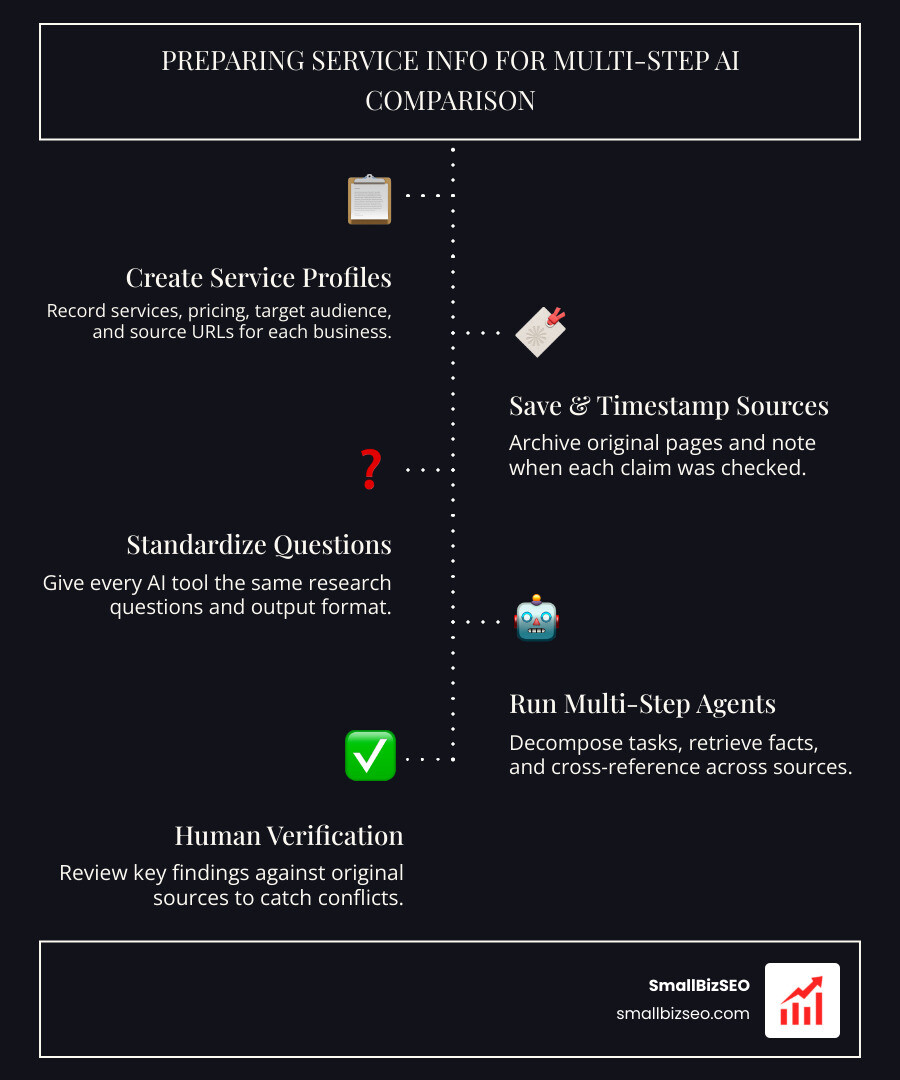
Start with a consistent service profile for every business you compare. Record what each service includes, who it serves, pricing when published, and the source URL for each claim. Save the original pages, note when you checked them, and mark missing details as not stated. Give each AI tool the same research questions and output format so you can compare its findings fairly.
A single AI agent can gather or summarize information. A coordinated system can split the work across steps, but it also needs checks to catch conflicting findings and unsupported claims. Either way, a person should verify important conclusions against the original sources.
I'm Clayton Johnson, founder of SmallBizSEO. My work on preparing service information for multi-step AI comparison research draws on SEO, content strategy, and developing shared research workflows that help small businesses present clear, useful information.
Introduction: The Shift to Multi-Step Autonomous AI Analysis
To conduct accurate comparative research today, organizations are moving away from single-prompt queries and adopting multi-step agentic workflows. When an AI processes complex service catalogs, it must break down questions, retrieve facts across several sources, cross-reference features, and synthesize findings into a coherent decision matrix.

Industry studies show that 46% of professionals feel overwhelmed by document volume, and an equal 46% struggle to extract clear signals across multiple data sources. While modern reasoning models can compress research tasks that once took 20+ hours into mere minutes, their output quality depends entirely on how well the underlying data is prepared.
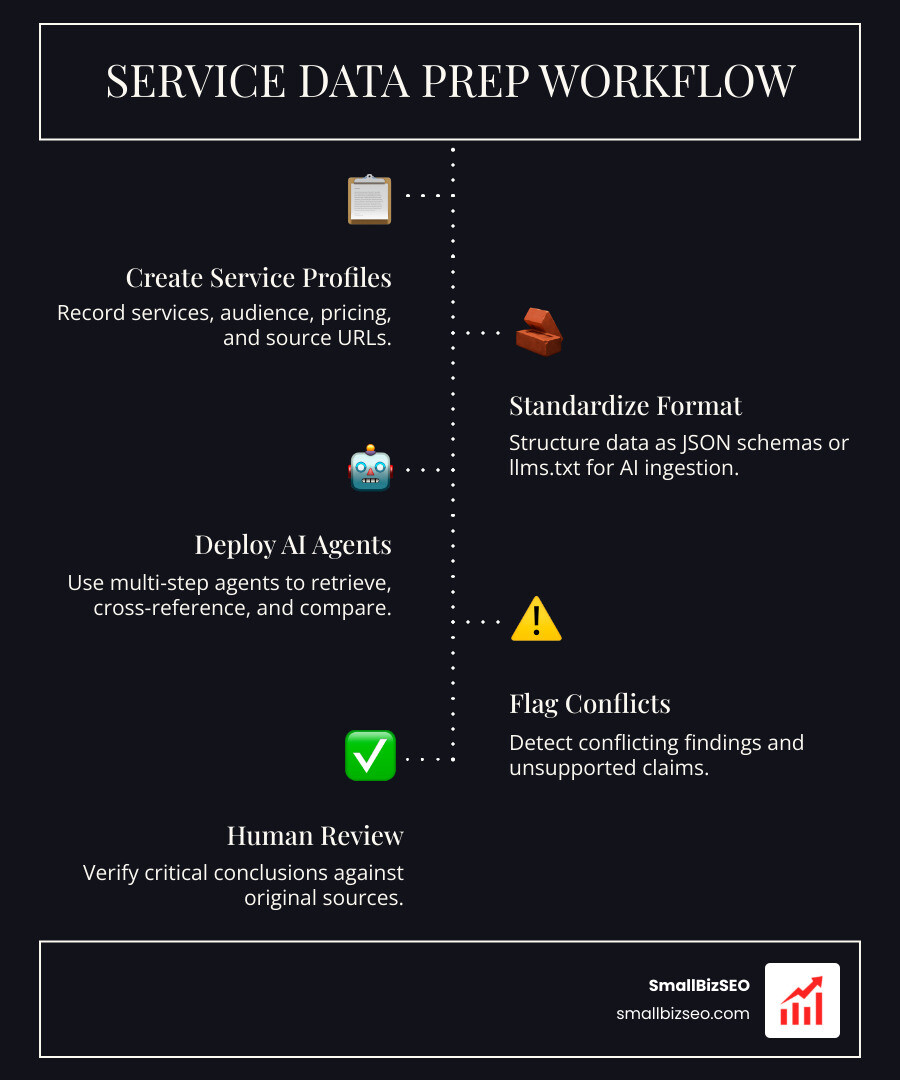
In multi-step comparative research, relying on raw, unstructured web pages causes autonomous agents to get lost in navigation loops or misinterpret pricing tiers. By establishing clean data pipelines, teams can streamline comparisons, eliminate hallucinated features, and help autonomous systems deliver auditable conclusions.
Preparing Service Information for Multi-Step AI Comparison Research: Architecture, Protocols, and Data Structuring
Preparing service data for automated analysis requires treating documentation as structured data rather than marketing fluff. When an agent analyzes an offering, it traces dependencies: what core features exist, what integrations are supported, what constraints apply, and how pricing tiers scale.
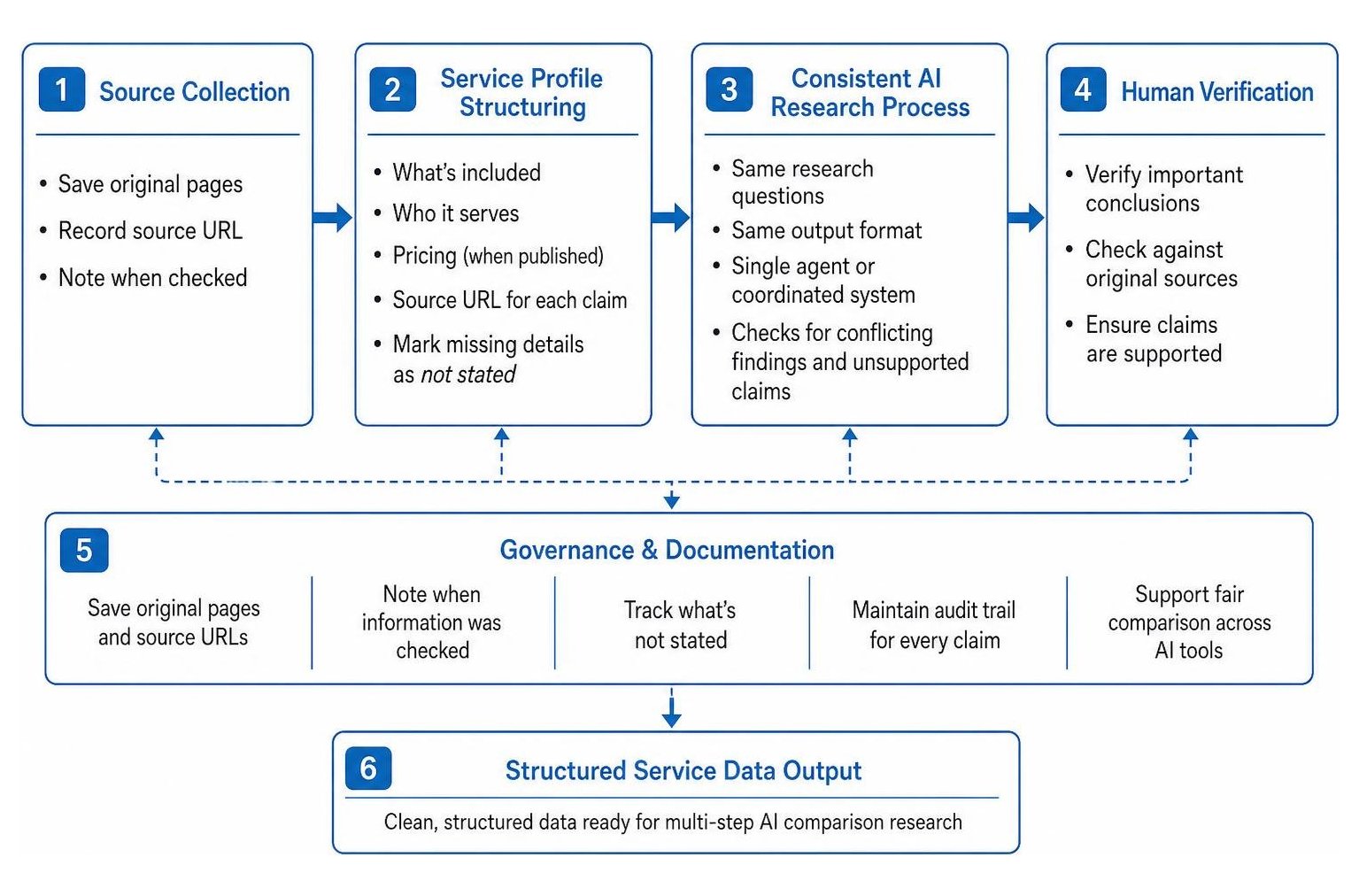
A critical lesson from enterprise deployments is that 80% of the work in deploying reliable AI agents is consumed by data engineering, workflow integration, and governance, rather than prompt tweaks. Establishing standard data schemas and transparent API documentation provides the foundation needed for consistent chain of thought reasoning across multi-step research runs.
| Ingestion Parameter | Structured JSON Ingestion | Unstructured Text Ingestion |
|---|---|---|
| Parsing Reliability | Deterministic schema validation; zero syntax confusion | Prone to layout misinterpretation and omitted fields |
| Traceability | Field-level citation links directly to source URLs | Requires fuzzy text matching across raw paragraphs |
| Agent Token Economy | Minimal overhead; passes only high-density facts | High token consumption from boilerplate text |
| Comparative Precision | High; standard key-value pairs allow direct diffs | Variable; requires multi-pass normalization steps |
How to Format and Structure Data When Preparing Service Information for Multi-Step AI Comparison Research?
To make service data readable for AI crawlers and research engines, organize your facts into machine-readable JSON schemas alongside clean markdown summaries. Using emerging standards like the llms.txt convention allows autonomous crawlers to quickly discover key service pages without scraping unnecessary visual clutter.
Clear formatting also enhances entity salience, ensuring that machine readers correctly associate specific capabilities, limits, and service tiers with your brand. Applying proven agentic research patterns ensures your service information is grounded and reproducible:
- Standardize Core Fields: Document exact service names, primary target audiences, mandatory prerequisites, and verifiable deliverables.
- Explicit Negative Constraints: Clearly state what a service does not do and mark omitted features explicitly as "not stated" to prevent models from inventing details.
- Establish Data Validation Tiers: Assign confidence scores to data points based on source reliability (e.g., official documentation vs. third-party commentary).
- Preserve Source Provenance: Attach original canonical URLs and snapshot dates to every feature claim for continuous auditability.
What Architectural Frameworks Enable Reliable Multi-Agent Comparisons?
Reliable comparison at scale relies on a multi-agent framework featuring a central orchestrator, dynamic task decomposition, and shared persistent memory. Rather than asking a single model instance to handle searching, parsing, verifying, and scoring, multi-agent architectures assign discrete subtasks to specialized agents running in parallel.
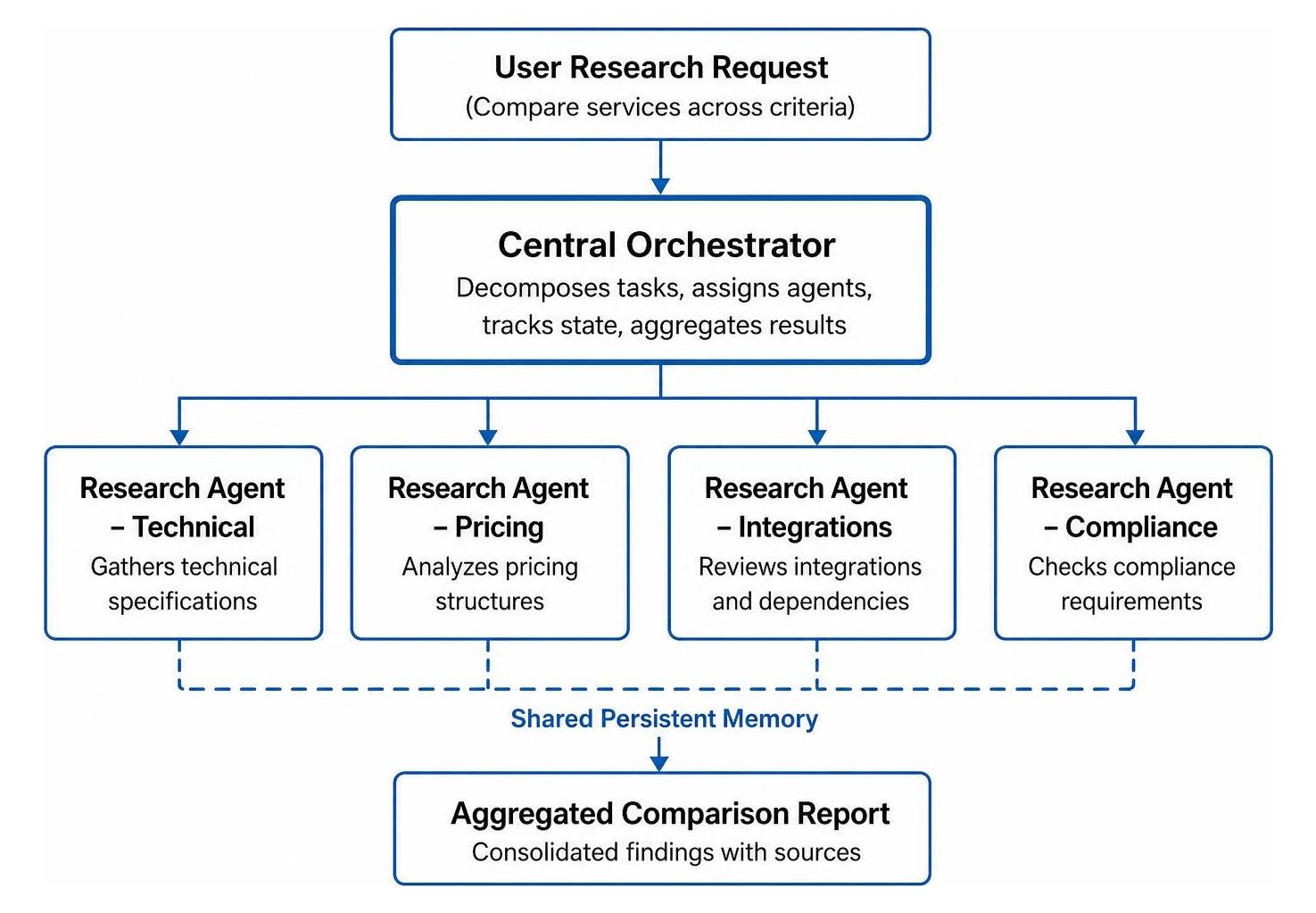
According to foundational information systems research on AI capabilities, modular coordination layers significantly improve system performance on complex analytical tasks. The central orchestrator deploys dedicated workers for technical specifications, pricing structures, and compliance requirements. By standardizing tool communication protocols, the system maintains accurate state tracking and achieves high truth-recall rates across thousands of comparative data points.
How Do AI Agents and Agentic AI Differ in Autonomous Operational Workflows?
Understanding the difference between standard AI agents and collaborative Agentic AI systems is essential when designing multi-step research workflows. As detailed in A Comprehensive Review of AI Agents, modular agents operate within fixed parameters to complete isolated jobs, whereas Agentic AI encompasses coordinated, multi-agent systems that autonomously adapt their strategies based on intermediate findings.
| Operational Dimension | Modular AI Agents | Collaborative Agentic AI Systems |
|---|---|---|
| Autonomy Level | Task-specific; follows predefined scripts or single prompts | Dynamic; plans, decomposes, and modifies research goals |
| State & Memory | Ephemeral context; resets after single-turn completions | Persistent shared memory across distributed sub-agents |
| Workflow Style | Linear, sequential tool execution | Parallel, asynchronous execution with central orchestration |
| Error Handling | Fails or halts when encountering unexpected data formats | Autonomously re-queries or flags ambiguous discrepancies |
Best Practices, Tool Selection, and Governance in Autonomous Comparison Research
Deploying autonomous systems for comparative research requires robust governance, clear validation benchmarks, and continuous human oversight. Grounding model reasoning in real-world facts builds trust: industry research highlights that 85% of professionals are confident in AI outputs when answers are directly grounded in source documents and clear system integrations.

At SmallBizSEO, we implement our data-driven Velocity framework to combine technical precision with transparent, automated reporting. Structuring business data around answer-ready SEO principles ensures that both prospective clients and automated research bots receive direct, unambiguous answers. Teams looking to expand their digital footprint can align these workflows with broader agentic search optimization strategies.
How Should Organizations Mitigate Failure Modes When Preparing Service Information for Multi-Step AI Comparison Research?
The most common failure modes in autonomous research are hallucinations, context drift, brittle scrapers, and coordination breakdowns. When models face ambiguous documentation, they tend to fill information gaps with plausible-sounding assumptions.
To prevent these errors, organizations must apply modern AI SEO best practices across their content assets:
- Implement ReAct Loops: Combine reasoning and acting steps so agents review intermediate outputs against live source pages before proceeding.
- Deploy Grounded RAG Pipelines: Restrict answering agents strictly to verified context snippets retrieved from authoritative documentation.
- Incorporate Causal Validation: Require the system to verify contradictory claims across at least two independent primary sources.
- Set Explicit Depth Budgets: Cap the number of search queries and tool calls per entity to prevent runaway loops and reduce latency.
Which Deep Research Tools and Evaluation Metrics Yield the Highest Benchmark Accuracy?
Selecting the right research tool depends on whether your project requires broad academic synthesis, real-time web retrieval, or low-level API customization. Teams evaluating the market can review specialized Deep Research APIs for Agentic Workflows to determine whether to purchase an off-the-shelf solution or build an in-house pipeline.
- ChatGPT Deep Research: Excels at broad, multi-angle web exploration and high-level synthesis across hundreds of consumer pages.
- Claude: Offers exceptional precision and concise synthesis over large context windows without conversational bloat.
- Elicit & Consensus: Highly specialized for structured, citation-first analysis of academic papers, methodology checks, and clinical data.
- Graph RAG Implementations: Maps complex inter-entity relationships into connected knowledge graphs, drastically reducing hallucinations across comparative matrices.
What Security, Governance, and Human Oversight Safeguards Are Required?
Autonomous data gathering must operate within established enterprise security boundaries. When agents crawl services, access private repos, or parse vendor contracts, governance protocols prevent accidental exposure of confidential information.
- Access Control & Compliance: Ensure all scraping and API ingestion engines comply with SOC 2 Type 2 standards, ISO 27001 requirements, and relevant privacy laws.
- Comprehensive Audit Trails: Maintain complete logs of every tool call, scraped URL, intermediate reasoning step, and schema validation result.
- Human-in-the-Loop Thresholds: Route comparisons with confidence scores below 70% to human subject-matter experts for manual verification.
- Data Opt-Out Enforcements: Use enterprise-tier LLM endpoints that guarantee proprietary service data is never used for foundation model training.
Building an Accurate Foundation for Future Research
Preparing service documentation for multi-step AI research requires clear data engineering, transparent schemas, and strong governance. As multi-agent workflows become the standard for market analysis and vendor evaluations, organizations that publish structured, verifiable, and well-cited service information will consistently achieve the most accurate representation across all automated platforms.