A Quick Start Guide to Franchise Local SEO Basics
A Quick Start Guide to Franchise Local SEO Basics
Introduction to Franchise Multi-Location Visibility
Franchise local SEO is the practice of optimizing multiple individual business locations within a unified brand network so each branch ranks at the top of local search queries and map packs. It combines centralized brand authority with localized relevance, ensuring every franchise unit appears when nearby customers search for immediate solutions. This approach requires consistent business data, location-specific landing pages, and steady review generation across all territories.
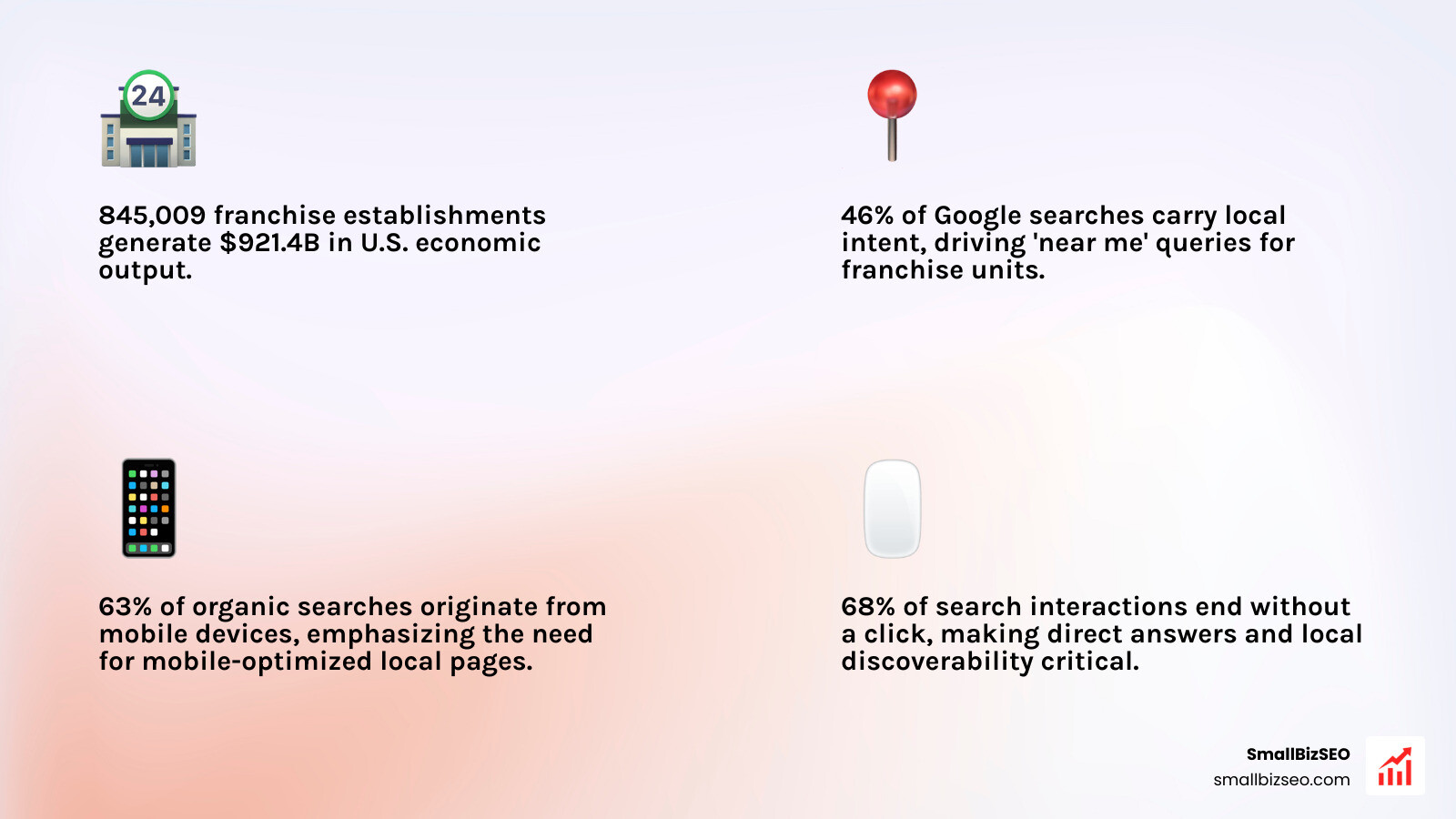
Franchise expansion is one of the most powerful growth models in business, encompassing over 845,000 establishments producing more than $921 billion in economic output. Yet, as a franchise network grows, connecting individual storefronts with nearby buyers becomes increasingly complex. High-intent consumers rarely search for a corporate parent company; instead, they conduct "near me" queries when they need immediate solutions. In fact, 46% of all Google searches carry local intent, and 63% of organic searches originate from mobile devices.
At the same time, over 68% of search engine interactions end without a click to an external website because search engines answer queries directly on the results page. To win in this environment, franchise systems must build strong local discoverability for every unit while maintaining centralized national brand authority.
Core Pillars of a Winning Franchise Local SEO Strategy
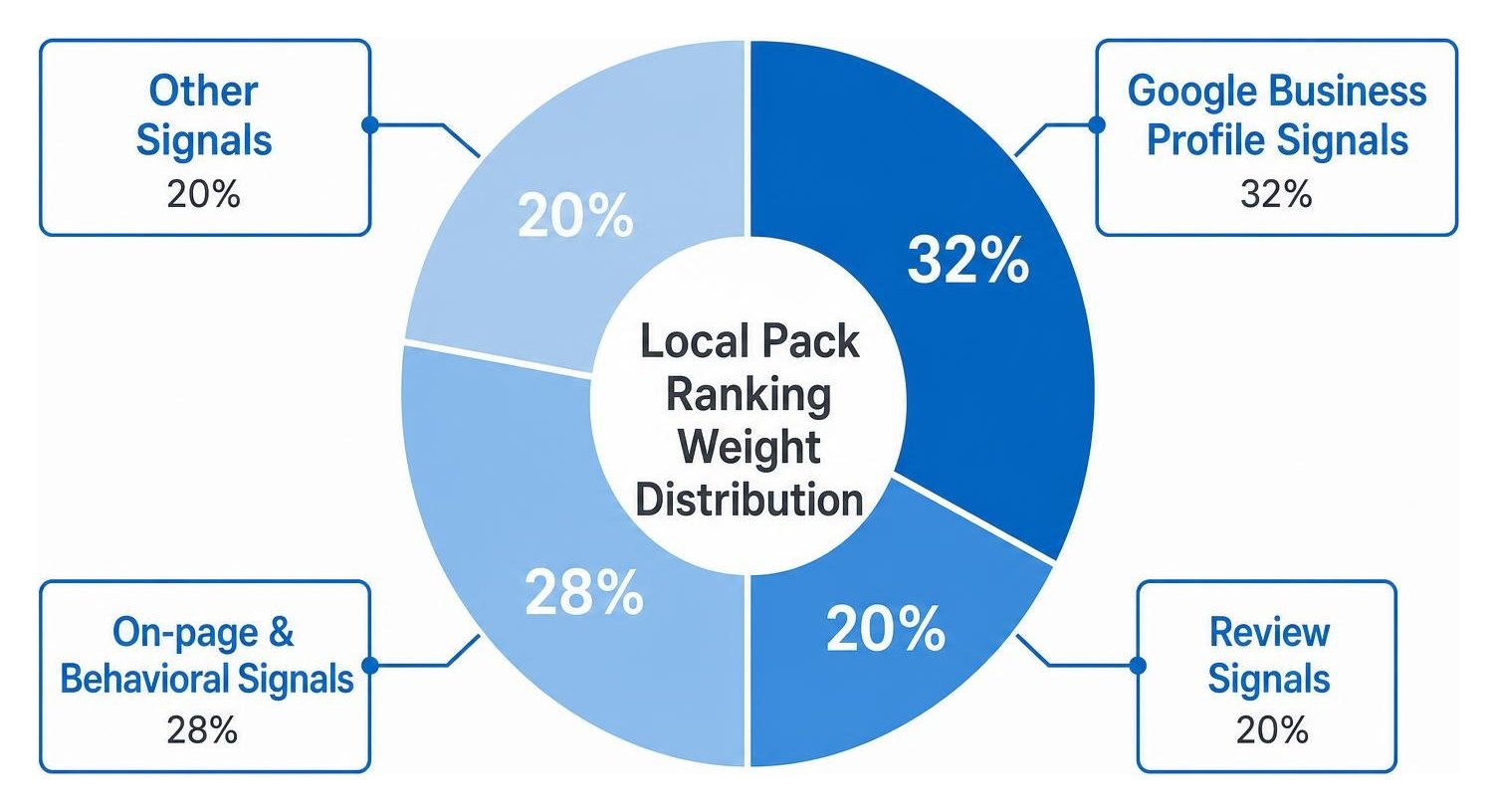
A successful multi-unit optimization program balances localized relevance with corporate oversight. Google determines local visibility using distinct algorithmic weights: Google Business Profile (GBP) signals account for roughly 32% of Local Pack ranking weight, while review signals drive 20%.
Analysis demonstrates a strong 0.72 correlation between local visibility scores and physical store visits. Partnering with an experienced enterprise local SEO company helps multi-unit operators scale localized optimization while maintaining strict corporate governance across dozens or hundreds of operating territories.
What Is Franchise Local SEO and How Does It Differ From Standard SEO?
Franchise local SEO is the practice of optimizing multiple individual business locations within a unified brand network so each branch ranks at the top of local search queries and map packs. It bridges the gap between high-level brand awareness and neighborhood-level search intent.
Standard local SEO optimizes a single storefront within a single market. National SEO targets broad, non-geographic informational terms across the entire country. Franchise local SEO must execute both simultaneously: capturing national brand authority while preventing internal keyword competition among neighboring franchisees.
| SEO Strategy Type | Primary Goal | Target Geographic Scope | Technical Structure | Key Ranking Drivers |
|---|---|---|---|---|
| National SEO | Broad brand visibility & organic traffic | Nationwide / Global | Single domain, general topic hubs | Backlink authority, technical crawlability, content depth |
| Standard Local SEO | Visibility for one physical store | Single city or neighborhood | Single domain, basic NAP setup | Single GBP listing, local citations, review volume |
| Franchise Local SEO | Coordinated visibility for 10 to 1,000+ units | Hundreds of unique local service areas | Unified domain with nested location subfolders | Centralized GBP management, localized schemas, review velocity |
Without a coordinated playbook, nearby locations risk cannibalizing each other's search rankings. Engaging an experienced franchise SEO company ensures your network avoids internal competition while deploying scalable local playbooks that keep every unit visible without undermining its neighbors.
How Should Franchises Structure Scalable Location Pages and Technical Architecture?
Franchises should structure their websites using a clean subfolder architecture on a single root domain rather than creating disjointed microsites. A unified structure (such as brand.com/locations/city-name/) consolidates all inbound backlink equity into one powerful domain that lifts every franchisee.
To avoid duplicate content penalties and internal cannibalization:
- Publish Hyperlocal Content: Research indicates that unique, community-tailored landing page content delivers an average 107% ranking lift compared to generic templated pages.
- Incorporate Custom Local Imagery: Authentic photos of local staff, storefronts, and branded vehicles generate an 84% average ranking improvement over stock photos.
- Implement LocalBusiness Schema Markup: Add structured data to every page with exact latitude and longitude geo-coordinates to five decimal places.
- Apply Self-Referential Canonical Tags: Point each location URL to itself to ensure search engines index every individual page as a unique local entity.
- Optimize Core Web Vitals: Ensure lightning-fast mobile load times and clean user experience across every location page template, particularly when managing service brands as outlined in our guide on home service franchise SEO playbooks.
How to Optimize Google Business Profiles and NAP Consistency at Scale
Franchises must centralize Google Business Profile management through bulk verification while maintaining 100% Name, Address, and Phone (NAP) consistency across all citation networks.
Incomplete or mismatched profile data confuses search engines and reduces customer trust. Data shows that fully optimized GBP listings drive a 41% increase in customer actions, including direction requests and direct phone calls.
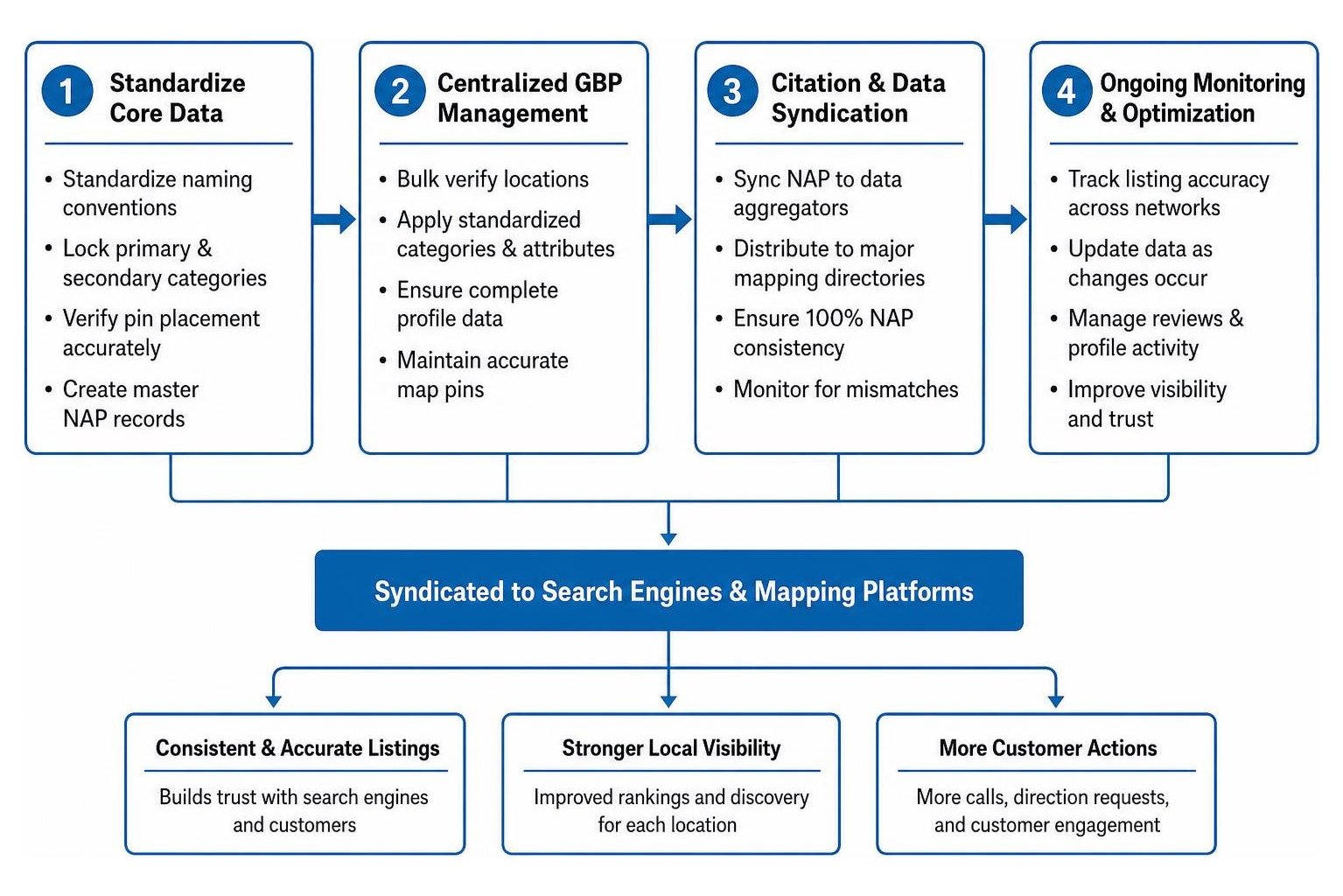
- Standardize Core Naming Conventions: Keep business names compliant with search engine guidelines across every unit without spamming geo-keywords into the official title.
- Lock Primary Categories: Set standardized primary and secondary business categories corporate-wide to preserve category relevance.
- Verify Pin Placement Accurately: Ensure map pins reflect exact storefront entrances or defined service boundaries.
- Synchronize Master NAP Records: Sync business data to major data aggregators and mapping directories. For further lead generation strategies, reference our comprehensive local SEO guide.
How to Build Review Velocity and Authority for Franchise Local SEO
Building review authority requires a steady, ongoing cadence of genuine customer feedback across every individual franchise location. Review recency carries significant algorithmic weight, ranking among the top primary signals for local pack rankings.
Maintaining 15 to 45 new customer reviews per month per location preserves ranking stability, whereas pausing review collection for even a few weeks can trigger noticeable drops in map pack placement. Consumer data reveals:
- 97% of buyers read online reviews before selecting a local business.
- 47% avoid businesses with fewer than 20 total reviews.
- Map pack visibility drops sharply for profiles rated below a 4.3-star average.
- A one-star improvement in overall rating can increase revenue by 5% to 9%.
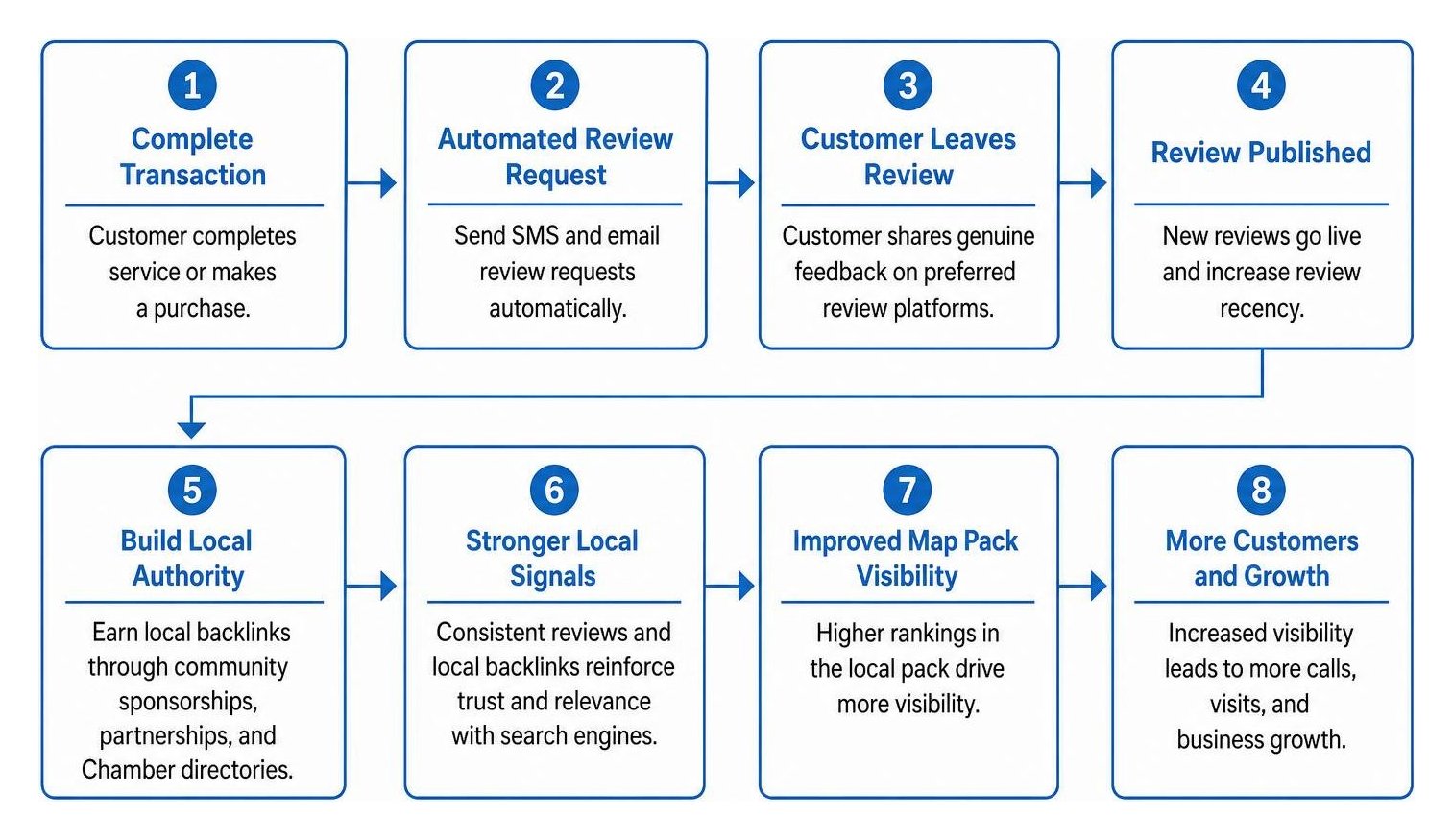
Automating review requests via SMS and email after completed transactions ensures high review velocity. Centralized teams should also secure local backlinks through community sponsorships, regional business partnerships, and Chamber of Commerce directories to scale local authority consistently across the entire network.
Execution Roadmap and Measuring Franchise SEO Success
A structured multi-location SEO roadmap combines automated listing governance, localized content updates, and data-driven performance monitoring. Adopting a hybrid marketing model—combining corporate strategic oversight with local execution—reduces marketing overhead by 20% to 30% while maximizing market penetration.
For guidance on coordinating location pages, listings and measurement, see our multi-location search playbook.
To benchmark where your network currently stands, you can schedule a comprehensive SEO visibility audit with our team.
How Does AI Search (GEO) Impact Multi-Location Local Visibility?
Generative Engine Optimization (GEO) ensures your franchise locations are accurately referenced and recommended by AI-powered search engines and conversational assistants. AI platforms do not simply look at keywords; they verify real-world business entities using structured data, comprehensive citation footprints, and third-party review databases.
Research shows a 0.72 correlation between traditional local search rankings and AI visibility. Platforms like ChatGPT frequently reference structured directory databases, such as Foursquare and Yelp, while drawing business information directly from brand websites over 58% of the time.
Furthermore, businesses surfaced by AI search platforms average over 133 Google reviews compared to just 10 reviews for unlisted competitors. Maintaining complete profiles, accurate schemas, and active review streams protects your franchise across both traditional search engines and next-generation conversational discovery tools. For deeper insights on platform capabilities, explore our franchise SEO agency comparison guide.
How Can New and Existing Franchise Units Track Key Local SEO Metrics?
Franchises should track performance using a unified reporting dashboard that evaluates both high-level network health and granular, location-specific metrics.
Key metrics every franchise network must track include:
- Geo-Grid Local Rank Visibility: Measuring map ranking positions across specific geographic radius points surrounding each unit.
- Google Local 3-Pack Share of Voice: The percentage of high-intent search queries where your location appears in the top map pack.
- Direct GBP Customer Actions: Total monthly phone calls, direction requests, website clicks, and appointment bookings generated per profile.
- Location Landing Page Conversions: Organic contact form completions, booking submissions, and phone calls originating from specific location subfolders.
- Review Velocity and Sentiment: Monthly review acquisition volume, average star ratings, and review response rates per branch.
When opening new franchise locations, establish the Google Business Profile and live location landing page 30 days prior to opening day, synchronize core citations, and initiate automated review outreach immediately with your first customers. When evaluating partner platforms, review our guide on comparing franchise SEO services.
Taking Control of Your Multi-Location Digital Growth
Scaling search visibility across dozens or hundreds of franchise locations requires a disciplined strategy, modern technical architecture, and consistent execution. By unifying your network under a structured subfolder hierarchy, automating listing accuracy, and fostering steady review growth, every franchise unit can dominate its local search territory while elevating the entire brand.