Beyond Keywords: A Guide to Generative AI SEO Services and GEO

Beyond Keywords: A Guide to Generative AI SEO Services and GEO
Understanding GEO and Generative AI SEO Services
Generative AI SEO services are specialized strategies that help your business get cited, quoted, and recommended inside AI-powered search tools like ChatGPT, Google AI Overviews, Gemini, and Perplexity - not just ranked in traditional search results.
Here's what they typically include:
- Content optimization - structuring content so AI engines can easily read, summarize, and cite it
- Entity and schema markup - helping AI systems understand who you are and what you offer
- Digital PR and citations - building third-party mentions that AI models use as trust signals
- Technical SEO foundations - ensuring your site is crawlable and readable by AI crawlers
- AI visibility tracking - monitoring where and how often your brand appears in AI-generated answers
Search isn't what it used to be.
A few years ago, ranking on page one of Google meant real traffic to your website. Today, millions of searches end without a single click. Google AI Overviews now appear in over 65% of searches, and tools like ChatGPT have more than 800 million users asking questions and getting direct answers - no list of blue links required.
For small business owners, this shift is painful. Many have reported a 20-40% drop in organic traffic since AI Overviews became mainstream. Gartner predicts organic clicks could fall by as much as 50%. If your business only optimized for traditional search rankings, you may already be losing ground to competitors who show up inside the AI answer itself.
This is the new reality: visibility in AI-generated answers matters as much as - or more than - a page-one ranking.
The good news? You don't need to start from scratch. The same principles that made good SEO work - quality content, authority, clear site structure - are the foundation of AI search optimization too. But there are important differences in how you apply them, and a few popular "AI SEO tactics" that are a complete waste of time.
This guide breaks all of it down in plain language.
I'm Clayton Johnson, and I've spent my career leveraging digital PR and strategic SEO to help businesses build real search visibility and market presence - including navigating the shift toward generative AI SEO services as AI search engines have reshaped how buyers find brands. In the sections ahead, I'll walk you through exactly what works, what doesn't, and how small businesses can compete in this new era of search.
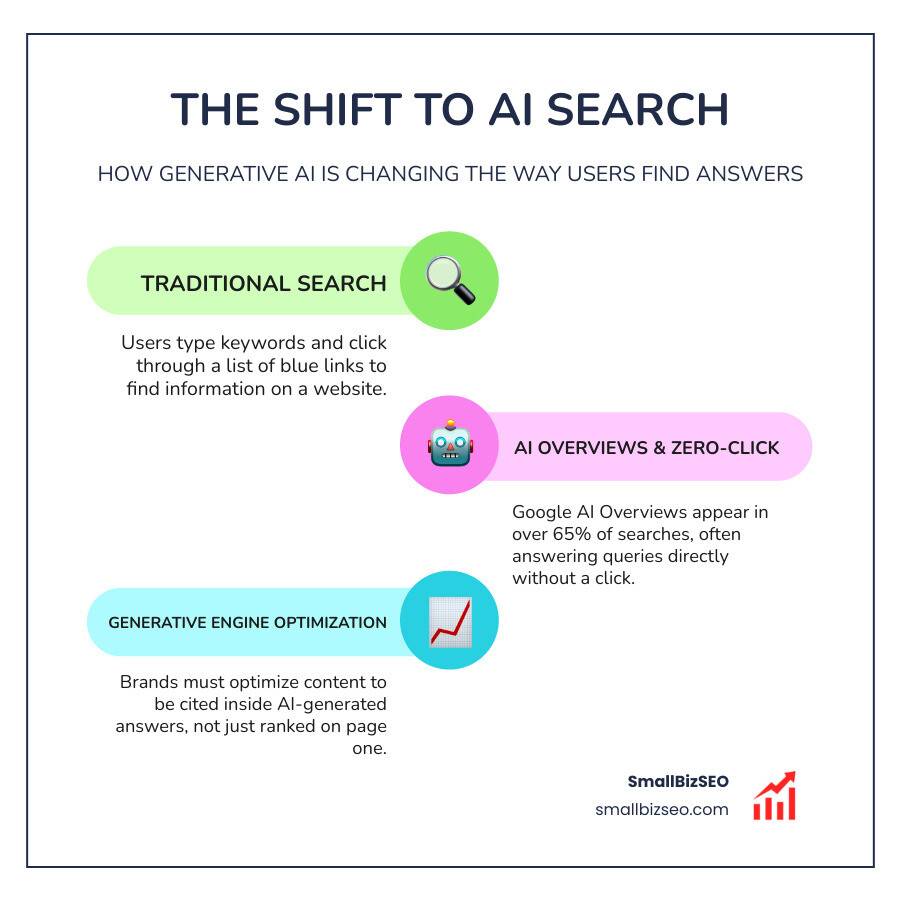
To win in this new landscape, we have to look beyond traditional keywords. This shift has given rise to Generative Engine Optimization (GEO) and Answer Engine Optimization (AEO). While traditional SEO focuses on ranking your web pages for specific queries, GEO focuses on ensuring your brand is synthesized, cited, and recommended within AI-generated responses.
At the heart of how these engines work is Retrieval-Augmented Generation (RAG). Instead of relying solely on static training data, AI engines use RAG to search the live web, pull up-to-date pages from search indexes, and ground their answers in real-time facts.
Additionally, search engines use a process called "query fan-out." When a user asks a complex question, the AI breaks it down into multiple concurrent, related searches to gather a comprehensive set of sources before writing its final response.
To help visualize how this changes your approach to search, here is a quick breakdown of how traditional SEO compares to GEO:
| Feature | Traditional SEO | Generative Engine Optimization (GEO) |
|---|---|---|
| Primary Goal | Rank on page one for target keywords | Get cited and recommended in AI-generated answers |
| User Experience | Clicks through to website to find answers | Direct answer synthesized with citations |
| Core Focus | Keyword optimization and backlinks | Entity clarity, trust signals, and RAG alignment |
| Success Metric | Organic traffic and keyword rankings | Citation frequency and brand mentions in LLMs |
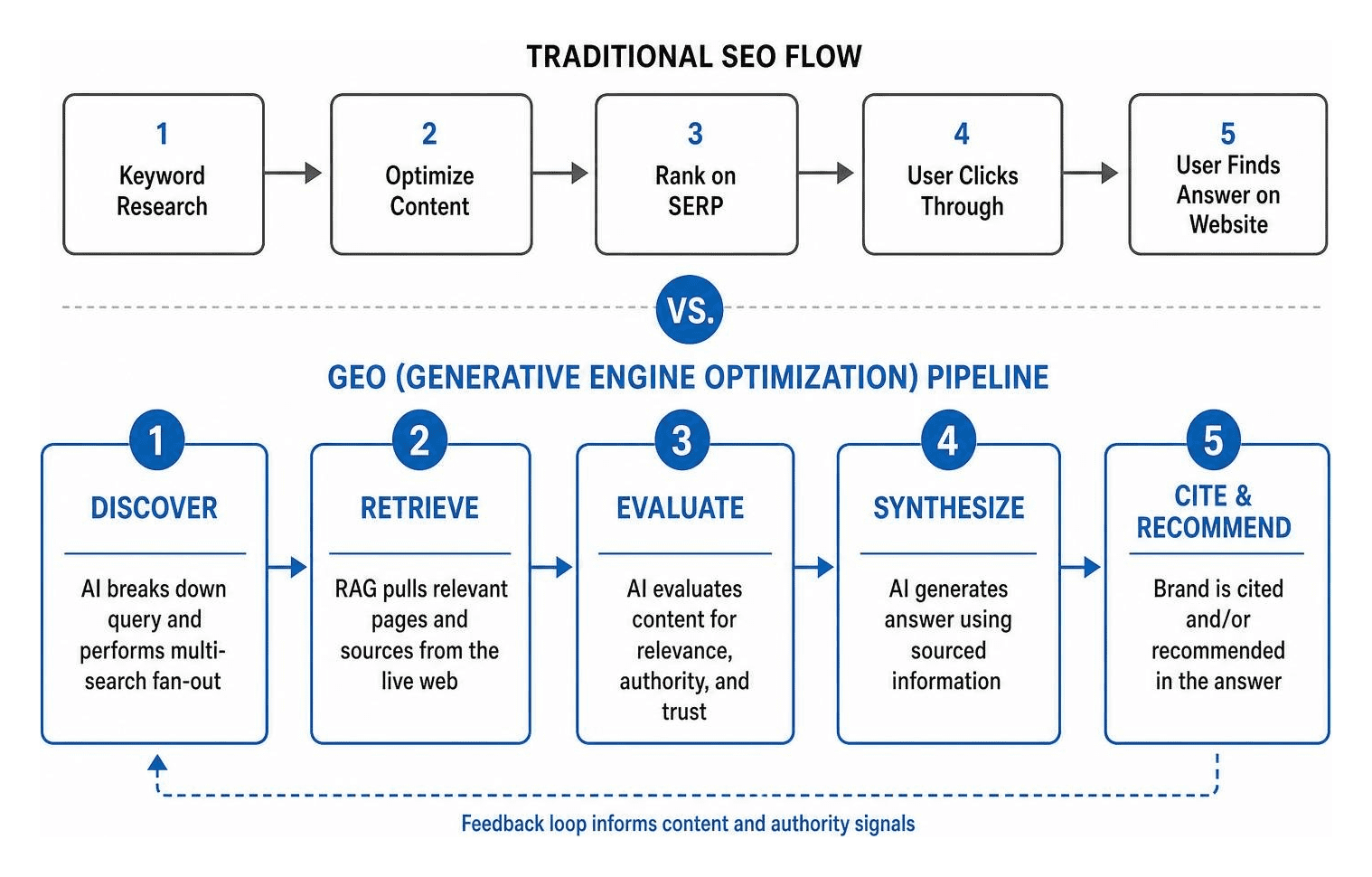
By partnering with professional AI SEO Services, you can ensure your business is optimized for every stage of this pipeline. Top-performing brands are already seeing massive returns; some have grown their total traffic from AI platforms by thousands of percentage points by getting cited directly in ChatGPT and Gemini.
Core Strategies for Optimizing Content for AI Search Engines
Getting cited by AI engines requires a multi-layered approach. It is not just about writing text; it is about building a digital footprint that AI models find highly credible.
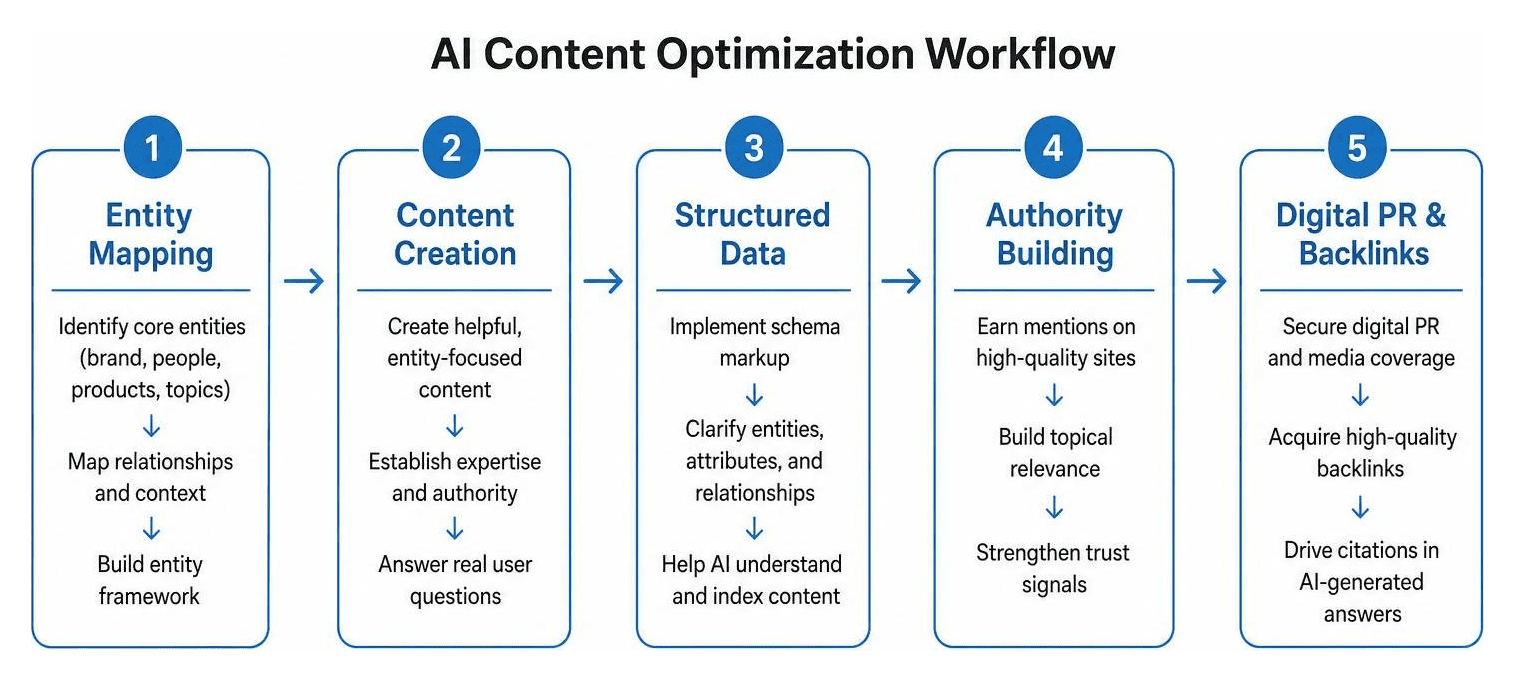
The core workflow of a modern GEO campaign relies on three primary pillars:
- Entity Optimization: AI models understand the world through "entities" (people, places, organizations, and concepts) and the relationships between them. We structure your content to clearly define your brand as a leading entity in your niche.
- Structured Data: Using precise schema markup helps AI crawlers map your site's data without having to guess the context.
- Digital PR and Backlinks: AI engines rely heavily on third-party validation. If high-authority industry blogs, directory listings, and news sites consistently mention your brand, the AI learns to trust you as an authoritative source.
By aligning these elements, we help you transition from a basic website to a citable resource. If you want to scale this process, our SEO Content Services can help you design a roadmap tailored to your industry.
Creating Non-Commodity Content for Generative AI SEO Services
Generic, synthesized content is a commodity. If your article looks like a simple summary of the top five search results, an AI engine has no reason to cite you—it can already write that summary itself.
To win citations, you must publish "non-commodity content." This means creating assets with high "information gain"—pieces that offer unique value, first-hand experience, and original data.
- Share First-Hand Experience: Write case studies, detail unique customer stories, or document real-world processes.
- Publish Original Data: Conduct surveys, release industry reports, or share proprietary datasets. AI models love citing original statistics.
- Take a Clear Position: Avoid neutral, hedged content. AI engines are more likely to recommend sources that take a clear, expert stance on a topic.
This approach directly feeds into Google's E-E-A-T guidelines (Experience, Expertise, Authoritativeness, Trustworthiness). To build a content engine that naturally earns these citations, check out our guide to SEO Content Marketing.
Technical Foundations and Schema for Generative AI SEO Services
While great content is critical, AI engines cannot cite what they cannot read. Technical SEO remains the absolute bedrock of GEO.
To make your site easily readable for AI crawlers like OpenAI's OAI-SearchBot, you should focus on several technical pillars:
- JSON-LD Schema Markup: Implement clear schemas (such as Organization, Product, FAQPage, HowTo, and Dataset) to explicitly define your business details, products, and guides.
- Semantic HTML: Use clean, logical heading structures (H1, H2, H3) and semantic tags to help parsers understand your page layout.
- JavaScript SEO: Ensure your dynamic content renders correctly so that crawlers do not miss key information hidden behind complex scripts.
- Crawlability: Regularly audit your robots.txt file to ensure you are not accidentally blocking the user-agents that power AI search features.
To find out if your site's technical structure is holding you back, you can get a Detailed SEO Analysis to identify and fix crawlability bottlenecks.
Debunking Common Myths in AI Search Optimization
As with any new marketing trend, the rise of AI search has brought plenty of bad advice. Let's clear up some of the most common myths so you do not waste time on ineffective tactics.
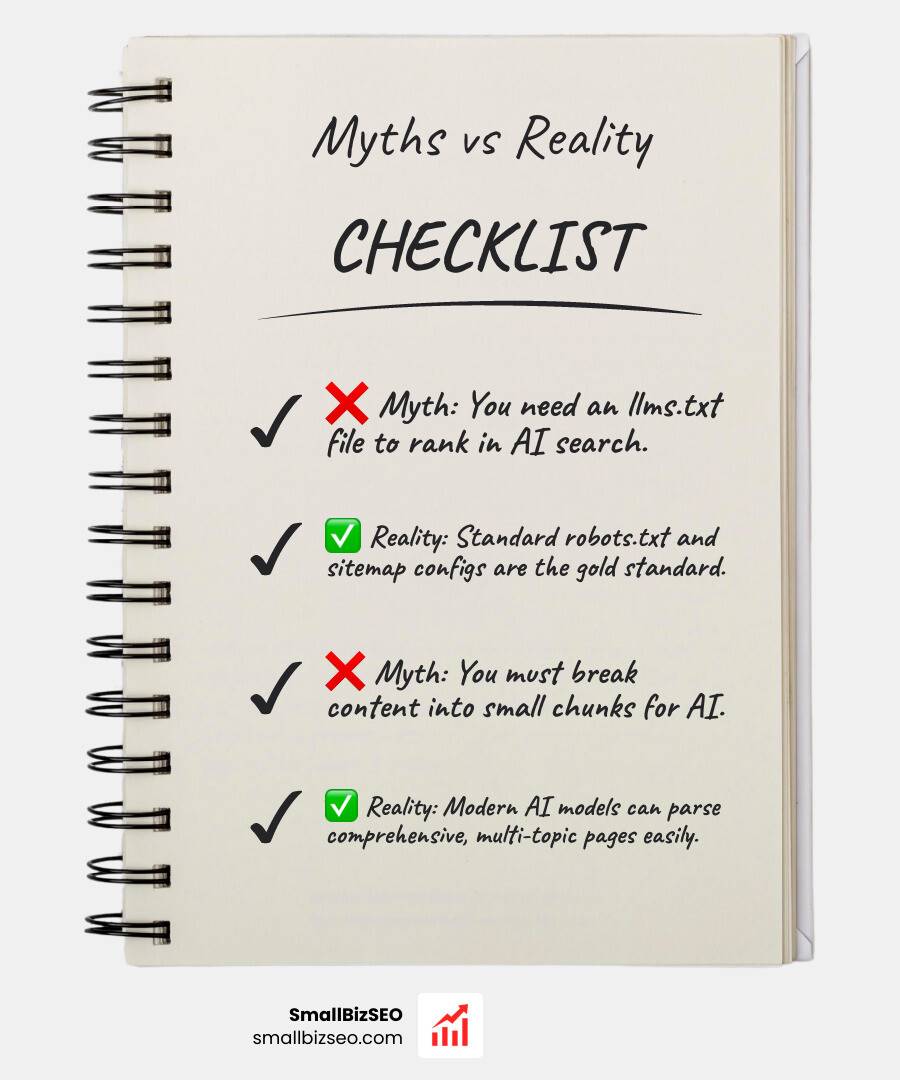
- Myth 1: You need an "llms.txt" file to rank in AI search. Google Search and other major engines do not require or use special AI text files to index your content for generative features. Standard robots.txt and sitemap configurations remain the gold standard.
- Myth 2: You must break your content into small "chunks" for AI. There is no need to manually slice your content into tiny pieces. Modern AI models are incredibly sophisticated; they can easily parse a comprehensive, multi-topic page and extract the exact sections they need.
- Myth 3: Buying fake brand mentions will trick the AI. Some suggest spamming forums and low-quality blogs with brand mentions to feed LLM training data. In reality, core ranking and spam systems are highly effective at filtering out inauthentic mentions.
To learn more about what actually moves the needle, explore our insights on going Beyond Content Optimization.
Frequently Asked Questions About Generative AI Search
How do AI engines decide which brands to cite?
AI platforms prioritize trust, accuracy, and external validation. When synthesizing an answer, they look for consistent information across multiple authoritative sources. They prefer sites with strong E-E-A-T signals, clear structured data, and active third-party mentions on reputable platforms like Wikipedia, industry-specific directories, and high-quality news sites.
How can businesses measure their visibility in AI search results?
While traditional keyword tracking is evolving, you can monitor your performance using a mix of first-party and third-party tools. Google Search Console provides valuable data on how your site performs in generative search features. Additionally, you can track referral traffic from AI platforms (like ChatGPT and Perplexity) in your analytics dashboard and monitor how often your brand is cited for core industry queries. If you are not sure where you stand, a professional SEO Visibility Audit is a great place to start.
What are the typical pricing ranges and timelines for GEO?
Because GEO requires a combination of technical optimization, high-quality content creation, and digital PR, campaigns are typically structured as ongoing monthly retainers.
- Standard GEO Programs: Often range from $3,500 to $7,500 per month, focusing on technical foundations, schema, and core citable content.
- Integrated SEO + GEO + PR: Typically ranges from $7,500 to $15,000+ per month for highly competitive industries requiring aggressive digital PR and brand citation building.
Most businesses begin to see measurable progress in AI citations and search visibility within 90 days, with results compounding over time. You can view our full range of professional packages on our SEO Services page.
Future-Proof Your Brand with SmallBizSEO
The search landscape is changing fast, but the goal remains the same: getting your business in front of the people who need your products or services. As we move deeper into the era of AI search, success will belong to the brands that are clear, credible, and consistently cited.
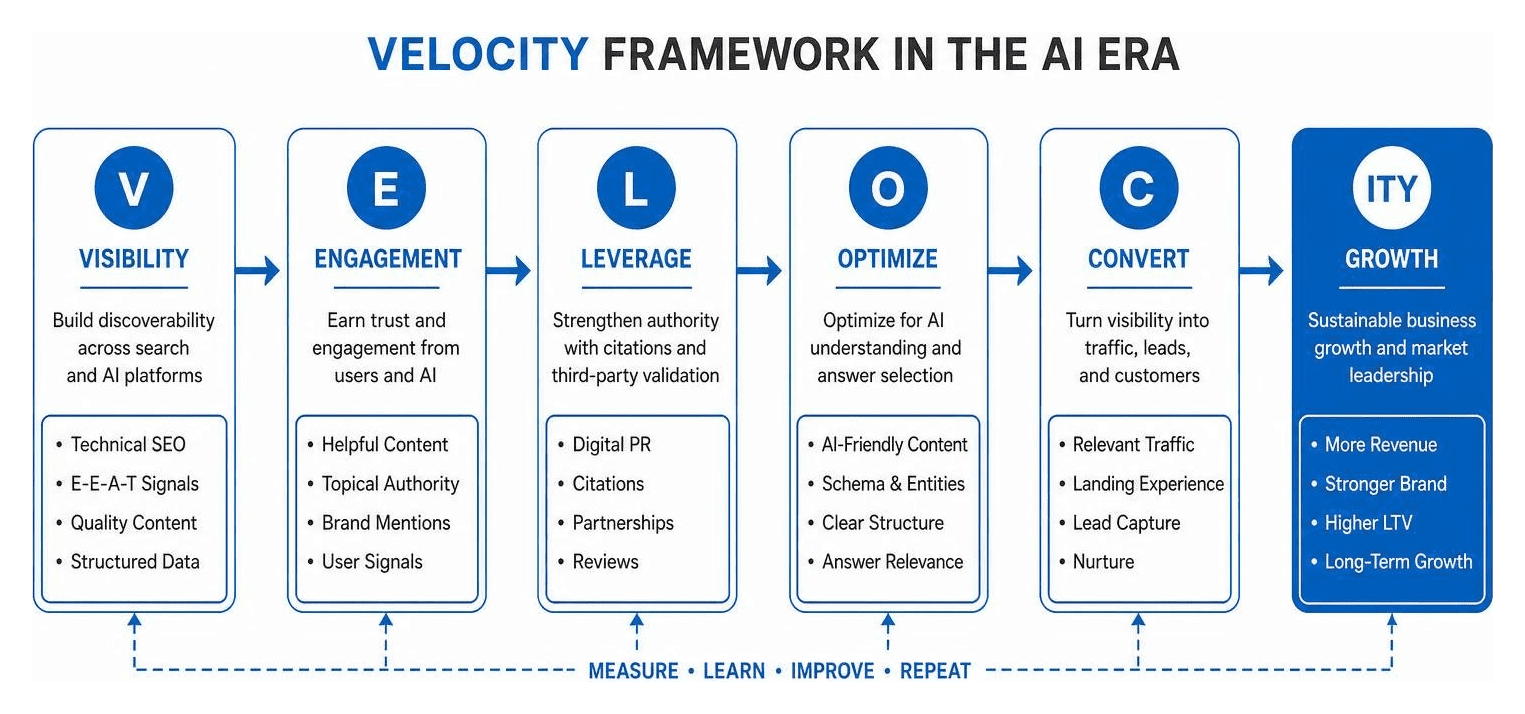
At SmallBizSEO, we help small businesses navigate this transition without the headache. Using our data-driven "Velocity" framework, we deliver fast, E-E-A-T-compliant growth through transparent, automated reporting. We ensure your website is fully optimized not just for human visitors, but also for emerging AI agent experiences and browser-based agents that crawl the web to perform tasks on behalf of users.
Ready to secure your brand's place in the future of search? Explore our specialized AI SEO Services today, and let's make sure your business is the answer the AI recommends.