Boost Your Coding Bootcamp Traffic and Enrollments with Proven SEO Strategies

How Can SEO Help Coding Bootcamps Attract More Students?
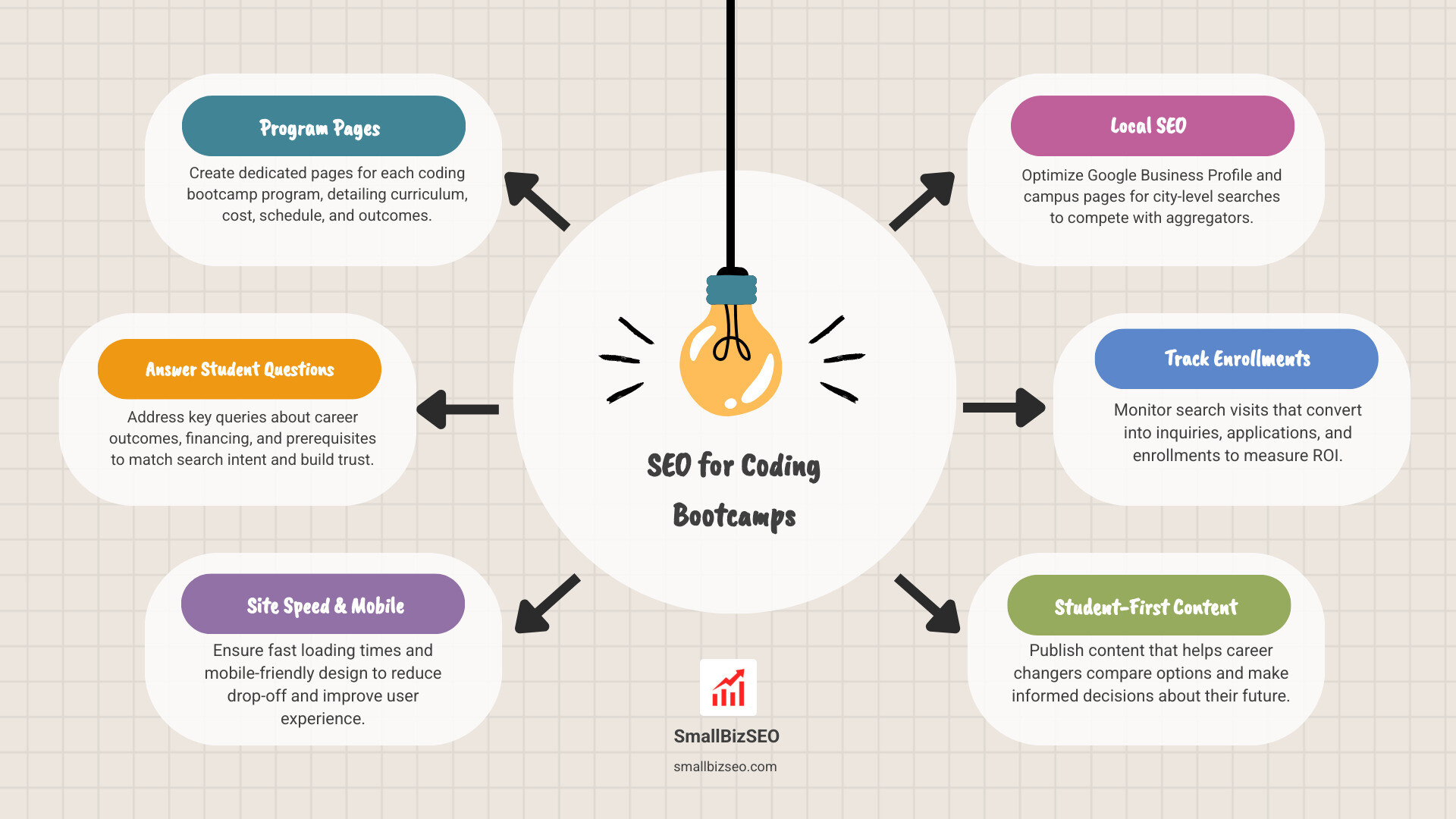
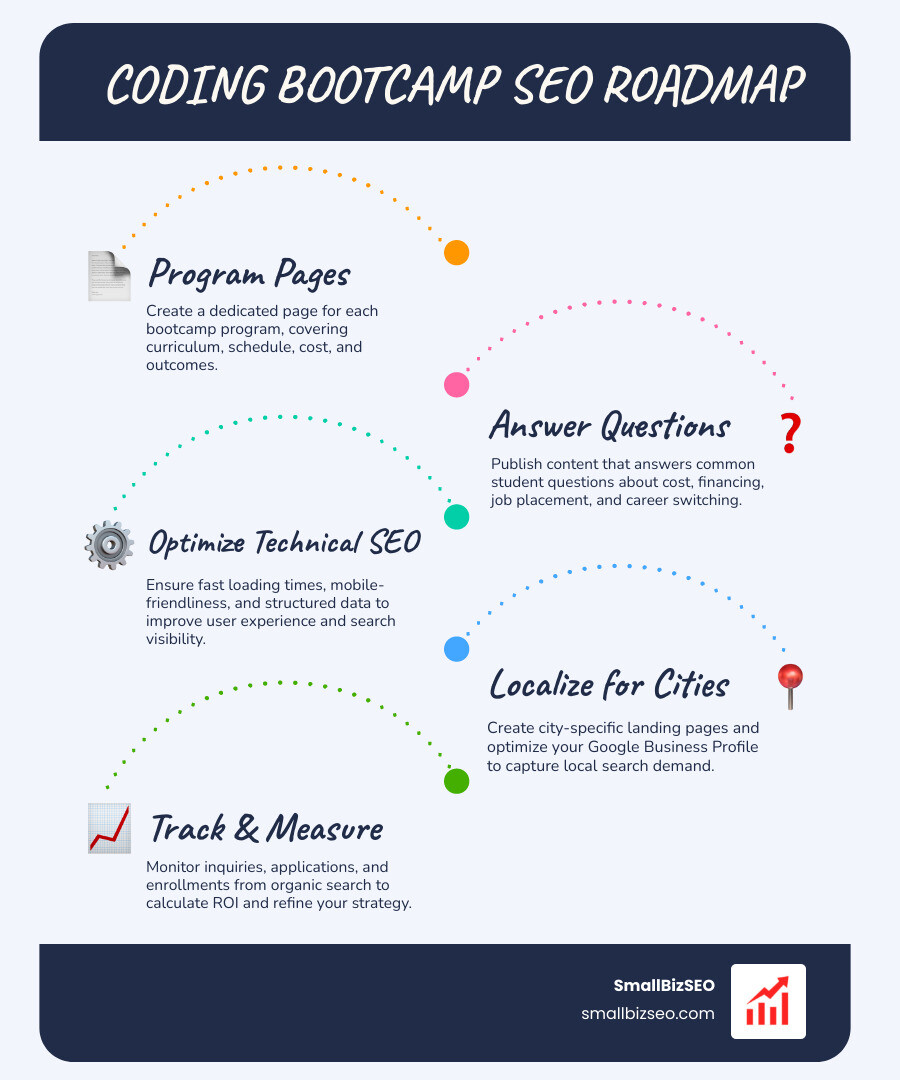
SEO for coding bootcamps starts with the pages students need to make a decision. Create a page for each program, answer questions about cost, schedule, curriculum, and outcomes, and make the site fast and easy to use on a phone. If you teach in person, add useful campus pages and keep your Google Business Profile up to date. Then track which search visits become inquiries, applications, and enrollments.
This approach helps you reach career changers and other prospective students while they compare their options, not just after they know your name.
I'm Clayton Johnson, founder of SmallBizSEO. My work in technical SEO, content strategy, and digital PR shapes this practical approach to SEO for coding bootcamps.
SEO for coding bootcamps vocabulary:
With software developer roles projected to grow 22% over the decade, learner demand remains strong. However, high student acquisition costs make paid advertising difficult to sustain without organic search visibility. Prospective learners spend weeks evaluating program curriculums, graduate outcomes, and flexible schedule formats before applying. A structured search strategy connects your courses with career changers and upskilling professionals right at their moment of peak intent.
Core Pillars of SEO for Coding Bootcamps That Drive Qualified Applicants
A successful organic acquisition model requires building deep topical authority, fixing technical friction, creating localized relevance, and earning high-quality industry backlinks.
Most coding academies struggle online because large third-party aggregators index thousands of pages across every major market. To build a reliable student recruitment pipeline, bootcamps must construct a comprehensive digital footprint that directly addresses student questions and curriculum details better than generic directory listings. Establishing fundamental crawlability and site structure aligns with the best practices outlined in the Google SEO Starter Guide.

What Keyword Strategy Works Best in SEO for Coding Bootcamps?
The best keyword strategy groups terms by search intent, targeting high-intent commercial and curriculum queries alongside broader informational questions.
Rather than chasing broad national keywords with massive competition, programs see the highest conversion rates by targeting decision-stage phrases. Commercial queries such as "part-time Python bootcamp" or "full-stack web development course with job placement" capture applicants who are actively ready to apply. Incorporating customized search strategies for computer technology schools helps identify gaps where competitors fail to address specific student concerns regarding scheduling, prerequisites, and payment options.
| Keyword Type | Search Intent | Example Query | Primary Conversion Goal |
|---|---|---|---|
| Informational | Researching careers and prerequisites | "How long does it take to learn JavaScript?" | Syllabus download or newsletter signup |
| Commercial | Evaluating and comparing specific schools | "Best full-stack coding bootcamp for beginners" | Program guide request or info session RSVP |
| Transactional | Ready to apply or enroll | "Part-time Python bootcamp tuition and financing" | Completed admissions application |
| Navigational / Local | Searching for specific locations | "Coding bootcamp campus open house" | Campus tour booking or direct inquiry |
How Should Bootcamps Build Topic Clusters and Program Pillar Pages?
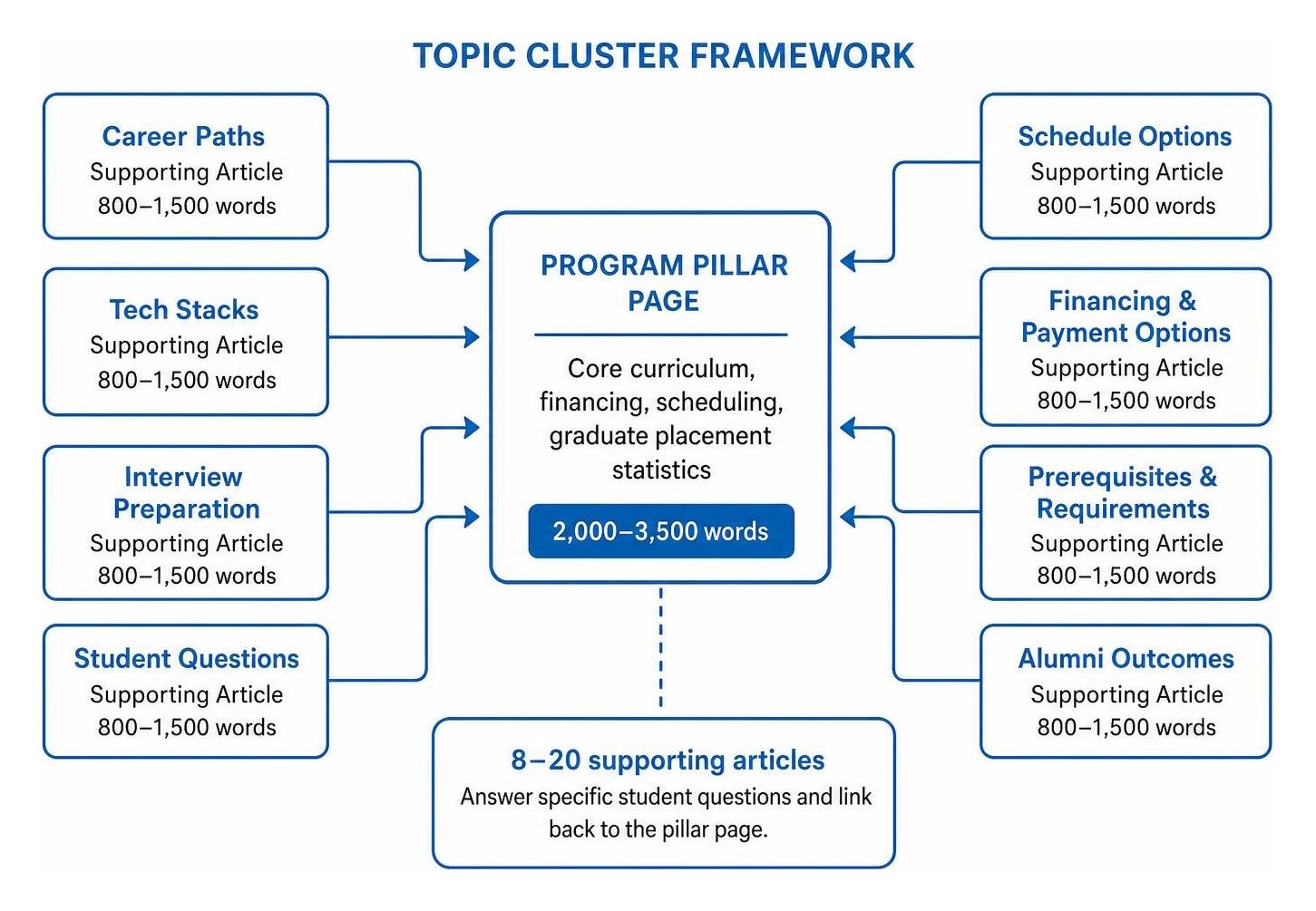
Bootcamps build authority by establishing comprehensive program pillar pages supported by tightly focused cluster pages that answer specific student questions.
A primary pillar page should span 2,000 to 3,500 words, detailing the core curriculum, financing options, scheduling flexibility, and verified graduate placement statistics. Around each pillar, publish 8 to 20 cluster articles between 800 and 1,500 words covering career paths, tech stacks, and interview preparation. As shown in marketing coding bootcamps research, prospective students demand outcome transparency and verifiable proof points before committing. Implementing tailored search engine optimization for online education ensures internal links pass equity from supporting articles directly back to your main application pages while incorporating real alumni feedback.
What Technical SEO and Page Speed Fixes Prevent Student Drop-Off?
Technical SEO for bootcamps requires optimizing mobile Core Web Vitals, ensuring Largest Contentful Paint (LCP) occurs under 2.5 seconds, and deploying educational structured data.

Page performance directly influences enrollment numbers. Research shows that conversion rates drop by 4.42% for every additional second of load time, and a single-second delay on mobile devices can reduce conversions by 20%. Mobile-friendly rendering, responsive forms, and lightweight templates prevent prospective students from abandoning your admissions page.
Furthermore, structured data markup helps search engines interpret course offerings accurately. Bootcamps should implement:
- Schema.org/Course: Outlines specific course names, descriptions, prerequisites, and credentials.
- Schema.org/EducationalOrganization: Establishes institution accreditation, parent organization details, and physical contact information.
- Schema.org/FAQPage: Generates rich search snippets by highlighting common tuition and admissions questions directly on search engine results pages.
Enlisting professional technical SEO services ensures these code-level enhancements are implemented correctly without conflicting with existing site frameworks.
How Does Local SEO Capture City-Level Enrollment Against Aggregators?
Local SEO captures nearby student interest through optimized Google Business Profiles, localized program landing pages, and consistent business citations.
While aggregators dominate broad national phrases, they struggle to replicate authentic local engagement. Bootcamps with physical classrooms or regional cohorts can earn prominent visibility in the Google 3-Pack by optimizing their primary business profile, publishing regular open-house updates, and maintaining exact Name, Address, and Phone (NAP) consistency across directories.
Creating a matrix of dedicated city and regional landing pages allows you to highlight local hiring partners, alumni meetups, and regional tech market salaries. Collecting verified Google reviews from recent graduates that mention specific technologies further boosts local ranking signals. Utilizing proven local SEO strategies bridges the gap between digital searches and classroom enrollments.
How to Execute and Measure Your Coding Bootcamp SEO Strategy
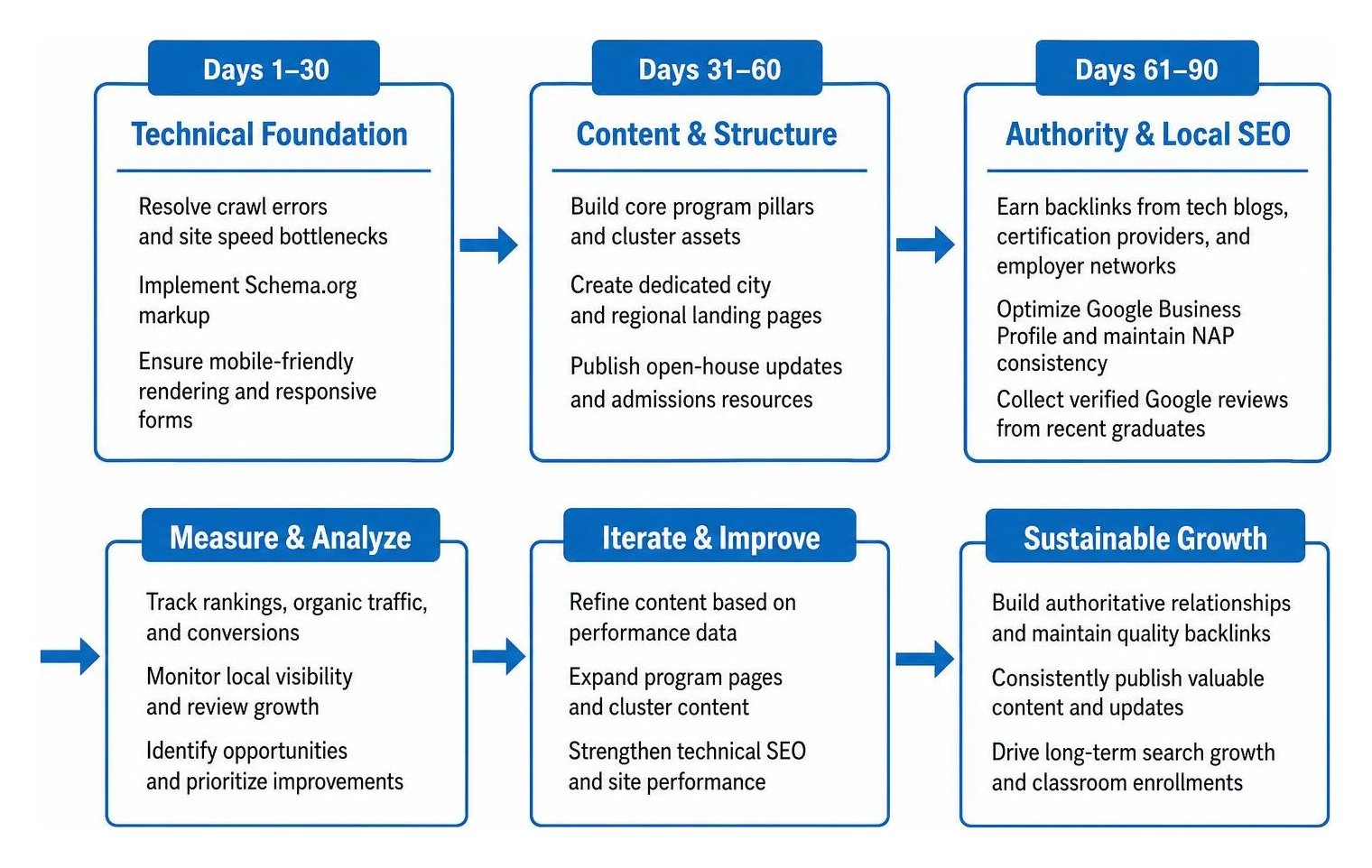
Executing a sustainable search growth campaign requires a structured roadmap that balances technical remediation, content creation, and quality link acquisition.
A standard rollout focuses on resolving crawl errors and site speed bottlenecks first, followed by building out core program pillars and cluster assets. Building authoritative relationships with technology blogs, certification providers, and regional employer networks earns valuable backlinks that increase overall domain trust.

Does SEO Require Coding, and Can Bootcamp Graduates Transition to SEO?
SEO does not require advanced programming knowledge, but basic familiarity with HTML, CSS, and JavaScript provides a strong advantage for technical roles.
A survey of 2,210 search professionals revealed that 91% believe you need either no coding background or only basic fundamentals to succeed in SEO. However, coding bootcamp graduates possess unique problem-solving capabilities, understanding site architecture and script rendering in ways that traditional marketers often miss. They can bridge communication gaps with software development teams, audit server responses, and automate data collection.
With average salaries for search professionals ranging from $50,000 to $80,000 annually and advanced marketing leadership positions reaching $130,000, technical search management offers a compelling career avenue. Individuals looking to enter the industry can reference a comprehensive guide to learning SEO to explore structured educational paths.
How Do You Measure ROI and Campaign Milestones in SEO for Coding Bootcamps?
Coding bootcamps measure search ROI by tracking qualified lead volume, application completion rates, and tuition revenue attributed across multi-touch student journeys.
Because career training involves a thoughtful consideration period, measurable ranking and traffic shifts typically develop over a 3 to 9 month timeline. Performance dashboards should focus on admissions-oriented KPIs rather than vanity impressions alone.
Key metrics include:
- Cost Per Qualified Lead (CPQL): Organic search should consistently lower your blended student acquisition cost compared to paid advertising channels.
- Program-Level Application Rates: Track form fills, syllabus downloads, and info session bookings by individual course track.
- Cohort Attribution: Connect initial organic search discovery touchpoints to finalized student enrollment and tuition payments.
At SmallBizSEO, our data-driven "Velocity" framework delivers rapid ranking improvements and transparent, automated reporting designed to maximize student enrollment pipelines.
Ready to Turn Organic Search into Your Most Reliable Admissions Channel?
Winning prospective students requires showing up with clear answers, transparent outcomes, and fast-loading pages right when they decide to change their careers. By aligning your program curriculums with search intent, optimizing local profiles, and resolving technical site hurdles, your school can stand out against crowded aggregator directories.
To discover untapped keyword opportunities and identify technical issues holding back your enrollment growth, request a comprehensive SEO visibility audit today.