Demystifying SEO Fundamentals from Keywords to Content Optimization

Demystifying SEO Fundamentals from Keywords to Content Optimization
What Is SEO Content Optimization (And Why It Matters for Your Business)
SEO Content Optimization is the process of improving your web pages so they rank higher in search engines and get found by the right people — without paying for ads.
Here is a quick breakdown of what it actually involves:
- Match search intent — give people exactly what they came to find
- Use the right keywords — primary, secondary, and semantically related terms
- Structure content clearly — logical headings, short paragraphs, scannable formatting
- Demonstrate expertise — show Google and readers that you know your stuff (E-E-A-T)
- Keep content fresh — update pages regularly so algorithms and AI tools keep citing you
- Optimize images and URLs — descriptive file names, alt text, and clean URL slugs
- Build smart links — internal links for navigation, external links for credibility
If you run a small business, you have probably felt this frustration before: you put real effort into writing a page, publish it, and then... nothing. No traffic. No leads. No idea why.
Here is the uncomfortable truth. Great writing alone does not guarantee a ranking. There is a significant gap between publishing content and actually showing up on page one. That gap is exactly what SEO Content Optimization is designed to close.
And it is getting more complex. Search is no longer just Google. AI tools like ChatGPT, Perplexity, and Google's AI Overviews are now answering questions directly — sometimes without sending users to any website at all. Nearly 90% of AI bot activity focuses on content published or updated within the past three years. If your pages are stale or poorly structured, you are invisible to both algorithms and AI assistants.
The good news? You do not need to be a technical expert to get this right. With the right framework, small business owners can compete and win.
I'm Clayton Johnson, a digital marketing and SEO specialist focused on using digital PR and strategic content to drive real search visibility — and SEO Content Optimization is at the core of every campaign I run. In the sections below, I will walk you through exactly what works, from keyword strategy to AI search readiness, in plain language you can act on today.
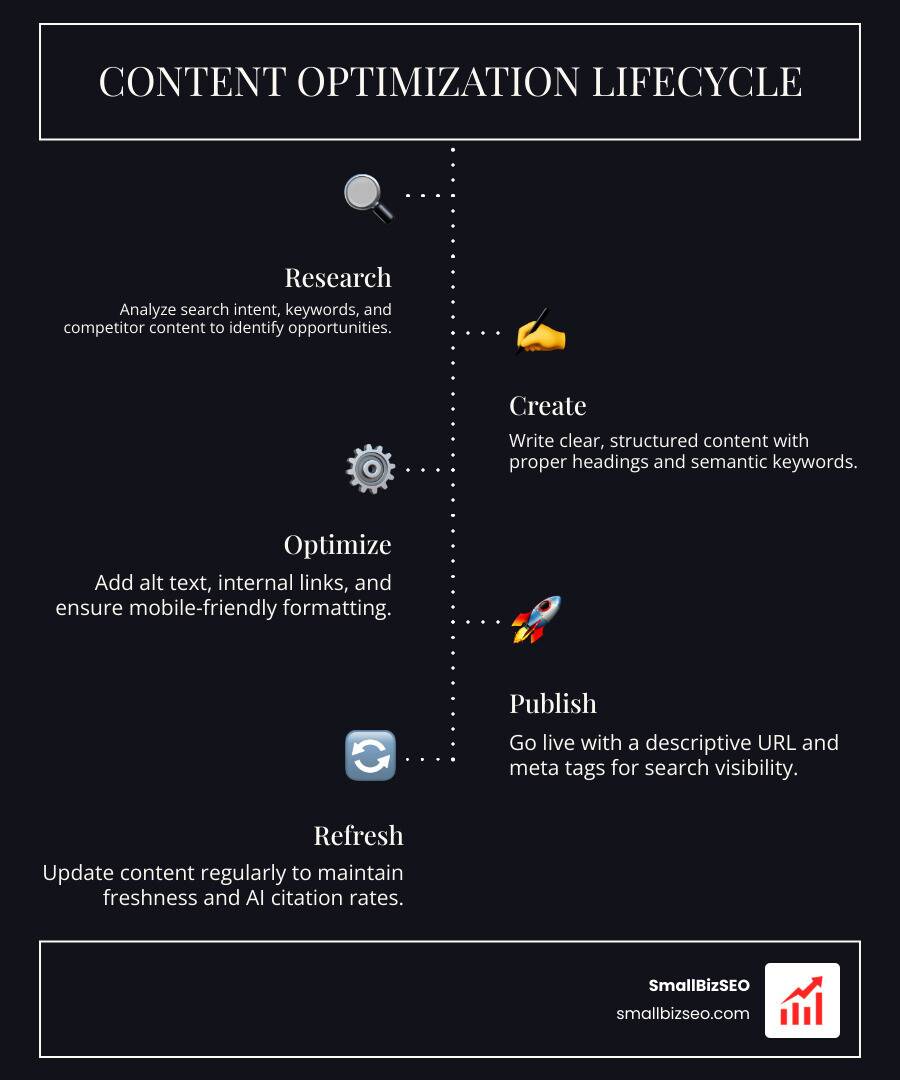
SEO Content Optimization vocabulary:
The Core Pillars of SEO Content Optimization
To build a website that consistently attracts qualified leads, we must understand how search engines and modern AI tools read our pages. This is where On-Page SEO comes into play. It is not about trying to trick an algorithm with hidden tricks; it is about organizing our knowledge so that both human readers and search crawlers can instantly understand the value we provide.
Defining SEO Content Optimization vs General SEO
We often hear business owners use "SEO" and "content optimization" interchangeably, but they are actually different parts of the same puzzle:
- General SEO is a holistic, site-wide strategy. It includes technical SEO (like fixing broken links, improving site speed, and managing XML sitemaps) and off-page SEO (like earning backlinks from other reputable websites).
- SEO Content Optimization is a specialized subset of On-Page SEO. It focuses entirely on the copy, structure, and media on a specific page.
Essentially, while general SEO makes sure search engines can find and crawl our website, content optimization ensures that once they get there, they find the most helpful, well-structured, and relevant information available.
Why SEO Content Optimization is Vital for AI Search
Search has evolved beyond the traditional list of blue links. Today, millions of people use conversational AI engines to find answers. This shift has introduced Generative Engine Optimization (GEO), which is the practice of optimizing our website so AI bots can easily find, summarize, and cite our brand.
AI bots show a strong preference for fresh, highly structured data. In fact, almost 90% of AI bot activity focuses on content published or updated within the past three years. If we let our blog posts sit without updates, we risk losing both our traditional organic rankings and our citations in AI-generated answers. To stay visible, we must continually look Beyond Content Optimization to ensure our digital assets remain active, accurate, and authoritative.
Aligning Content with Search Intent and Keyword Strategy
Before we write a single sentence, we need to know exactly what our audience is looking for and how they talk about it. Achieving true topical authority requires a deliberate Content Planning Process that balances search intent with smart keyword selection.
Matching the Four Types of Search Intent
Search intent is the "why" behind a user's search query. If we do not match the intent of a search, Google will not rank our page, no matter how long or beautifully written it is. We group search intent into four primary categories:
- Informational Intent: The user wants to learn something (e.g., "how to optimize a blog post").
- Commercial Intent: The user is researching options before making a decision (e.g., "best SEO content tools").
- Transactional Intent: The user is ready to buy or sign up (e.g., "hire SEO Content Services").
- Navigational Intent: The user is looking for a specific website or physical page (e.g., "SmallBizSEO login").
By mapping our target keywords to these categories, we can tailor our formatting to give users exactly what they expect. For example, an informational search benefits from a comprehensive guide, while a commercial search requires comparison tables and clear feature lists.
Integrating Primary, Secondary, and Semantic Keywords
Gone are the days of stuffing a single keyword into our text until it sounds robotic. Modern search engines use natural language processing (NLP) to understand the broader context of our writing.
For high-performing SEO-Friendly Content Writing, we use a three-tiered keyword strategy:
- Primary Keyword: The main topic of our page (e.g., "SEO Content Optimization"). This goes in our title, introduction, and at least one heading.
- Secondary Keywords: Supporting terms that expand our reach (e.g., "on-page ranking factors" or "content score").
- Semantic Keywords: Related concepts and entities that naturally occur when discussing the topic (e.g., "search engines," "readability," "metadata").
This approach ensures our writing remains completely natural for human readers while signaling deep topical coverage to search crawlers.
Best Practices for Structuring and Formatting Content
How we present our information is just as important as the information itself. If a page looks like a massive, unbroken wall of text, users will bounce immediately, signaling to Google that our page is not helpful. This is one of the key reasons Why Does Google Rank Thin Content less and less over time — structure and engagement metrics matter.
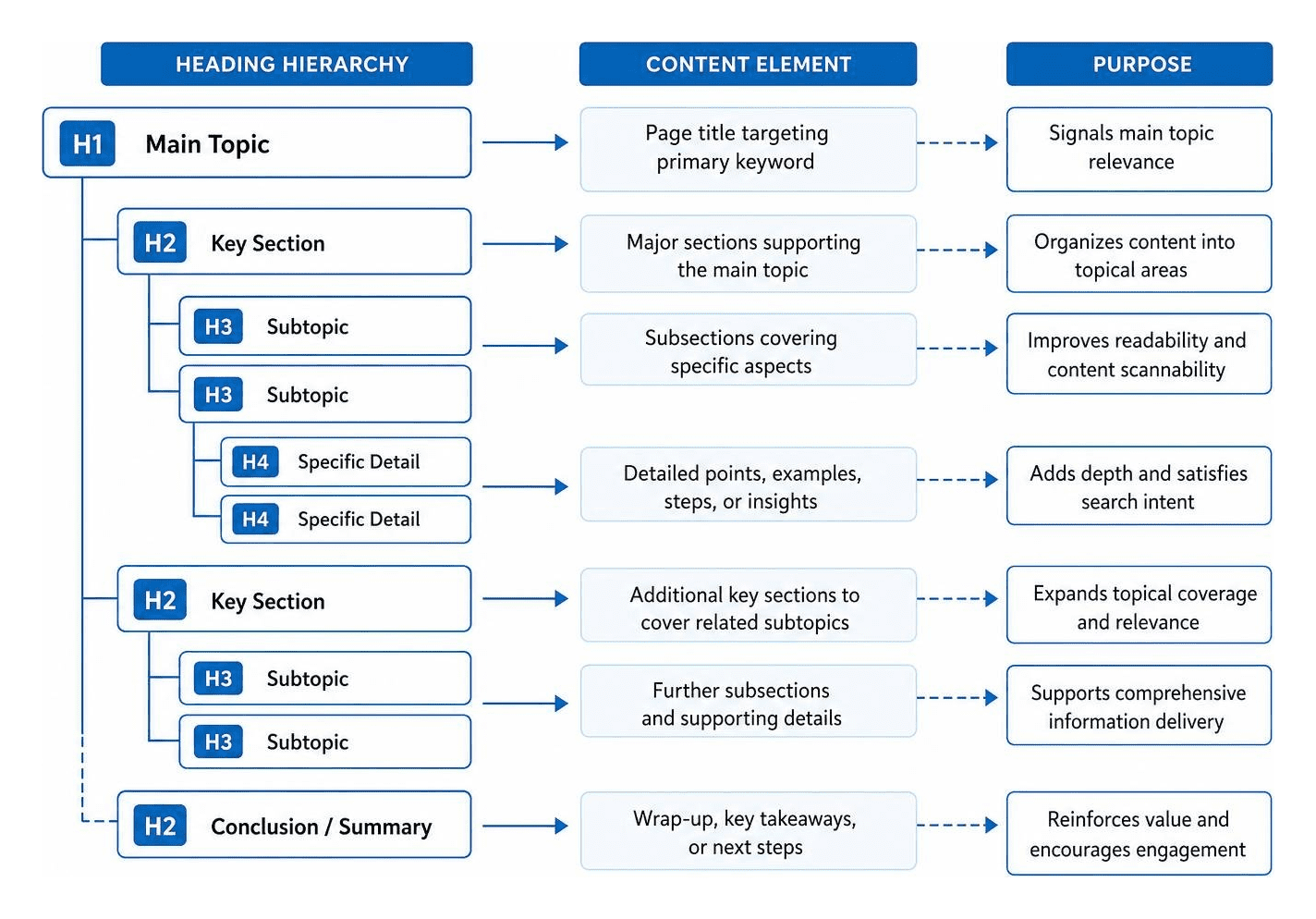
Structuring for Readability and User Experience
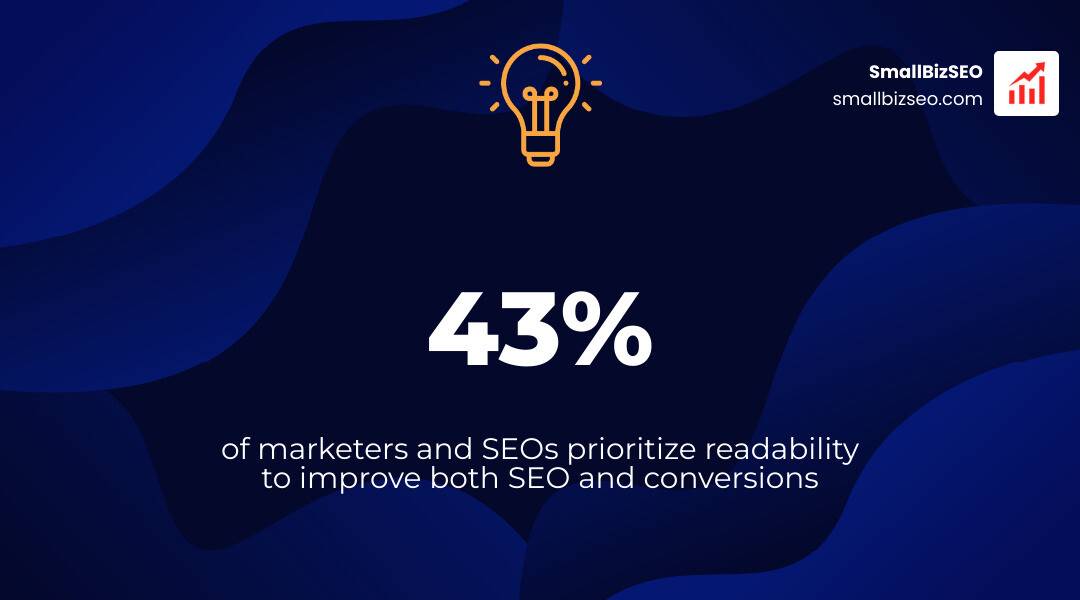
A clean layout keeps readers on our page longer, which directly boosts our search visibility. Studies show that 43% of marketers and SEOs prioritize readability to improve both SEO and conversions.
To make our content easy to digest, we follow these formatting rules:
- Use a logical heading hierarchy: Stick to one H1 for the page title, followed by H2s for main sections and H3s for sub-points.
- Write in the active voice: It keeps our sentences punchy, direct, and engaging.
- Keep paragraphs short: Limit paragraphs to two or three sentences to create plenty of white space.
- Incorporate bullet points: Lists help break down complex steps or features into scannable takeaways.
Optimizing Visual Media and Descriptive URLs
Search engines cannot "see" images or videos the way humans do, so we must help them understand our media assets:
- Image Alt Text: Write descriptive, keyword-rich alt text for every image. This helps visually impaired users and allows our images to rank in image search.
- File Compression: Large files slow down our page speed. We compress every image using next-gen formats like WebP to keep our load times fast.
- Descriptive URLs: Keep our URL paths short, clean, and descriptive (e.g.,
/seo-content-servicesinstead of/post-id-98745).
Mastering E-E-A-T and Strategic Link Building
To turn our website traffic into actual business growth, we must prove to search engines that our business is a trusted authority in our space. We do this by focusing on E-E-A-T (Experience, Expertise, Authoritativeness, and Trustworthiness).
Building Trust with E-E-A-T Signals
Google uses E-E-A-T as a conceptual framework to evaluate the quality and credibility of our content. To align our pages with these guidelines, we must actively Optimize E-E-A-T Signals Today.
We can build this trust on every page by:
- Including clear author bios that highlight years of industry experience.
- Citing original research, proprietary data, or hands-on customer case studies.
- Linking out to highly credible, verified external sources to back up our factual claims.
For a deeper dive into these trust signals, read our guide on How to Optimize Your Content for E-E-A-T and Build Real Search Trust.
Connecting the Dots with Internal and External Links
Links are the pathways that search crawlers and users use to navigate the web. A strong, strategic linking strategy can turn a single visit into a deep, multi-page journey:
- Internal Linking: We link our new articles to existing pillar pages using descriptive, natural anchor text. This passes authority throughout our site and helps search engines crawl our pages more efficiently.
- External Linking: Linking to trusted external resources proves we have done our homework. For example, referencing Google's Search Essentials or citing industry-standard research from authoritative marketing platforms helps establish our content's credibility and provides readers with additional context.
By combining internal and external links, we turn our raw Data Into Traffic by guiding visitors logically from basic education to transactional decision-making.
Optimizing for AI Prompts and Generative Answers
As conversational search continues to grow, we must format our content to be easily read by AI models. AI search engines like ChatGPT and Perplexity rely on clear, direct formatting to extract answers for their users.
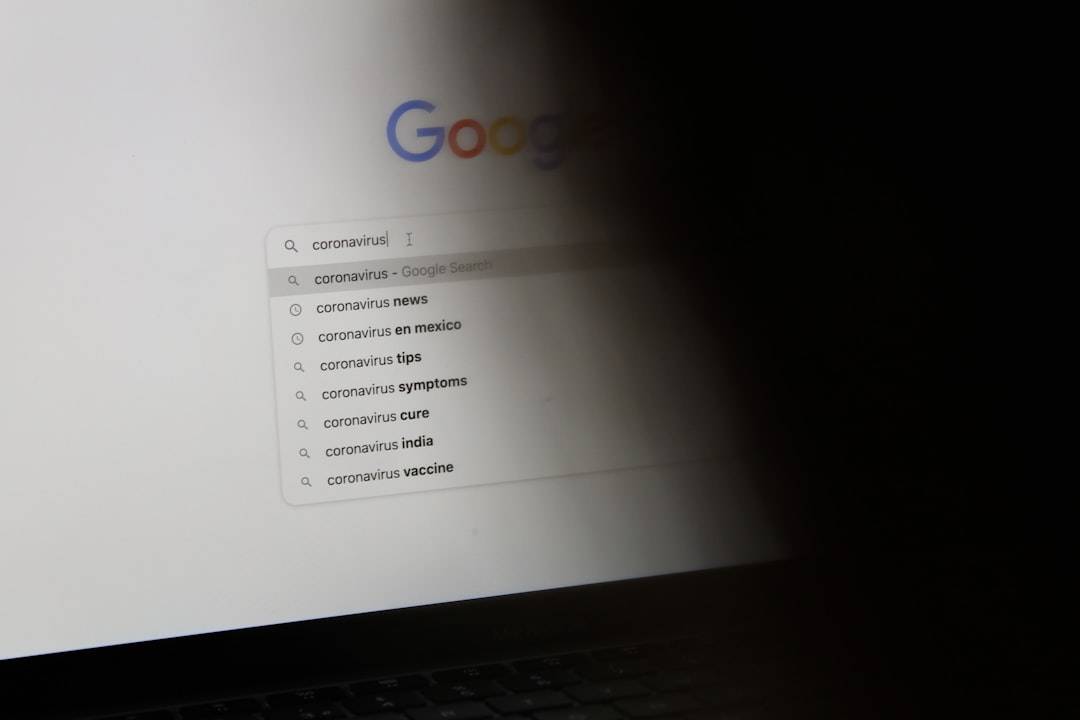
To optimize our pages for generative answers, we use the "Bottom Line Up Front" (BLUF) method. Lead each informational section with a direct, 40-to-60-word answer to the primary question. Follow this concise summary with deeper, supporting details, structured bullet points, or data tables. This clean layout makes it incredibly simple for AI models to pull our text as a direct citation.
Selecting the Right Content Optimization Tools
We do not have to guess what keywords to add or how long our articles should be. Modern content optimization tools analyze the top-performing pages for our target keywords and give us a clear blueprint for success.
When selecting a tool, it helps to compare the top options based on your specific business goals and budget:
| Tool | Best For | Key Feature |
|---|---|---|
| SEO Content Editor | Quick, free on-page checks | Real-time SEO and readability scoring |
| MarketMuse | Deep topical modeling and audits | AI-driven content gap analysis |
| Clearscope | Professional content brief creation | Highly accurate semantic keyword suggestions |
| LowFruits | Finding low-competition keywords | Spotting weak spots in competitive SERPs |
Using these tools as part of our regular SEO Content Marketing workflow allows us to write with confidence, knowing our pages are mathematically optimized to compete for top spots.
Frequently Asked Questions About Content Optimization
How often should I re-optimize my website content?
We recommend auditing your high-performing pages every six months. Search intent can shift, competitors can publish newer data, and search algorithms change over time. Regular updates keep your content fresh and protect your hard-earned rankings from content decay.
Does optimizing content for AI search hurt traditional Google rankings?
Not at all. In fact, they work hand-in-hand. Both traditional search engines and AI models reward high-quality, well-structured, and authoritative writing. Leading your sections with clear, direct answers helps you win both Google featured snippets and AI citations simultaneously.
What is the ideal reading level for SEO content?
For most general audiences, we aim for a seventh-to-ninth-grade reading level. Keeping our language simple, clear, and free of unnecessary jargon ensures that both human readers and search algorithms can easily understand our message.
Accelerate Your Search Visibility with SmallBizSEO
At SmallBizSEO, we believe that high-quality optimization should be straightforward, highly effective, and accessible for every growing business. We specialize in helping small businesses build sustainable search engine rankings through technical SEO, strategic content planning, and authority-building link campaigns.
Our unique, data-driven "Velocity" framework is designed to deliver fast, E-E-A-T-compliant rankings backed by fully transparent, automated reporting. We take the guesswork out of search engine optimization so you can focus on running your business.
Ready to turn your website into a reliable lead-generation engine? Explore our tailored SEO Content Services today, and let us help you build a digital presence that stands out to both human customers and modern search engines.