How to Boost Your Search Engine Visibility Score Without Selling Your Soul
How to Boost Your Search Engine Visibility Score Without Selling Your Soul
Why Your Visibility Score SEO Strategy Is More Important Than Your Rankings
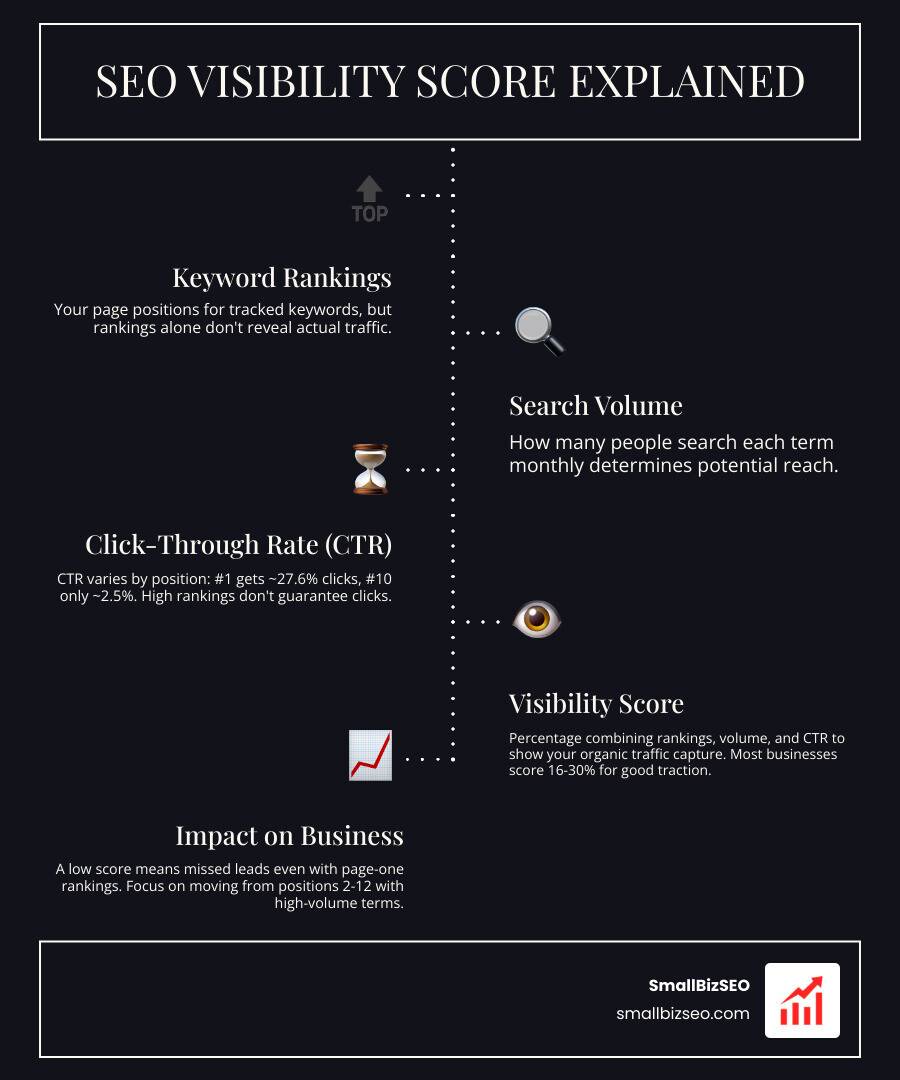
A visibility score in SEO is a percentage that shows how much of the available organic search traffic your site captures across a tracked set of keywords. It combines three inputs:
| Input | What It Means |
|---|---|
| Keyword rankings | Which positions your pages hold |
| Search volume | How many people search each term monthly |
| Click-through rate (CTR) | How often users click at each position |
Here is a quick snapshot of what the score ranges mean:
- 1–5% — Low: barely any page-one presence
- 6–15% — Moderate: some rankings, but not enough high positions
- 16–30% — Good: clear competitive traction
- 31–50% — Very good: strong market presence
- 51%+ — Excellent: dominant share of tracked search demand
Most businesses, even large ones in competitive industries, rarely exceed 30–40%.
Here is the problem most small business owners run into. Your ranking report looks fine. A handful of keywords sit on page one. But traffic is soft, leads are inconsistent, and nothing seems to add up.
Raw rankings don't tell the full story. A site can rank #1 for a term and still capture almost no clicks — because the keyword has low search volume, or because SERP features push organic results further down the page. Conversely, a site with a modest average ranking can drive significant traffic simply by ranking for many terms with meaningful search volume.
That gap between where you rank and how much visibility you actually have is exactly what the SEO visibility score is designed to expose.
I'm Clayton Johnson, a digital PR and SEO specialist who has spent years helping businesses use visibility score SEO data to build campaigns that drive real search presence — not just prettier ranking reports. In the sections ahead, we'll walk through exactly how visibility scores work, what a good one looks like for your industry, and the most effective ways to move the number in the right direction.
Demystifying the Visibility Score SEO Metric: Why Rankings Lie
If we only track raw rankings, we miss how search engines actually distribute user attention. Rankings are highly non-linear. Moving from position 100 to position 60 on Google might feel like progress on a spreadsheet, but it does not improve your real-world search presence because virtually no one scrolls that far.
Real visibility is heavily concentrated at the very top of the search engine results page (SERP). The first organic result on Google captured a massive share of clicks, while the third result garners approximately 18.6% of all clicks, and the tenth result drops sharply to receive only about 2.5%.
Because of this steep drop-off, your visibility score SEO metric weights your rankings based on search volume and position-based CTR. If you rank in position 3 for a keyword with 10,000 monthly searches, your visibility score reflects a much larger share of market attention than if you rank in position 1 for a keyword with only 10 monthly searches.
To get a true picture of your organic footprint, we must look beyond isolated keyword lists. For a deep dive into your current search landscape, we recommend conducting a Detailed SEO Analysis or consulting the AWR SEO Visibility Guide to understand how search engines index and display your brand.
Visibility Score SEO vs. General SEO Health Scores
It is common to confuse a visibility score SEO metric with a general SEO health score. However, they measure two entirely different things:
- General SEO Health Scores: These are technical audits that grade page speed, broken links, crawl errors, and mobile usability. While critical for performance, a perfect technical score does not guarantee anyone is actually finding your website.
- SEO Visibility Scores: These measure your actual share of voice in the search results. They calculate how prominent your pages are for the specific keyword sets that drive your business.
If your technical health is excellent but your organic traffic is flatlining, our guide on Why Your Rankings Are Still Stuck can help you identify the disconnect between technical optimization and market visibility.
How Major SEO Tools Calculate Your Score
Different SEO tools use proprietary formulas to calculate visibility, which is why your score will vary across platforms.
- Semrush: Focuses on position tracking and weights your rankings against estimated CTR curves. If you rank in top spots for high-volume keywords, your score climbs quickly.
- Ahrefs: Uses a "Share of Voice" metric that estimates the percentage of all organic clicks your tracked keywords receive.
- Moz: Calculates search visibility by taking the estimated CTR of your ranking positions across your target keyword set. You can learn more about this in the Moz Search Visibility Guide.
- SISTRIX: Uses a standardized "Visibility Index" based on a massive, permanent keyword set to measure a site's overall search footprint across desktop and mobile.
Because each tool uses its own CTR assumptions and keyword databases, we advise choosing one platform as your consistent baseline rather than trying to reconcile different scores.
What is Considered a Good Visibility Score?
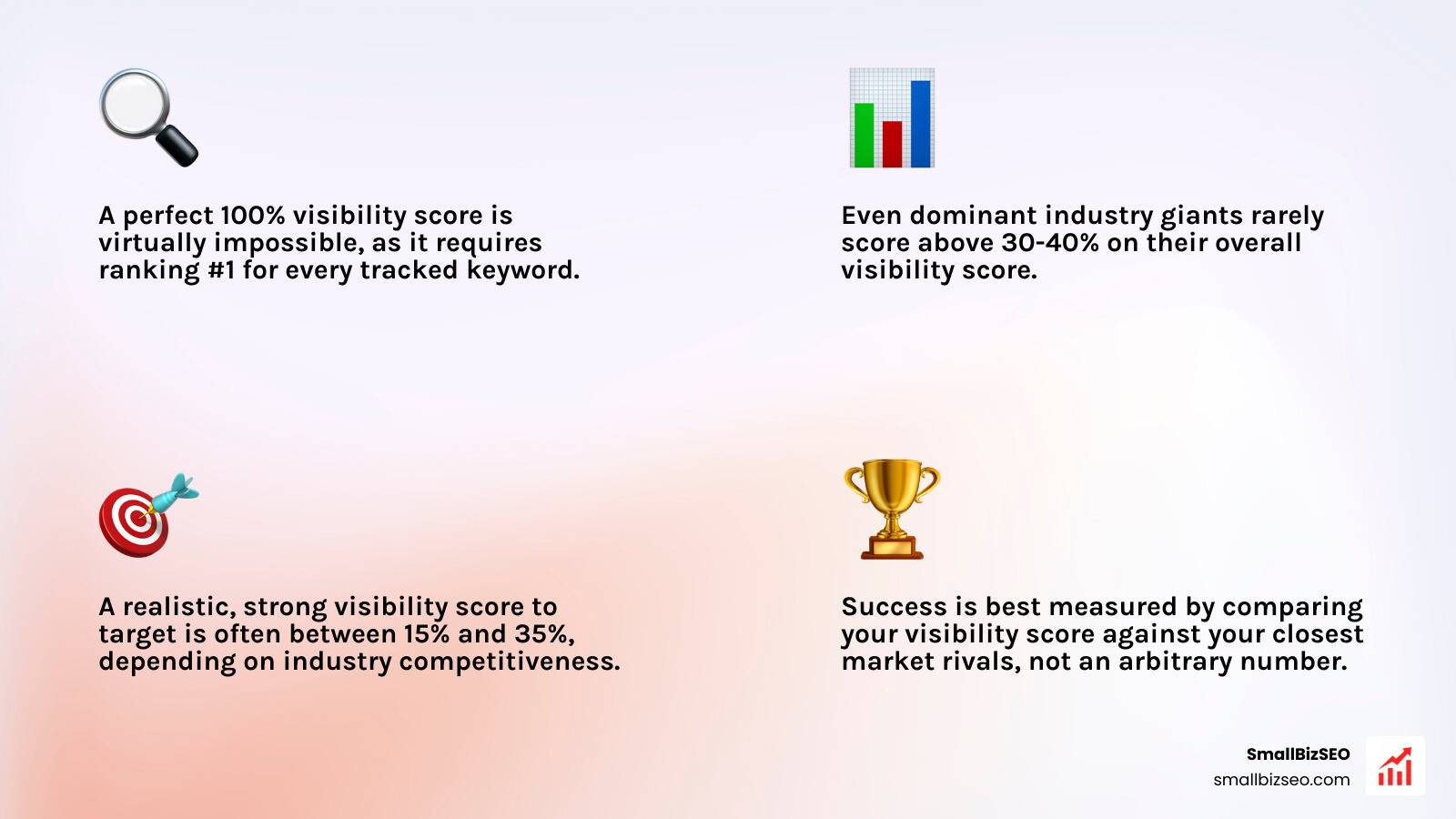
A "perfect" 100% search visibility score is virtually impossible. To achieve it, your website would need to rank in the #1 position for every single tracked keyword in your campaign—including highly competitive, non-branded terms.
Even dominant industry giants rarely score above 30–40% on their overall visibility score. A realistic, strong score to target is often between 15% and 35%, depending entirely on your industry, the competitiveness of your keywords, and your direct competitors.
Instead of chasing an arbitrary number, we should measure success by comparing our score against our closest market rivals. For a more detailed breakdown of these ranges, read our analysis on What Is a Good SEO Visibility Score?.
Benchmarking Your Visibility Score SEO Performance by Industry
A good score in one niche might be considered poor in another. Highly competitive markets like SaaS or e-commerce naturally have lower median visibility scores because thousands of brands are fighting for the same search terms.
| Industry | Median Visibility Score | What is Considered "Good" | What is "Dominant" |
|---|---|---|---|
| Local Services | 8–12% | 20% | 40%+ |
| E-commerce | 5–8% | 15% | 30%+ |
| SaaS / B2B | 3–6% | 12% | 25%+ |
| Publishing / Media | 15–25% | 35% | 55%+ |
| YMYL (Your Money Your Life) | 2–5% | 10% | 20%+ |
Actionable Strategies to Improve Your Search Visibility
Improving your search visibility requires a strategic focus on where you can win the fastest. Rather than trying to rank for highly competitive, broad keywords overnight, we use targeted tactics to claim more search engine real estate. For a complete blueprint, check out our comprehensive SEO Services Guide.
Targeting the Low-Hanging Fruit (Positions 2 to 12)
The fastest way to boost your visibility score SEO metric is to optimize pages that already rank on the first or second page of Google but haven't reached the top spots.
Moving a page from position 11 to position 5, or from position 5 to position 2, yields an exponential increase in click-through rates and search visibility. We can achieve this by refreshing the content, aligning it more closely with search intent, and improving internal linking from higher-authority pages on our site. To learn more about this approach, explore our guide on going Beyond Content Optimization.
Optimizing for Rich Snippets and SERP Features
Search results are no longer just "ten blue links." Google now displays a variety of visual features that capture user attention:
- People Also Ask (PAA): This feature appears on 34.53% of search result pages.
- Image Packs: These visual assets show up on 65.53% of search results.
- AI Overviews: These AI-generated summaries appear on approximately 14.49% of query pages.
By structuring your content with clear headings, bulleted lists, schema markup, and concise direct answers (ideally 40–60 words), you can win these featured spots and stand out. Learn how to align your site with these technical requirements in our guide on How to Pass Google's Own SEO Analysis Audits.
Traditional SEO Visibility vs. AI Visibility
The search landscape is undergoing a massive shift. While traditional search visibility measures your presence in standard organic results, AI visibility tracks how often and how favorably your brand is cited in AI-generated answers like Google's AI Overviews, ChatGPT, Perplexity, and Gemini.
This distinction is critical. When AI engines answer a user's question directly, traditional click-through rates for the top organic spots can drop significantly. If your brand isn't cited as a source within that AI answer, you become invisible to a rapidly growing audience. You can measure your current standing with the AI Visibility Score Calculator and learn how to audit your site for this new era with our Guide to AI SEO Audit.
The Four Pillars of AI Search Visibility
To build a strong presence in AI search results, we focus on four core areas:
- Brand Inclusion: Ensuring your brand name or product is actively mentioned in AI-generated responses for relevant commercial queries.
- Citation Frequency: How often AI engines link directly to your website as a trusted source for their answers.
- Entity Clarity: Using structured data and consistent language so LLMs can easily identify your brand, authors, and core topics.
- Off-Site Visibility: AI engines pull information from across the web. Having a strong presence on third-party review sites, forums, and digital PR publications is essential.
Building Brand Awareness for AI-Mediated Discovery
AI models are trained on massive datasets of public information. To make sure they recommend your business, you must build brand authority off-site.
This means earning mentions in industry discussions, getting featured on reputable review platforms, and securing digital PR coverage. When AI models see your brand consistently associated with a specific topic across multiple authoritative websites, they are much more likely to cite you as a trusted solution. For strategies on turning these brand signals into organic traffic, read our guide on turning Data Into Traffic.
Frequently Asked Questions About Search Visibility
Can I improve my visibility score without building backlinks?
Yes. While high-quality backlinks are incredibly powerful, you can make significant visibility gains by resolving technical SEO issues, fixing keyword cannibalization (merging thin, competing pages), and optimizing your existing content to target featured snippets and long-tail keywords.
Why does my visibility score fluctuate while traffic remains stable?
Your visibility score is based on a specific set of tracked keywords. If you lose rankings for high-volume keywords that don't actually drive qualified leads or clicks to your site, your visibility score might drop while your actual business traffic and conversions remain completely stable.
How often should my team check our visibility score?
We recommend monitoring your visibility score on a weekly basis to catch sudden technical drops or algorithm updates. However, you should focus on monthly or quarterly trends for strategic decision-making, as daily fluctuations of 1–3% are completely normal.
Elevating Your Search Presence with a Unified Strategy
At SmallBizSEO, we believe that search visibility should always connect directly to business outcomes. A high visibility score is only valuable if it brings qualified leads, phone calls, and sales to your business.
Through our data-driven "Velocity" framework, we help small businesses build sustainable search presence using transparent, automated reporting that tracks both traditional organic rankings and modern AI citations side-by-side. We handle the complex technical optimizations, content creation, and authority building so you can focus on running your business.
Ready to see where your website stands in today's search landscape? Let us help you map out a clear path to growth with a professional SEO Visibility Audit.