How to Understand the Shift from Batch Crawling to Live Index Updates

How Did Google Caffeine Make Index Updates Faster?
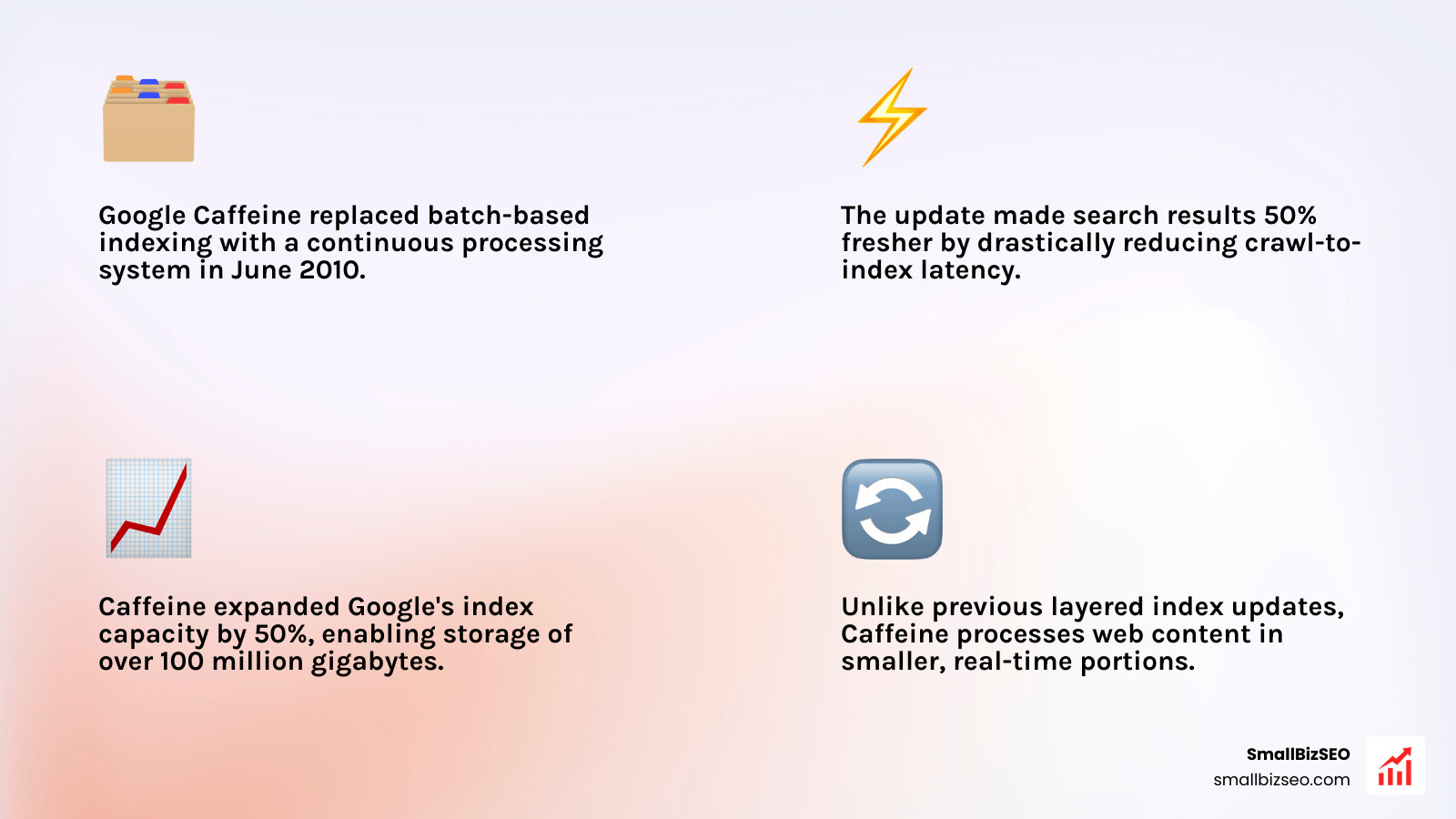
Google Caffeine replaced slower, layered index updates with a system that could process new and changed pages continuously. When it fully rolled out, it made Google’s search results 50% fresher, according to Google. It was an indexing overhaul, not a ranking boost for newly published pages.
For site owners, the lesson is simple: faster indexing creates an opportunity to be found sooner, but it does not guarantee that Google will crawl, index, or rank a page right away.
I’m Clayton Johnson, founder of SmallBizSEO. My work in technical SEO and content strategy helps small businesses connect the history of Google Caffeine and its faster index updates to the practical question of how their pages get found.
How Did Google Caffeine Change the Indexing Architecture?
Google Caffeine was an infrastructure overhaul designed to let Google process massive amounts of web content continuously rather than waiting for large batch cycles. In the Google announcement of the Caffeine index, the search engine confirmed it provided 50 percent fresher search results while expanding its index capacity by 50 percent.
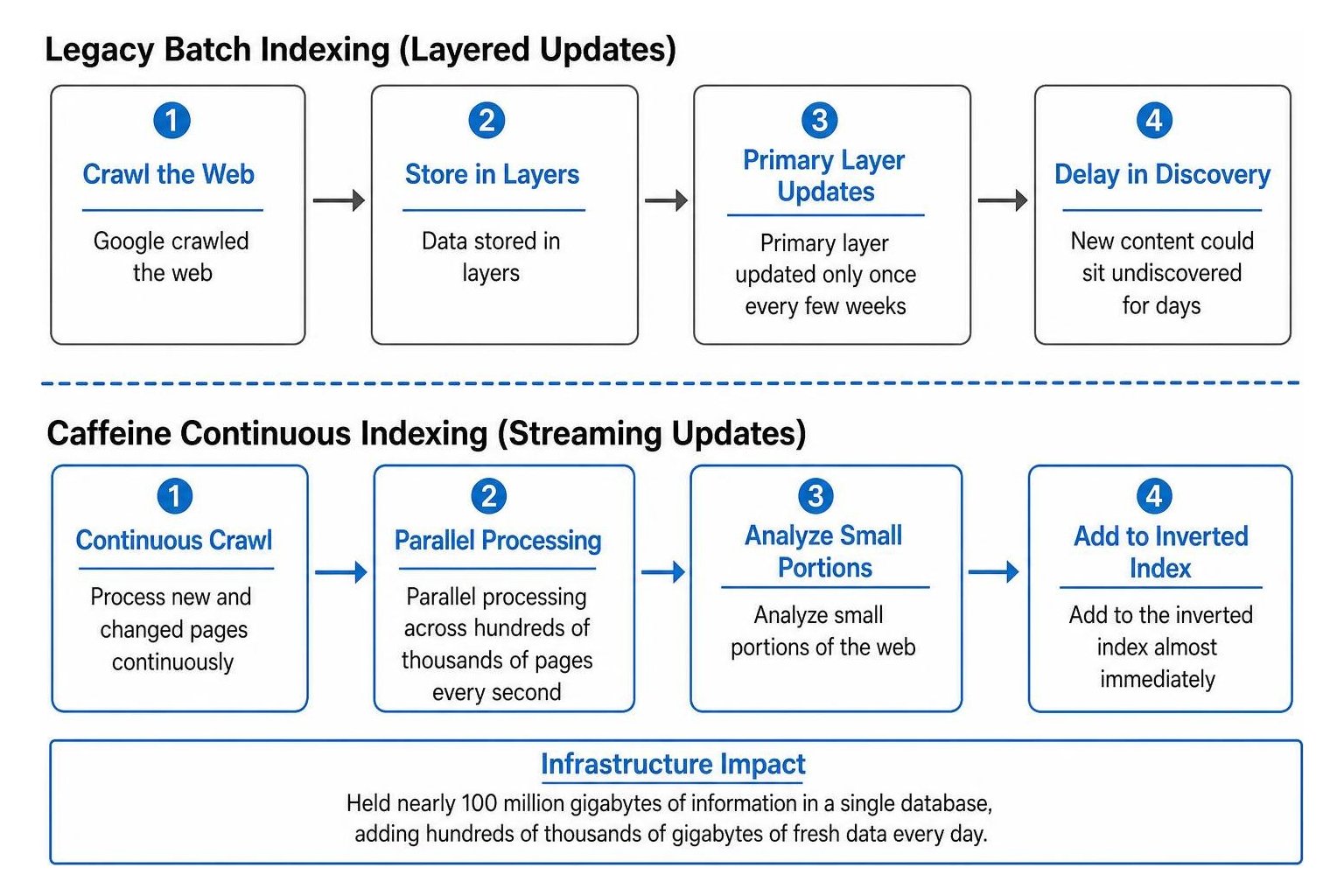
Before this shift, Google crawled the web and stored data in layers. The primary layer updated only once every few weeks. This delay meant newly published content could sit undiscovered for days. Caffeine changed this dynamic by introducing parallel processing across hundreds of thousands of pages every second.
The new system held nearly 100 million gigabytes of information in a single database, adding hundreds of thousands of gigabytes of fresh data every day. Instead of waiting for a full cycle to complete, Caffeine analyzed small portions of the web and added them to the inverted index almost immediately.
| Feature | Legacy Batch Indexing | Caffeine Continuous Indexing |
|---|---|---|
| Processing Method | Batch-oriented MapReduce jobs | Incremental stream processing via Bigtable |
| Underlying Storage | Original Google File System (GFS) | Colossus distributed file system (GFS2) |
| Refresh Frequency | Every few weeks for the main index layer | Continuous, real-time ingestion in seconds |
| Index Size | Limited by batch coordination overhead | 50% larger capacity at launch |
| Search Freshness | High latency between publishing and discovery | 50% fresher results across search queries |
Why Did Google Replace MapReduce Batch Indexing with the Caffeine Architecture?
Google replaced MapReduce because batch jobs could no longer keep pace with the exploding volume of rich web content, video, and social media. As detailed when the Google search index splits with MapReduce, running eight-hour batch cycles created bottlenecks that kept new information out of search results for far too long.
The legacy system relied on the original Google File System and MapReduce jobs that parsed the entire web in bulk stages. When the web grew from a few million websites to hundreds of millions, this approach reached its scaling limit.
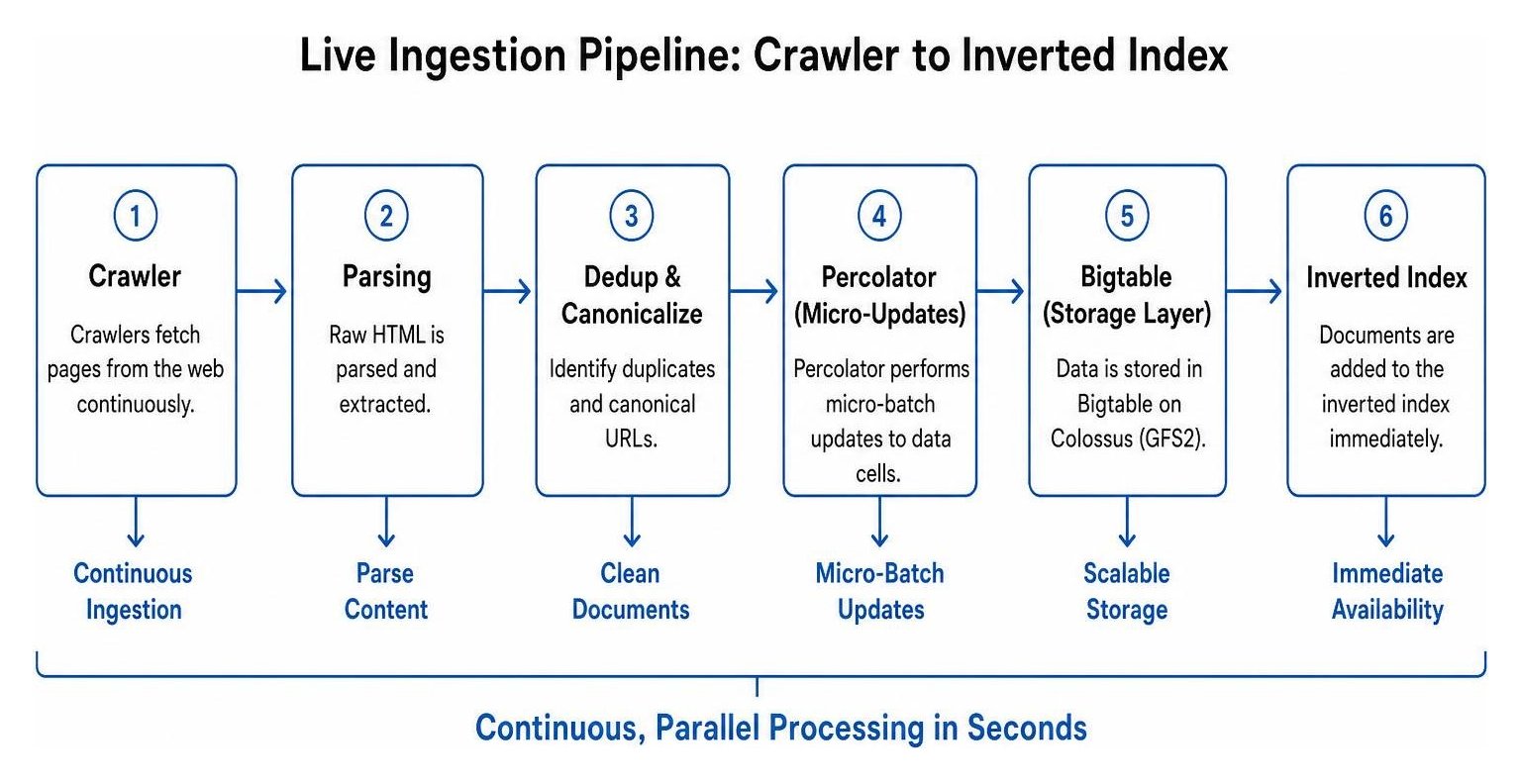
To solve this, Google engineered a new storage layer called Colossus (also known as GFS2) paired with Bigtable and a transaction management system named Percolator. Instead of rebuilding the entire web index from scratch during every cycle, Percolator allowed Google to perform micro-batch updates directly on individual data cells.
This architectural leap mirrored modern server caching strategies, where granular updates prevent expensive full-system recalculations and ensure data stays current with minimal overhead.
How Did the Google Caffeine History and Faster Index Updates Reshape Web Discovery?
The shift to continuous indexing reshaped web discovery by shrinking the gap between when an author publishes content and when searchers can find it. This live ingestion pipeline laid the technological groundwork for features like Google Instant and real-time news aggregation.
In the modern search environment, understanding google caffeine history and faster index updates helps us appreciate how Googlebot processes URLs today:
- Continuous Ingestion: Crawlers send raw HTML to parsing systems without waiting for scheduled batch windows.
- Micro-Updates to the Inverted Index: Content changes, newly discovered links, and metadata update in small, parallel streams.
- Rapid Signal Attachment: Machine learning systems and pre-computed signals attach to document identifiers in near real-time.
For webmasters, tracking these events in the Search Console coverage reporting tools reveals how quickly Googlebot moves from discovery to evaluation. To assist this continuous pipeline, maintaining structured XML sitemap best practices ensures search engines receive accurate change timestamps without unnecessary crawling delays.
Was Google Caffeine an Indexing Overhaul or a Ranking Algorithm Change?
Caffeine was strictly an indexing infrastructure overhaul, not a ranking algorithm change. It altered how Google collected and organized web data, rather than determining which website deserved the top position for a query.
This distinction is critical for SEO. Caffeine built the high-speed pipeline that allowed subsequent ranking algorithms to evaluate content rapidly. For instance, it strengthened Google's ability to detect spam networks, assess thin pages, and evaluate canonical signals on the fly.
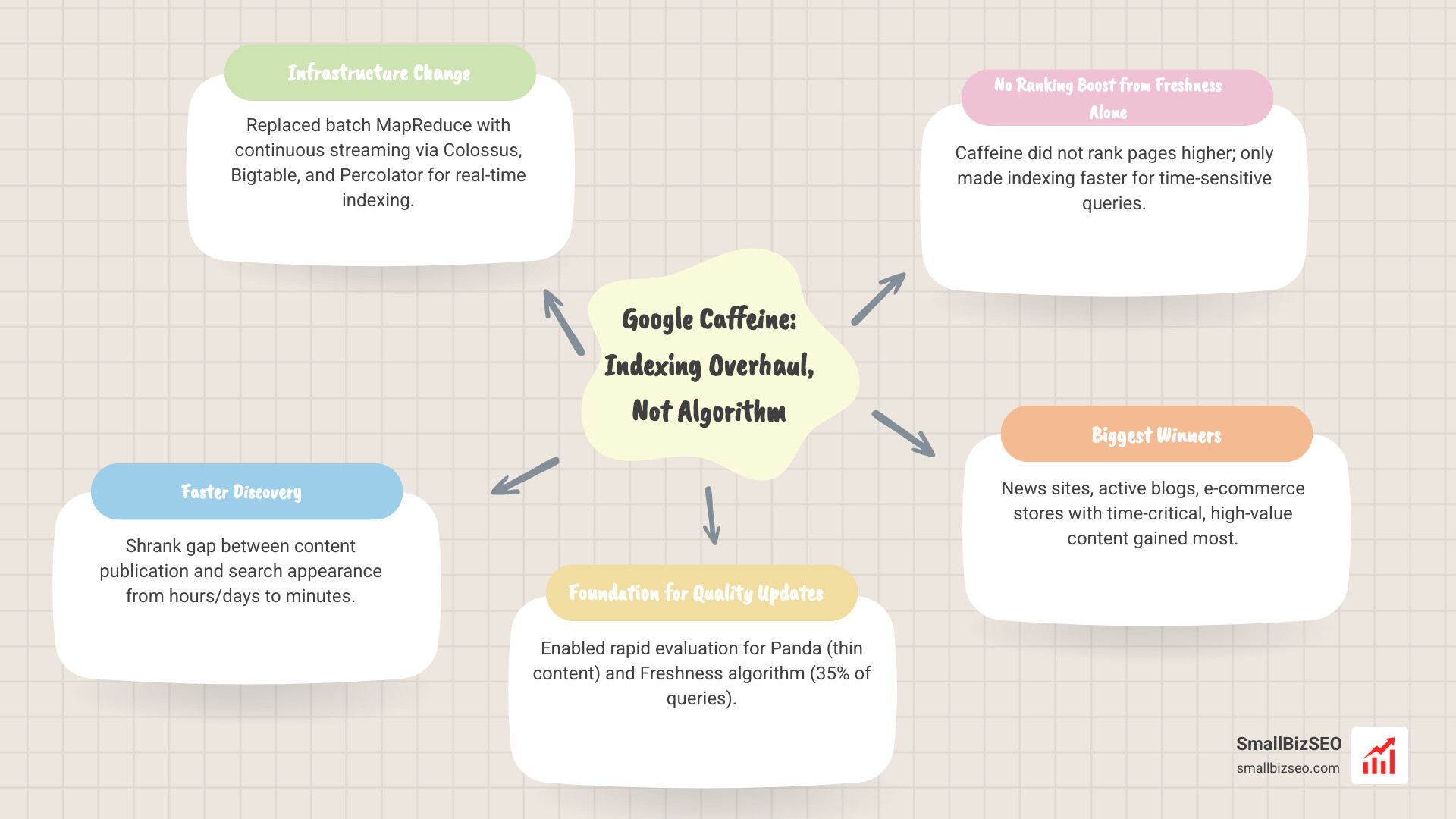
By giving Google the capacity to index pages quickly, Caffeine paved the way for major quality initiatives such as the Google Panda update. A year after Caffeine launched, Google released its dedicated freshness algorithm. As reported during the Google Freshness ranking update impact, that separate algorithmic update influenced roughly 35 percent of searches by boosting recent content for time-sensitive queries. Caffeine provided the engine; the freshness algorithm provided the ranking rules.
Which Websites Benefited Most from the Real-Time Streaming Index?
Websites that published time-critical, high-value information gained the most from continuous indexing. News organizations, breaking coverage platforms, active community blogs, and large online stores saw their newly published URLs become searchable within minutes rather than weeks.
The benefits varied significantly across different site types:
- News Outlets & Media: Breaking stories appeared in search results while events were still unfolding.
- E-Commerce Stores: Inventory changes, product launches, and price updates reflected in search snippets much faster.
- Active Blogs: Timely commentary and industry analysis captured organic traffic during peak interest windows.
- Static Business Sites: Broke away from bi-weekly update cycles, though sites that rarely updated saw little immediate ranking change.
However, rapid indexing also exposed structural weaknesses on large sites. When new pages are published continuously, managing your crawl depth optimization is essential so search bots do not get trapped in deep site architecture. Similarly, correctly managing canonical URLs prevents search engines from indexing duplicate parameter strings created during live crawl streams.
What Modern SEO Lessons Remain from the Google Caffeine Transition?
The primary lesson from Caffeine is that while search engines can index content within seconds, discovery is governed by crawl efficiency, server reliability, and perceived content value. Faster indexing capability does not mean automatic inclusion for every URL.

To ensure your web pages move through the indexing pipeline efficiently, implement these core practices:
- Eliminate Crawl Friction: Remove redirect loops and broken internal links to preserve crawler resources.
- Improve Server Response Times: Keep server latency low to prevent search schedulers from throttling requests.
- Audit Indexation Status: Regularly review page indexing reports to find and resolve excluded pages.
- Fix Architectural Bottlenecks: Partner with experts for deep crawling and indexing fixes when large sections of your site remain unindexed.
- Deliver Clean HTML Payloads: Ensure essential text and metadata are accessible in the initial HTML rather than deferred behind heavy client-side scripts.
How to Apply Google Caffeine History and Faster Index Updates to Modern Technical SEO
Applying these historical lessons means designing your website architecture for continuous discovery. At SmallBizSEO, we use our data-driven Velocity framework to help small businesses optimize technical performance, streamline server delivery, and build search visibility.
Search engines maintain a scheduler known as the URL Frontier. When your server responds quickly and your site publishes high-quality information, the scheduler assigns higher crawl priority. Aligning your publishing schedule with modern content velocity helps search engines recognize regular updates across your core topics.
For full-site audits, our comprehensive technical SEO guide outlines how server speed, structured data, and clean internal linking work together. If your business struggles with slow indexation or stalled rankings, explore our specialized SmallBizSEO caffeine indexing services to resolve technical crawl barriers.
What Myths About Freshness, Crawl Budget, and Indexing Persist Today?
Several persistent myths continue to confuse website owners regarding how search indexing and content freshness operate.
The most common misconception is that making minor edits—such as changing a date, fixing a typo, or updating a headline—will automatically trigger an algorithmic ranking boost. While Caffeine allows Googlebot to notice edits rapidly, ranking adjustments depend on whether the search query demands fresh information under Query Deserved Freshness (QDF) rules.
Another myth is that Google guarantees real-time indexing for every published page. Caffeine created the capacity for near-instant indexing, but Google's systems still evaluate domain quality, user demand, and internal linking before committing computing resources to index and serve a URL.
How to Build a Future-Ready Indexing Strategy for Your Business
Modern SEO requires a balance between technical speed and content quality. Google's transition to continuous indexing proved that infrastructure matters just as much as content creation. By ensuring your website is easy to crawl, fast to render, and consistently updated with valuable information, you remove the technical roadblocks between your business and your target audience.
If you are ready to eliminate indexing errors, accelerate crawl discovery, and improve your search rankings, contact our team at SmallBizSEO today to audit your technical performance and unlock sustainable organic growth.