Is Your Blog Content for SEO Driving Traffic or Just Gathering Dust?

Is Your Blog Content for SEO Driving Traffic or Just Gathering Dust?
How Do You Turn Blog Content Into SEO Traffic?
Start with a question your customers search for. Check what the top results answer, then write a post that answers it more clearly or adds something useful they miss. Give the answer early, use headings people can scan, and link to a relevant service page. After publishing, check organic clicks and leads so you know whether the post is working.
A post that gets no traffic is not always a lost cause. It may need a better match for search intent, clearer information, or an update. This guide shows you how to spot the problem and fix it.
I'm Clayton Johnson. My work in SEO, content, and digital PR focuses on making blog content for SEO easier to find, trust, and share. For a broader look at how search engines evaluate content, Google's SEO Starter Guide explains the fundamentals of crawling, indexing, and ranking.
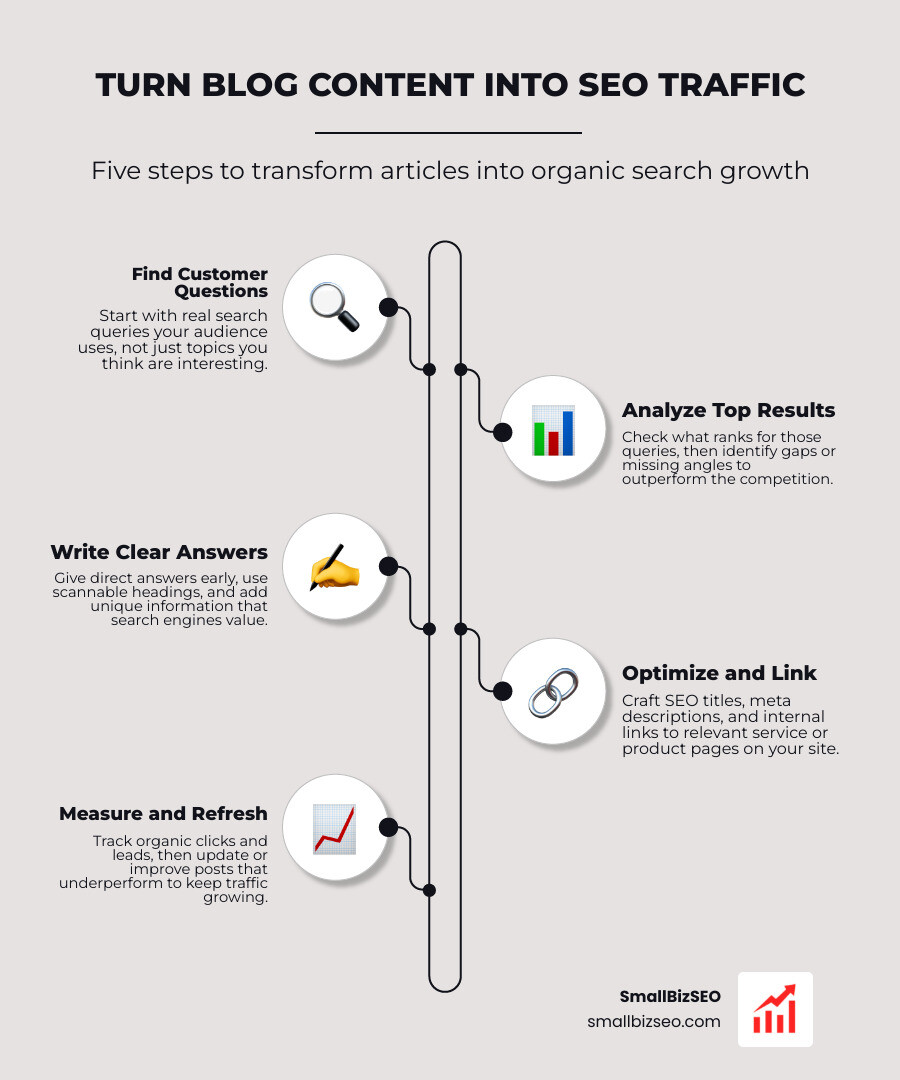
Why Is Your Blog Strategy Failing to Drive Organic Search Traffic?
Blog posts fail to drive organic search traffic when they do not align with user search intent, lack unique information, suffer from technical crawling issues, or experience natural content decay over time.
Publishing articles without a strategic foundation means your pages compete for attention without giving search engines or readers a compelling reason to choose them. To turn things around, you must understand both modern algorithms and the needs of your audience. Our comprehensive blog SEO guide breaks down the complete process of building pages that rank and convert.
What Is the Role of Blog Content for SEO?
Blog content builds topical authority by covering the breadth of your subject matter, earning search engine trust, and capturing long-tail queries that your primary service pages cannot target.
While service pages focus on direct conversions, blog articles establish your business as an industry authority. In modern search environments, search engines reward websites that demonstrate information gain—providing fresh data, unique perspectives, or direct solutions rather than summarizing existing articles. High-quality blog posts also serve as primary sources for AI Overviews and answer engines, securing brand mentions and early-funnel visibility across digital discovery channels.
How Do Search Intent Mismatches Sabotage Your Blog Rankings?
Search intent mismatches occur when an article provides the wrong format or angle for what a searcher wants, causing visitors to leave quickly and signaling to search engines that the page does not satisfy the query.
Search engines prioritize user satisfaction above all else. If someone searches for a step-by-step tutorial and lands on an aggressive sales pitch, they immediately bounce back to search results. Aligning your article format with specific search queries prevents this friction.
| Search Intent Type | User Expectation | Ideal Blog Format | Primary Call to Action |
|---|---|---|---|
| Informational | Quick answers, definitions, and guides | How-to guides, definitions, listicles | Newsletter signup, related guide |
| Commercial Investigation | Comparisons, pros and cons, evaluations | Comparison tables, review roundups | Product demo, consultation |
| Transactional | Immediate pricing, booking, or purchase | Service breakdowns, feature overviews | Direct purchase, quote request |
How to Create High-Performing Blog Content for SEO Step-by-Step
To create high-performing blog content, identify target keyword clusters, structure your post with extractable headings and direct answers, and optimize technical on-page elements before distribution.
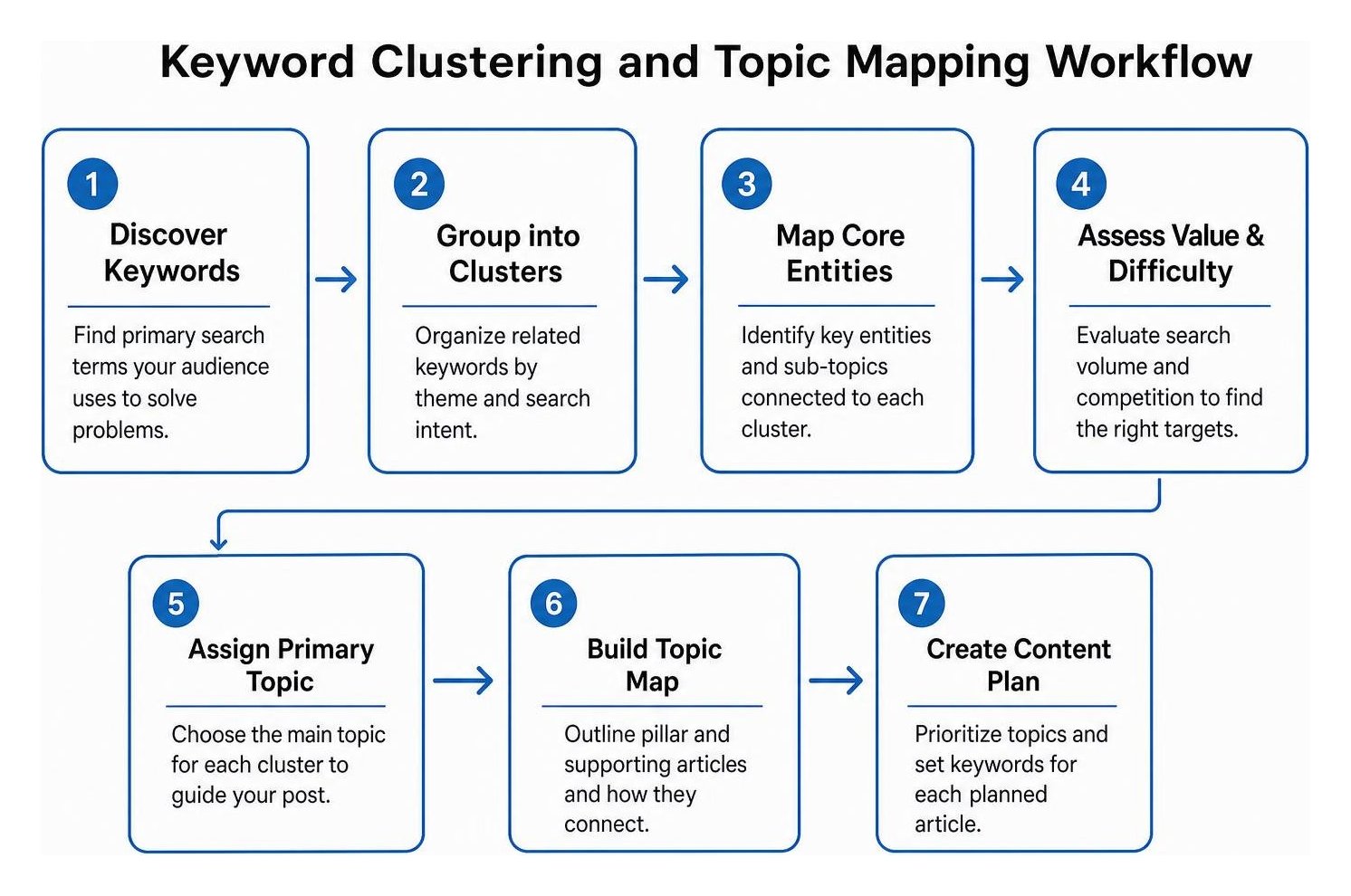
How Do You Conduct Keyword and Entity Research for Blog Topics?
Conduct keyword research by discovering primary search terms, identifying related sub-topics, evaluating search volume against competition, and mapping the core entities associated with your subject.
Begin by uncovering queries your prospective customers enter when solving everyday problems. Group these queries into distinct clusters rather than writing disconnected pieces. Our keyword content optimization guide outlines how to select terms with realistic ranking difficulty while establishing clear entity relationships that search engines can map.
How Do You Structure Blog Content for SEO and AI Overviews?
Structure blog content with an inverted pyramid format that delivers the direct answer in the first two sentences, followed by logical H2 and H3 subheadings, concise bullet points, and extractable tables.
Search crawlers and large language models favor scannable formatting. Setting up clear outlines ahead of time streamlines this process, and mastering SEO content briefs ensures every article provides immediate clarity for both human readers and AI systems.
How Should You Optimize On-Page Mechanics, Media, and Links?
Optimize on-page mechanics by placing target keywords naturally in the title tag, URL slug, and primary header, while compressing media files and connecting relevant internal resources.
- Title Tags and Meta Descriptions: Keep titles concise and front-load primary terms to maximize organic click-through rates.
- Internal Linking: Link directly to related supporting guides and relevant core service pages using descriptive anchor text.
- Media Optimization: Compress all images to maintain fast page speed and add descriptive alternative text. Learn more about optimizing visual media and images to improve asset discovery.
What Are the Essential Quality and Authority Standards for Modern SEO?
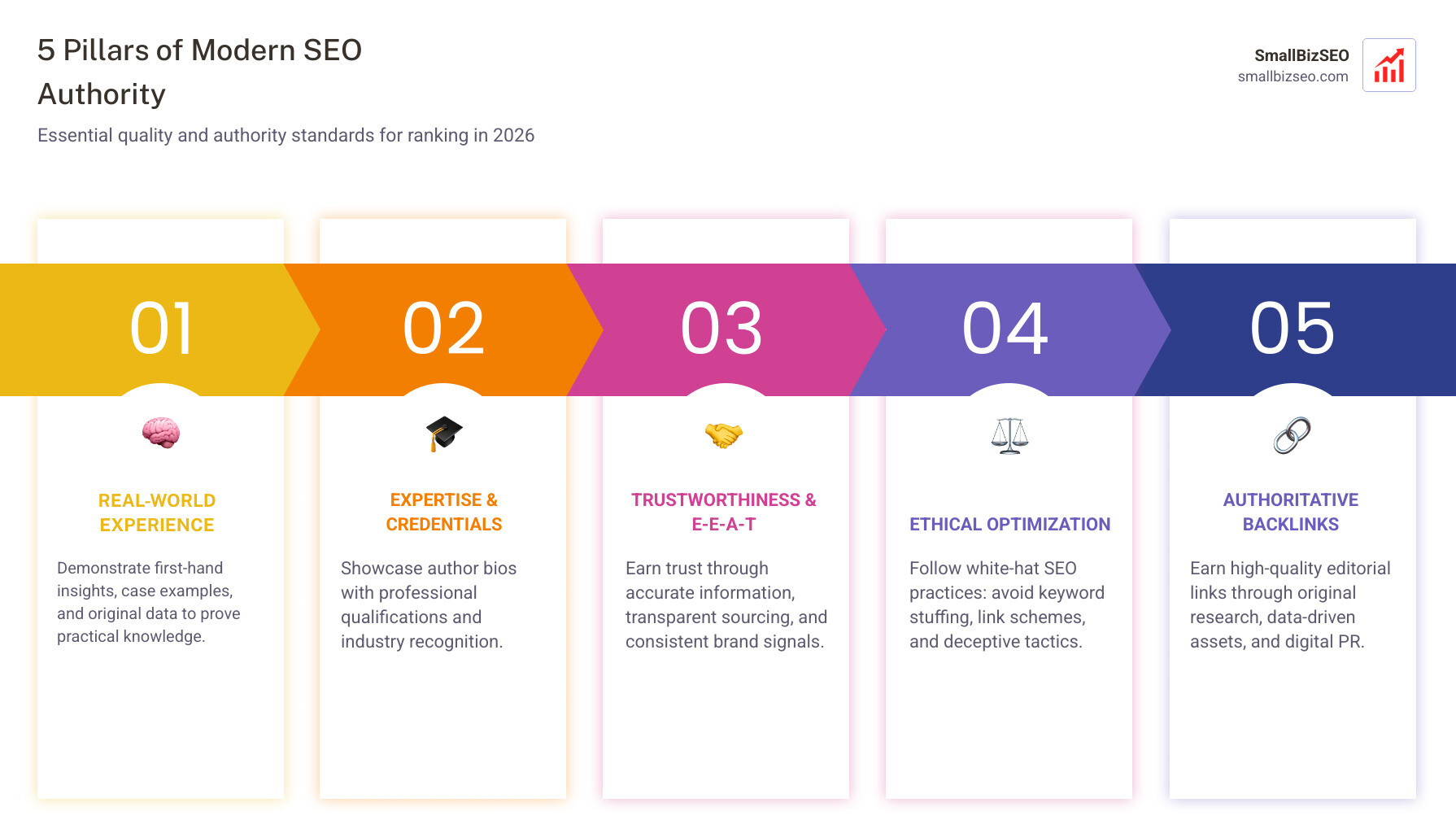
Modern SEO quality standards require demonstrating real-world experience, adhering to ethical optimization guidelines, and earning authoritative external citations through original research.
How Does Google E-E-A-T Shape Blog Content Rankings?
Google evaluates Experience, Expertise, Authoritativeness, and Trustworthiness (E-E-A-T) to ensure content comes from credible sources with real-world knowledge of the topic.
Demonstrate genuine experience by sharing first-hand insights, clear case examples, and original data. Include detailed author bios detailing professional credentials, link out to reputable third-party publications, and maintain accurate business details to reinforce credibility across your site.
What Is the Difference Between White Hat and Black Hat SEO in Blogging?
White hat SEO focuses on delivering long-term value to human users through ethical optimization, while black hat SEO relies on manipulative shortcuts like keyword stuffing, hidden text, and automated link schemes.
- White Hat Practices: Writing comprehensive answers, optimizing site structure, earning editorial links, and maintaining fast, secure pages.
- Black Hat Practices: Buying low-quality links, duplicating competitor articles, cloaking content, and spamming comment sections. Manipulative tactics risk severe algorithmic suppression or complete removal from search engine indexes.
How Do You Earn High-Value Backlinks Through Data and Thought Leadership?
Earn authoritative backlinks by publishing original industry surveys, creating proprietary frameworks, and producing comprehensive visual assets that other publications naturally reference.
Publishing primary data turns your blog into an authoritative reference point. Reach out to journalists and industry peers who cover your niche, monitor brand mentions to claim unlinked citations, and share actionable takeaways that establish your brand as a trusted industry resource.
How Do You Audit, Refresh, and Measure Blog Performance Over Time?
Audit and refresh your blog content by identifying declining URLs in Google Search Console, updating outdated information, and tracking clear business metrics like organic clicks and conversions.
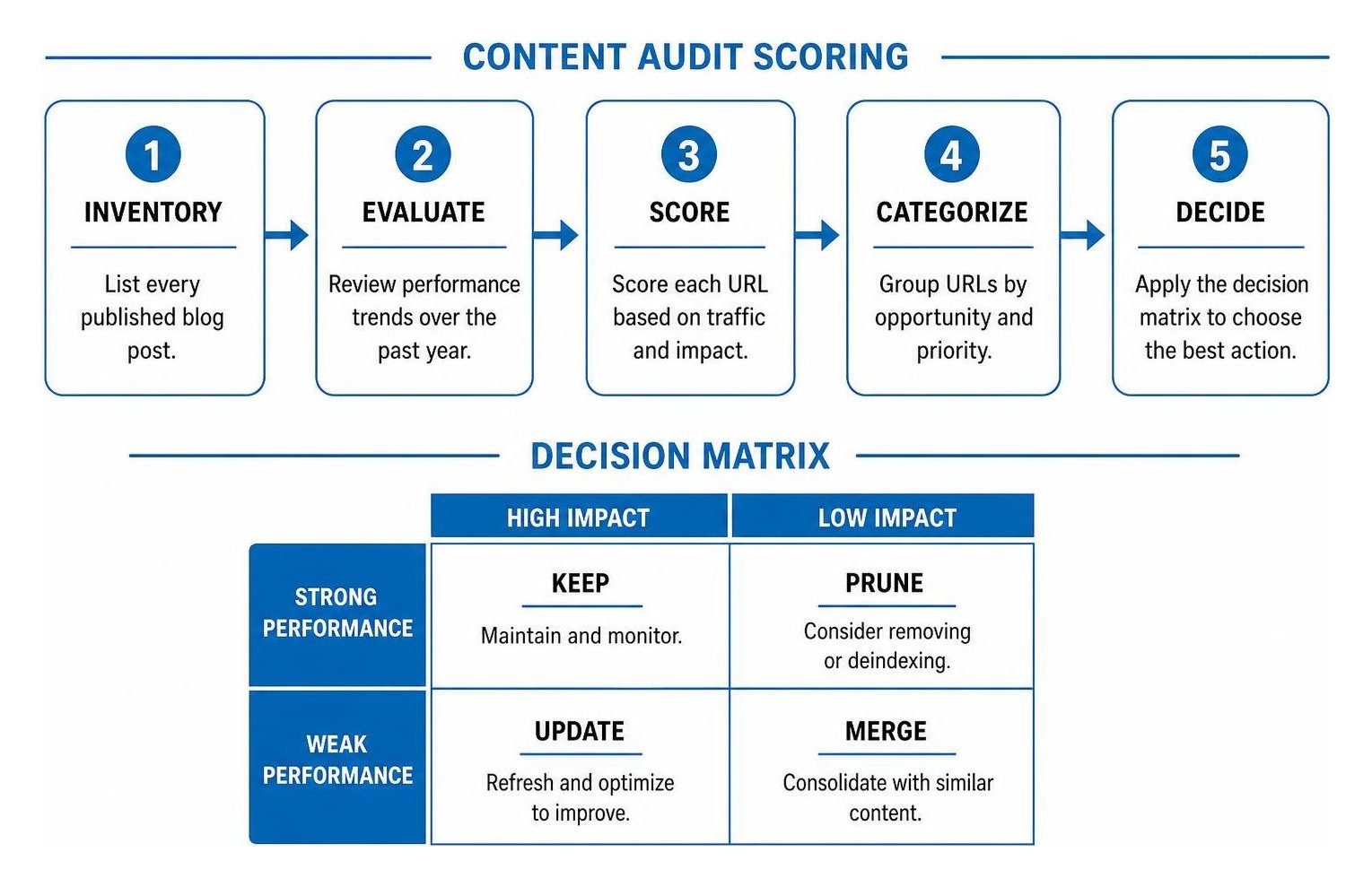
How Do You Conduct a Content Audit to Revive Dead Blog Traffic?
Conduct a content audit by inventorying every published post, evaluating performance trends over the past year, and categorizing URLs to keep, update, merge, or prune.
Content naturally decays as industry facts change and competitors publish newer guides. Following a proven content audit process allows you to spot decaying pages quickly, refresh outdated steps, consolidate overlapping articles, and recover lost organic visibility.
What Metrics and KPIs Prove SEO Success?
Measure SEO success by monitoring non-branded organic impressions, total clicks, target keyword positions, engagement time, and organic lead conversions.
Track how your content performs across primary search listings and generative AI answer summaries. Prioritize bottom-line business outcomes—such as contact form submissions and scheduled consultations—over vanity traffic metrics that generate no revenue.
Frequently Asked Questions About Blog Content for SEO
What is the ideal word count for an SEO-optimized blog post?
The ideal word count matches the depth required to answer the searcher's query completely, typically ranging from 800 words for concise questions to 2,500 words for comprehensive technical guides. Avoid adding filler text purely to meet an arbitrary word target, as clarity and completeness determine ranking success.
How often should a business publish new blog posts for SEO?
A business should publish at a consistent schedule that maintains uncompromising quality, typically 2 to 4 in-depth articles per month for small teams. Establishing a structured content planning process ensures every new post serves a strategic business purpose and addresses genuine customer questions.
How do AI Overviews and GEO change blogging strategies?
AI Overviews and Generative Engine Optimization (GEO) require making content easily extractable through direct answers, structured bullet points, clear definitions, and verified entity relationships. Providing original data and expert perspectives increases the likelihood that AI discovery engines cite your content in synthesized summaries.
Ready to Turn Stagnant Blog Posts into Measurable Growth?
Transforming underperforming articles into high-ranking assets requires disciplined keyword research, clear structural formatting, strong authority signals, and systematic performance tracking. At SmallBizSEO, we help businesses implement our data-driven Velocity framework to build search visibility, capture qualified leads, and achieve sustained digital growth. Explore our scalable SEO services to start driving predictable organic results today.