Is Your Brand Actually Authoritative? How to Calculate and Boost Your Score

Is Your Brand Actually Authoritative? How to Calculate and Boost Your Score
Is Your Brand Actually Authoritative? Here's What That Really Means for Search
SEO for brand authority is the practice of building your brand's trust, recognition, and credibility so that both search engines and AI systems consistently surface your business as the go-to source in your category.
Here's a quick breakdown of what it involves and why it matters:
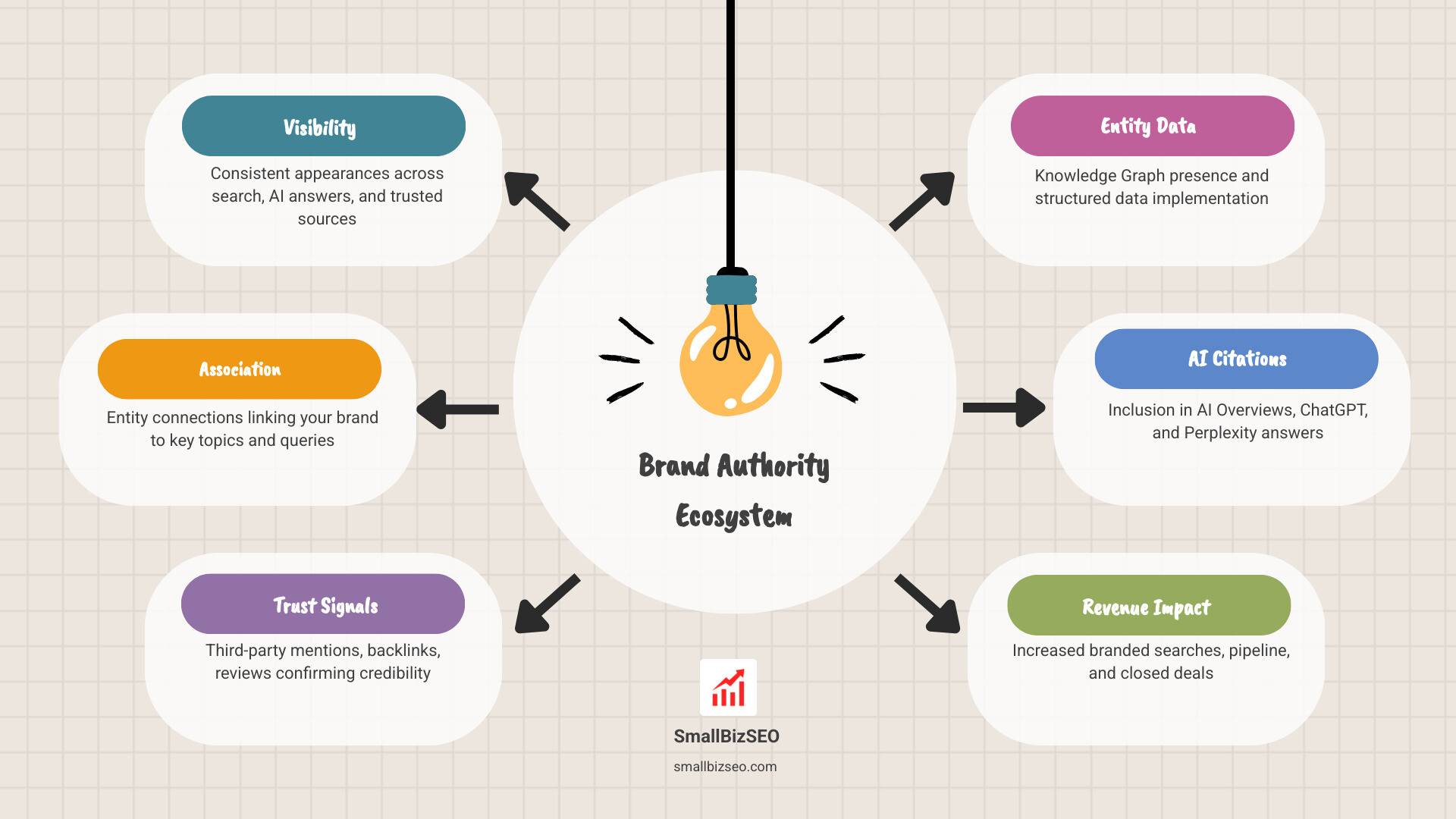
- Visibility - Your brand appears consistently across search results, AI answers, and trusted third-party sources
- Association - Search engines and AI models connect your brand name to the topics you want to own
- Trust signals - Third-party mentions, backlinks, reviews, and expert content confirm your credibility
- Revenue impact - Authority-driven visibility translates into more branded searches, pipeline conversations, and closed deals
Ranking on page one used to be enough. Write good content, earn some backlinks, and traffic would follow.
That equation has changed.
AI-powered search — Google's AI Overviews, ChatGPT, Perplexity — now answers questions directly on the results page. Users get what they need without ever clicking through. In fact, over 60% of searches now end without a single click.
So the new question isn't just "Can people find you?" It's "Does the AI know who you are, and does it trust you enough to cite you?"
That's what brand authority in SEO is really about. And the gap between brands that get cited and brands that get skipped is growing fast.
Here's another number worth knowing: 1 out of every 3 searches on Google includes a brand name. Branded keywords in the first search position see click-through rates as high as 60.4% — far above non-branded terms. That kind of performance doesn't happen by accident. It's the result of deliberate, compounding authority-building work.
The good news? You don't need a massive marketing budget to compete. You need a clear framework.
I'm Clayton Johnson, and I specialize in using digital PR to strengthen search visibility and market presence through campaigns that build real, measurable authority — exactly the kind of SEO for brand authority work that small businesses often overlook but consistently benefit from most. In the sections below, I'll walk you through how to calculate where your brand stands today and what to do to move the needle.
Defining Brand Authority in the Era of AI Search
To win in modern search, we have to understand how search engines and Large Language Models (LLMs) define "authority." In the past, we relied heavily on proprietary metrics to guess how well a website would rank. Today, brand authority is much broader. It represents the degree of trust, recognition, and credibility your business has accumulated across the entire digital ecosystem.

Unlike metrics that only measure website power, true brand authority is about real-world perception. Search engines are transitioning from analyzing mere text strings to understanding real-world "things" (entities) and the relationships between them.
To understand where brand authority fits, it helps to compare it to other common SEO metrics:
| Metric Type | What It Measures | Key Signals | Why It Matters |
|---|---|---|---|
| Brand Authority | Real-world reputation and trust across the web | Branded searches, entity mentions, media coverage, reviews | Determines if AI models and Google trust your brand enough to cite it |
| Topical Authority | Depth of expertise on a specific subject | Content depth, hub-and-spoke coverage, semantic relevance | Helps you rank for highly competitive, non-branded industry terms |
| Domain Authority | The technical ranking strength of your website | Link quantity, link quality, domain age | Acts as a baseline indicator of your site's overall ranking potential |
Why AI Search Demands SEO for Brand Authority
AI search engines do not merely rank pages; they synthesize answers. When a user asks a complex question, platforms like Google's AI Overviews, ChatGPT, and Perplexity analyze the web to compile a response. If your brand isn't recognized as a trusted authority, the AI will bypass your content entirely and cite your competitors instead.
This shift means citation is decoupling from traditional rankings. Research shows that a significant portion of pages cited in AI Overviews do not even rank in the top ten organic results. AI systems prioritize brands that have strong external validation, clear topic associations, and easily extractable data. To build a brand that AI engines confidently recommend, you can Learn more about brand SEO frameworks to guide your strategy.
The Shift from Keywords to Entities
To search engines and LLMs, your business is not just a collection of keywords — it is an "entity" in a vast Knowledge Graph. Google connects your brand to specific concepts, people, and topics based on how consistently you are mentioned across the web.
We can influence this by managing our technical brand foundation. This starts with structured data, specifically Schema markup. By implementing Organization Schema on your homepage and utilizing properties like sameAs (to link to verified profiles) and knowsAbout (to list your areas of expertise), you explicitly tell search engines who you are and what you do. This technical alignment is crucial to Optimize E-E-A-T Signals Today and ensure search crawlers map your entity correctly.
The Strategic Blueprint: Implementing SEO for Brand Authority
Building brand authority requires a deliberate, multi-layered approach. We cannot rely on isolated content pieces or bulk link-building campaigns. Instead, we must create a reinforcing loop where our on-site expertise matches our off-site reputation.
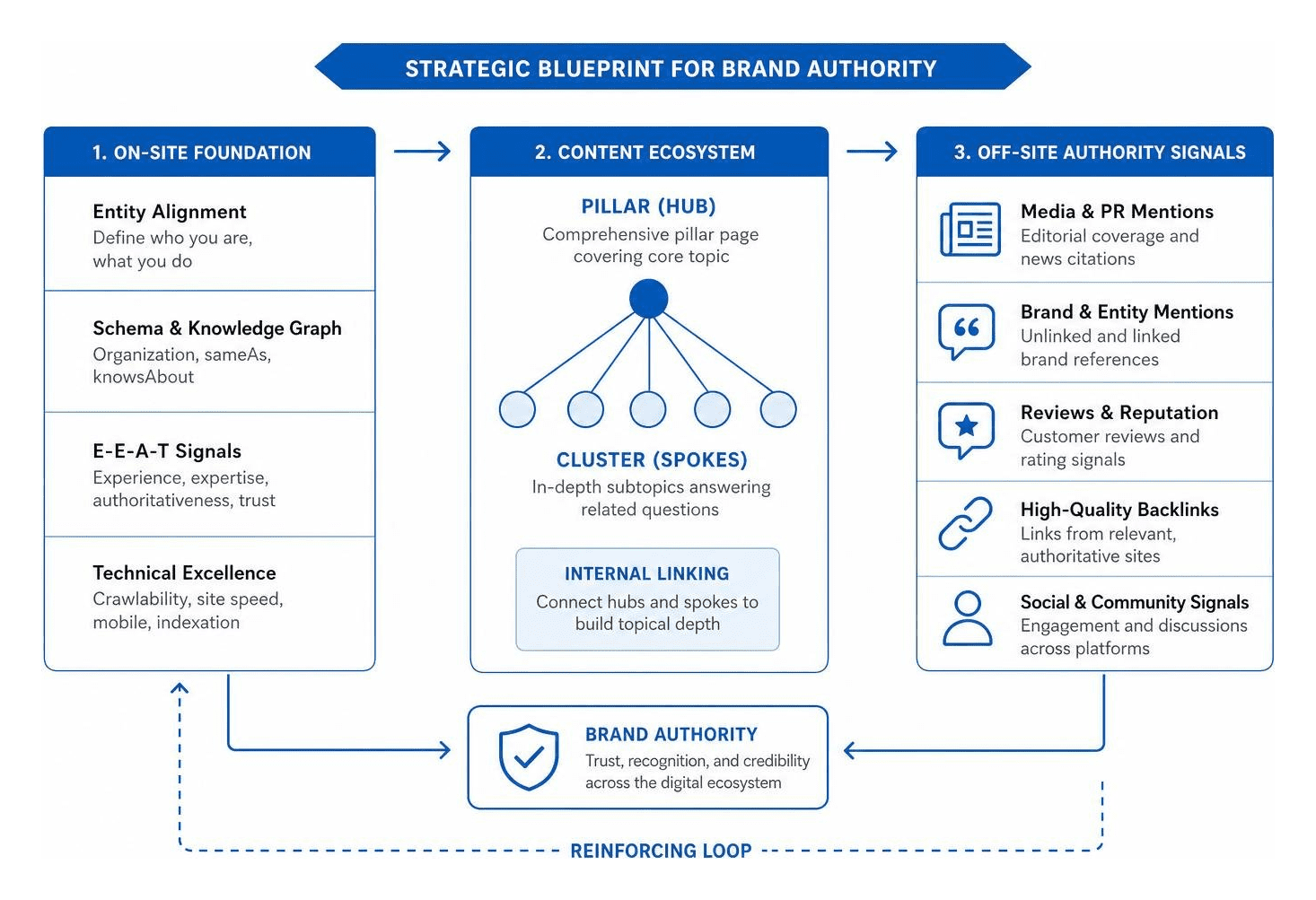
By aligning our content architecture with digital PR and structured data, we make it easy for both search engines and AI models to verify our credibility. To ensure your content meets these high standards, learn How to Optimize Your Content for E-E-A-T and Build Real Search Trust as you build out your roadmap.
Building Topical Authority and the Complexity Moat
To establish your brand as a leader, you must cover your niche exhaustively. This is accomplished through a hub-and-spoke content architecture. By creating comprehensive pillar pages and linking them to detailed subtopic articles, you signal to search engines that you possess deep, structured knowledge.
To stand out in an era of generic, AI-generated content, we must build a "complexity moat." This means publishing proprietary research, original data, and expert syntheses that cannot be easily replicated. When you publish insights that require genuine expertise, other publications will naturally cite your brand as the primary source. If you need assistance building these high-value assets, our SEO Content Services can help you design and execute a custom strategy.
Earning Off-Site Trust and Distributed Recognition
On-site content is only half the battle. Search engines rely heavily on third-party validation to confirm your reputation. This is where digital PR and distributed recognition come into play.
Earning high-quality backlinks from reputable industry publications, news outlets, and academic institutions passes immense trust to your entity. Furthermore, unlinked brand mentions on credible sites are increasingly valued by AI search engines as digital citations. Co-citation — where your brand is mentioned alongside established industry leaders in relevant articles — helps search engines associate your brand with top-tier authority.
For businesses looking to amplify their off-site footprint, studying successful campaigns and exploring industry publications can provide valuable competitive insights. You can also partner with an experienced digital marketing agency to scale your digital PR outreach and secure authoritative placements.
The Measurement Model: How to Calculate Your Authority Score
You cannot manage what you do not measure. To determine if our SEO efforts are successfully building brand authority, we must track metrics that go beyond basic organic traffic and keyword rankings.

We look at a variety of indicators to build a holistic picture of our search presence:
- Branded Search Growth - The volume of search queries that include our brand name over time.
- Brand-Plus-Category Queries - Searches that combine our brand with a keyword (e.g., "SmallBizSEO link building").
- Topic Visibility Share - Our share of voice across the priority topics we want to own.
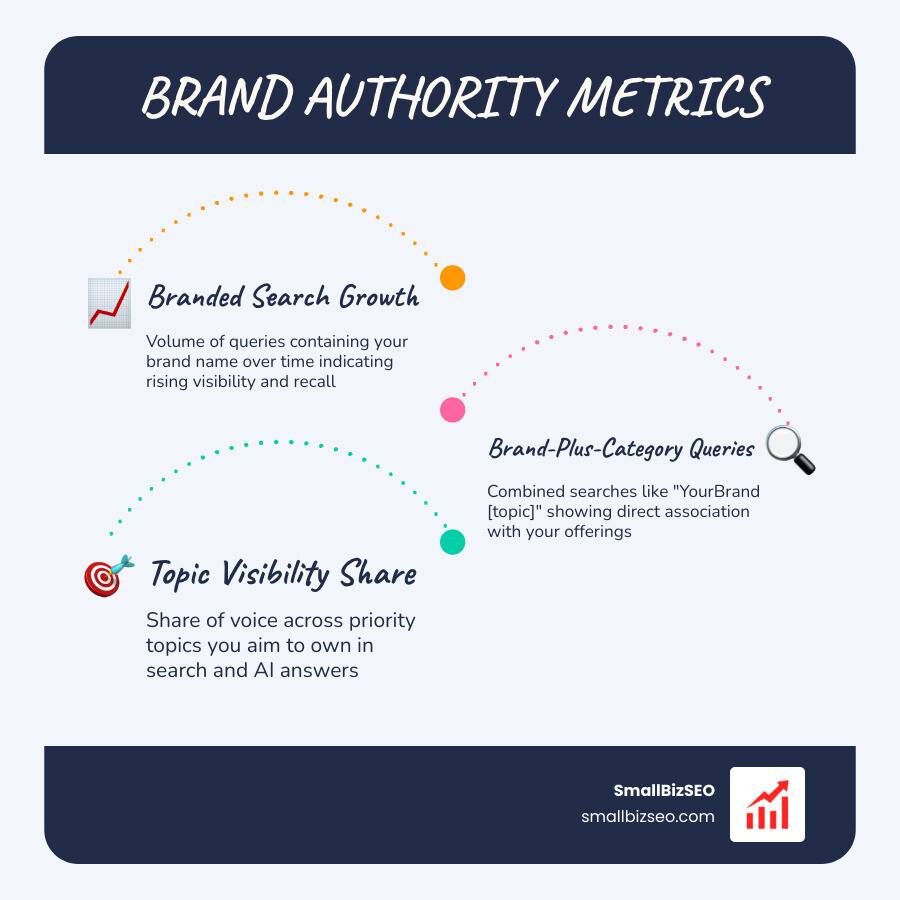
Tracking these signals allows us to see if buyers are actively seeking us out or associating us with our core offerings. For a deeper dive into adjusting your tracking methodologies, read about what lies Beyond Content Optimization.
Measuring the Revenue Impact of SEO for Brand Authority
For B2B and highly considered purchase paths, brand authority must connect directly to business outcomes. We track how our authority-building content influences our sales pipeline. This includes monitoring target-account engagement, direct traffic growth, return visits, and the consumption of "proof assets" like case studies and original research.
When target accounts engage with our expert content before reaching out to sales, it proves our SEO strategy is doing more than just generating clicks — it is building the trust required to close deals. To learn how to align your search metrics with your business goals, check out our comprehensive SEO Services Guide.
Tracking AI Citation Share and Answer Visibility
In the age of AI search, we must also measure our "Generative Share of Voice" (GSOV). This involves tracking how often our brand is cited, mentioned, or recommended in answers generated by ChatGPT, Gemini, and Perplexity.
We can build a basic GSOV scorecard by querying AI engines with core industry questions and auditing the sources they cite. If our brand is consistently cited as a trusted source, our authority score is strong. If competitors dominate these answers, we must refine our off-site citations and structured data. To learn more about how digital visibility impacts market awareness, you can Explore business awareness strategies to build a more resilient online footprint.
Frequently Asked Questions about Brand Authority
How often should we review and refresh our brand authority metrics?
We recommend tracking operational signals — like branded search volume, direct traffic, and brand-plus-category queries — on a monthly basis. Broader authority indicators, such as off-site media mentions, backlink quality, and AI citation share, should be audited quarterly, as these compounding signals take time to build and stabilize.
What is the difference between brand awareness and brand authority?
Brand awareness is simply fame; it is achieved through repetition, reach, and ad spend. Brand authority is trust; it requires third-party validation, expert-level content, and consistent recommendations from credible sources. Awareness gets you recognized, but authority gets you chosen.
Can unlinked brand mentions actually improve search rankings?
Yes. Modern search engines and LLMs use semantic processing to understand mentions of your brand name across the web, even when there is no hyperlink attached. These unlinked mentions act as digital citations, strengthening your entity's association with specific topics and boosting your overall site quality score.
Conclusion
Building brand authority is the ultimate defense against changing algorithms and the rise of AI-powered search. When you establish your business as a trusted, recognizable entity, you create a marketing moat that technical SEO alone cannot replicate.
At SmallBizSEO, we help businesses build lasting search authority. Through our data-driven "Velocity" framework, we deliver fast, E-E-A-T-compliant growth backed by transparent, automated reporting. We focus on the technical, content, and off-site signals that make both search engines and AI models trust your brand.
Ready to turn your search presence into a powerful engine for growth? Partner with us for professional SEO services and let's start building your brand's authority today.