Map Your Way to the Top with These Google My Business Ranking Tips

Map Your Way to the Top with These Google My Business Ranking Tips
Why Google My Business Rankings Decide Whether Local Customers Find You or Your Competitor
Google My Business rankings determine which businesses appear in the coveted Local 3-Pack — the three results that dominate the top of Google Search and Maps when someone nearby is ready to buy.
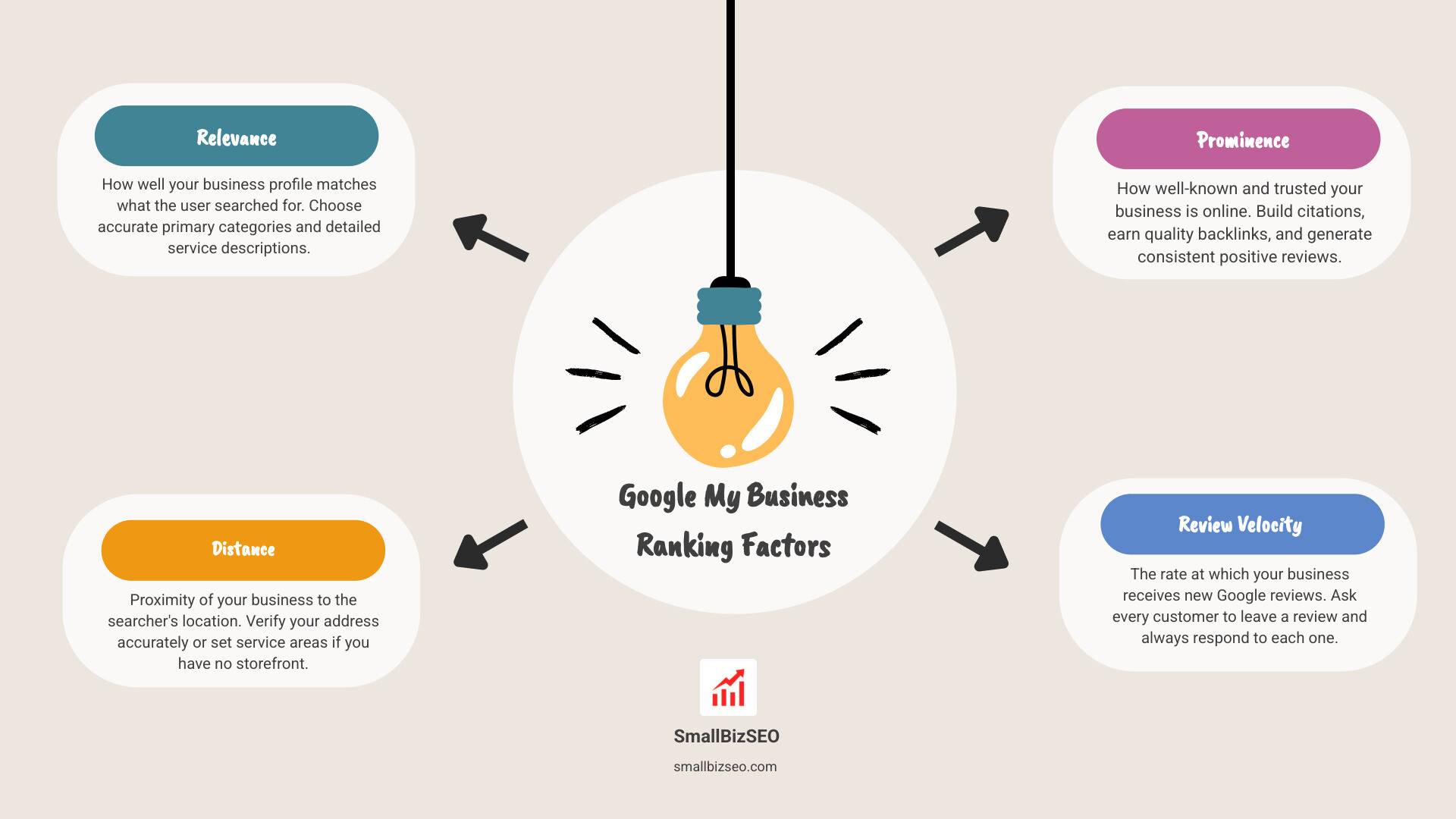
Here is a quick breakdown of what drives your local ranking and how to improve it:
| Factor | What It Means | What You Can Do |
|---|---|---|
| Relevance | How well your profile matches the search | Choose the right categories, fill out your services, write a strong description |
| Distance | How close your business is to the searcher | Verify your address; use service areas if you have no storefront |
| Prominence | How well-known and trusted your business is | Earn reviews, get backlinks, keep your profile active |
| Profile Completeness | How much useful information Google has | Fill every field — hours, photos, attributes, NAP |
| Review Velocity | How consistently new reviews come in | Ask every customer, reply to every review |
Open Google right now and type any local service — "Italian restaurant," "emergency plumber," "best bakery near me." Three businesses appear at the top with stars, photos, and a phone number. The customer calls the first one. Not the best one. The first one.
That is the power of the Local 3-Pack. And with 44% of all local clicks going to those top three results, the businesses sitting below position three receive 93% fewer actions than the ones at the top. The gap is not small — it is enormous.
The good news? Your ranking is not random, and you cannot pay Google to improve it. It is entirely algorithmic, built on factors you can directly influence.
I'm Clayton Johnson, a digital PR and SEO specialist focused on helping businesses build search visibility through smarter optimization and content strategy. My work on Google My Business rankings has shown me exactly where small businesses lose ground — and where small, consistent changes create outsized results. This guide walks you through every one of those levers.
Understanding the Core Pillars of Google My Business Rankings
To rank in the Local 3-Pack, we must understand the three core pillars Google uses to calculate local search results: Relevance, Distance, and Prominence.
According to Google's official Tips to improve your local ranking on Google, these three signals combine to deliver the most helpful answer to a user's query. If you want to dive deeper into local search mechanics, our comprehensive Local SEO Guide breaks down how these elements fit into a broader digital marketing strategy.
- Relevance: How well does your Google Business Profile (GBP) match what someone is searching for? If your profile lacks detail, Google cannot confidently match your business to specific search terms.
- Distance (Proximity): How far is your business from the searcher's physical location or the area they specified in their query? This accounts for roughly 55% of the local ranking algorithm. While we cannot change a searcher's physical location, we can maximize our footprint for the other two pillars.
- Prominence: How well-known and trusted is your business? This is determined by your offline fame, review signals, and traditional web authority.
Relevance: Aligning Your Profile for Better Google My Business Rankings
Relevance is the foundation of local visibility. If Google does not know exactly what you do, you will not rank, regardless of how close you are to the searcher.
The single most impactful ranking signal on your profile is your Primary Business Category. Choosing an incorrect primary category is also one of the costliest mistakes you can make. We recommend searching for your main target keywords on Google Maps and looking at the primary categories your top three competitors use.
Beyond your primary category, you can add up to nine secondary categories to cover your full range of offerings. For instance, if you run a home services company in New York, setting your primary category as "Plumber" and adding "Drainage Service" or "Water Heater Installation Service" as secondary categories ensures you match highly specific searches.
You should also write a detailed business description (up to 750 characters) that naturally incorporates your primary services and target neighborhoods, and fully complete your services list using clear, consumer-friendly language.
Distance and Prominence: Building Authority Beyond Proximity
While proximity is a major factor, prominence is where you can truly outshine competitors who happen to be physically closer to the searcher. A business located further away can easily outrank a closer competitor if it has significantly higher prominence.
Prominence is heavily tied to traditional SEO signals. Google indexes the entire web to understand your business, which means organic search signals directly influence your google my business rankings.
To build prominence, you need high-quality local backlinks, consistent directory citations, and editorial mentions on local blogs or news sites. If you are looking to build a strong backlink profile, explore our guide on Scoring The Best Local Backlinks to discover high-authority local link strategies.
Step-by-Step Optimization and Activity Signals for Your Profile
You cannot optimize a profile you do not control. If your business is part of the 11.1% of Google Business Profiles that remain unclaimed, your first step is to Get Listed on Google and complete the verification process.
Once verified, you must actively manage your profile to signal to Google that your business is open, active, and trustworthy.
Completing Core Fields for Maximum Google My Business Rankings
A complete profile is a ranking profile. To prevent search engines from filtering your business out of relevant queries, ensure these core fields are fully optimized:
- NAP Consistency: Your Name, Address, and Phone number must be identical across your website, GBP, and all third-party directories. Minor discrepancies can confuse search engine bots and damage your prominence. To avoid common pitfalls, read our breakdown of 5 Local SEO Mistakes Killing Your Visibility.
- Operating Hours: Keep your business hours highly accurate. Google deprioritizes closed businesses in real-time search results, meaning accurate holiday hours and special event hours are critical to maintaining visibility.
- Attributes: Add specific business attributes (such as wheelchair accessibility, Wi-Fi, or outdoor seating) to match niche search filters.
- Website Link: Link directly to your optimized homepage or a dedicated local landing page.
Leveraging Reviews, Photos, and Ongoing Engagement
Once your foundation is secure, ongoing engagement signals tell Google that your business is thriving.
Reviews are a massive ranking driver. However, total review count is not the only metric that matters; review velocity (how consistently you receive new reviews) and review recency are highly influential. Having hundreds of old reviews suggests your business may be inactive, whereas a steady stream of weekly reviews signals a healthy, active business.
When responding to reviews, aim for detail. Top-ranking businesses write review responses that average roughly 140 words — about 40% longer than lower-ranked competitors. Encourage customers to mention specific services and locations in their reviews to feed Google's semantic search engine.
Visual content is another powerful tool. Businesses with more than 100 photos on their profile receive 520% more customer calls and significantly more direction requests than average listings. We recommend uploading high-quality, authentic photos of your team, physical location, and completed work weekly. For a deeper dive into maps optimization, check out this guide on How to Rank Higher on Google Maps.
How to Track and Audit Your Local Visibility Over Time
Because local search rankings change block-by-block and mile-by-mile based on the searcher's precise GPS coordinates, traditional rank trackers that report a single static city-level ranking are insufficient.
To get an accurate picture of your local visibility, we use visual GeoGrid tracking. These tools plot your rankings across an interactive geographic grid (ranging from 3x3 to 13x13) to show exactly where your visibility drops off. If you want to identify gaps in your current local strategy, you can schedule a professional SEO Visibility Audit with our team.
| Tracking Method | Pros | Cons | Best Use Case |
|---|---|---|---|
| Manual Search (Incognito) | Free, easy to perform quickly | Highly biased by physical IP address, only shows one location | Quick spot-checks |
| Traditional Rank Tracker | Automated, tracks historical trends | Only tracks from a single coordinate, misses neighborhood-level shifts | General brand tracking |
| GeoGrid Tracking | Visualizes hyper-local rankings block-by-block, reveals competitor hotspots | Requires specialized software or API integrations | Comprehensive local SEO audits |
Frequently Asked Questions about Local Map Pack Rankings
Why is my Google Business Profile not showing up?
If your profile is completely invisible, you may be dealing with a suspension, a duplicate listing, or a severe category error. Google will filter out duplicate listings at the same address to keep search results clean.
In other cases, weak relevance signals or inconsistent NAP data across the web can cause Google to favor your competitors. If you are struggling to diagnose the issue, read our guide on Why Your Rankings Are Still Stuck for actionable troubleshooting steps.
Can I rank in cities where I do not have a physical address?
Yes. Service Area Businesses (SABs) that deliver services directly to customers can define their service areas by city, county, or zip code without displaying a physical storefront address. To maximize visibility in neighboring cities, we recommend building dedicated, highly optimized city landing pages on your website and acquiring reviews from clients in those specific areas.
How often should I post updates or add new content?
While Google Posts do not directly boost your traditional map rankings, they are highly valuable for conversions and feed directly into Google's AI-driven search summaries. We recommend publishing at least one update, offer, or event weekly, and uploading fresh photos every 30 days to keep your profile active and engaging.
Map Your Way to the Top of Local Search
Optimizing your Google Business Profile is not a one-time task; it is an ongoing process of building relevance, maintaining activity, and earning trust.
At SmallBizSEO, we help small businesses simplify this process. Using our data-driven "Velocity" framework, we deliver fast local rankings and sustainable growth. From technical optimization to link-building and transparent, automated reporting, we handle the heavy lifting so you can focus on running your business.
Ready to claim your spot in the Local 3-Pack? Explore our SEO Services Guide or read our complete Local SEO Guide to start driving more local calls and visits today.