An Essential Guide to Comparing SEO Services for Schools

How Can SEO for Private Schools Bring in More Inquiries?
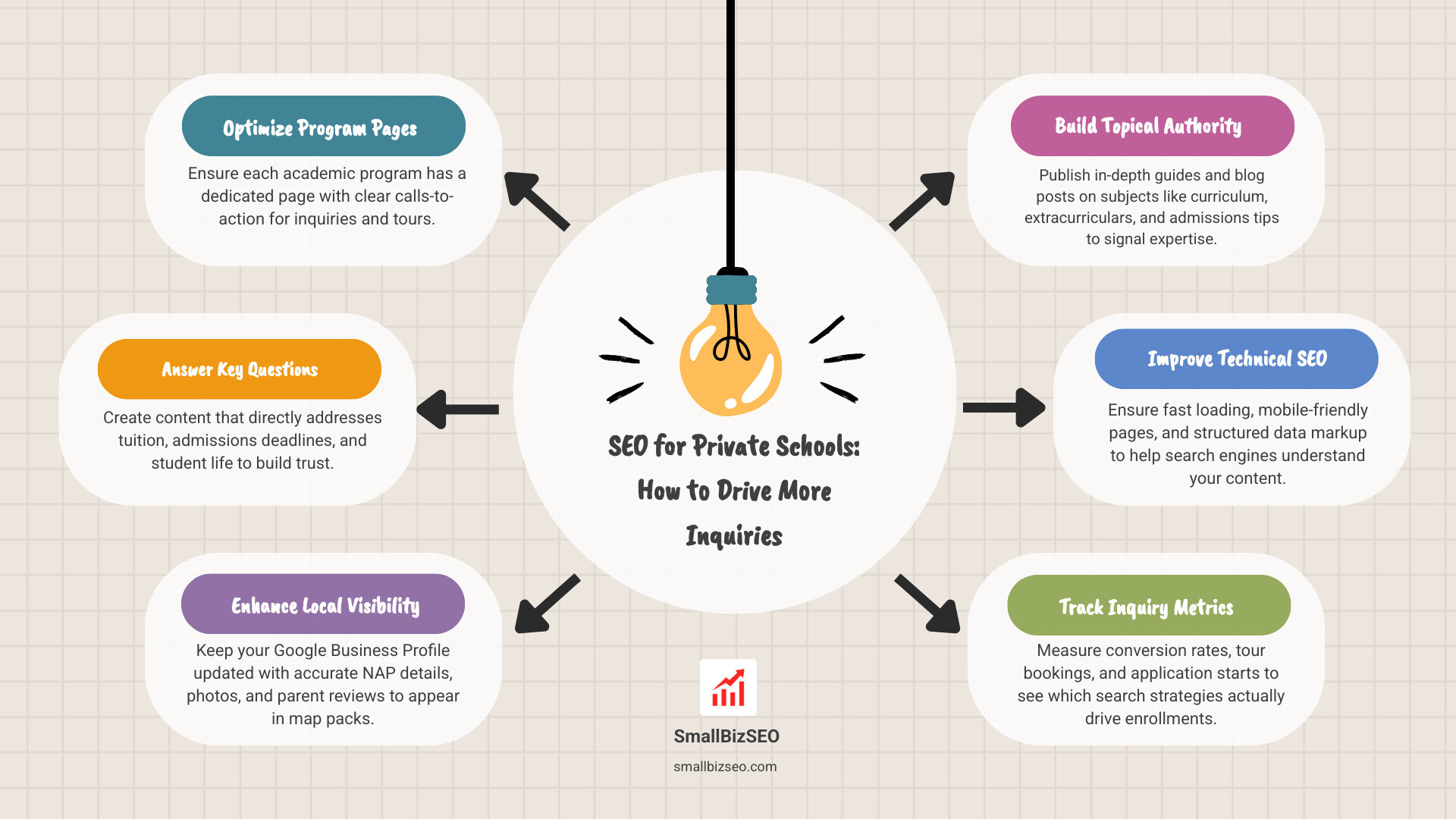
SEO for private schools helps nearby families find your school and take the next step toward enrollment. Start by making your admissions and program pages easy to find, answering questions about tuition and school life, and keeping your Google Business Profile accurate. Then track whether search visitors request information, book tours, and apply.
When comparing SEO services, look beyond promises of higher rankings. Ask what the provider will improve on your website, how it will help families find you locally, and how it will report admissions results.
I’m Clayton Johnson, founder of SmallBizSEO. My work in technical SEO, content strategy, and authority building shapes this guide to evaluating SEO for private schools; I won’t claim school-specific results I can’t document.
Quick SEO for private schools definitions:
Core Strategies for SEO for Private Schools That Drive Inquiries
Effective SEO for private schools centers on matching search intent, fixing technical website issues, and building topical depth around your curriculum and values. Google processes more than 40,000 internet searches per second—totaling over 3.5 billion searches every day. Since about 88% of searches go to organic search engine results pages, capturing those clicks directly impacts your inquiry pipeline.
When families begin researching educational alternatives, between 30% and 60% of school website traffic comes from organic search. To capture this interest, your search strategy must address search engines and prospective parents simultaneously. Adhering to the fundamentals outlined in the Google Search Central SEO Starter Guide ensures your site remains resilient against frequent algorithm updates.
Every comprehensive K-12 private institution SEO plan requires four primary deliverables:
- Intent-Aligned Keyword Mapping: Identifying high-intent search phrases that match what parents ask at every stage of the admissions process.
- On-Page Optimization: Structuring concise title tags (under 60 characters), meta descriptions (under 160 characters), proper heading hierarchies, and descriptive image alt text.
- Technical Performance Enhancements: Optimizing site architecture, mobile responsiveness, and page load speeds so mobile users have a seamless browsing experience.
- Authority and Citation Building: Securing reputable backlinks and directory placements that signal institutional credibility to search algorithms.
Why is Local SEO for Private Schools Essential for Campus Tours?
Local SEO ensures your campus appears prominently in map packs and localized searches when families look for options nearby. Proximity is a primary factor when parents select a school. Approximately 80% of education-related queries include a geographic term, and profile signals account for roughly 32% of local ranking weight.
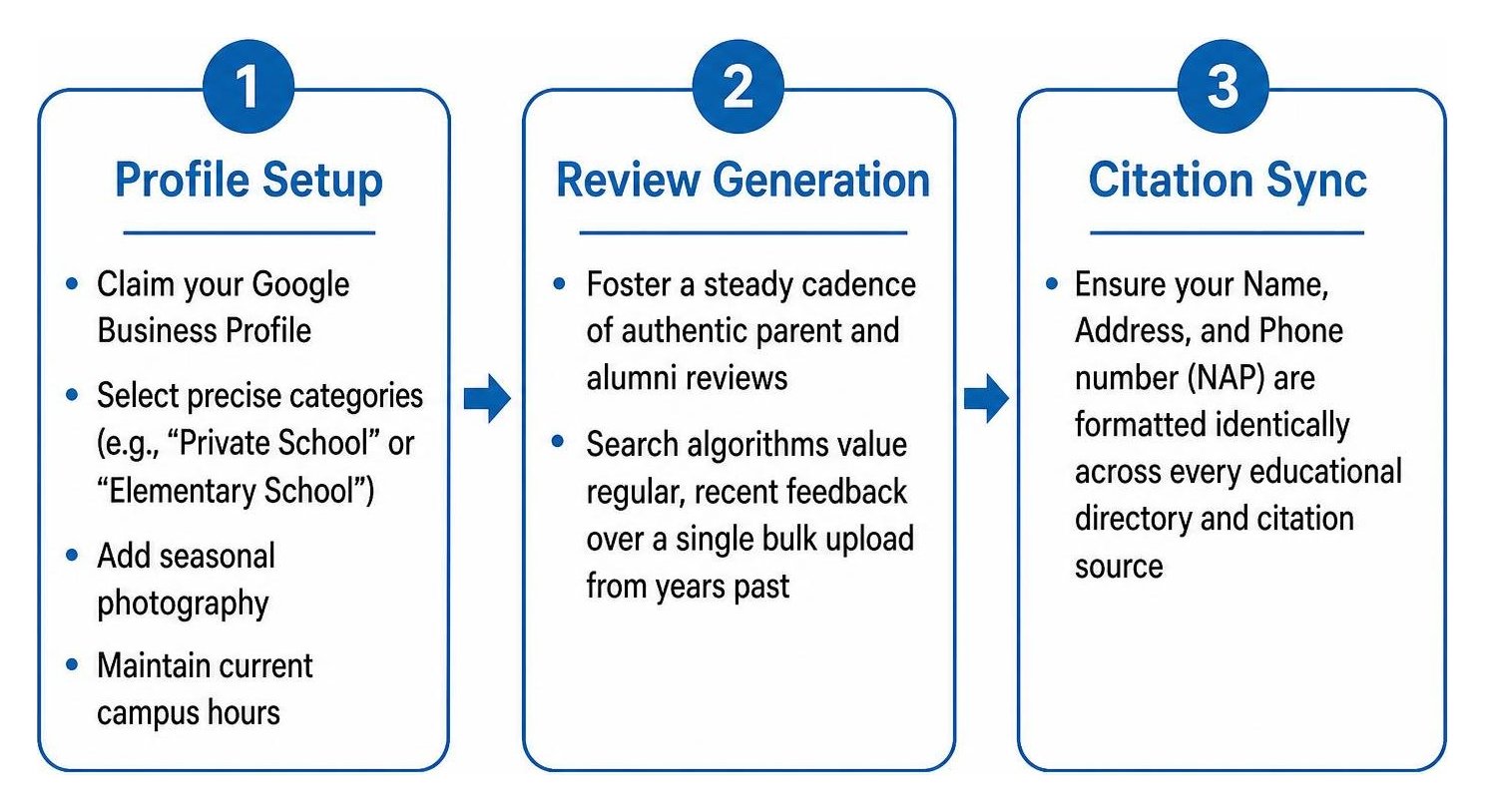
Dominating local search requires three core actions:
- Google Business Profile (GBP) Completion: Claim your listing, select precise categories (e.g., "Private School" or "Elementary School"), add seasonal photography, and maintain current campus hours.
- NAP Consistency: Ensure your Name, Address, and Phone number are formatted identically across every educational directory and citation source.
- Parent Reviews: Foster a steady cadence of authentic parent and alumni reviews. Search algorithms value regular, recent feedback over a single bulk upload from years past.
Similar geographical optimization principles are applied by a specialized public schools SEO company to secure map pack rankings across community districts.
How Does Technical Architecture and Content Build Authority in SEO for Private Schools?
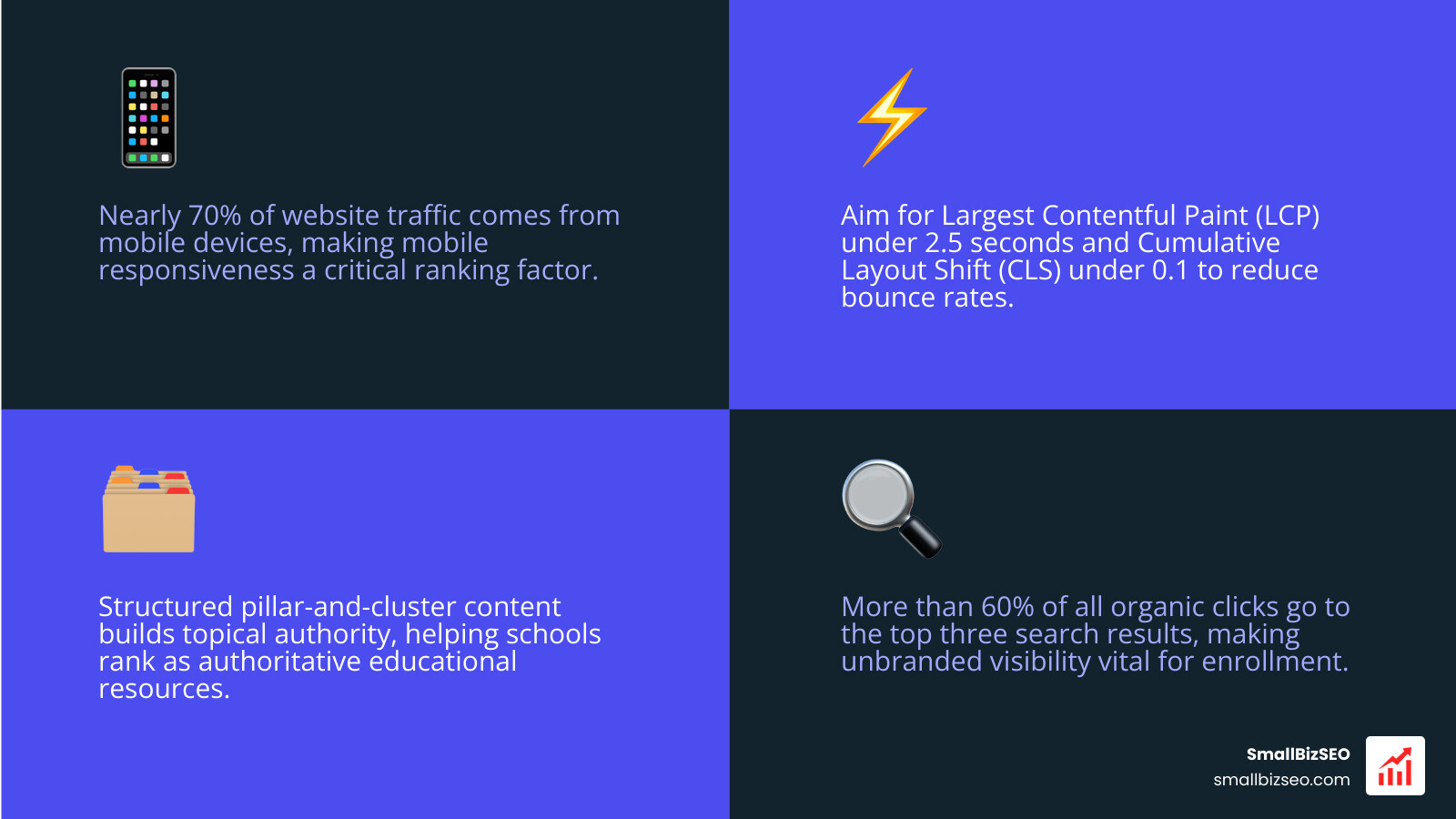
A clean technical foundation paired with structured pillar-and-cluster content establishes the topical depth search engines need to rank your site as an authoritative educational resource. Search engines reward websites that demonstrate real-world Experience, Expertise, Authoritativeness, and Trustworthiness (E-E-A-T).

Nearly 70% of website traffic comes from mobile devices, making mobile responsiveness and Core Web Vitals essential ranking factors. Aim for a Largest Contentful Paint (LCP) under 2.5 seconds and a Cumulative Layout Shift (CLS) under 0.1 to prevent prospective parents from bouncing. Additionally, applying structured data—specifically schema.org/School and Event markup for open houses—helps search engines parse your tuition details, grade levels, and calendar events accurately.
Building subject authority requires moving beyond simple news updates. Create comprehensive pillar pages on topics like curriculum philosophy, STEM programs, and arts education, then support them with detailed cluster posts answering parent questions. Demonstrating subject depth helps your domain outrank competitors with superficial content. You can also review how these content frameworks mirror the tactics used by high schools SEO company specialists to rank distinct academic departments.
Branded vs. Unbranded Search: How Do They Impact Enrollment Pipelines?
Branded searches capture families who already know your school by name, while unbranded searches introduce your programs to families searching by criteria or location. More than 60% of all organic clicks go to the top three search results, making unbranded visibility vital for filling your top-of-funnel pipeline.
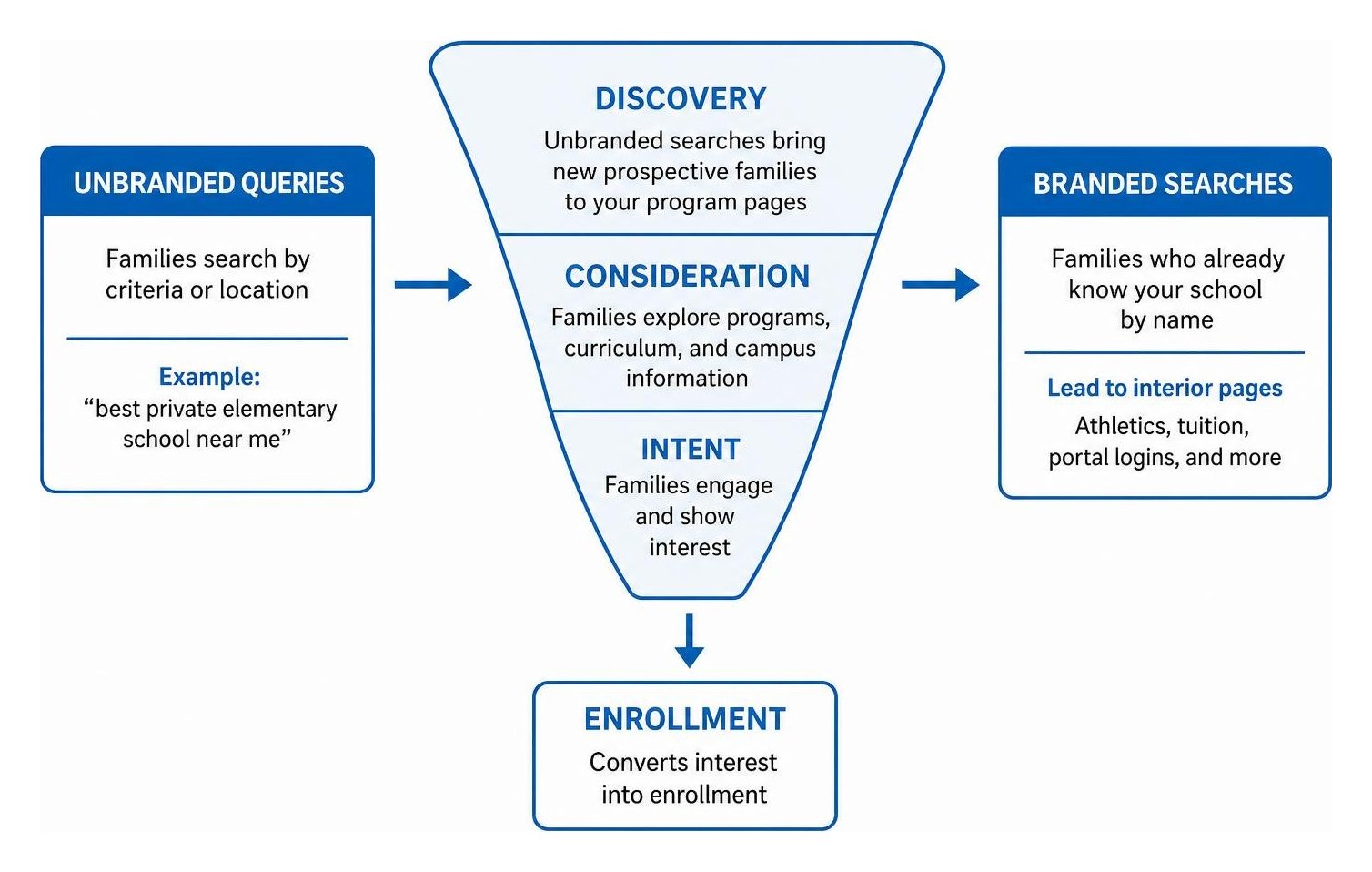
Branded searches usually lead to interior pages such as athletics schedules, tuition schedules, or portal logins. Unbranded searches (such as "college prep schools near me") bring new prospective families to your program pages.
| Search Type | Example Search Query | Primary Parent Intent | Primary Landing Page Target |
|---|---|---|---|
| Unbranded | "best private elementary school near me" | Discovery & Initial Research | Grade-Level / Program Pillar Page |
| Unbranded | "private school with small class sizes" | Criteria Evaluation | Academic Philosophy Page |
| Branded | "[School Name] tuition and fees" | Decision-Making & Validation | Admissions / Tuition Details Page |
| Branded | "[School Name] open house schedule" | Action & Campus Visit | Open House Registration Page |
Mapping search intent across both categories ensures your website captures new families while serving current stakeholders, a process similar to the tailored strategies from a military schools SEO company used to reach national audiences.
How to Evaluate and Compare School SEO Providers for Maximum ROI
When evaluating SEO partners, compare their technical capabilities, content quality standards, data transparency, and understanding of the academic admissions cycle. A reliable agency focuses on qualified inquiries, campus visits, and completed applications rather than vanity traffic numbers.
Evaluate providers against these core operational criteria:
- E-E-A-T and Content Integrity: Do they write authentic, parent-centric content, or do they rely on generic, unedited text that ignores your unique culture?
- Customized Architecture: Can they build structured program pages and implement educational schema markup?
- Local SEO Mastery: Do they have a clear process for optimizing Google Business Profiles, directories, and review generation?
- Reporting Cadence and Dashboards: Do they provide transparent reporting that ties search performance directly to admissions milestones?
These same evaluation standards apply when assessing after school and summer programs SEO company options or specialized educational marketing partners.
How Does SEO Build Sustainable Search Visibility for Private Schools?
Organic SEO builds compounding search visibility that delivers inquiries year after year. While short-term marketing campaigns offer temporary visibility, organic rankings establish enduring credibility and continuous admissions interest.

Building high-quality content, earning relevant backlinks, and refining your technical performance creates an asset that gains momentum over time. As your website answers more parent questions, your search footprints expand, keeping your admissions funnel steady throughout the academic calendar.
Which Metrics and Key Performance Indicators Actually Measure Enrollment Growth?
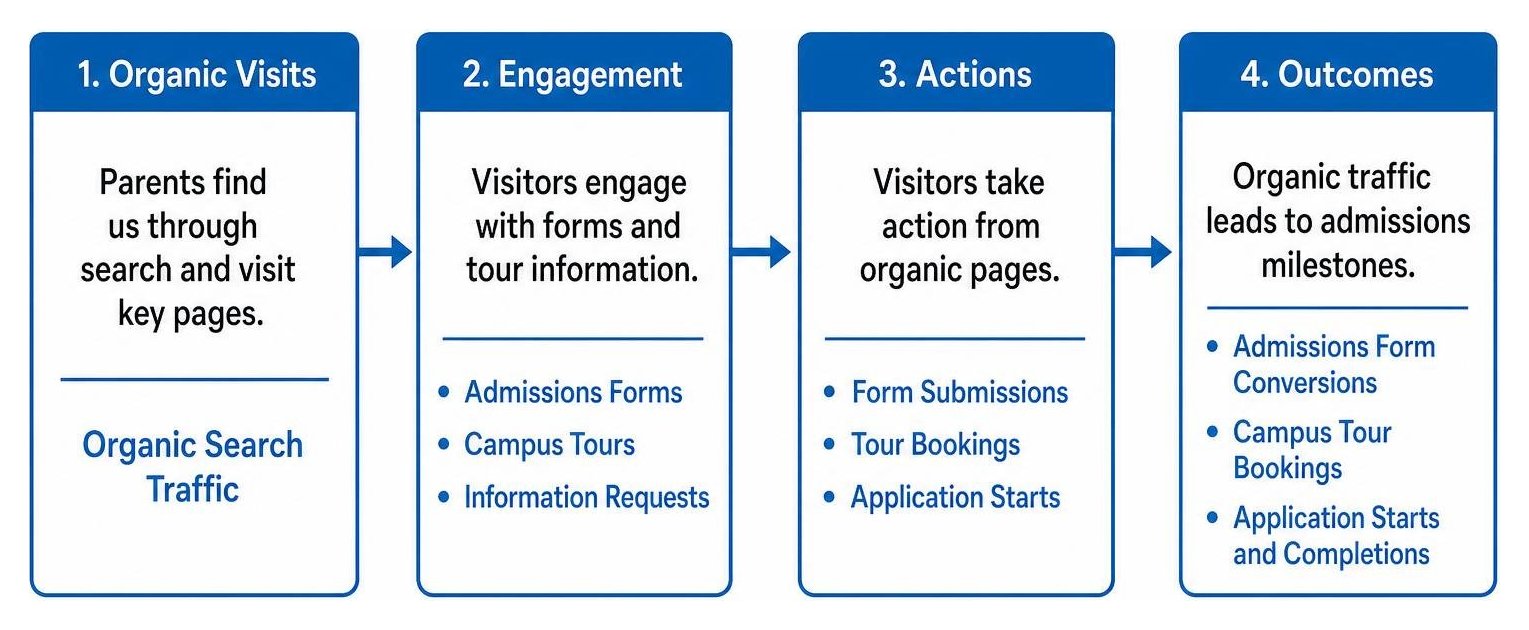
Meaningful SEO success is measured through lead conversions, tour bookings, and application starts rather than raw impressions or overall traffic. Form conversion rates for education websites typically range from 1% to 5%. Tracking how search users navigate your admissions funnel provides a clear picture of marketing return on investment.
Focus on these essential performance indicators:
- Admissions Form Conversions: Track inquiries submitted via contact and information request forms.
- Campus Tour Bookings: Monitor scheduled tours originating from organic landing pages.
- Application Starts and Completions: Measure organic traffic paths leading into your admissions portal.
- Average Session Duration: Track engagement depth; higher-intent parents typically spend more time reviewing curriculum and tuition details.
Our data-driven Velocity framework focuses on resolving technical bottlenecks, expanding intent-driven content, and delivering transparent, automated reporting so your leadership team can see how organic search drives enrollment.
Taking the Next Step Toward Enrollment Growth
Evaluating search marketing partners comes down to finding a team that understands how families choose educational institutions. By prioritizing technical health, local map pack visibility, and parent-focused content, your school can stand out in search results and welcome more families to campus. If you want to identify where your website currently stands and uncover high-impact opportunities for your admissions pipeline, schedule a comprehensive SEO visibility audit with our team.