Show Me the Money: A Guide to Delivering Measurable SEO Client Results

Show Me the Money: A Guide to Delivering Measurable SEO Client Results
What Do Strong SEO Client Results Actually Look Like?
SEO client results that matter go far beyond rankings and traffic numbers. They show up as revenue, leads, and measurable business growth.
Here is a quick breakdown of what real SEO results look like — and how to evaluate them:
| What Agencies Often Report | What Actually Matters |
|---|---|
| Organic traffic volume | Revenue attributed to organic search |
| Keyword rankings | Rankings for high-intent, buyer-ready terms |
| Impressions | Click-through rate and qualified visits |
| Domain Authority score | Backlink quality and conversion impact |
| Page speed score | Core Web Vitals tied to conversion lift |
A few benchmarks worth knowing:
- Organic search drives roughly 53% of all trackable website traffic (64% for B2B)
- SEO leads close at a 14.6% rate — compared to just 1.7% for outbound marketing
- Positive ROI from SEO typically arrives within 6 to 12 months, with peak returns in years two and three as content compounds
- 3-year SEO ROI ranges from ~317% for e-commerce to over 1,389% for real estate
The honest truth? Many agencies report metrics that look impressive but prove nothing about business impact. The goal of this guide is to help you cut through that noise.
I'm Clayton Johnson, a digital marketing and SEO strategist focused on using digital PR and content to drive real search visibility and measurable growth — the kind of SEO client results that show up in your revenue, not just your rankings report. In the sections below, we will walk through exactly how to track, report, and deliver SEO performance that clients can see in their bottom line.
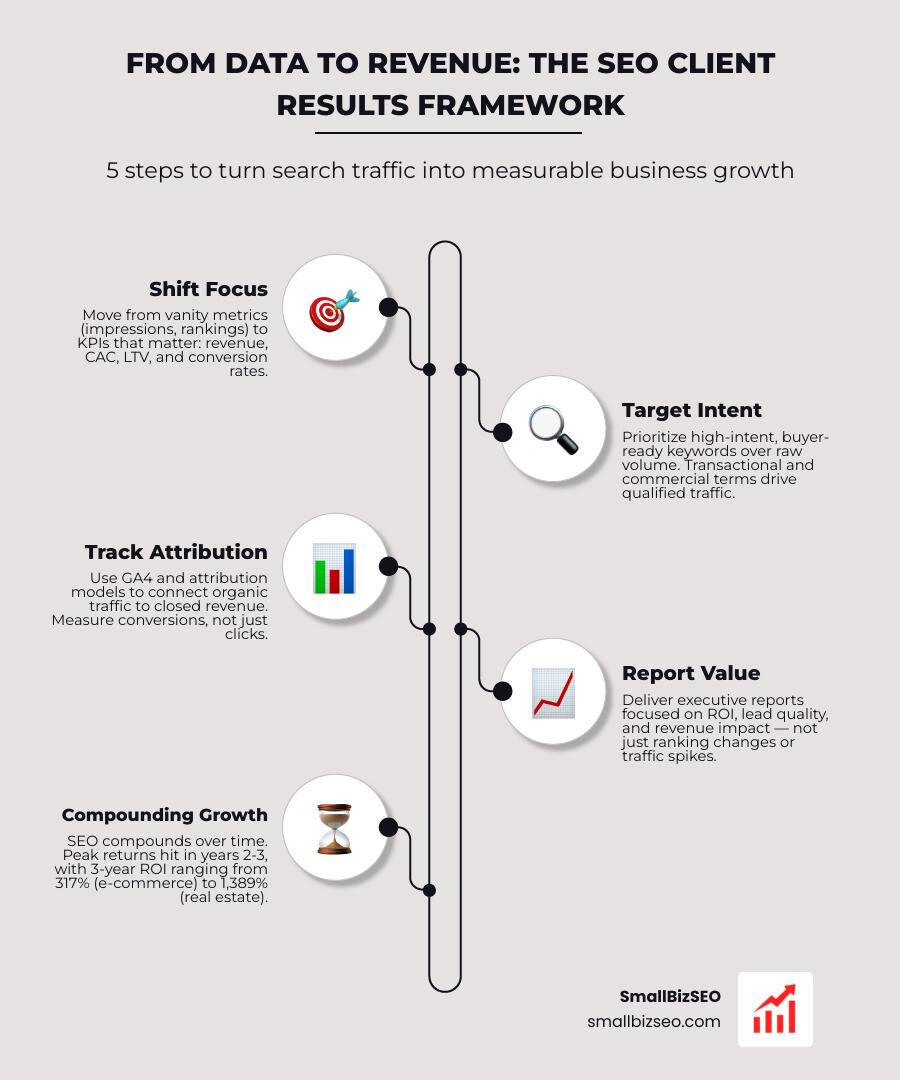
Shifting from Vanity Metrics to Real SEO Client Results
Many agencies drown their clients in data while proving nothing about actual business growth. They report impressions, keyword rankings, and traffic spikes, yet business owners are left asking the same question: "So what does this actually mean for our revenue?"
To deliver true value, we must shift the focus from vanity metrics to strategic key performance indicators (KPIs). Raw traffic is a great starting point, but our ultimate goal is turning that raw Data Into Traffic that converts into paying customers.
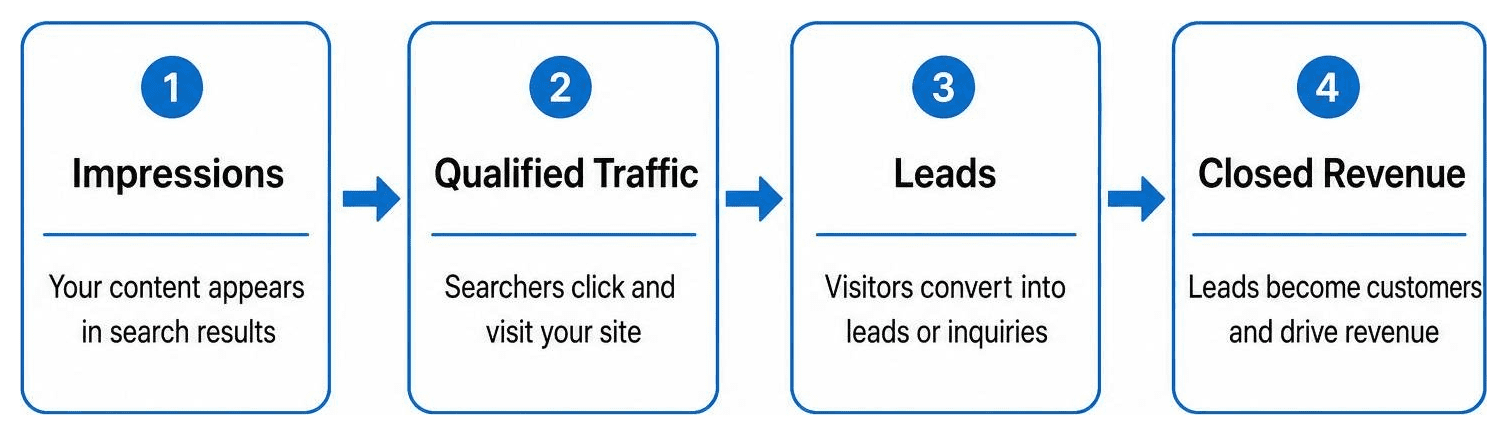
By focusing on metrics like Customer Acquisition Cost (CAC) and Customer Lifetime Value (LTV), we treat SEO as a financial growth engine rather than a mere technical checklist. Organic search customers consistently show higher loyalty and value, often carrying a 31% higher lifetime value than those acquired through social media channels.
Connecting Organic Traffic to Revenue Outcomes
To connect organic traffic directly to business revenue, we set up robust tracking in Google Analytics 4 (GA4). Google's documentation on key events in Google Analytics is a useful reference for understanding how important user actions can be measured inside GA4. This allows us to measure both macro conversions, such as completed transactions or signed service contracts, and micro conversions, such as newsletter sign-ups or pricing guide downloads.
Using multi-touch attribution models ensures that early-stage educational content receives proper credit for introducing buyers to your brand before they make a final purchase. This approach is highly effective for high-value contracts. For example, in a campaign for a flexible workspace provider, shifting the strategic focus toward high-intent pages helped generate a 49% increase in total contract value, even though overall traffic volume remained flat.
Prioritizing High-Intent Keywords Over Raw Volume
Not all search traffic is equal. Ranking at the top of search results for a broad informational query might bring thousands of visitors to your site, but if those visitors have no intent to buy, they will not help your business grow.
We prioritize targeting transactional and commercial-intent keywords that reach buyers when they are ready to make a decision. If you want to identify where your website currently stands and uncover hidden opportunities, getting a comprehensive SEO Visibility Audit is the best way to start mapping out a revenue-focused keyword strategy.
The Anatomy of a High-Impact SEO Report Template
A great SEO report does not overwhelm stakeholders with endless spreadsheets. Instead, it tells a clear, visual story of how organic search is driving business success.

An effective report template should be built around four main pillars:
- Performance Summary: A high-level, jargon-free executive snapshot of progress.
- Organic Visibility: Tracked keyword rankings, SERP feature ownership, and brand presence.
- Organic Traffic: Deep-dive analysis of which landing pages are performing best.
- Organic Conversions: Direct proof of leads, sales, and revenue generated by SEO efforts.
Tailoring Reports for Executives and Marketing Managers
Different stakeholders require different types of information. A Chief Financial Officer or corporate executive does not need to see technical crawl errors or meta description updates. They want to know the return on investment and how search visibility is protecting their market share.
As noted by industry experts, clearly explaining the business value of your efforts is just as important as executing the technical work itself. For marketing managers, we provide detailed technical reports, including Core Web Vitals and click-through rates, while keeping executive summaries focused strictly on business growth and financial performance.
Streamlining Communication with Automated Reporting Tools
Manual reporting is slow and prone to errors. By utilizing automated, white-label reporting tools, we pull live data directly from Google Search Console, GA4, and backlink monitors into clean, easy-to-read client dashboards.
This automation saves valuable time, allowing our specialists to focus on optimizing your campaigns rather than building slides. It also ensures you receive consistent, transparent updates on your schedule, keeping you fully informed of your campaign's progress.
Navigating the New Era of AI Overviews and Search Behavior
Search engine results pages are changing rapidly. The introduction of AI Overviews and conversational search tools has fundamentally altered how users interact with search results.
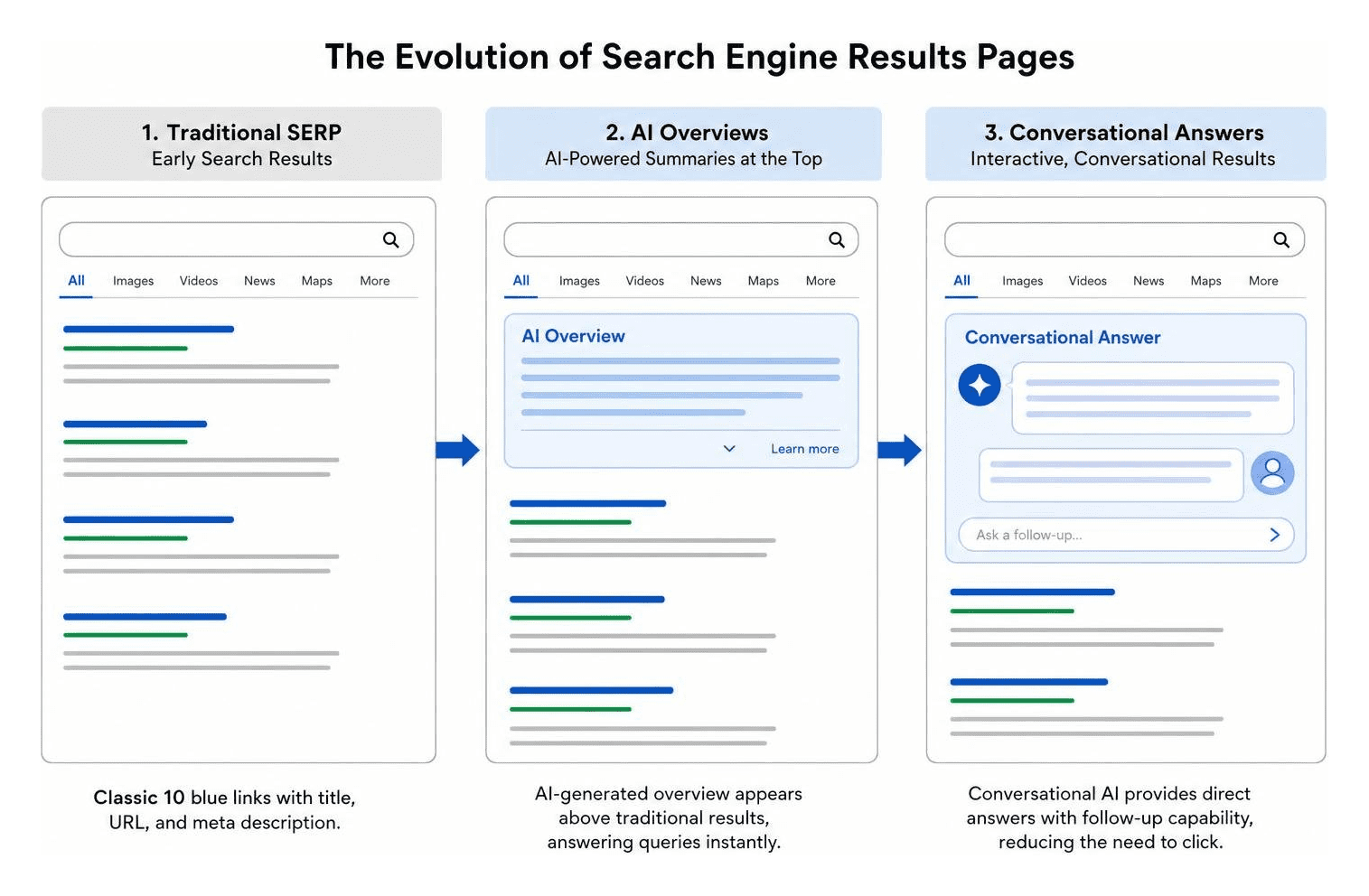
These AI-driven features have caused traditional click-through rates (CTR) to shift. Position #1 CTRs dropped from 28% to 19% (a 32% decline) when AI Overviews appeared on the SERP, while Position #2 fell from 20.8% to 12.6%. However, positions #6 through #10 actually experienced a 30% increase in clicks as users scrolled past unsatisfying AI summaries to find authentic, in-depth sources.
Tracking AI Visibility and Brand Authority as Key SEO Client Results
Because searchers use platforms like ChatGPT, Gemini, Claude, and Grok to make buying decisions, tracking AI visibility is now a critical part of proving SEO client results.
Pages cited in AI Overviews receive 35% more organic clicks. To win these citations, your brand must be recognized as an authority. Over 99% of AI Overview citations come from websites that already rank in the top 10 organic results. Building high-quality backlinks and establishing strong brand authority are essential to securing these AI citations.
Optimizing for Conversational Search and Entity Authority
To optimize for AI search engines, we focus on structured schema markup, entity optimization, and direct-answer copywriting. AI models prefer clear, factual, and structured content.
By answering common customer questions clearly in the first 40 to 60 words of your articles, using comparative tables, and deploying Merchant Listing schema, we make it easy for AI engines to understand and cite your site. This structured approach, paired with strong E-E-A-T (Experience, Expertise, Authoritativeness, and Trustworthiness) signals, ensures your business is recommended by both traditional and conversational search engines.
Winning and Retaining Clients with Value-Based Proposals
We believe that long-term client relationships are built on trust, transparency, and clear expectations. That is why we avoid generic sales pitches and focus on collaborative discovery calls to understand your unique business goals.
Our customized Small Business SEO Packages are designed around this philosophy, ensuring that every deliverable directly supports your target business outcomes.
Designing Tailored Packages for Diverse Budgets
Every business has different resources and competitive landscapes. We design custom campaigns that match your budget with the exact services you need—whether that is technical optimization, content creation, or digital PR. Our proven track record across various industries is highlighted in our Case Studies, showing how tailored plans drive rapid and sustainable search growth.
Proving Long-Term Value to Maximize SEO Client Results
SEO is an investment that compounds over time. While we work quickly to resolve technical issues and secure early ranking wins, the most significant revenue breakouts typically occur within 6 to 12 months as your content authority grows.
We focus on building a permanent, high-value digital asset that continues to generate leads long after your initial investment. You can read about the long-term success our clients have achieved in our Testimonials.
Frequently Asked Questions about SEO Client Results
How long does it take to see measurable SEO client results?
While minor ranking improvements and technical fixes can show progress within the first 3 months, meaningful business results like increased leads and revenue typically take 6 to 12 months of consistent work to fully compound.
What are the most important KPIs to include in a monthly SEO report?
A high-impact monthly report should focus on organic conversion rate, attributed organic revenue, keyword rankings for high-intent terms, backlink profile growth, and Core Web Vitals.
How do AI Overviews affect organic click-through rates?
AI Overviews have reduced clicks for the very top organic positions. However, they have increased click-through rates for positions #6 through #10, and being cited directly within an AI Overview provides a massive 35% boost in organic traffic.
Partner with a Team Built for Velocity

At SmallBizSEO, we do not believe in vanity metrics or empty promises. Our data-driven "Velocity" framework is built to deliver fast rankings, robust search authority, and transparent reporting that connects directly to your bottom line.
If you are ready to stop chasing impressions and start driving real, measurable revenue, we are here to help. Get started with our professional SEO services today, and let us build a predictable channel for your business growth.