Smart Strategies for Answering Nuanced Customer Questions Accurately

Why Clear Service Answers Need More Than a Short Reply
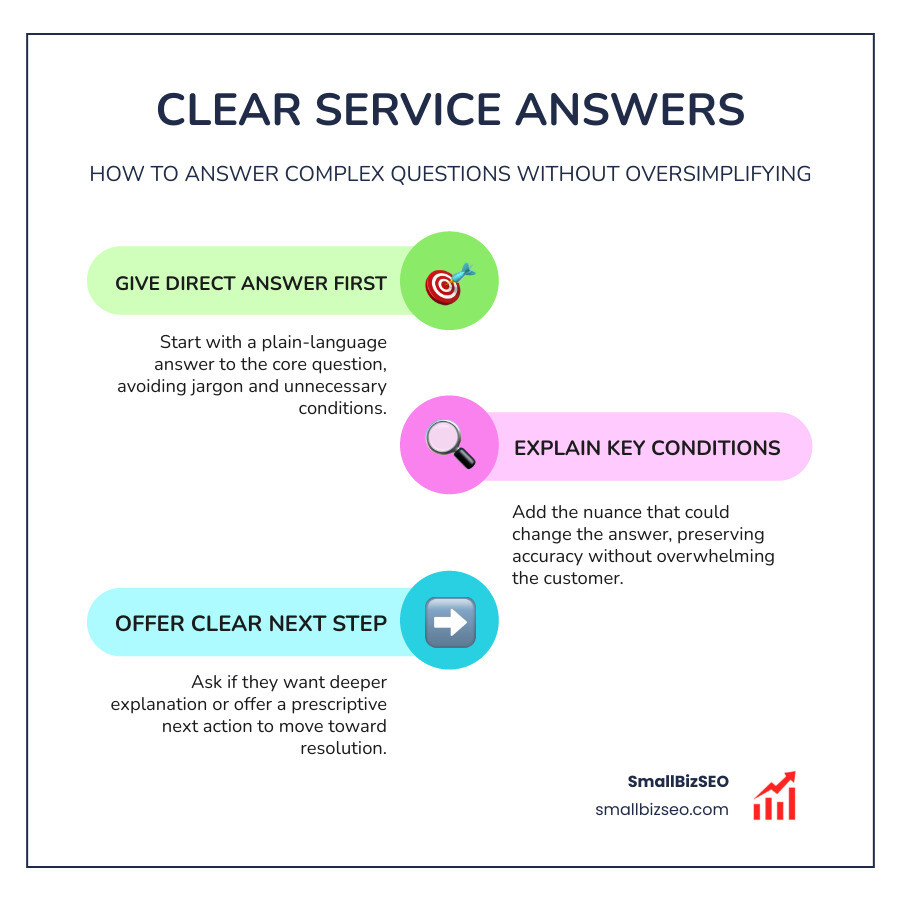
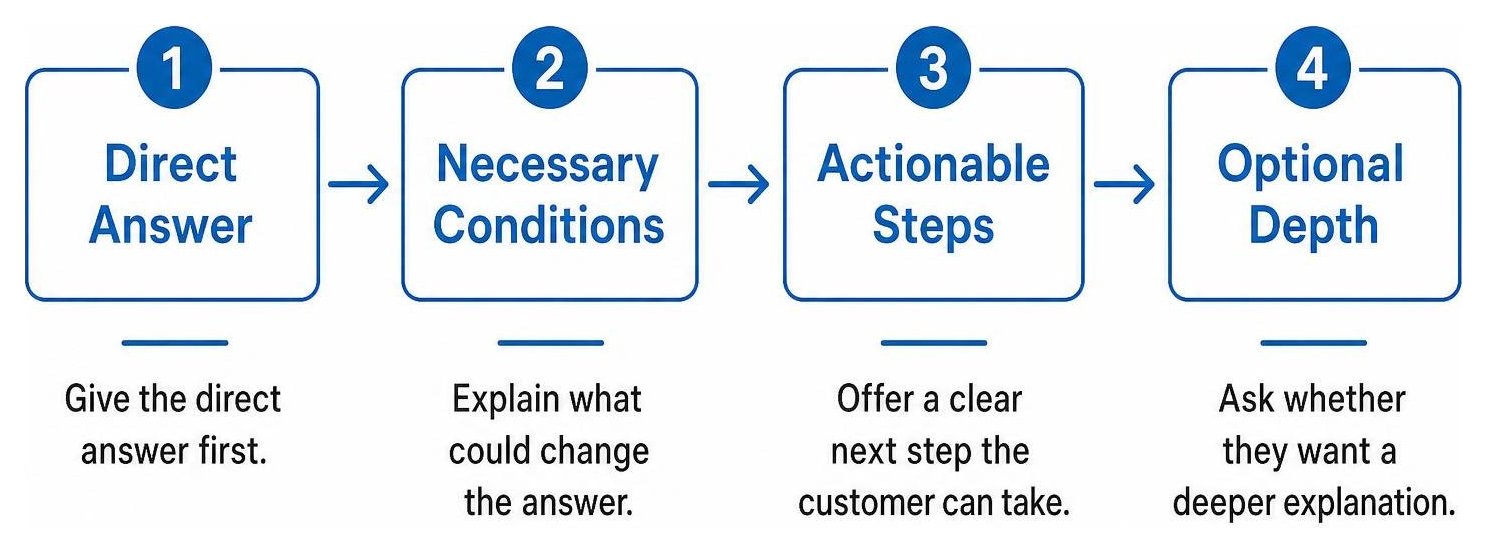
Here's how to answer complex service questions without oversimplifying: give the direct answer first, explain what could change it, and offer a clear next step. Use plain language, but keep any detail the customer needs to make a sound decision. Then ask whether they want a deeper explanation.
A short answer can save time. An answer that hides a key condition can create more confusion later.
I'm Clayton Johnson, founder of SmallBizSEO. I turn SEO expertise into practical guidance for small businesses, including how to answer complex service questions without oversimplifying.
Customer expectations for rapid answers have reached an all-time high. Recent customer experience benchmarks show that 88% of customers expect faster response times than before, and more than half of CRM leaders report that customers expect complete problem resolution in three hours or less. When service teams rush to hit speed benchmarks, they often strip out crucial nuances, which harms first contact resolution and customer trust. Understanding how to reduce cognitive load while preserving core accuracy is what separates elite customer service from frustrating support loops.
How to Answer Complex Service Questions Without Oversimplifying: Core Frameworks
To answer intricate customer inquiries accurately, structure your reply using an inverted pyramid: state the primary conclusion upfront, supply the necessary operational conditions, and provide a path to explore further technical depth.

When people face a difficult service dilemma, their immediate priority is finding a clear path forward. Sales engineers and support representatives often fall into the trap of over-explaining the background before delivering the conclusion. Instead, you should always answer the question first.
Delivering the bottom line immediately establishes credibility and respects the user's time. After providing the direct answer, optimize for information density by applying the deletion heuristic: eliminate every sentence or filler phrase that does not actively help the user solve their problem or understand critical risks. Writing answer-ready content ensures that your explanations resolve immediate concerns while keeping essential facts intact.
| Response Style | Characteristics | Example Customer Reply | Outcome |
|---|---|---|---|
| Confusing & Jargon-Heavy | High technical detail, unexplained terminology, passive voice. | "We cannot provision the SSL certificate due to propagation delays in the CNAME record mapping on your authoritative DNS nameserver." | Customer confusion, escalation, increased cognitive load. |
| Oversimplified / Facile | Omits conditions, hides trade-offs, overpromises simplicity. | "Everything is fixed! Your security settings are all set now." | High immediate satisfaction, but broken trust when edge cases fail. |
| Layered & Accurate | Direct answer first, clear assumptions, structured technical depth. | "Yes, your SSL certificate will activate within two hours once your DNS records update. We've verified your settings, and no further action is needed on your end." | Immediate clarity, accurate expectations, high first contact resolution. |
What Is the Difference Between Simplifying and Oversimplifying a Service Query?
Simplifying a service query means removing unnecessary cognitive friction and industry jargon, whereas oversimplifying means omitting vital facts, limitations, or prerequisites that the customer needs to make an informed decision.
A superficial or facile explanation sounds neat on the surface but ignores real-world complexity. For instance, telling a client that a server migration will cause zero downtime sounds reassuring, but if that outcome requires them to freeze database updates during the process, omitting that condition is misleading. High-performing teams improve content readability by making difficult technical workflows accessible without stripping out the foundational logic that protects customer operations and long-term retention.
How to Answer Complex Service Questions Without Oversimplifying Using the Layered Approach
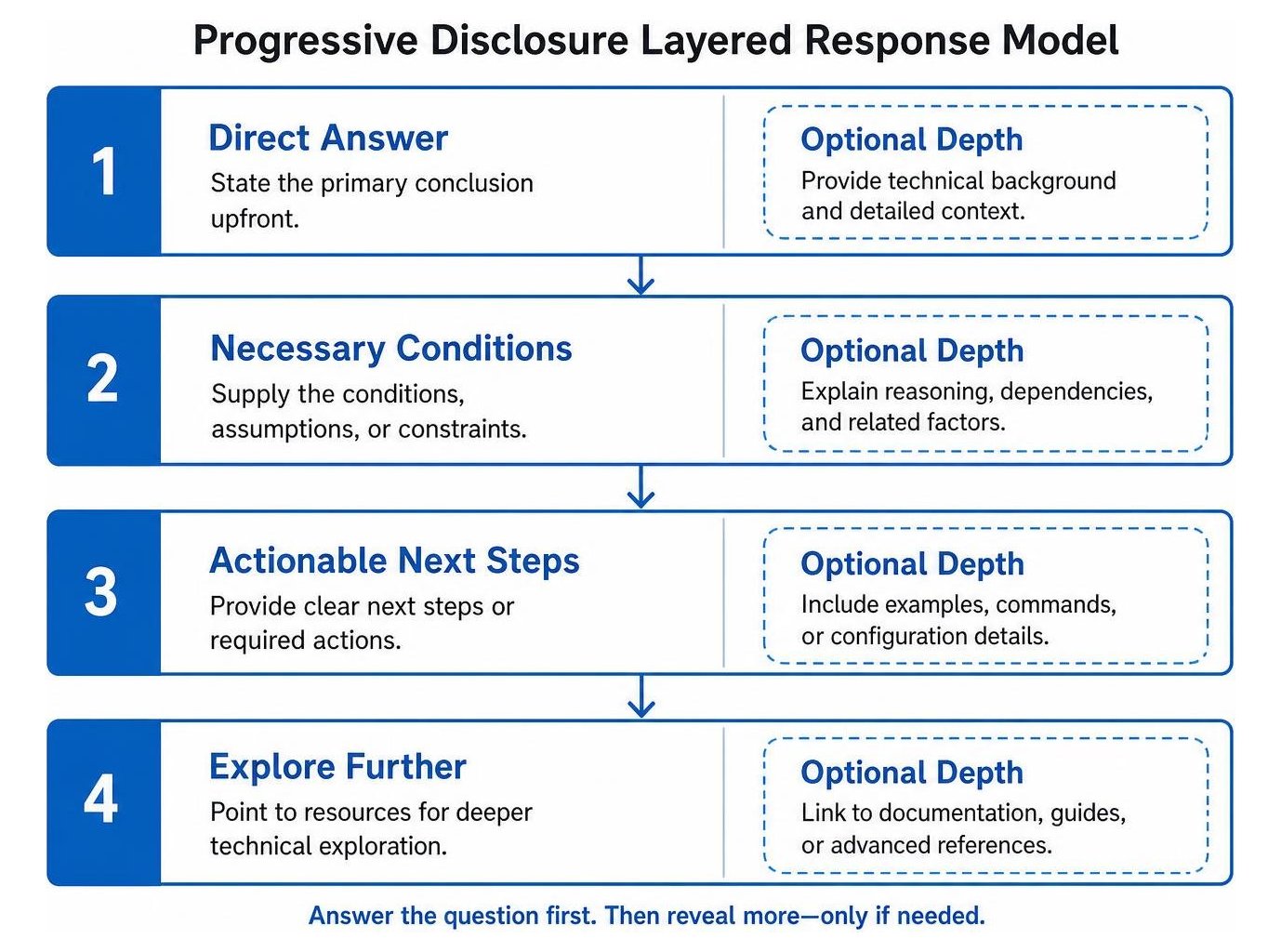
The layered approach uses progressive disclosure: deliver a concise executive summary first, followed by clear next steps, and conclude with optional, expandable technical detail.
When fielding multifaceted questions, customer support agents succeed by providing concise yet complete answers. Aligning your response structure with specific search intent allows you to serve both the hurried executive who only needs the decision and the hands-on specialist who requires detailed documentation.
You can implement this layered framework through four distinct gates:
- Urgency Detection: Identify whether the customer has an active production emergency or is conducting high-level research.
- Core Direct Answer: Provide an unambiguous, 1-2 sentence resolution or status confirmation.
- Operational Context: Detail any dependencies, assumptions, or alternative paths in plain language.
- Expandable Technical Depth: Provide links to documentation, detailed technical logs, or step-by-step guides for users who want to review the mechanics.
How to Answer Complex Service Questions Without Oversimplifying When Using Analogies and Metaphors?
Use analogies that map unfamiliar technical mechanisms to familiar everyday concepts, and explicitly state the limitations of the comparison so the client does not make incorrect assumptions.

Analogies serve as conceptual bridges. For example, explaining API rate limits by comparing them to a water meter helps a non-technical stakeholder understand why requests are throttled during traffic spikes. However, every analogy has boundary conditions. If an analogy is stretched too far, it distorts reality.
To maintain accuracy, connect your analogies to semantically related terms that reinforce correct industry concepts. State the comparison, explain the principle, and briefly clarify the boundary so your explanation remains accurate.
Best Practices for Delivering Layered and Precise Support Responses
Delivering precise service responses requires disciplined formatting, clear hypothesis testing, and structured reply checklists that keep answers concise and empathetic.

Standardizing your communication workflow prevents agents from alternating between confusing jargon dumps and unhelpful oversimplifications. Leading engineering teams design their ticket response workflows around two operational modes: characterization mode, where facts and logs are systematically gathered, and hypothesis-testing mode, where concrete solutions are tested and validated. Organizing your internal knowledge into a comprehensive topic cluster gives support teams instant access to verified, deep technical explanations that can be linked directly in customer replies.
How Can You Gauge Audience Expertise and Urgency Without Making Them Feel Patronized?
Gauge your audience's technical proficiency and urgency by analyzing the specific vocabulary in their prompt, looking for explicit time markers, and verifying comprehension using collaborative, non-condescending phrasing.
If a customer asks for a fast answer with keywords like "ASAP" or "quick confirmation," lead with the direct answer. If they ask conceptual questions starting with "why" or "how does this affect," provide additional technical context.
To verify understanding without sounding patronizing, avoid asking, "Does that make sense?" which can imply the user might struggle to comprehend. Instead, use collaborative, ownership-based checks such as:
- "Let me know if you would like me to dive deeper into how this impacts your database configuration."
- "We can explore the alternative migration paths together if your team wants to review those options."
How Do You Anticipate Follow-Up Questions and Proactively Address Nuance?
Anticipate follow-up questions by identifying the logical next action the customer must take once their initial issue is resolved, addressing that step directly in your first response.
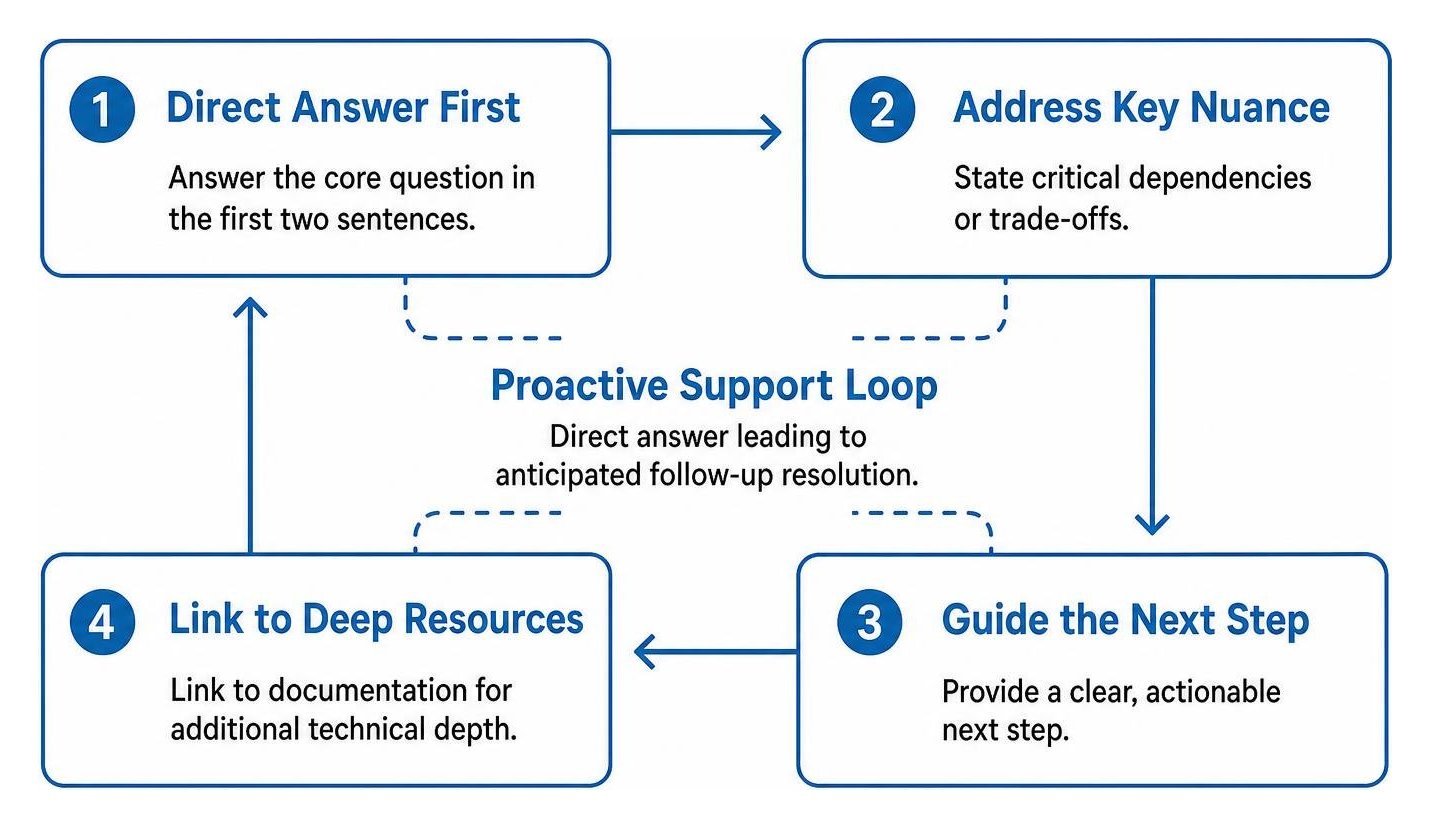
Before sending an answer to a complex service query, run through this concise pre-send verification checklist:
- Did I answer the core question in the first two sentences? Ensure the primary conclusion is obvious upfront.
- Did I clearly state any critical dependencies or trade-offs? Check that prerequisites or operational requirements are visible.
- Is the tone human, objective, and calm? Verify that the reply is free from corporate defensiveness or robotic phrasing.
- Did I provide a clear, actionable next step? Ensure the recipient knows exactly what will happen next and who owns the action.
- Did I link to deep documentation rather than pasting walls of text? Keep the main email readable while preserving full technical depth.
By mastering these structured communication models, your business builds trust and elevates customer satisfaction. At SmallBizSEO, we build data-driven organic growth and AEO optimization and strategy services using these exact principles: delivering concise, accurate answers that serve user intent while preserving the depth and authority required to succeed.
Mastering Nuanced Service Communication for Long-Term Trust
Explaining complex technical services does not require choosing between confusing jargon and superficial summaries. By leading with the bottom-line answer, outlining critical conditions in everyday language, and offering structured layers of technical depth, you can deliver fast, complete, and honest service communications. Apply these layered communication habits across your service channels to turn complex interactions into lasting customer relationships.