Step-by-Step Blueprint for Knowledge Graph Construction
How Do You Start Building a Knowledge Graph?
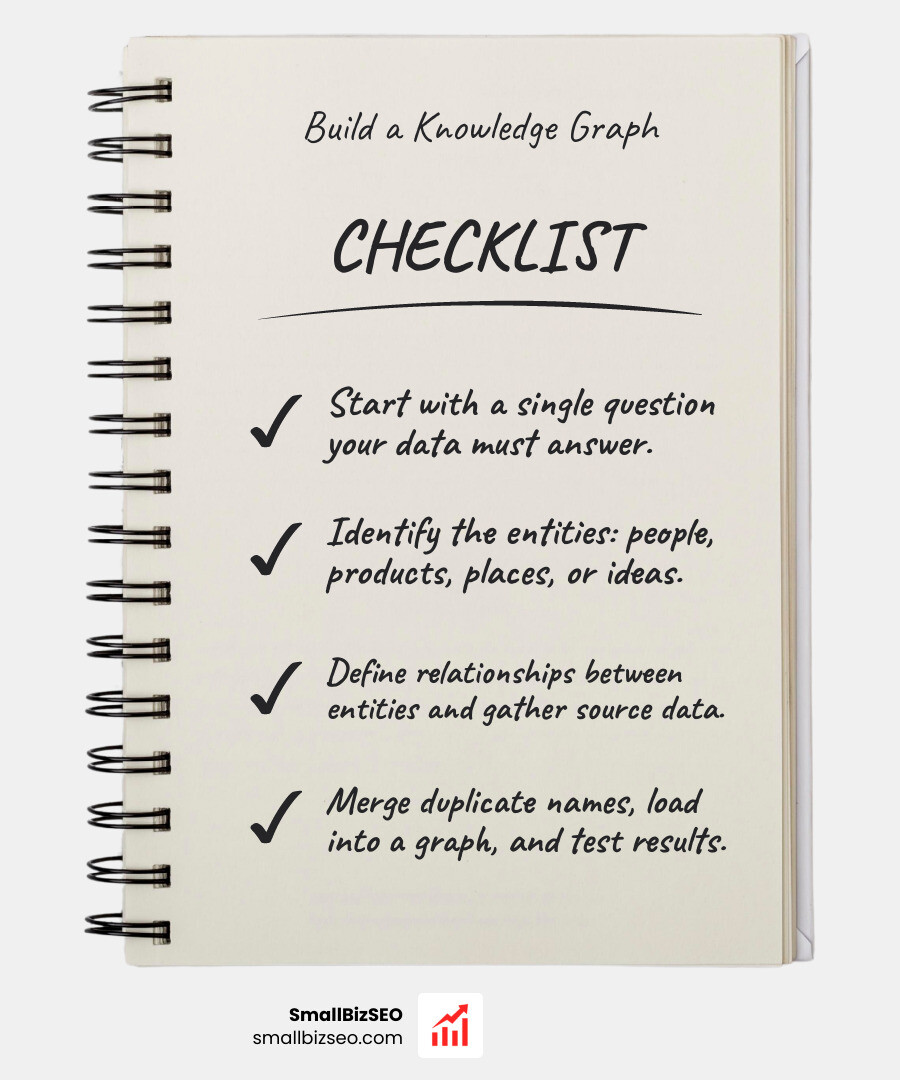
Start building a knowledge graph with one question you need your data to answer. Identify the people, products, places, or ideas involved. Define how they relate, gather the source data, and combine duplicate names for the same thing. Then load those connections into a graph and test whether it answers your question correctly.
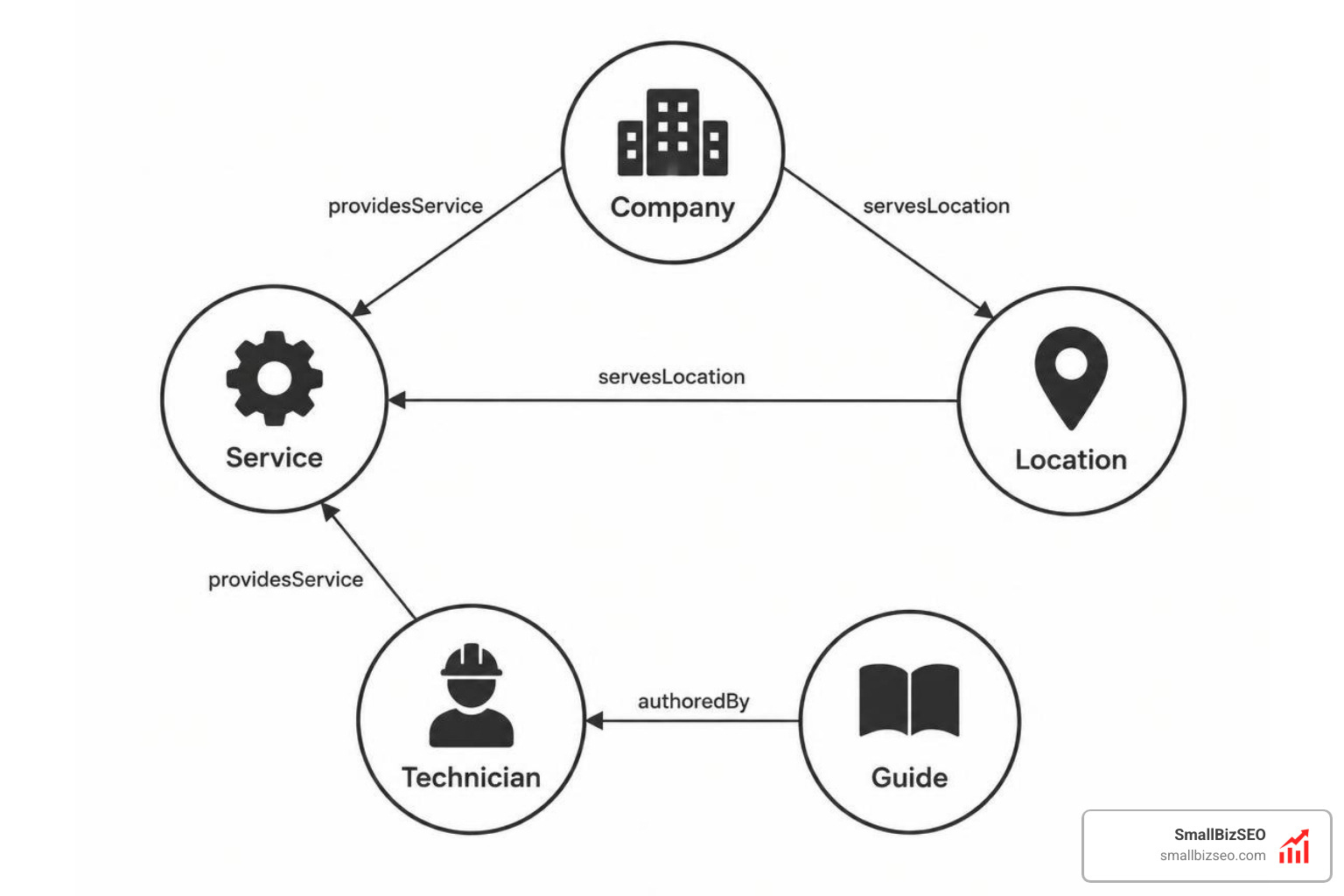
For example, a business graph might connect a company to its services and the locations it serves. Keeping the first version small makes errors easier to find before you add more data.
I’m Clayton Johnson, founder of SmallBizSEO, where my work in SEO and content strategy focuses on clear, consistent business information. I bring that focus to building a knowledge graph: define what matters, check the evidence, and keep the information useful as it changes.
What Is a Knowledge Graph, and Why Build One?
A knowledge graph is a network of real-world entities—such as people, organizations, locations, or concepts—connected by explicit, descriptive relationships. Unlike traditional databases that store information in separate tables, a graph models information the way people think about it: as objects and facts linked together.
When organizations manage information across dozens of systems, traditional relational databases hit a wall. As a rule of thumb, relational systems begin to struggle when data spans around thirty interconnected tables. Below this threshold, relational tables work well; above it, running complex multi-table joins creates heavy computing bottlenecks. Graph structures eliminate these bottlenecks by treating relationships as direct physical links.
Consider how an organization structures its operations. A company does not exist in isolation; it offers specific services, operates across designated service areas, employs certified technicians, and publishes authoritative educational guides. In a knowledge graph, each of these elements is a distinct node, connected by clearly labeled edges such as providesService, servesLocation, or authoredBy.
This explicit structure guarantees factual accuracy across enterprise systems. NASA documented this value during mission planning, saving over $2 million by linking decades of historical engineering records to uncover recurring trends and prevent past mistakes. Similarly, Cisco indexed 20 million internal technical and sales documents using a graph architecture, cutting search times in half and saving more than 4 million work hours annually.
How Do You Build a Knowledge Graph from Scratch?
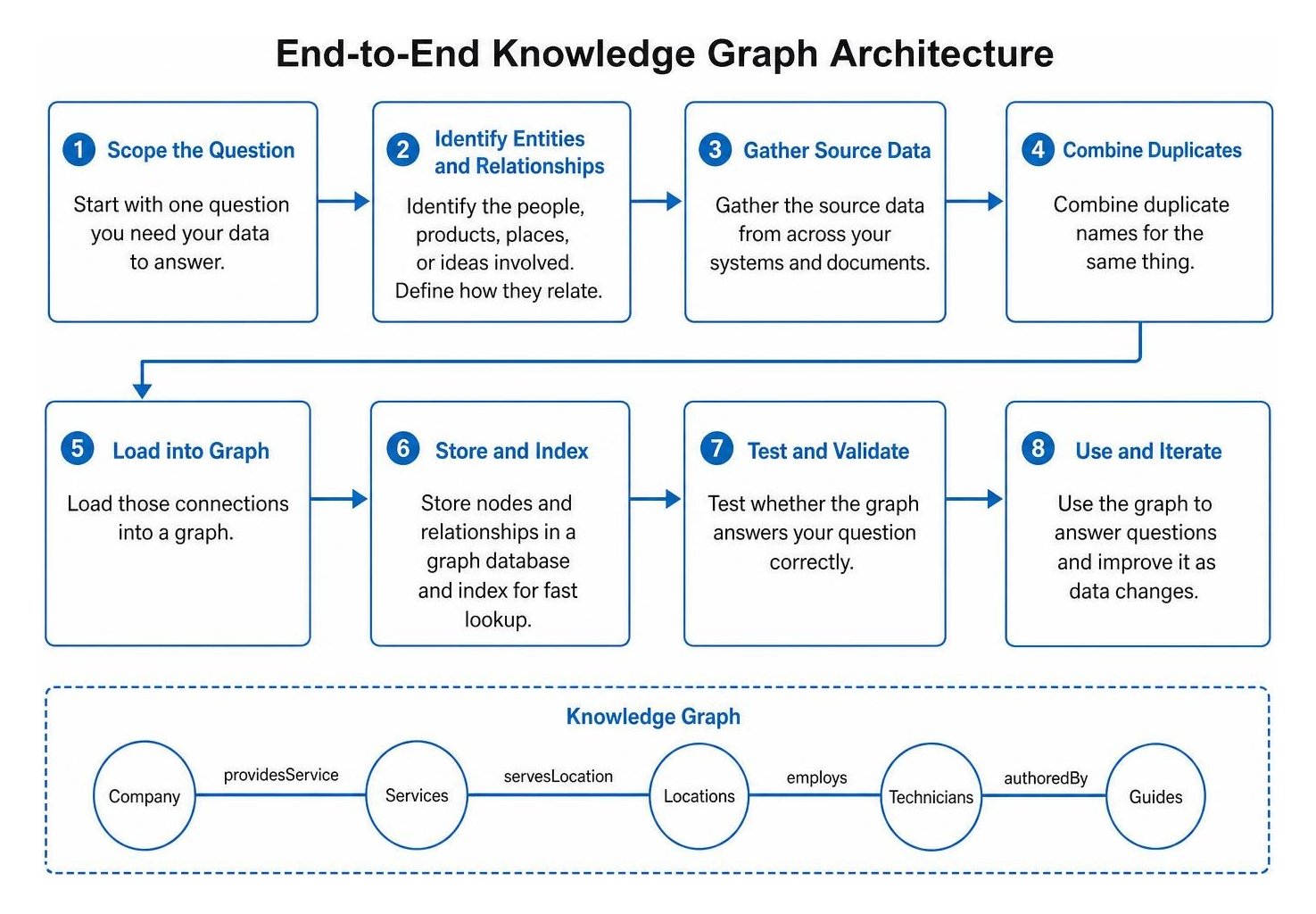
Building a knowledge graph requires a systematic workflow: scoping business questions, mapping data models, extracting connections, deduplicating records, loading nodes into storage, and validating results against real-world queries.
Constructing an enterprise-grade knowledge graph relies on forensic data modeling. This means acquiring messy, multi-structured data from internal spreadsheets, SQL databases, customer portals, and unstructured documents, then cleaning it into standard representations.
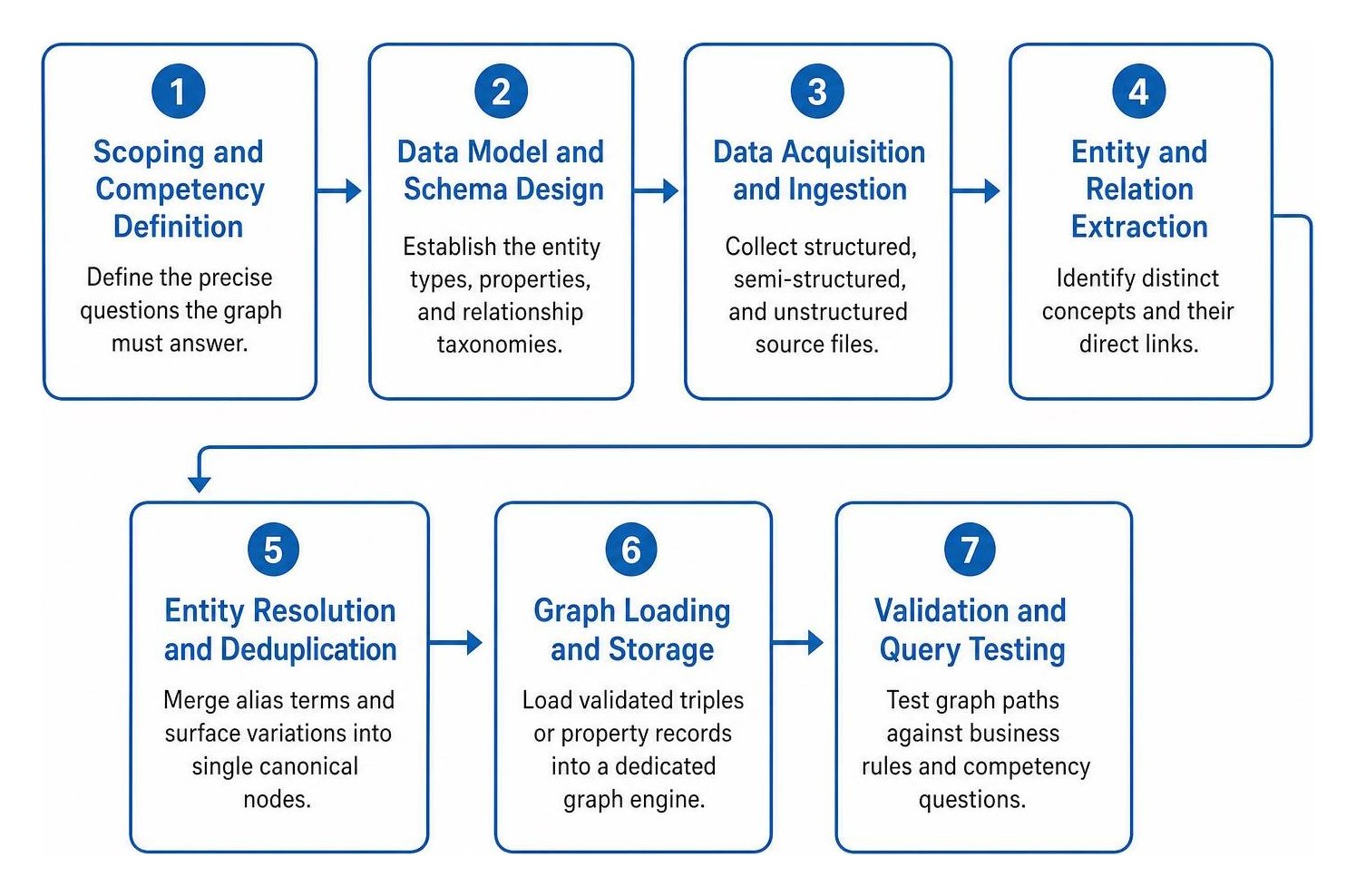
The primary phases of graph construction follow a repeatable sequence:
- Scoping and Competency Definition: Define the precise questions the graph must answer.
- Data Model and Schema Design: Establish the entity types, properties, and relationship taxonomies.
- Data Acquisition and Ingestion: Collect structured, semi-structured, and unstructured source files.
- Entity and Relation Extraction: Identify distinct concepts and their direct links.
- Entity Resolution and Deduplication: Merge alias terms and surface variations into single canonical nodes.
- Graph Loading and Storage: Load validated triples or property records into a dedicated graph engine.
- Validation and Query Testing: Test graph paths against business rules and competency questions.
Which Data Model Should You Choose for a Knowledge Graph?
Choose between an RDF (Resource Description Framework) triple store and a Labeled Property Graph (LPG) database based on your primary use case. RDF triple stores excel at cross-system data federation, web interoperability, and formal semantic inferencing. Labeled property graphs excel at fast pattern traversals, operational analytics, and property-heavy entity modeling.
| Feature | RDF Triple Store | Labeled Property Graph (LPG) |
|---|---|---|
| Primary Unit | Subject-Predicate-Object triple | Node, Relationship (Edge), Properties |
| Standard Query Language | SPARQL | Cypher, GQL, Gremlin |
| Edge Properties | Requires reification or RDF-Star | Native key-value pairs on edges |
| Identifier System | Global HTTP Uniform Resource Identifiers (URIs) | Internal database identifiers and labels |
| Schema Validation | SHACL (Shapes Constraint Language), OWL | Database constraints, schema schemas |
| Best Used For | Web-scale linked data, public ontologies | Deep traversals, real-time analytics |
An ontology provides the formal organizing principle for the graph, defining classes and permissible relationships in clear terms. Grounding your schema in academic research on graph modeling helps prevent unnecessary complexity. Instead of inventing proprietary vocabularies from scratch, follow best practices for FAIR graph creation by adopting established standards like Schema.org, SKOS, or Dublin Core. Using persistent, dereferenceable URIs ensures your entity identifiers remain stable as backend technologies change over time.
How Do You Extract and Resolve Entities from Raw Content?
Extracting information from unstructured documents requires identifying named mentions, establishing their relational ties, and merging duplicate terms into canonical records.
Unstructured text—such as technical manuals, research reports, and customer transcripts—contains valuable facts trapped in plain prose. The extraction pipeline uses Named Entity Recognition (NER) to locate words representing real-world concepts, followed by Relation Extraction (RE) to determine how those items interact.
Once terms are extracted, entity resolution and coreference resolution resolve variations across texts. Different surface forms frequently describe the same underlying entity. For instance, "Dr. J. Smith," "John Smith," and "Chief Technical Officer" might all point to a single individual within the same corporate dataset. Traditional string matching fails when aliases share zero character overlap.
Modern pipelines resolve this by applying disambiguation cascades:
- Contextual Description Extraction: Capture short surrounding descriptions during extraction.
- Blocking and Clustering: Group candidate mentions using lexical blocking, phonetic indexes, or vector similarity.
- Disambiguation Filtering: Use contextual prompts or deterministic matching rules to separate distinct individuals sharing the same name while merging true aliases.
- Canonical Assignment: Map all surface variants to a single master node identifier.
As outlined in the survey on automated graph construction, systematically refining raw mentions into canonical nodes prevents disconnected or circular graph structures.
How Do You Ingest, Validate, and Test Graph Connections?
Ingesting data requires bulk-loading mapped datasets into the target database, validating structural constraints, and testing the graph against the original competency questions.
Individual transactional write operations create massive processing overhead during initial builds. Instead, use bulk import utilities to load nodes, edges, and properties in parallel batches. To maintain dependable data grounding, incoming facts must be validated before being treated as permanent ground truths.
Validation uses SHACL (Shapes Constraint Language) or structural graph constraints to enforce data integrity:
- Target Node Checks: Confirm that every instance labeled Service contains mandatory properties like a title and service code.
- Cardinality Limits: Ensure an entity possesses exactly one primary operational headquarters.
- Value Type Restrictions: Check that properties like pricing, dates, and geographic coordinates match expected formats.
- Relationship Integrity: Verify that relationships only link permitted entity types (for example, certifies must connect an AccreditationBody to a Business).
As highlighted in lecture insights on graph construction, regression testing with explicit SPARQL or Cypher queries guarantees that recent data loads have not introduced logical contradictions or broken relationship paths.
How Can You Optimize a Knowledge Graph for Search and AI?
Optimizing a knowledge graph for modern search and artificial intelligence requires structuring connections so machine systems can traverse context, verify facts, and extract verified answers efficiently.

A well-modeled graph transforms isolated documents into an interconnected knowledge layer. Search engines and enterprise platforms use this relational fabric to perform advanced semantic search, resolving user intent rather than simply matching isolated keywords. By publishing Schema.org structured data aligned with an internal knowledge graph, businesses make their service footprints, verified locations, and leadership profiles instantly readable by search engines and generative answer engines.
How Can Graph Architectures Support AI Search and Multi-Hop Reasoning?
Knowledge graphs provide the factual reasoning foundation needed to connect disparate pieces of information across multiple documents.
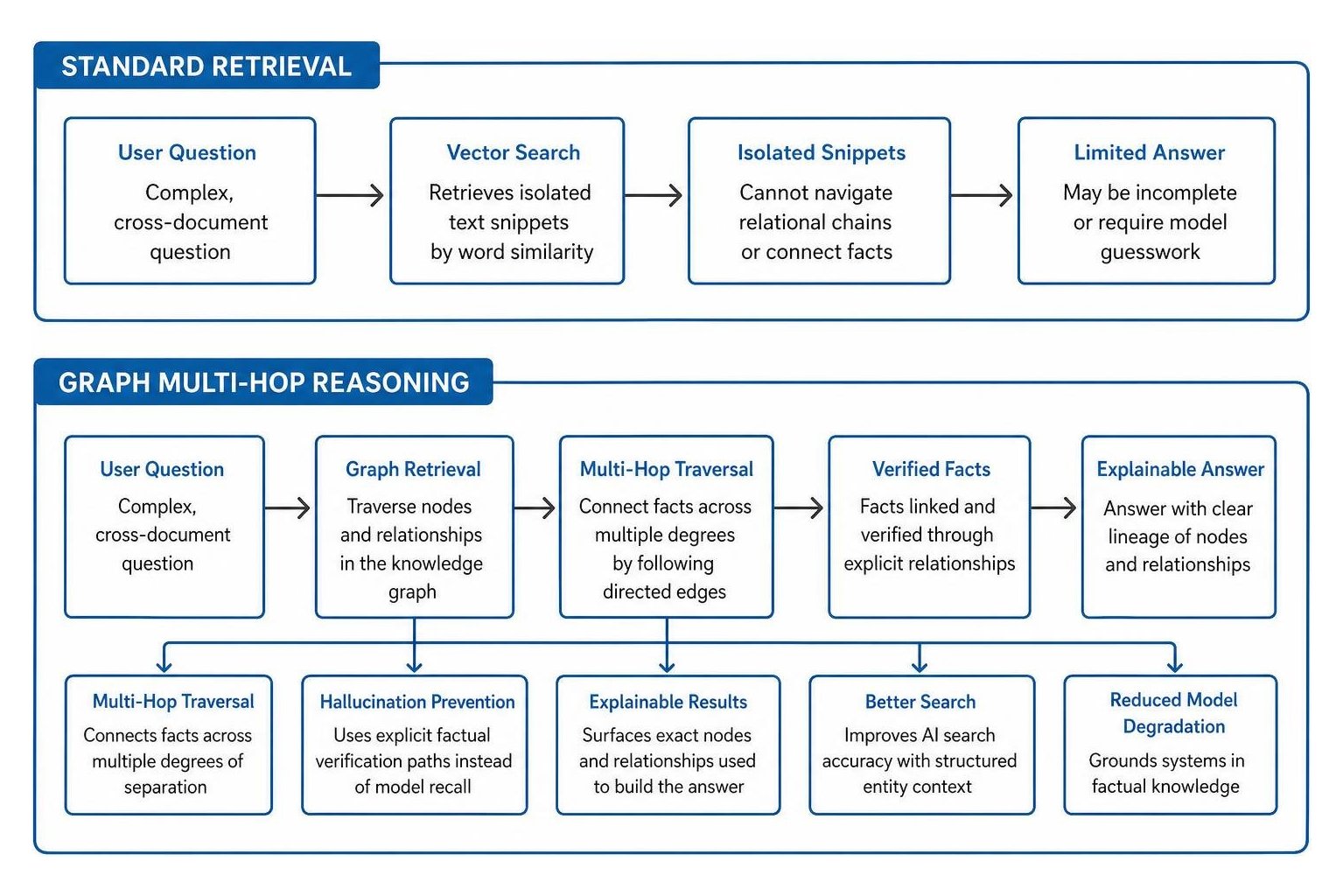
Standard vector retrieval systems often struggle when answering complex, cross-document questions, such as tracing which subcontractor supplied materials for a specific infrastructure project. Vector search retrieves isolated text snippets based on word similarity, but cannot navigate relational chains. Integrating a knowledge graph through RAG architectures solves this limitation.
Graph-driven context retrieval delivers measurable operational advantages:
- Multi-Hop Traversal: Connects facts across multiple degrees of separation by following directed edges between nodes.
- Hallucination Prevention: Replaces uncertain internal model recall with explicit factual verification paths.
- Explainable Results: Surfaces the exact nodes and connecting relationships used to construct an answer, providing clear lineage.
- Better Search Performance: Improves AI search accuracy by supplying structured entity contexts.
- Reduced Model Degradation: Grounds systems so they do not rely entirely on static parametric knowledge.
Modern digital commerce relies on these principles. For example, a unified shopping graph connects products, technical specifications, compatible accessories, customer reviews, and regional stock levels into an integrated network that powers accurate product recommendations.
How Do You Maintain a Knowledge Graph Over Time?
Maintaining a knowledge graph requires automated pipelines that track information sources, account for changes over time, and measure graph health systematically.
As business operations evolve, entities and relationships change. Maintaining graph utility requires a clear knowledge evolution strategy. Track provenance using standards like the W3C PROV-O model so every asserted relationship records its original source, extraction confidence score, and ingestion timestamp.
Model time-sensitive facts using temporal properties or reification nodes that include explicit validFrom and validTo dates. This structure prevents outdated records from polluting current queries while preserving historical data.
Incorporate an ongoing information gain framework to expand the graph only when new data sources add fresh, non-redundant insights. Finally, measure graph quality using clear benchmarks:
- Node and Edge Completeness: Monitor the percentage of expected properties populated across classes.
- Orphan Node Ratios: Identify and resolve disconnected entities that lack active relationships.
- Query Latency Benchmarks: Track execution speeds for standard multi-hop queries as the total graph size grows.
- Schema Conformance: Run automated SHACL shape validations during every data pipeline run to block malformed triples.
Unlocking Business Value Through Connected Knowledge
Building an enterprise knowledge graph turns fragmented, unorganized data into a structured business asset. By starting with clear competency questions, choosing the right data model, and enforcing strict validation checks, organizations create an enduring information foundation.
Whether powering GraphRAG implementations, improving enterprise search, or maintaining consistent data across internal systems, an interconnected graph delivers factual accuracy and deep contextual intelligence. Building your graph incrementally ensures that every node and edge directly supports the questions your business needs to answer.