Stop Over-Optimizing and Start Writing Naturally for Context Queries

How Do You Write Naturally for Context-Sensitive Search Queries?
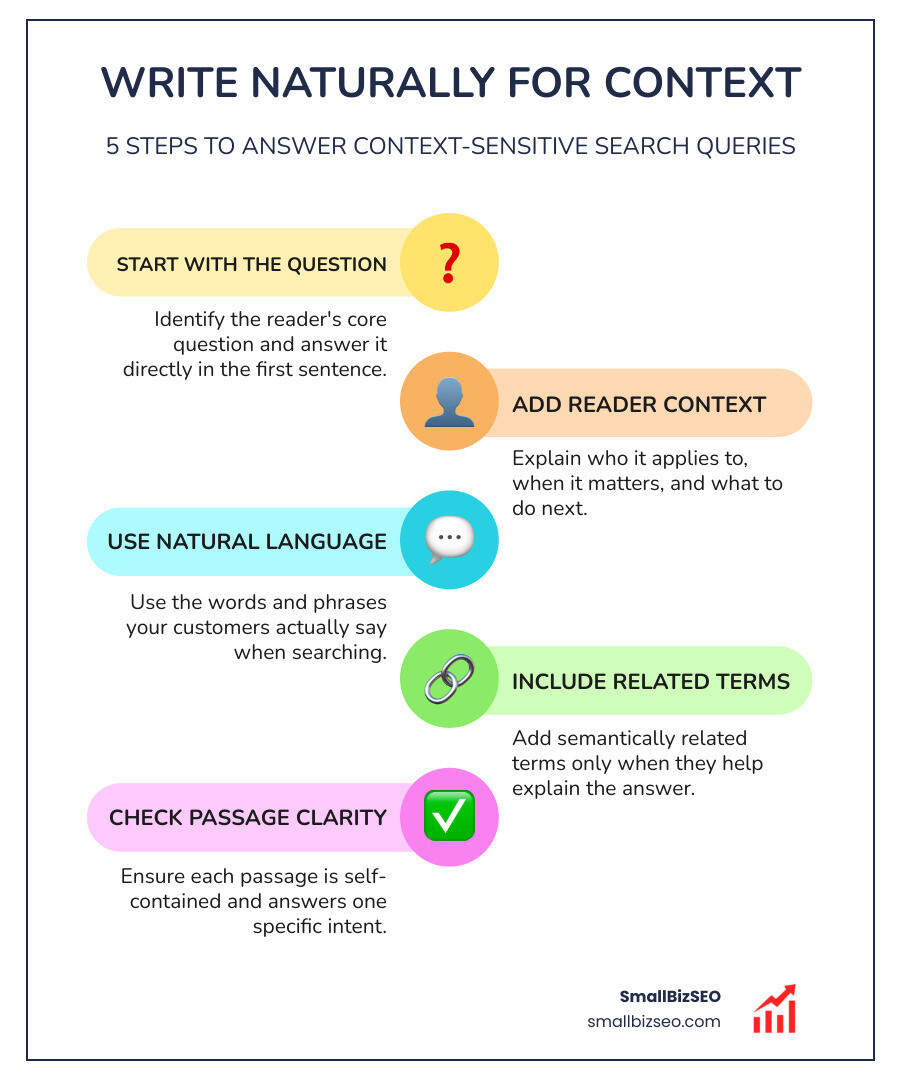
Writing naturally for context-sensitive search queries starts with the reader’s question. Give a clear answer first. Then add the details that make it useful: who it applies to, when it matters, and what the reader should do next. Use the words customers use, and include related terms only when they help explain the answer.
A page about SEO costs, for example, should not just repeat “SEO pricing.” It should explain what affects the cost and what a small business can expect. That helps readers with different situations find an answer they can use.
I’m Clayton Johnson, founder of SmallBizSEO. My work in content strategy and Answer-Ready SEO focuses on writing naturally for context-sensitive search queries so small businesses can answer customer questions clearly and build search visibility.
What Are Context-Aware Search and Natural Language Queries?
Context-aware search uses the meaning, intent, and background constraints behind a query rather than relying on exact keyword matching to retrieve accurate information.

Modern search engines and discovery tools process language using a Natural Language Query (NLQ) framework. Instead of scanning pages solely for recurring strings of text, these systems interpret relationships between real-world entities, user constraints, and conversational context. When a person asks an AI assistant or search bar a multi-part question, the system determines the underlying intent before surfacing an answer.
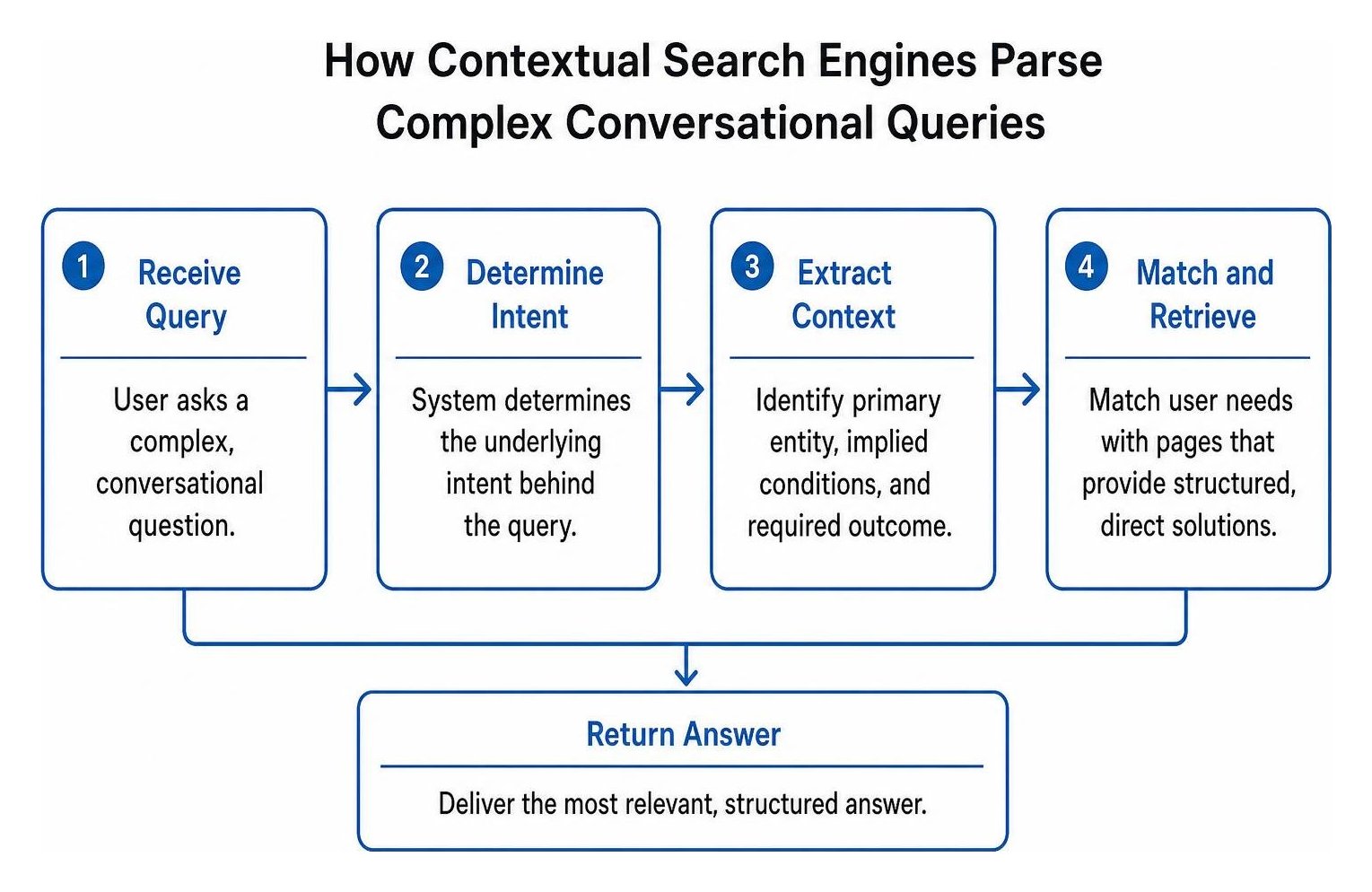
Contextual systems deconstruct full-sentence inquiries into structured semantic elements. By identifying the primary entity, implied conditions, and required outcome, retrieval models match user needs with pages that provide structured, direct solutions.
How Can You Write Naturally for Context-Sensitive Search Queries?
Put the clearest answer first, then add the context, entities, and supporting details readers need to understand the topic thoroughly.

Writing for modern search requires aligning your material with how retrieval systems parse meaning. As highlighted in research on Language Models as Context-sensitive Word Search Engines, advanced algorithms evaluate terms based on surrounding textual clues rather than static definitions.
By prioritizing passage-level indexing, publishers can ensure search engines understand every section of an article. Accurately understanding search intent allows you to structure pages so both human readers and automated systems immediately locate relevant information.
How Does Search-Based NLQ Differ from AI-Powered Context Querying?
Search-based NLQ relies on keyword indexing and basic grammar filters to locate matching documents, whereas AI-powered NLQ interprets contextual nuances, entity relationships, and conversational history to generate accurate answers.
Scientific research on natural language processing demonstrates how computational models have evolved from rigid keyword matching to deep transformer architectures capable of semantic parsing.
| Feature | Search-Based NLQ | AI-Powered NLQ |
|---|---|---|
| Query Interpretation | Matches literal keywords against an index | Interprets underlying semantic intent |
| Context Handling | Evaluates isolated search terms | Analyzes multi-turn context and constraints |
| Output Type | Document links and raw passages | Direct answers and structured synthesis |
| Ambiguity Resolution | Struggles with pronouns and homonyms | Resolves references using surrounding text |
| Data Handling | Requires exact phrase matches | Maps everyday questions to structured entities |
Search-based tools often produce inaccurate results when queries contain unusual phrasing or missing keywords. In contrast, AI-powered systems restructure vague user questions into precise semantic inquiries, dramatically improving retrieval accuracy across complex knowledge bases.
What Techniques Help You Write for Context-Sensitive Search Queries?
Answer the question directly, use natural wording, and include related terms only when they help explain the topic.
Following the Google Search Central guidelines on creating helpful content requires prioritizing user satisfaction over keyword density. We recommend the following techniques for drafting context-ready copy:
- Lead with an Answer Summary: Open key sections with a 40-to-60-word passage that directly addresses the core question before explaining nuances.
- Maintain Conversational Clarity: Write in simple language at an accessible reading level, avoiding forced industry jargon.
- Connect Related Concepts: Focus on integrating semantically related terms to provide clarity rather than repeating a primary phrase.
- Address Specific Situations: When targeting long tail keyword variations, specify conditions such as budget limits, team size, or operational requirements.
How Do You Structure Self-Contained Passages and Data Tables?
Make each passage understandable on its own by naming the subject clearly and avoiding references that depend on earlier text.

When search algorithms extract text passages for featured snippets or AI summaries, surrounding context can be lost. Replacing vague pronouns with explicit nouns ensures standalone clarity. When developing search-ready long-form content, every section should function as an independent knowledge asset.
Follow these best practices to structure self-contained content blocks:
- Explicit Entity Naming: State the specific tool, concept, or process in the opening sentence of each paragraph instead of using terms like "it" or "this solution."
- Defined Conditions: Mention applicable limitations, scopes, or criteria directly within the paragraph.
- Structured HTML Tables: Use clean data tables with explicit header rows to present comparative data clearly for search crawlers.
How Can You Apply and Measure a Contextual Content Strategy?
Review the queries bringing visitors to a page, refine the content to answer them directly, and track changes in organic visibility and engagement metrics.

Iterative content refinement ensures your copy aligns with evolving search trends. Studies exploring Contextualizing Search Queries In-Context Learning show that language models interpret queries more accurately when presented with structured situational context.
Regular content audits help maintain precision by preventing search intent drift across existing pages and eliminating keyword cannibalization where multiple articles compete for identical concepts.
How Can You Reduce Semantic Ambiguity and Entity Confusion?
Name entities clearly and check that each term refers to the intended person, place, concept, or data value.
In automated question-answering research, semantic-lexical errors account for approximately 65% of query interpretation failures, most often occurring when a system confuses literal values with named entities. When generating technical queries against complex knowledge graphs, systems frequently fail if entities are poorly defined or missing relational links. Normalizing terms and using precise labels removes ambiguity, ensuring search systems map your content accurately to the appropriate knowledge graph concepts.
How Do You Optimize a Context-Sensitive Search Query Step by Step?
Identify the searcher’s question, clarify the key entities, write a direct answer, and verify that the full passage is accurate and useful.
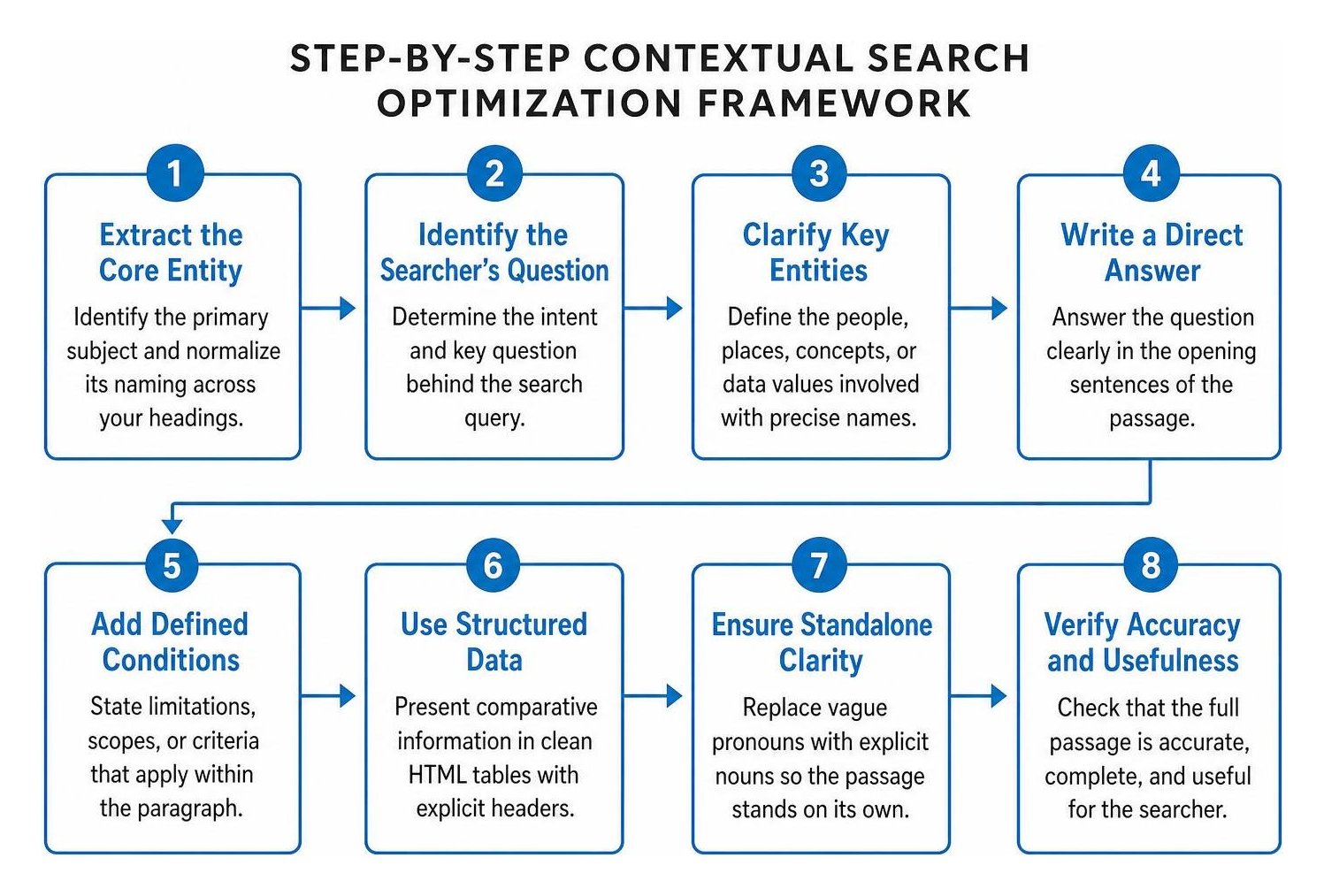
Guided query formulation techniques demonstrate substantial performance improvements in information retrieval. For example, researchers achieved a 6% exact match accuracy gain over baseline systems when mapping natural language to structured queries by using contextual examples and entity normalization.
Apply these steps to optimize individual content passages:
- Extract the Core Entity: Identify the primary subject and normalize its naming across your headings.
- Draft the Standalone Answer: Write a concise response in two to three sentences that states the outcome immediately.
- Attach Necessary Context: Add essential parameters, such as industry requirements or technical limitations, to prevent misinterpretation.
- Audit for Standalone Utility: Read the paragraph independently to confirm it makes complete sense without surrounding sections.
How Does NLQ Help with Self-Service BI and Content Discovery?
NLQ lets people ask questions in everyday language to explore data and find relevant information without relying on technical query syntax.
Business intelligence platforms use natural language querying to help non-technical users analyze complex datasets. Instead of writing database queries, team members can ask plain-English questions to generate visual reports.
At SmallBizSEO, our data-driven Velocity framework uses advanced semantic strategies and BERT and AI-driven SEO services to help small businesses structure their digital content for search visibility and automated discovery.
Delivering Answers That Match Natural Search Intent
Optimizing content for context-aware search requires moving away from repetitive keyword stuffing toward direct, well-structured communication. By answering user questions clearly in the opening sentences, defining entities explicitly, and keeping passages self-contained, you ensure that search engines and AI assistants can easily extract and cite your insights. Building an authoritative online presence starts with creating clear, reliable, and people-first content that solves real problems.