The AI SEO Audit: Tracking the Signals That Actually Matter to LLMs

Why SEO Visibility Audit Signals Now Include AI Search
SEO visibility audit signals have expanded well beyond title tags and backlinks. Today, they determine whether your business gets found on Google and whether it gets cited by ChatGPT, Perplexity, or Google's AI Overviews.
Here is a quick overview of the core signal categories that modern visibility audits must cover:
| Signal Category | What It Controls |
|---|---|
| Technical accessibility | Whether Google and AI bots can crawl and index your pages |
| Content structure | Whether AI engines can extract and cite your answers |
| Structured data | Whether machines can identify facts and entities on your page |
| Entity clarity | Whether AI systems can verify who you are and what you do |
| Trust and authority | Whether your site is credible enough to be cited as a source |
| Content freshness | Whether your content is recent enough to surface in AI answers |
| Core Web Vitals | Whether your pages are fast enough to be prioritized for crawling |
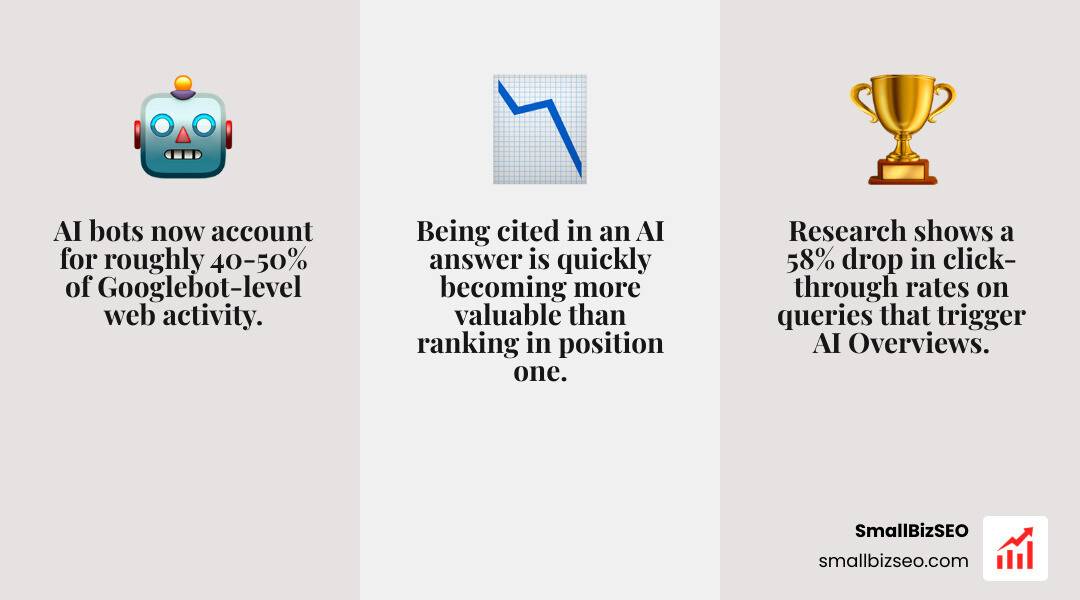
The landscape has shifted dramatically. AI bots now account for roughly 40-50% of Googlebot-level web activity. At the same time, research shows a 58% drop in click-through rates on queries that trigger AI Overviews — meaning that being cited in an AI answer is quickly becoming more valuable than ranking in position one.
Most traditional SEO audits were not built for this world. They check broken links, page speed, and meta tags. What they miss are the retrieval signals that decide whether an AI engine trusts your page enough to quote it.
If your site ranks well but never appears in AI-generated answers, the gap is almost certainly in these newer signal layers — not your keyword targeting.
I'm Clayton Johnson, a digital PR and SEO specialist focused on building search visibility through structured, signal-driven strategies, including SEO visibility audit signals that cover both traditional rankings and AI citation readiness. In the guide below, I'll walk you through every layer your audit needs to cover in today's AI-first search environment.
Traditional SEO vs. AI Search: The Paradigm Shift
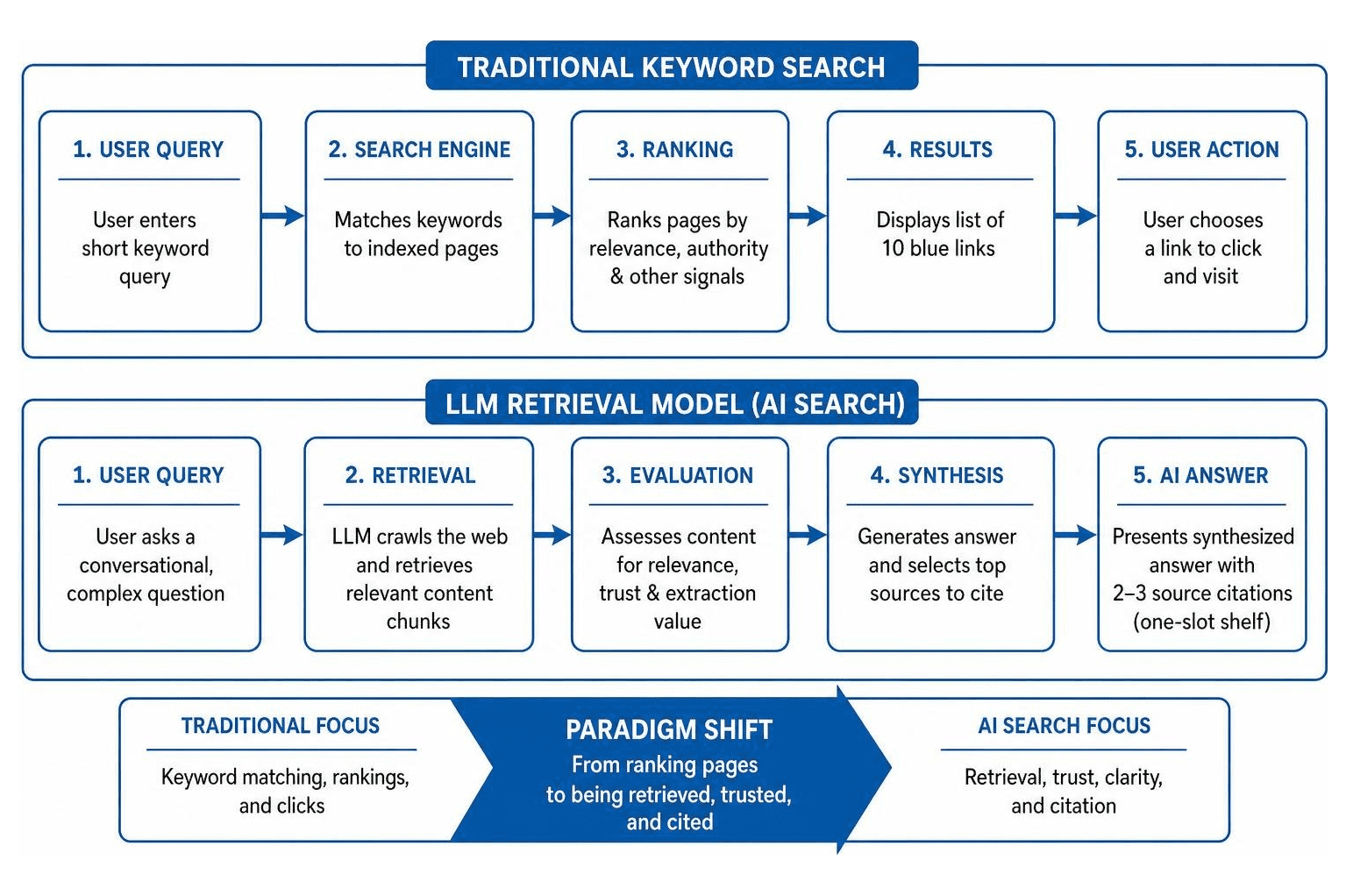
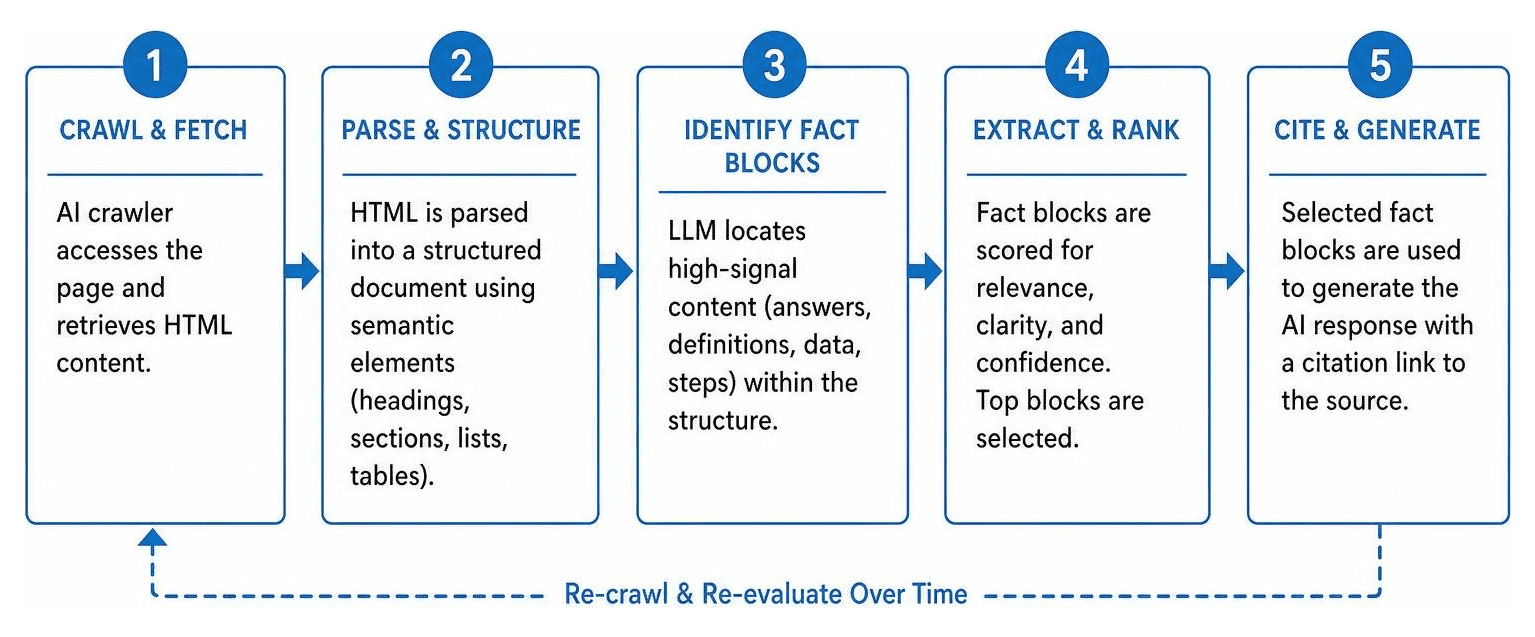
Traditional search is built on a simple model: a user types a keyword, and Google returns a list of ten blue links. AI search, however, operates as a retrieval and synthesis engine. When a user asks a complex question, large language models (LLMs) crawl the web, extract specific factual blocks, synthesize an answer, and cite their sources in a "one-slot shelf" containing only two or three references.
This shift has changed user behavior. Google's AI Mode has surpassed one billion monthly users, with conversational queries three times longer than traditional searches. In addition, follow-up queries are increasing by 40% monthly, and over 16% of searches are now multimodal, incorporating voice, images, and video.
Because of this, traditional click-through rates (CTR) are dropping. Ahrefs measured a 58% CTR reduction on queries with AI Overviews across 300,000 keywords. Position-one CTR for keywords that trigger an AI Overview fell from 0.073% to 0.016%. If your business is not cited directly within the AI summary, you are effectively invisible to a massive portion of your audience.
| Feature | Traditional Search | AI Search (GEO) |
|---|---|---|
| Goal | Rank in the top 10 blue links | Win a citation slot in the generated answer |
| User Intent | Short keywords (2-3 words) | Conversational, long-tail queries (8+ words) |
| Retrieval Focus | Domain authority and keyword density | Extraction efficiency and entity trust |
| Interface | Static list of URLs | Synthesized text with inline citations |
Why Traditional Audits Miss Critical SEO Visibility Audit Signals
Standard technical audits focus heavily on surface-level metrics like broken tags, sitemap formats, and page speed. While these are important, they fail to explain why a highly authoritative page is ignored by AI search engines.
AI engines evaluate pages based on extraction efficiency and trustworthiness. If your answers are buried deep inside a narrative block of text without clear semantic markers, or if your author's credentials cannot be verified across platforms, AI systems will bypass your page. To understand why your content might be struggling to gain traction, read our guide on Why Your Rankings Are Still Stuck.
The Core Layers of Modern SEO Visibility Audit Signals
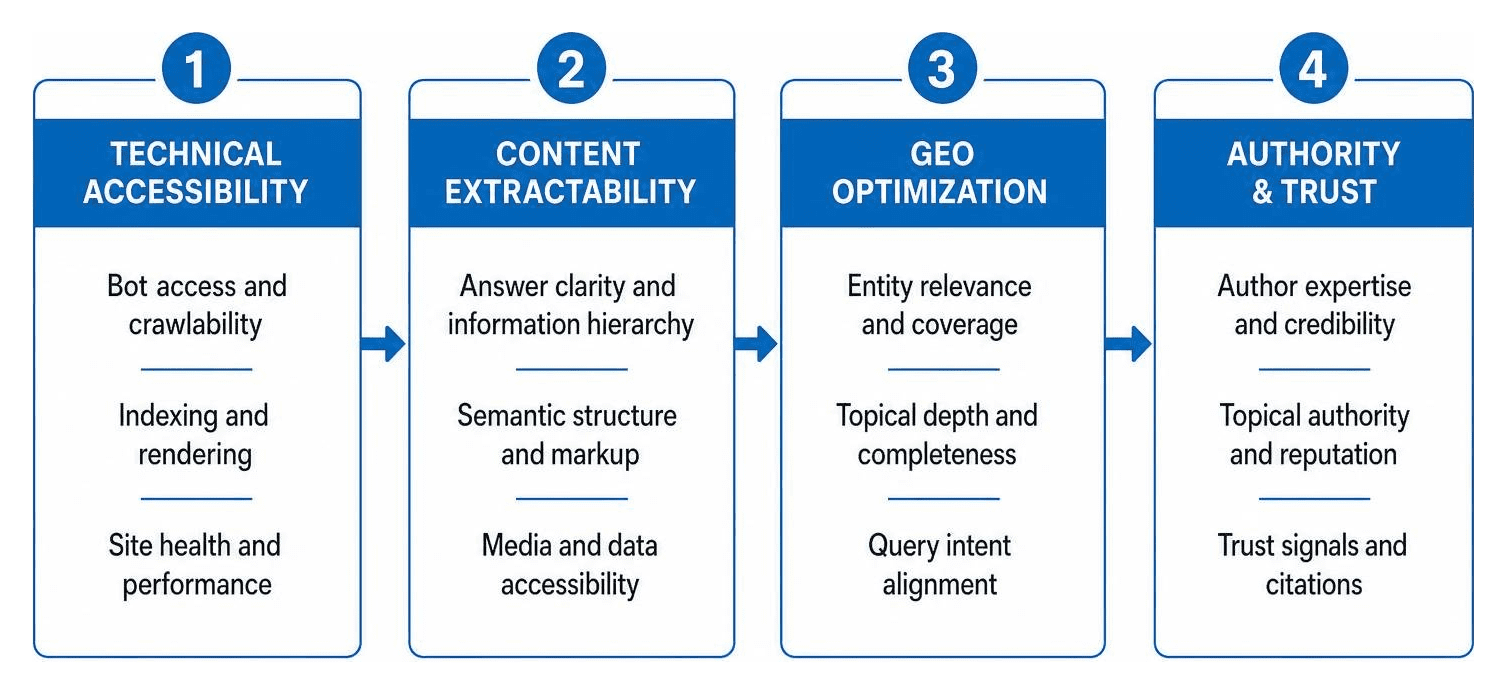
To ensure your website is fully optimized for both Google's traditional algorithm and conversational AI engines, we must look at search visibility through four distinct layers.
Technical Accessibility and Bot Crawlability
If an AI bot cannot access your page, it cannot cite it. AI search engines use specialized crawlers like GPTBot (OpenAI), ClaudeBot (Anthropic), and PerplexityBot to pull real-time data from the web.
Unfortunately, roughly 30% of websites silently block at least one major AI bot without the owner realizing it. This often happens due to outdated firewall rules or generic robots.txt files. To verify your technical foundations, cross-reference your setup with the AI Search Visibility Checklist (22 Signals) — GeoDaddy to ensure your site is fully accessible.
Content Architecture and Semantic Structure
LLMs do not read content the way humans do; they parse it. They rely on a strict heading hierarchy (H1 to H2 to H3) and semantic HTML tags (like article, section, and aside) to build a mental map of your page.
Using descriptive, question-based headings instead of generic topic titles helps AI engines quickly identify what your page is about. Bulleted lists, numbered steps, and clean tables also make your data highly extractable. Dive deeper into optimizing your page layouts with our guide on On-Page SEO.
Generative Engine Optimization (GEO) and Content Extractability
Generative Engine Optimization (GEO) is the practice of optimizing your website so that AI models can easily retrieve, understand, and cite your content. To measure this, modern audits calculate a "GEO Score" based on how easily an LLM can parse your pages.
Optimizing Content Structure for AI SEO Visibility Audit Signals
To maximize your GEO score, your content must be structured for high "fact-block density." AI engines favor "answer-first" writing.
We recommend placing a concise, direct answer of 40 to 80 words within the first 200 characters of your main content blocks, directly beneath a question-based H2 heading. This gives the AI crawler a perfect, ready-to-use snippet for its citation slot. To scale this across your entire site, explore our SEO Content Services.
Structured Data and Schema Stacking
While schema markup accounts for roughly 9% of AI crawler traffic, its share of factual citations is significantly higher. JSON-LD structured data provides clean, machine-readable facts that AI models can trust.
By stacking multiple schemas on a single page—such as Organization, Article, and FAQPage schema—you provide multiple citation hooks for the crawler. Including sameAs links pointing to authoritative, verified external profiles helps the engine resolve who you are. For a step-by-step breakdown of how this works, check out the guide on How to Audit a Page for AI Visibility: The Signals That Actually Matter - AI Visibility Analyst (AIVA).
Trust, Authority, and Cross-Platform Corroboration
AI search engines are highly risk-averse. They do not want to cite incorrect information, so they cross-reference the claims on your website with third-party sources across the web. This means off-page E-E-A-T (Experience, Expertise, Authoritativeness, and Trustworthiness) is a critical retrieval signal.
To build this trust, ensure your brand is mentioned consistently across directories, social profiles, and industry publications. If you want to see how your brand's authority looks to search engines, you can request a Detailed SEO Analysis.
Entity Resolution and Brand Consistency
Entity resolution is the process an AI engine uses to connect your brand name to a specific, verified organization in its database. If your business name is written differently across your website, social media, and local listings, the AI's confidence in your brand decreases.
Using consistent naming conventions and linking your profiles together using structured data helps search engines build a solid entity profile for your brand. Learn how to align your local and digital presence with our Local SEO Guide.
Measuring and Tracking AI Visibility Over Time
Tracking AI visibility requires a different set of metrics than traditional rank tracking.
- AI Visibility Score: A composite score measured across core technical and content dimensions, including structured data, HTML clarity, and bot accessibility.
- Citation Decay Rate: A metric that tracks how quickly your brand's citations in AI search engines decrease over time, helping you identify when your content needs refreshing.
- Freshness Cadence: Content age matters. Sites that publish weekly receive AI bot traffic at roughly three times the rate of sites that publish less often. Conversely, sites that go silent for over 60 days see their AI bot traffic drop to near-baseline levels within two weeks.
- RSS Feed Optimization: Interestingly, RSS feeds are the single most-consumed endpoint by AI fetchers, accounting for roughly 40% of logged requests across research networks. Keeping your RSS feed clean and active is a high-leverage way to keep AI bots returning to your site.
To understand how these dimensions work together, read The 7-Dimension AI Visibility Score, Explained - Misha Manko.
Common Failure Modes That Silently Block AI Bots
Many websites fail AI visibility checks because of silent technical blocks:
- JavaScript Rendering: AI crawlers consume about 25% of their traffic as raw HTML. If your site relies entirely on client-side JavaScript to render text and internal links, AI bots will see an empty page and move on.
- Aggressive Rate-Limiting: Web application firewalls (WAF) designed to block malicious scrapers often accidentally block legitimate AI crawlers like GPTBot or ClaudeBot.
- Noindex Tags: Leftover staging tags or misconfigured canonical URLs can silently prevent AI engines from indexing your highest-value pages.
To ensure your technical setup is flawless, follow our guide on How to Pass Google's Own SEO Analysis Audits.
Frequently Asked Questions About AI Search Visibility
What is the difference between an SEO audit and an AI visibility audit?
A traditional SEO audit focuses on fixing technical errors, meta tags, and page speed to improve rankings in Google's blue links. An AI visibility audit evaluates your site's citation readiness, entity clarity, and content extractability to ensure your brand is cited as a trusted source in AI-generated answers.
How do Core Web Vitals affect AI Overview citations?
AI search engines rely heavily on traditional search indexes to find source pages. If your pages have poor Core Web Vitals (such as an LCP over 2.5 seconds), search engines will crawl your site less frequently, reducing your chances of being indexed and cited.
Why is my high-ranking page not cited by ChatGPT or Perplexity?
A page can rank well in traditional search due to high backlink authority, but still be ignored by AI engines if its content is buried in long paragraphs, lacks structured schema, or blocks AI crawlers in its robots.txt file.
Take Control of Your Search and AI Visibility with SmallBizSEO
At SmallBizSEO, we help small businesses navigate the evolving world of search. Our data-driven Velocity framework is designed to deliver fast rankings and build E-E-A-T-compliant growth across both traditional Google search and conversational AI engines.

We combine technical SEO audits with advanced GEO strategies to ensure your business is not only crawled and indexed, but actively cited by the AI systems your customers use every day. Ready to find out what is holding your website back? Get started today by booking your comprehensive SEO Visibility Audit.