A – Z Guide to Searchmetrics Visibility Score Meaning
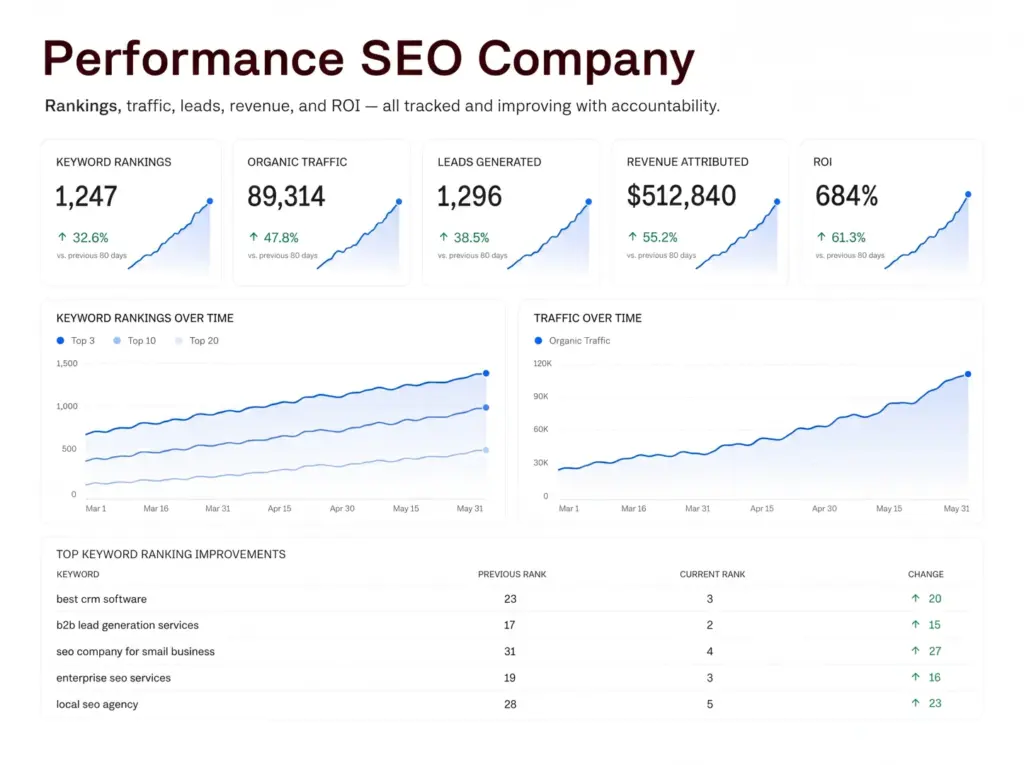
What a Search Visibility Score Means
A search visibility score is an index that shows how visible a website is in organic Google results across a large keyword set. It combines keyword search volume, ranking position, estimated click-through rate, and keyword type into one number, making it useful for spotting broad SEO gains, losses, and competitor trends.
It is not a traffic report or a count of rankings. A site can gain visibility by moving up for a high-volume query, while losing positions on important terms can pull the score down fast. The metric is especially useful for comparing domains on the same market-wide baseline rather than relying only on a hand-picked keyword list.
The concept still matters because it shaped how many SEO teams report organic search performance. But search visibility now extends beyond classic results pages. Brands also need to know whether AI tools mention, recommend, or cite them when people ask natural-language questions.
I am Clayton Johnson, a digital PR and SEO marketer focused on helping brands earn stronger search visibility and market presence. My work with search visibility score principles centers on turning rankings, content, links, and brand signals into meaningful business visibility.
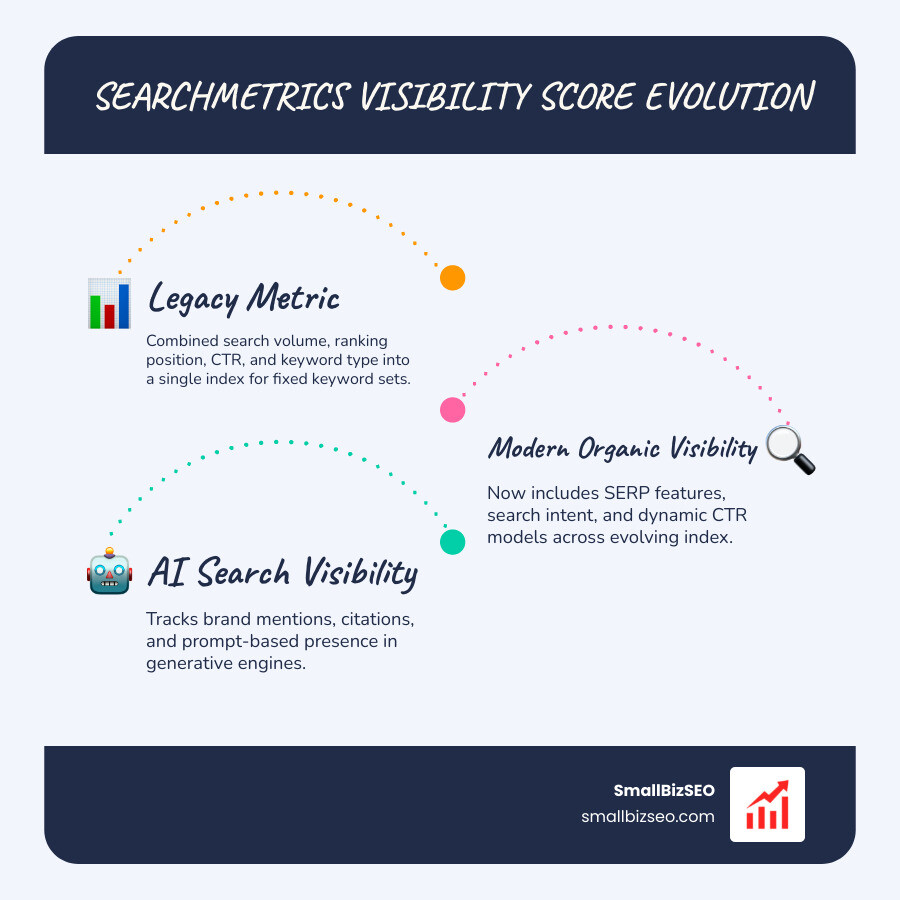
Key search visibility score vocabulary:
Understanding SEO Visibility Scores and How They Are Calculated
To understand how a search visibility score functions, we have to look at how organic search presence is evaluated. At its core, the metric measures the overall organic search presence of a domain across a standardized, predefined keyword index. Instead of looking at raw page views or arbitrary keyword counts, it aims to answer a simple question: If a user searches for topics in your industry, how likely are they to see your website?
Visibility scoring systems combine search volume data with ranking positions across large sets of search queries. Industry explanations of SEO visibility commonly factor in keyword classification, search volume, and ranking position, applying dynamic click-through rate (CTR) models to reflect real-world user behavior.
How Search Visibility Score Methodology Works
The calculation formula behind visibility scoring is intentionally sophisticated. It does not treat every ranking position linearly. Slipping from position 1 to position 2 results in a far greater visibility drop than dropping from position 50 to 51.
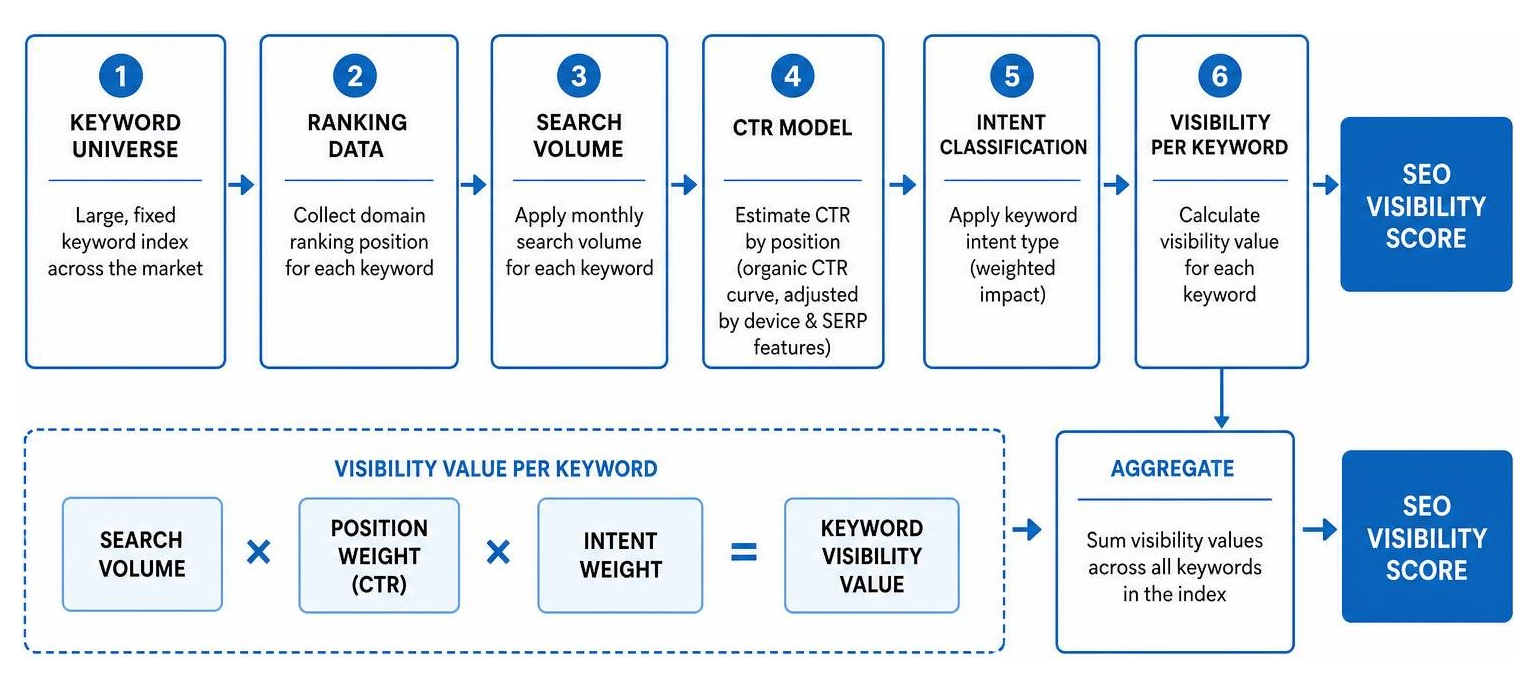
The methodology relies on several core components:
- Position Weighting Factors: Higher ranking positions earn exponentially higher mathematical multipliers, reflecting the steep drop-off in organic CTR past top positions.
- Search Volume Weighting: Ranking number one for a search term with 50,000 monthly searches contributes significantly more to the domain index than ranking first for a query with 50 monthly searches.
- Intent Classification: Keywords are categorized by search intent, distinguishing between navigational brand queries and broader informational queries.
- Dynamic CTR Models: Machine learning models can adjust estimated click-through rates based on SERP layout variations across desktop and mobile devices.
Understanding these inputs is essential for cracking the Google visibility score and identifying performance levers across your site.
Most visibility platforms offer two general environments for evaluation: broad market research indexes and custom project tracking. A market research index tracks domain visibility across a standardized national database of keywords, creating an objective market benchmark. Custom project tracking allows businesses to monitor keyword sets specific to their business goals.
Why Search Visibility Scores Became a Regional Industry Standard
In many digital marketing circles, particularly across regional markets, the search visibility score became an essential industry benchmark. SEO agencies, enterprise brands, and publishing houses relied on visibility indexes for client reporting, executive updates, and competitive analysis.
The main reason for widespread adoption was brand neutrality. Because fixed-index reporting evaluates competing domains against the same keyword database, no company can manipulate the underlying keyword sample to artificially inflate its score. It creates a reliable baseline for domain tracking. Digital strategists can instantly compare two competing publishers or e-commerce sites to see who holds a commanding share of voice in organic search.
Limitations of Traditional Search Visibility Metrics
While the search visibility score improved standard SEO reporting, traditional index-based visibility scores have clear structural limitations. First, an organic index score does not equal actual website traffic. Approximately 15% of daily search queries on Google are completely unique, meaning long-tail queries driving real conversion traffic are often missed by static keyword databases.

Second, traditional visibility algorithms sometimes conflate organic performance with brand-driven paid search behavior or navigational intent. A brand with massive real-world awareness can dominate the visibility score simply due to high-volume brand searches, masking underlying technical or content weaknesses on informational terms.
Finally, as search engines evolved to feature interactive elements such as AI overviews, image packs, local maps, and knowledge panels, traditional rank-based visibility formulas began struggling to capture true user attention share. These market shifts influenced broader changes across SEO measurement, pushing teams to combine classic rank tracking with stronger content, entity, and AI-search visibility analysis.
The Modern Alternatives Replacing Legacy Visibility Scores
As search behavior and tool ecosystems evolved, several modern platforms emerged to fill the visibility tracking needs of digital marketers. Today, tracking search presence requires a split focus: monitoring classic organic search engines while simultaneously evaluating brand presence inside conversational AI platforms.
| Tool Name | Core Focus Surface | Methodology & Strength | Primary Pricing Level |
|---|---|---|---|
| Sistrix | Traditional Google SERPs | Fixed keyword index with exceptional regional market data coverage | Starting around €99/mo |
| Ahrefs | Traditional Google SERPs | Combined Domain Rating (DR) and customizable CTR-weighted rank tracking | Starting around $129/mo |
| SEMrush | Traditional Google & AI SERPs | Position tracking visibility percentages and emerging AI visibility toolkits | Starting around $140/mo |
| Honeyb | AI Conversational Engines | Share of voice and prompt citation tracking across major generative models | Starting around $29/mo |
Traditional Search Engines: Sistrix, Ahrefs, and SEMrush
For teams seeking functional replacements for traditional Google search visibility measurement, three tools dominate the space:
- Sistrix: The Sistrix Visibility Index is one of the closest methodological matches to the legacy fixed-index model. It uses a fixed keyword set weighted by search volume and position, maintaining strong accuracy across regional markets.
- SEMrush: The Position Tracking tool calculates a visibility percentage based on CTR-weighted positions for custom target keyword lists. Additionally, SEMrush provides specialized toolkits to measure search feature exposure.
- Ahrefs: By combining rank tracker metrics with organic traffic estimates, Ahrefs allows teams to monitor dynamic visibility fluctuations across massive global keyword indices.
Generative Engines: Measuring Brand Share of Voice in AI Search
As user behavior shifts toward conversational platforms, measuring search visibility requires tracking brand citations inside generative response engines. Modern platforms now monitor brand share of voice by evaluating prompt outputs across popular large language models.
When users submit natural-language prompts, AI engines return direct answer summaries. Specialized tools like Honeyb track prompt visibility on a percentage scale ranging from 0% (no citations across prompt runs) to 100% (consistently holding top citations). Modern frameworks for measuring brand visibility in AI search focus on link citation rate, source page inclusion, and narrative sentiment across generative models.
How AI Search Visibility Differs from Traditional SEO Visibility
Traditional SEO visibility and AI search visibility measure fundamental brand presence, but their mechanics differ significantly. Classic SEO visibility measures your position on a fixed, structured search results page populated by ten blue links and SERP features. AI search visibility measures whether an AI assistant synthesizes, recommends, and links to your brand within a generated text answer.

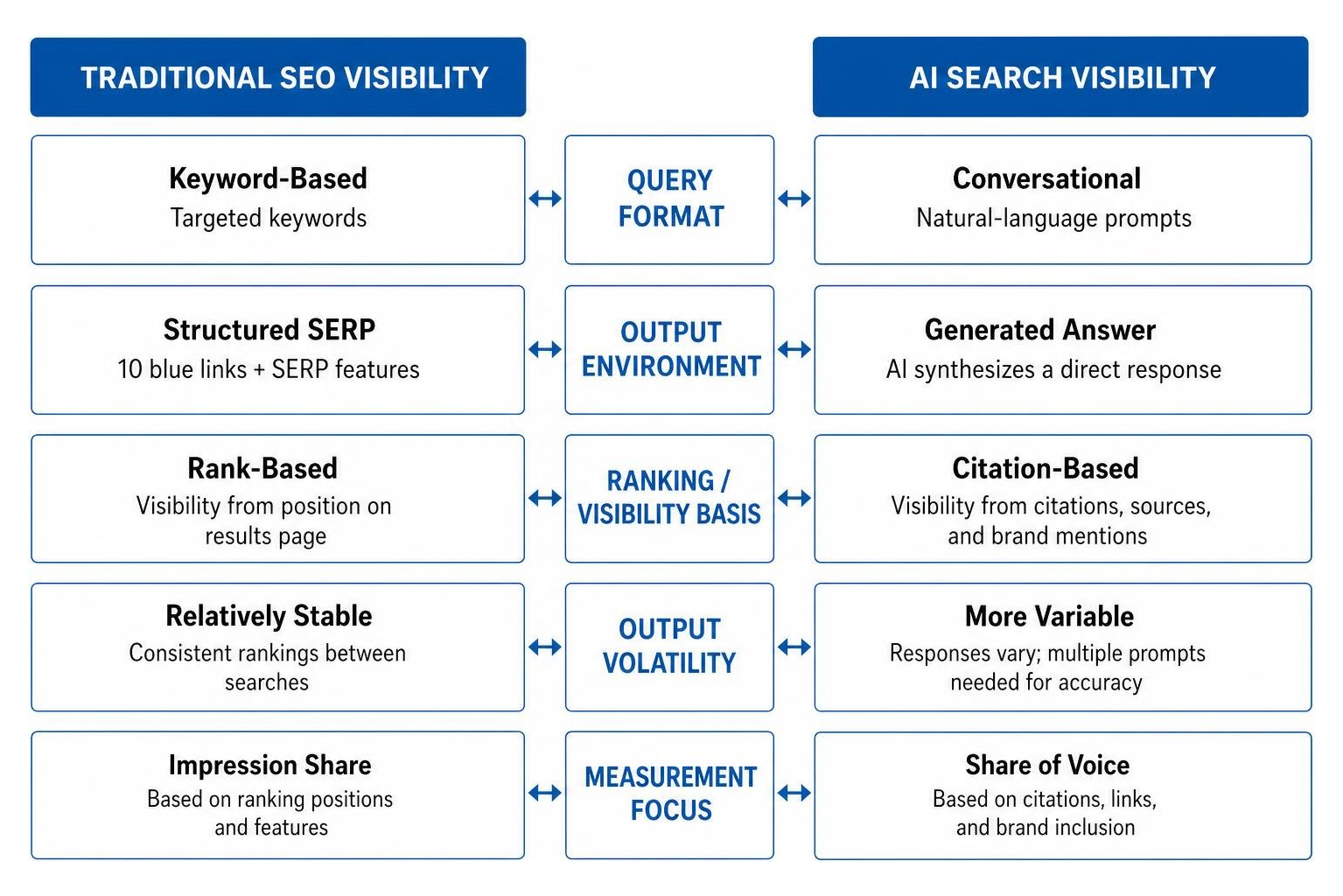
Key differences between these environments include:
- Query Format: Traditional visibility relies on targeted keywords, whereas AI visibility relies on conversational, natural-language prompts.
- Output Volatility: Traditional SERP rankings remain relatively stable between consecutive user searches. AI engine responses exhibit natural response variation, requiring multiple prompt tests to establish reliable visibility benchmarks.
- Citation Mechanics: Traditional search grants impression share based on ranking positions. AI engines award visibility based on citation links, source references, and brand entity associations.
Understanding these structural differences helps teams learn how to boost visibility score across both classic search engines and emerging answer engines.
What Is a Good Visibility Score and How to Benchmark It
A common question among digital marketers is what specific numerical score represents a "good" visibility score. The simple truth is that an absolute score of 100% in traditional search is practically impossible, as it would require holding position one and capturing every click for every tracked query in an entire industry.
Instead, a good visibility score is entirely relative. It must be benchmarked against direct, thematic competitors within your specific industry niche.
To establish an accurate visibility baseline, we recommend using structured SEO analysis for better rankings:
- Identify True Competitors: Compare your domain only against businesses competing for the exact same audience and search queries, rather than generic global publishers.
- Track Market Share Movement: Focus on your relative share of voice trends over time rather than minor weekly point fluctuations.
- Isolate Branded vs. Non-Branded Metrics: Separate branded search terms from non-branded query lists to isolate true organic growth from overall brand marketing campaigns.
Strategies to Improve Visibility in Classic and AI Search
Building robust visibility across traditional search engines and AI platforms requires a combined optimization strategy. Here is our step-by-step framework to maximize your total search presence:

- Target Page-Two Striking-Distance Keywords: Identify pages currently ranking in positions 11 through 20. Quick content refreshes, internal link additions, and schema enhancements on these pages yield rapid visibility jumps.
- Optimize Core Technical Health: Technical performance impacts both classic crawlers and AI bots. Resolving site errors using a detailed SEO audit errors guide keeps your content accessible. Pages with fast Largest Contentful Paint (LCP) loading speeds achieve notably higher citation rates in AI responses.
- Maintain Entity and Brand Consistency: Ensure your business name, core services, and product details are identically represented across key third-party platforms, social networks, and industry directories to strengthen entity signals for LLMs.
- Structure Content for Rich Answers: Use clear subheadings, concise definitions, direct answers, and structured schema markup to capture Featured Snippets and AI Overview citations.
- Build Presence on High-Authority Discovery Platforms: AI search engines frequently source information from active community forums, news publishers, and industry platforms. Maintaining an active digital PR presence on these hubs directly drives conversational search visibility.
Frequently Asked Questions About Search Visibility
What is a normal search visibility score?
There is no universal "normal" score because visibility metrics are calculated as an index or percentage relative to a specific keyword set. A specialized B2B site might hold strong market leadership with a low absolute index score, while a broad national news publisher might reach massive numerical visibility scores. Normal performance is evaluated strictly by comparing your score against direct market competitors targeting identical search terms.
Why did my website's search visibility suddenly drop?
Sudden visibility drops typically stem from three main causes:
- Search Engine Algorithm Updates: Major core updates can shift how search engines evaluate content quality, relevance, or site authority.
- Technical Site Issues: Crawl blockages, unintentional noindex tags, broken redirects, or server outages can cause rankings to drop quickly.
- Tracking Configuration Changes: Modifying tracked search locations, adding competing search engines, or removing keywords mid-campaign inside your tracking software can cause artificial visibility drops in reporting dashboards.
Can a website achieve a 100% search visibility score?
No, achieving a 100% visibility score across a realistic keyword set is practically impossible. A 100% score would mean your domain ranks in position one for every single keyword in the dataset and captures 100% of available search clicks. A realistic goal for market leaders is capturing the highest relative share of voice compared to direct sector competitors.
Elevating Your Brand's Search Presence
The legacy of the search visibility score lives on in how digital marketing teams approach SEO reporting. By moving past simple keyword lists and evaluating holistic share of voice, modern brands can accurately measure their market footprint. Today, success requires a dual-engine optimization strategy that builds authority across both traditional search results pages and generative AI response models.
Measuring and growing your domain visibility requires deep technical accuracy, clear entity building, and data-driven execution. If you are ready to evaluate your overall search footprint and unlock immediate growth opportunities, Get a free SEO Visibility Audit with our team today. We will help you analyze your current visibility baseline, diagnose technical barriers, and build a tailored SEO velocity roadmap to dominate your niche.