Why Do AI Answers Favor Middlemen Over Original Sources, and What Can Publishers Do?
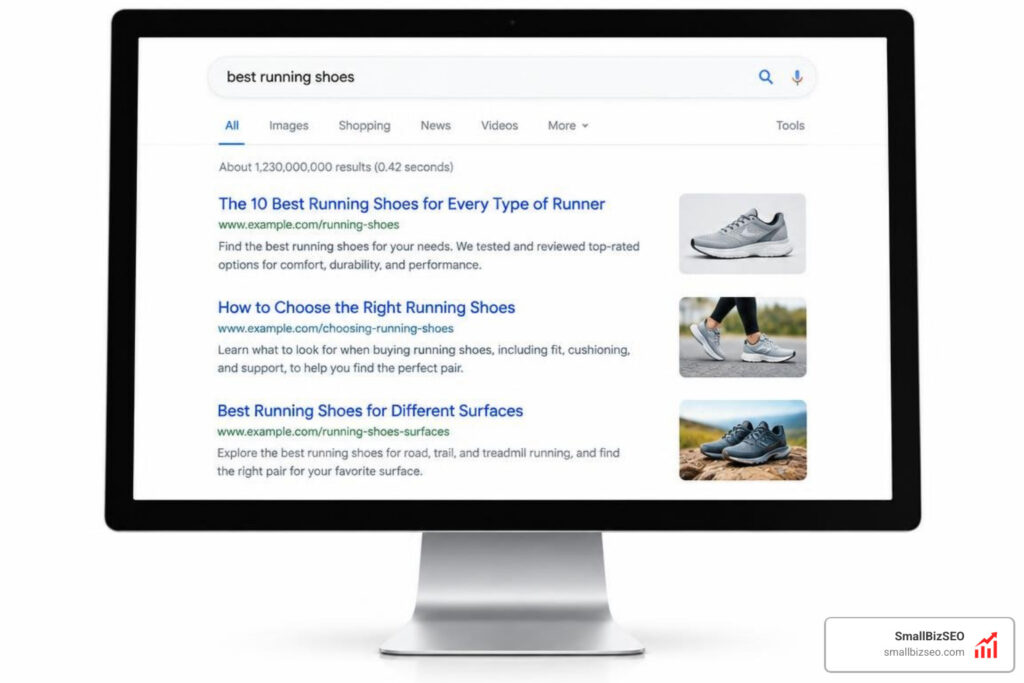
Why Does an AI Answer Cite an Aggregator Instead of the Original Source?
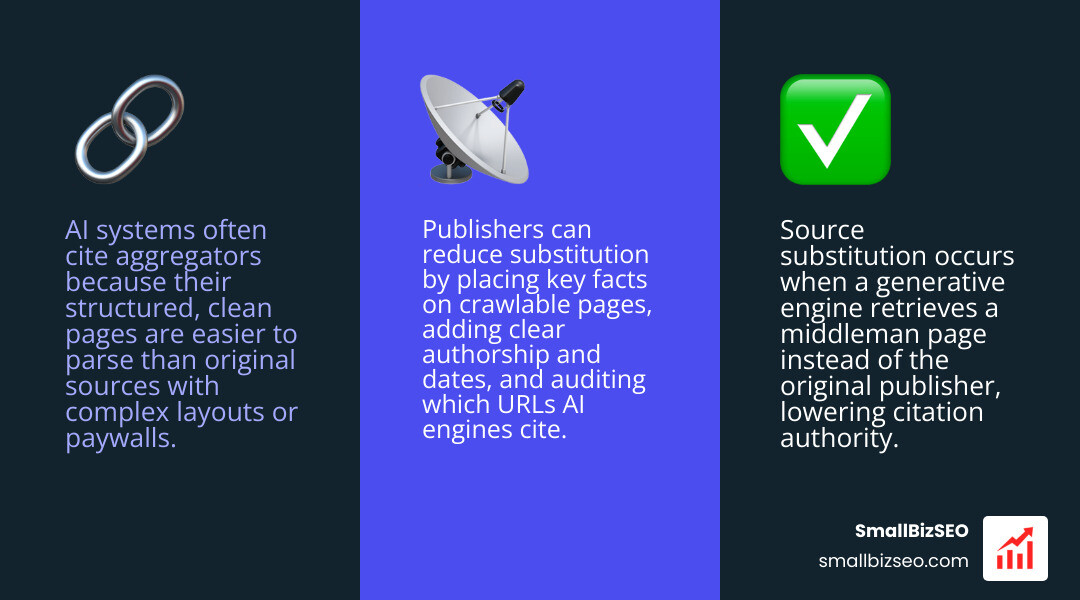
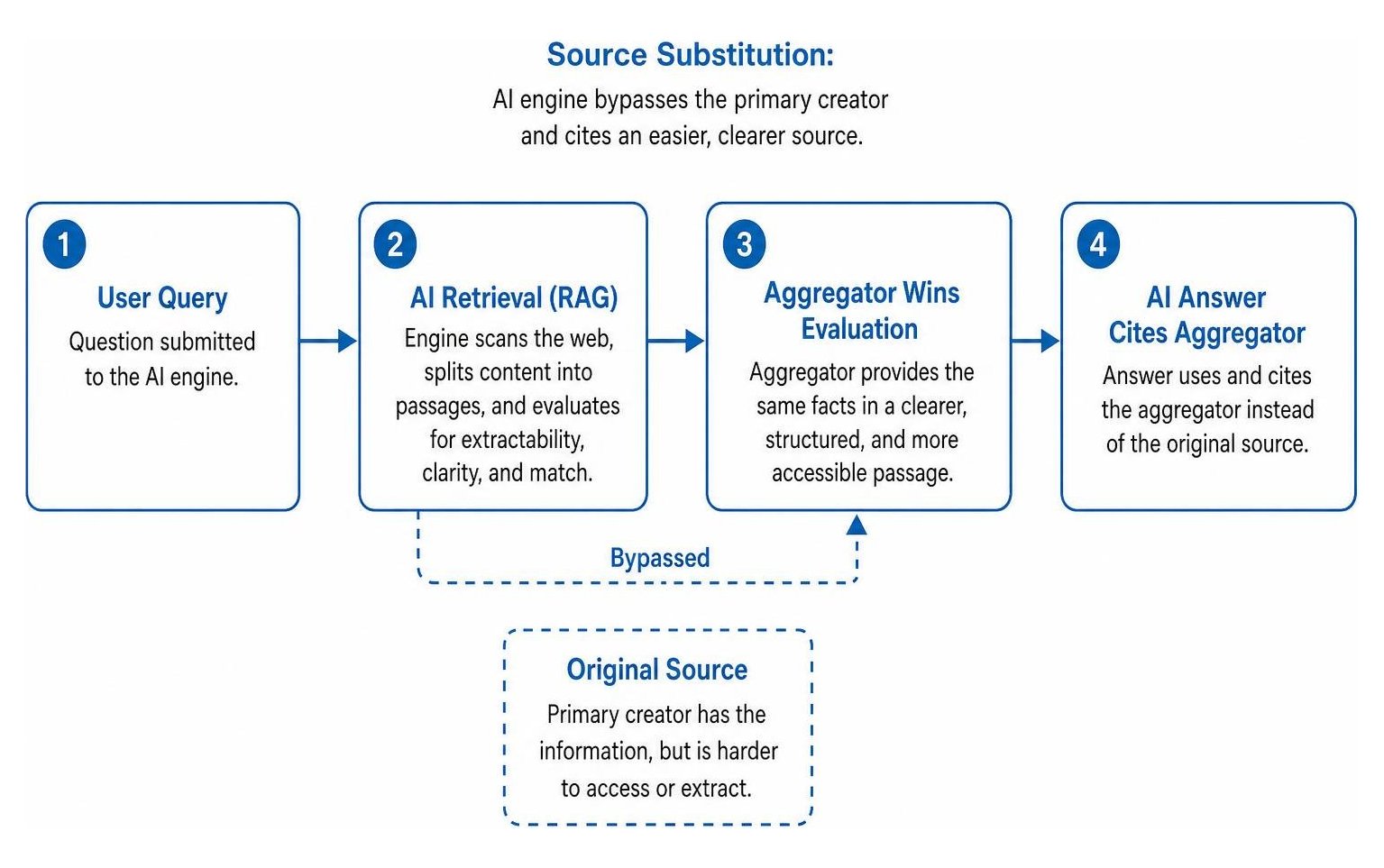
An AI answer may cite an aggregator instead of the original source because the aggregator’s page is easier to access and gives the system a clearer passage to use. This is source substitution: the answer links to a middleman rather than the publisher that created the information. To improve your chances of being cited, put key facts on an accessible page, identify the original author and publication date, and check which URLs AI tools cite for questions about your work.
I’m Clayton Johnson, founder of SmallBizSEO. My work in SEO, content strategy, and AI search focuses on why an AI answer cites an aggregator instead of the original source and how publishers can make their original work easier to find and credit.
How Do Generative Engines Select Content?
Generative engines retrieve and evaluate content from multiple sources, then select information to include and cite in an answer. Instead of simply ranking whole web pages like traditional search engines, answer engines split documents into focused passages to synthesize comprehensive responses.
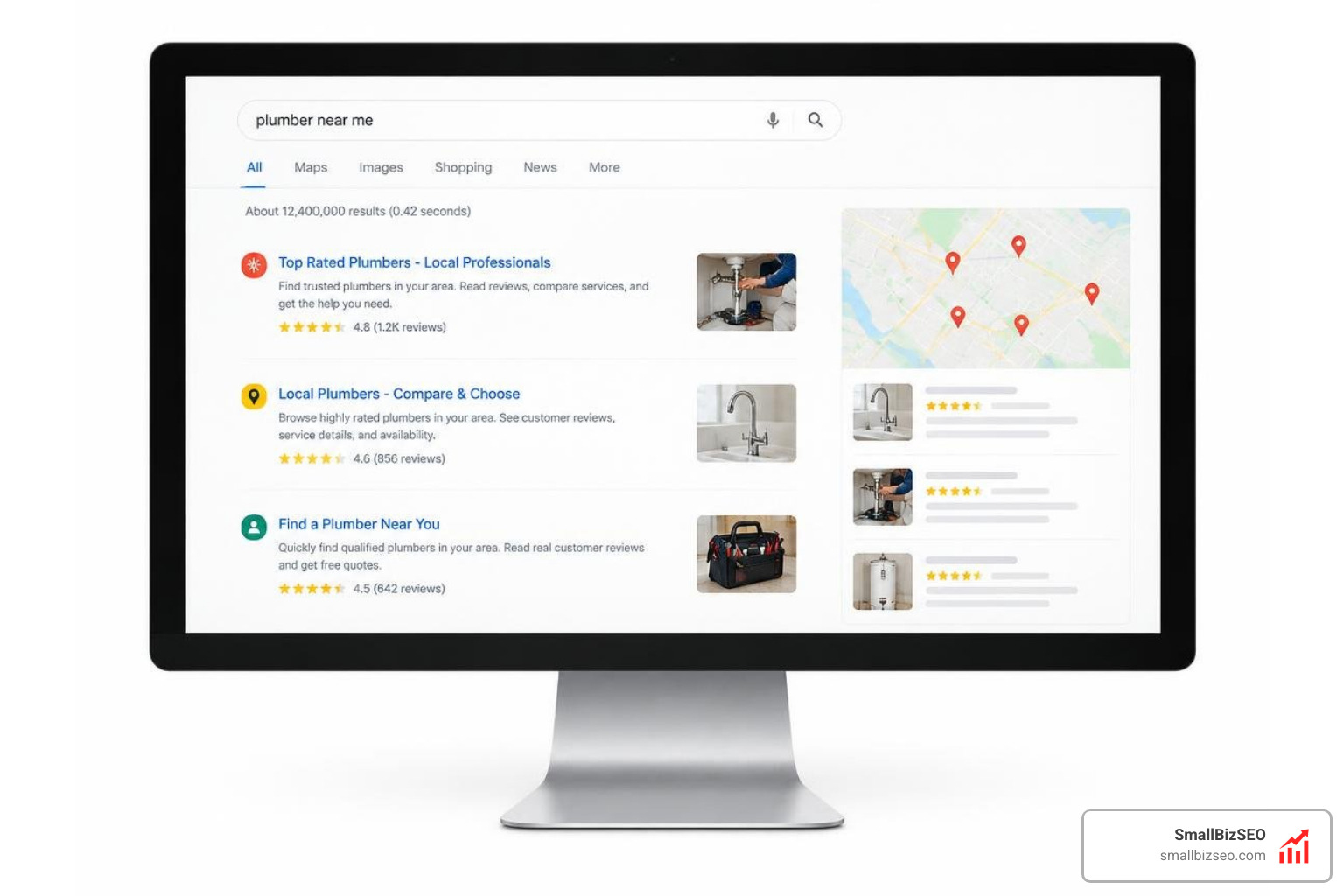
When a user submits a query, generative engines use Retrieval-Augmented Generation (RAG). RAG scans a live web index, translates queries into mathematical concepts, and retrieves the most semantically relevant text passages. This shift powers zero-click searches, where users receive complete answers directly on the interface rather than browsing external links.
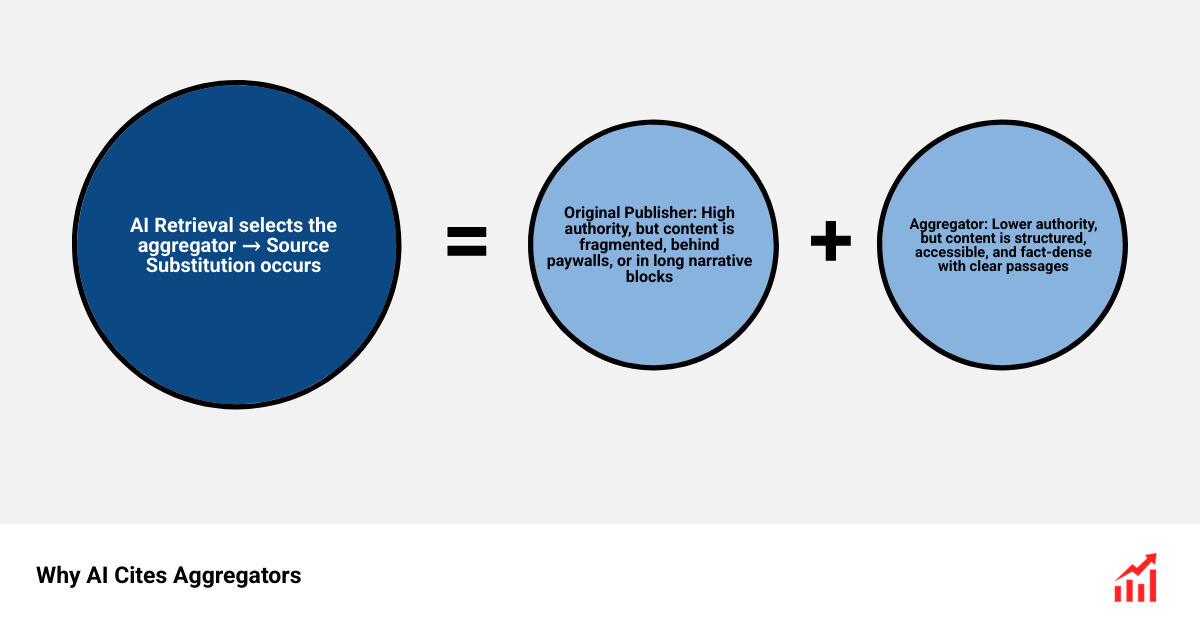
During this process, generative models construct a dynamic "source stack." They prioritize text blocks that deliver high factual clarity and direct answers to specific user prompts. If an original publisher presents facts in long narrative blocks or behind technical barriers, the retrieval algorithm extracts the identical information from a secondary aggregator that formatted it clearly.
Why Might an AI Answer Cite an Aggregator Instead of the Original Source?
An aggregator may be easier for an AI system to retrieve and extract than the original, even when the original source is more authoritative. Retrieval models focus on extractability, structural clarity, and cross-platform consensus rather than the chronological origin of an idea.

During RAG operations, language models convert content into high-dimensional vector embeddings and break text into 200- to 500-word chunks. Models evaluate these chunks for factual density and semantic match. Aggregators often win these evaluations through multi-path discovery and trust cascades: when an engine encounters matching information across multiple high-authority secondary directories, its confidence in those intermediary pages increases.
What Is Source Substitution, and Why Does It Happen?
Source substitution occurs when an answer engine cites a secondary directory, social forum, or media summary instead of the canonical source that legitimately governs the claim. Understanding source substitution in AI answers reveals that generative models prioritize retrieval ease and structural clarity over chronological origin. When original research is buried in complex prose, models substitute third-party summaries that offer direct, extractable definitions for authoritative grounding.
How Can Syndication Make Middlemen More Visible?
Syndication networks distribute original reporting across hundreds of secondary web portals. While this expands reader reach, it often creates duplicate copies on high-authority platforms that outrank the primary creator in retrieval pipelines.
An investigative analysis on AI search citation accuracy demonstrated that AI search engines frequently credit syndicated republishers rather than primary reporting outlets. Even when publishers hold formal corporate licensing agreements with AI companies, automated retrieval algorithms consistently credit large syndication partners within AI Overviews because of their massive backlink volume and crawl frequency.
How Do Robots Exclusion Rules and Authority Affect AI Citations?
When publishers block AI web scrapers using robots exclusion directives, they protect their raw text from unauthorized model training. However, this creates an operational paradox. Blocking crawlers prevents retrieval engines from reading breaking coverage directly. The AI engine then fulfills user queries by citing unrestricted third-party directories, forums, and aggregators that summarize the blocked publisher's work.
| AI Answer Engine | Primary Indexing Strategy | Dominant Citation Tendency | Impact of Crawler Blocking |
|---|---|---|---|
| Google AI Overviews | Direct Search Index & Knowledge Graph | High-authority organic domains & forums | Reverts to secondary indexed summaries |
| Perplexity | Real-time live-web RAG retrieval | Direct links, aggregators, & news hubs | Extracts quotes from unblocked syndicators |
| ChatGPT Search | Live-web browsing & model synthesis | Major media partners, directories, & forums | Relies on third-party web reporting |
Why Might AI Answers Cite Aggregators for Technical Queries?
For complex product, pricing, or technical inquiries, primary publishers often fragment critical details across separate subpages, user manuals, and password-protected portals. Aggregators consolidate this data into single, readable comparison tables and FAQ modules.
Establishing a primary source preference in generative answers requires presenting consolidated, atomic facts in public HTML. When technical details are scattered, AI models cite community forums and comparison aggregators that have already synthesized the information, denying the brand a direct AI citation.
How Can Publishers Reclaim Source Attribution and Prevent Substitution?
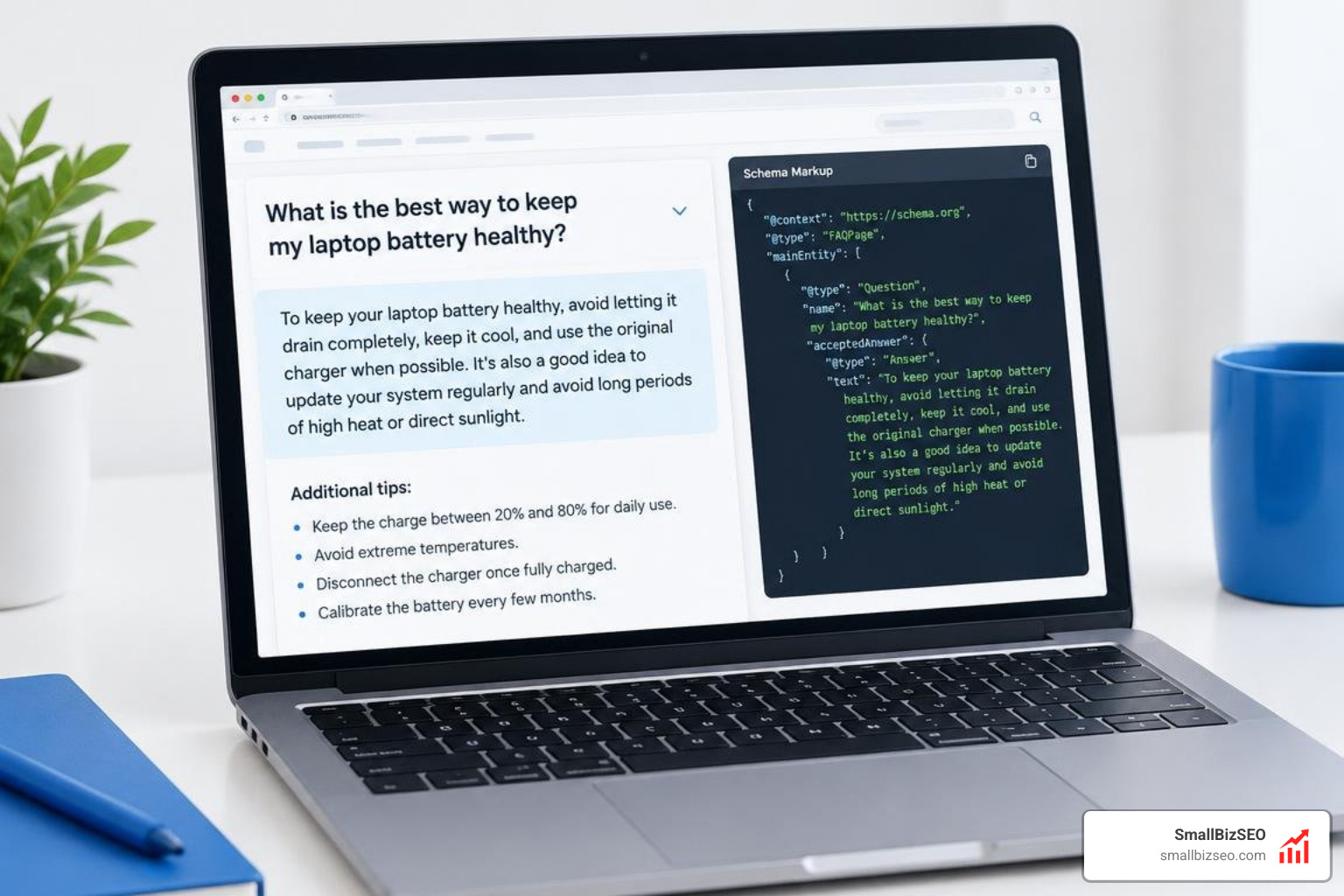
Publishers can improve their chances of direct citation by making original information easy for AI systems to find, understand, and attribute. Formatting key takeaways into clean, machine-readable structures allows retrieval bots to quote the primary source directly.
At SmallBizSEO, we help businesses implement technical SEO, content strategy, and link-building frameworks that turn owned assets into direct references for generative search models.
How Can Publishers Audit and Fix Content Extraction to Win Direct Citations?
To resolve attribution loss, publishers must audit how AI systems interpret their content:
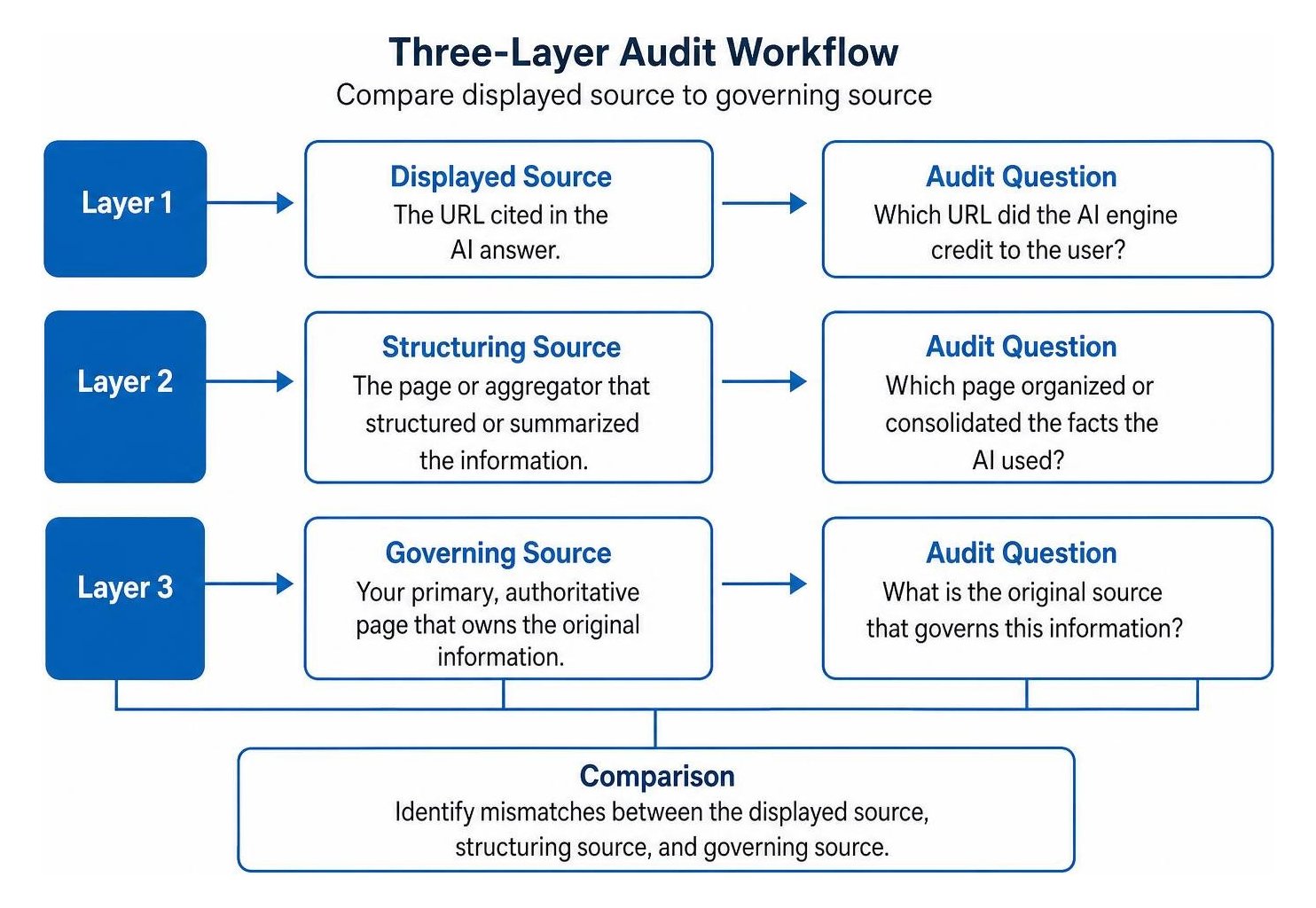
- Conduct a Three-Layer Audit: Compare the displayed cited URL against the structuring source and your primary governing page for core queries.
- Benchmark Query Clusters: Run industry prompts across major generative engines to identify which aggregators are replacing your brand.
- Format for Vector Chunking: Organize content into concise, self-contained sections of 200 to 500 words under descriptive H2 and H3 subheadings.
- Implement Structured Metadata: Use comprehensive JSON-LD markup—including Article, Organization, and author metadata—to reinforce definitive source attribution.
- Publish Direct Q&A Blocks: Answer customer questions explicitly at the top of informational pages to serve as ready-to-extract passage candidates.
How Can Canonical Answer Design Support Long-Term AI Visibility?
Canonical answer design involves creating clear, authoritative summary blocks at the top of important pages. By presenting atomic facts—such as explicit pricing rules, release dates, and core specifications—publishers eliminate the need for an AI model to interpret complex text.
Pairing atomic answers with robust entity disambiguation ensures that generative models identify your site as the definitive origin of an insight. Structuring your content correctly establishes lasting AI visibility. For teams seeking an advanced optimization strategy, collaborating with specialized AI SEO services ensures your publication earns consistent, direct citations across all major answer engines.
Taking Control of Your AI Attribution
Earning direct citations in generative search requires operational precision. As answer engines rely heavily on extractable, structured data, publishers must actively prevent aggregators from claiming their original reporting. By resolving retrieval friction, adopting canonical answer design, and structuring key facts in clean HTML, you ensure AI systems recognize and credit your website as the primary source of truth. Reach out to our team at SmallBizSEO to audit your search footprint and build a high-performance citation strategy.