Why Single-Touch Attribution Misses the Early Customer Search Journey
How does last-click attribution miss early customer searches?
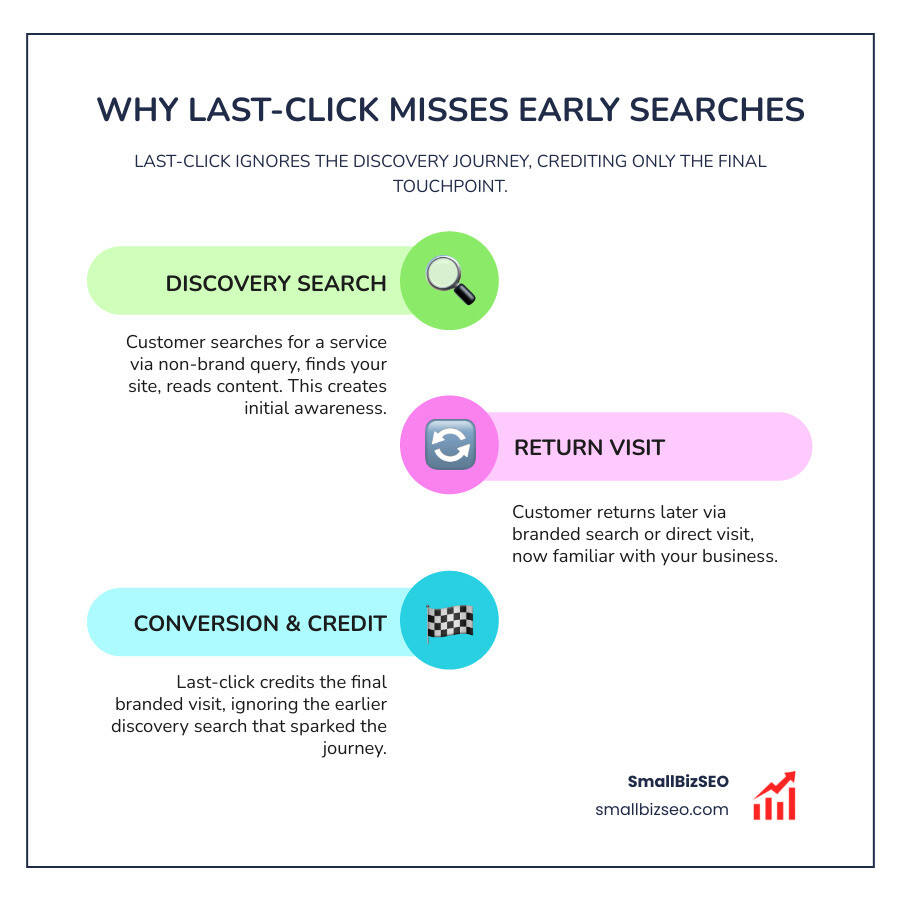
Here’s why last-click reports miss earlier search visits: they give conversion credit to the final recorded interaction, not to every visit that helped the customer decide. Someone might first find your business through a search for a service, then return days later through a branded search and contact you. The report credits the branded search; the earlier visit gets none.
That makes last-click useful for seeing what happened just before a lead came in, but risky as the only guide to SEO investment. To see more of the journey, compare first-touch and last-click reports, then check whether tracking gaps hide earlier visits.
I’m Clayton Johnson, founder of SmallBizSEO. My work connecting SEO visibility to qualified leads informs how I explain why last-click reports miss earlier search visits.
How does last-click reporting handle a customer’s search journey?
Last-click reporting assigns 100% of the conversion value to the final recorded touchpoint before a user buys or fills out a form. It ignores whether that customer spent weeks reading your educational articles, comparing your solutions, or clicking non-brand search listings.
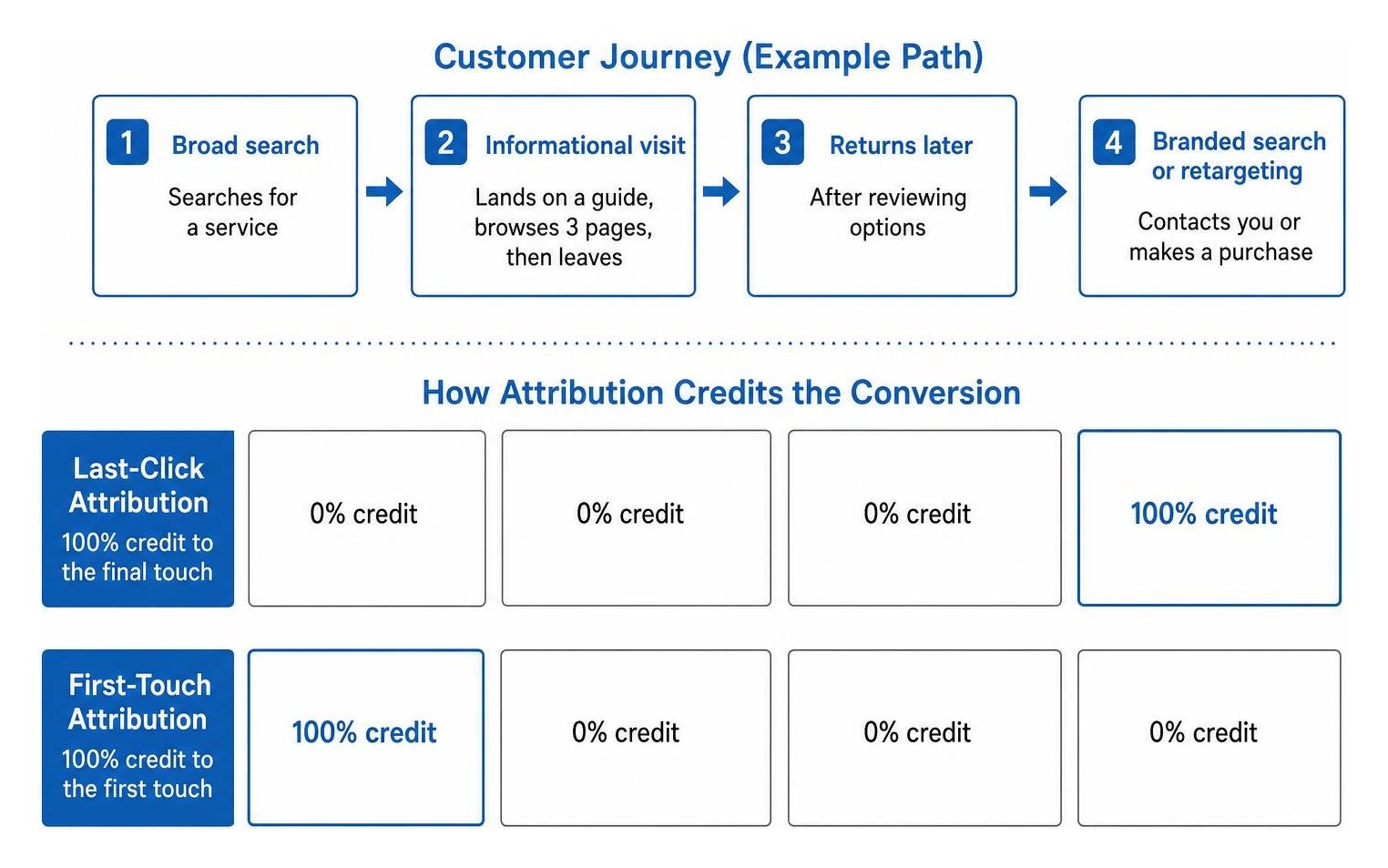
Consider a standard buyer path: a prospect searches for a broad industry problem, lands on an informational guide on your site, browses three pages, and leaves. A week later, after reviewing their options, they search specifically for your company name or click a retargeting link to make a purchase.
Under single-touch rules, that initial organic conversion pathway receives zero credit. Instead, the final touchpoint takes all the glory. As industry research from Fospha on measuring upper-funnel channels reveals, standard last-click models undervalue discovery channels by more than 90% on average, missing up to 92% of the actual marketing impact that initiated the sale.
Why does single-touch logic miss visits in multi-stage journeys?
Single-touch logic operates under the assumption that a customer journey is an isolated event rather than an evolving relationship. When someone conducts non-brand informational searches, they are exploring solutions. By the time they reach the decision stage, they use direct navigation or transactional queries.
Because standard platforms use fixed lookback windows (often defaulting to 30 or 90 days), any early research session falling outside that arbitrary boundary is erased from the conversion path entirely. As highlighted in research on first-touch versus last-touch attribution differences, single-touch systems force a binary choice: you either credit only where the user entered or where they exited, blinding you to the crucial middle touchpoints.
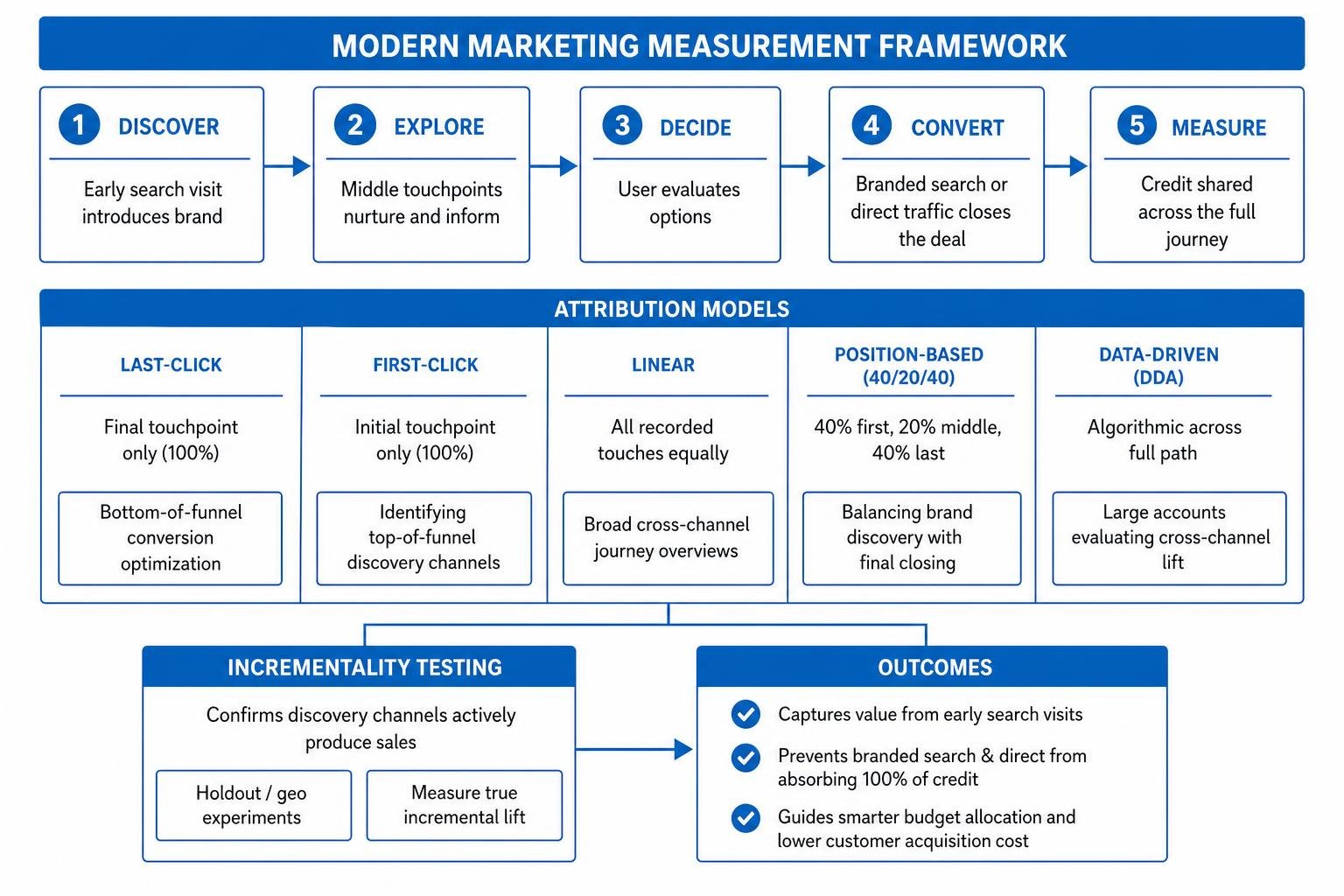
| Attribution Model | Touchpoints Covered | Data & Setup Requirements | Best Used For |
|---|---|---|---|
| Last-Click | Final touchpoint only (100%) | Low; standard analytics default | Bottom-of-funnel conversion optimization |
| First-Click | Initial touchpoint only (100%) | Low; available in most platforms | Identifying top-of-funnel discovery channels |
| Linear | All recorded touches equally | Medium; multi-touch reporting tool | Broad cross-channel journey overviews |
| Position-Based (40/20/40) | 40% first, 40% last, 20% middle | Medium; custom rules configuration | Balancing brand discovery with final closing |
| Data-Driven (DDA) | Algorithmic across full path | High; requires significant conversion volume | Large accounts evaluating cross-channel lift |
How can direct and branded searches take credit from earlier visits?
Direct traffic and navigational search terms act like cash registers at the front door: they collect the sale, but they rarely convinced the customer to enter the store in the first place. When someone already knows your brand name, their search represents branded search demand created by prior marketing efforts.
Yet in standard reporting dashboards, branded search and direct traffic systematically absorb credit for upstream work. Industry incrementality data shows that branded search often displays only 20% to 40% true incrementality—meaning most of those users would have found your site and converted anyway. When last-click rules give 100% credit to these navigational touches, marketers mistakenly divert budget from awareness-building content into expensive brand-bidding campaigns.
How can device and cookie limits hide earlier search visits?
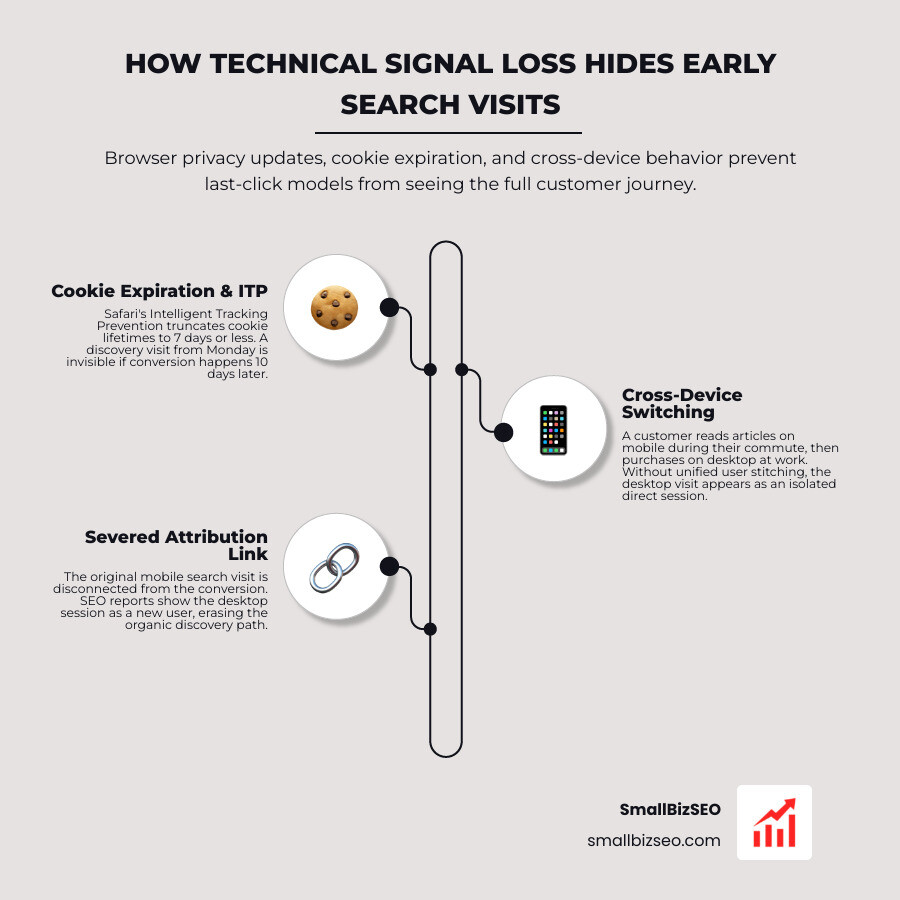
Even when a measurement platform supports multi-touch tracking, technical signal loss can make early visits invisible. Browser privacy updates, such as Safari's Intelligent Tracking Prevention (ITP), frequently truncate cookie lifetimes to seven days or less. If a prospect discovers your blog on Monday and converts ten days later, the analytics tool treats them as a completely new user.
Cross-device behavior creates an even larger blind spot. A customer often reads informational articles on a mobile device during their morning commute, discusses the decision offline, and completes the purchase on a desktop computer at work. Without unified user stitching or advanced identifier resolution, your SEO performance reports will show the desktop session as an isolated direct visit, severing the link to the original mobile search visit.
How can businesses measure channel value beyond single-touch models?
To measure channel performance without single-touch distortion, marketers must combine multi-model evaluation with experimental testing. Relying on an isolated dashboard metric often produces inflated performance figures; as search industry analyses point out in evaluating true paid media ROAS, ad platforms frequently claim credit for the same conversions that organic search introduced.
Evaluating your marketing using a blend of position-based modeling and total business metrics protects your customer acquisition cost from runaway inflation.
How can multi-touch attribution and incrementality tests help?
Multi-touch attribution redistributes value across the entire recorded journey. A position-based model, for example, assigns 40% of the conversion credit to the discovery visit that introduced your brand, 40% to the final touchpoint that closed the deal, and divides the remaining 20% among intermediate nurturing visits.
To confirm that your discovery channels are actively producing sales rather than merely collecting passive pageviews, use incrementality testing:
- Geo-Holdout Experiments: Turn off paid campaigns or isolate organic landing pages in specific geographic regions for four to six weeks, measuring the net change in total revenue compared to control regions.
- Brand Search Holdouts: Temporarily pause branded ad spend to measure how many conversions naturally shift into organic search listings without loss of total volume.
- Media Mix Modeling (MMM): Statistical modeling that calculates the relationship between top-line business revenue and marketing spend across online and offline channels simultaneously, bypassing cookie limitations.
What steps can improve balanced attribution?
Small business marketing teams do not need complex enterprise software to uncover hidden search touchpoints. Following structured data hygiene practices provides reliable visibility across campaigns:
- Maintain Strict Tracking Hygiene: Standardize source, medium, and campaign parameters across all marketing links so referral paths do not degrade into unattributed direct traffic.
- Align Lookback Windows with Sales Cycles: Adjust your analytics conversion windows to match your actual sales cycle. If customers take 60 days to choose a vendor, a 30-day reporting window will guarantee your discovery touches remain uncredited.
- Monitor Range Reporting: Rather than presenting a single attribution figure to leadership, compare first-touch, last-touch, and position-based numbers side by side to establish an honest performance range.
- Integrate CRM Lead Data: Pass web interaction parameters directly into your CRM so sales reps can view which search queries and articles a lead engaged with prior to scheduling a call.
Uncovering the Full Value of Your Search Strategy
Attribution models are not objective scorecards; they are specific lenses designed to answer specific questions. Last-click reporting tells you which page stood closest to the checkout line, but it cannot tell you what sparked the buyer's interest in the first place.
By identifying tracking gaps, accounting for branded search capture, and evaluating discovery channels through comprehensive assisted conversion analysis, you can build an SEO and content strategy that drives sustainable long-term revenue. At SmallBizSEO, our data-driven Velocity framework uses transparent reporting and technical precision to ensure your high-impact search touchpoints receive the credit and investment they deserve.