Optimizing Content for E-E-A-T: Why Your Rankings Are Still Stuck
Optimizing Content for E-E-A-T: Why Your Rankings Are Still Stuck
Why Your Content Isn't Ranking (And What E-E-A-T Has to Do With It)
E-E-A-T content optimization is the process of improving your web content so that Google's systems recognize it as trustworthy, expert, and genuinely useful — which directly influences how well your pages rank.
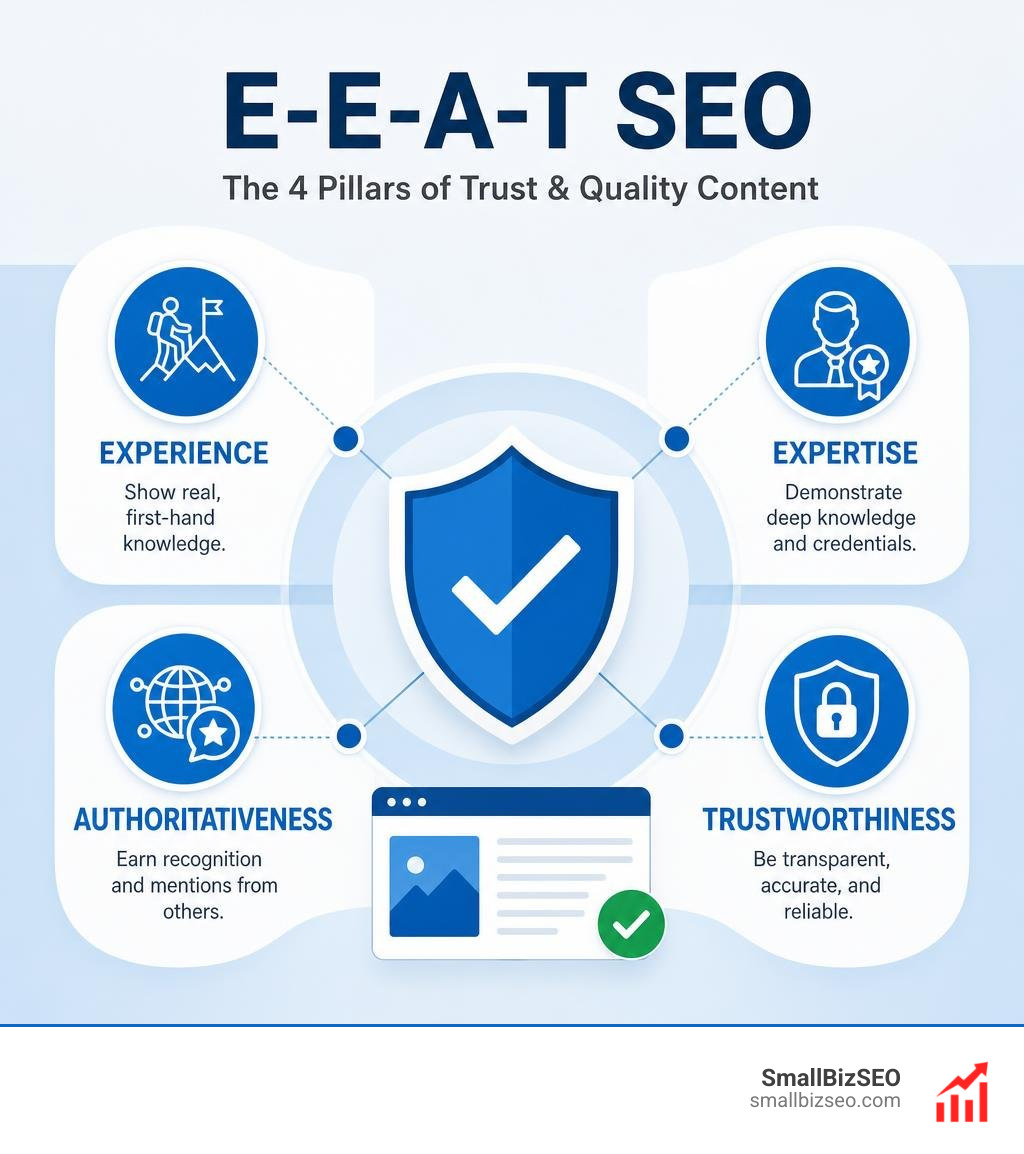
Here's a quick breakdown of what that means in practice:
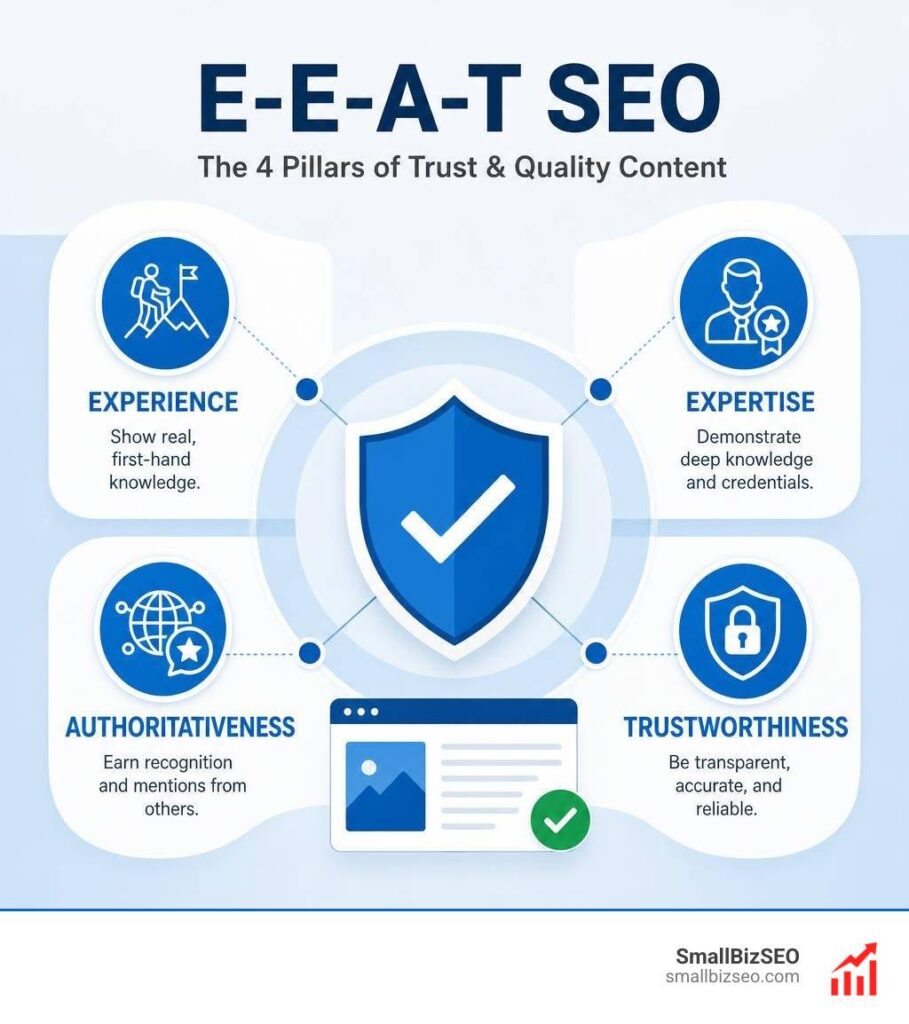
- Experience - Show real, first-hand knowledge (photos, case studies, personal results)
- Expertise - Demonstrate that the author actually knows the subject (credentials, depth of knowledge)
- Authoritativeness - Build recognition beyond your own site (backlinks, mentions, reviews)
- Trustworthiness - Make your site safe and transparent (HTTPS, clear policies, accurate info)
You've published the content. You've done the keyword research. You've even added a few backlinks. But your rankings are still stuck.
Sound familiar?
This is one of the most frustrating situations a small business owner can face. You're doing most of the right things — but missing a layer that Google increasingly cares about.
That layer is E-E-A-T.
Over 62% of ranking drops tied to Google's Helpful Content updates were linked to weak experience signals or unclear author credibility — not backlinks. And with the rise of AI-generated content flooding the web, Google's systems are working harder than ever to separate genuinely trustworthy sources from the noise.
The good news? You don't need a massive content team or a big budget to fix this. You need a clearer strategy.
I'm Clayton Johnson, a digital PR and SEO specialist focused on building search visibility through credibility and authority — the exact principles behind eeat content optimization. In this guide, I'll walk you through everything you need to know to close the trust gap and start moving up in the rankings.
Demystifying E-E-A-T: The Evolution of Search Quality Standards
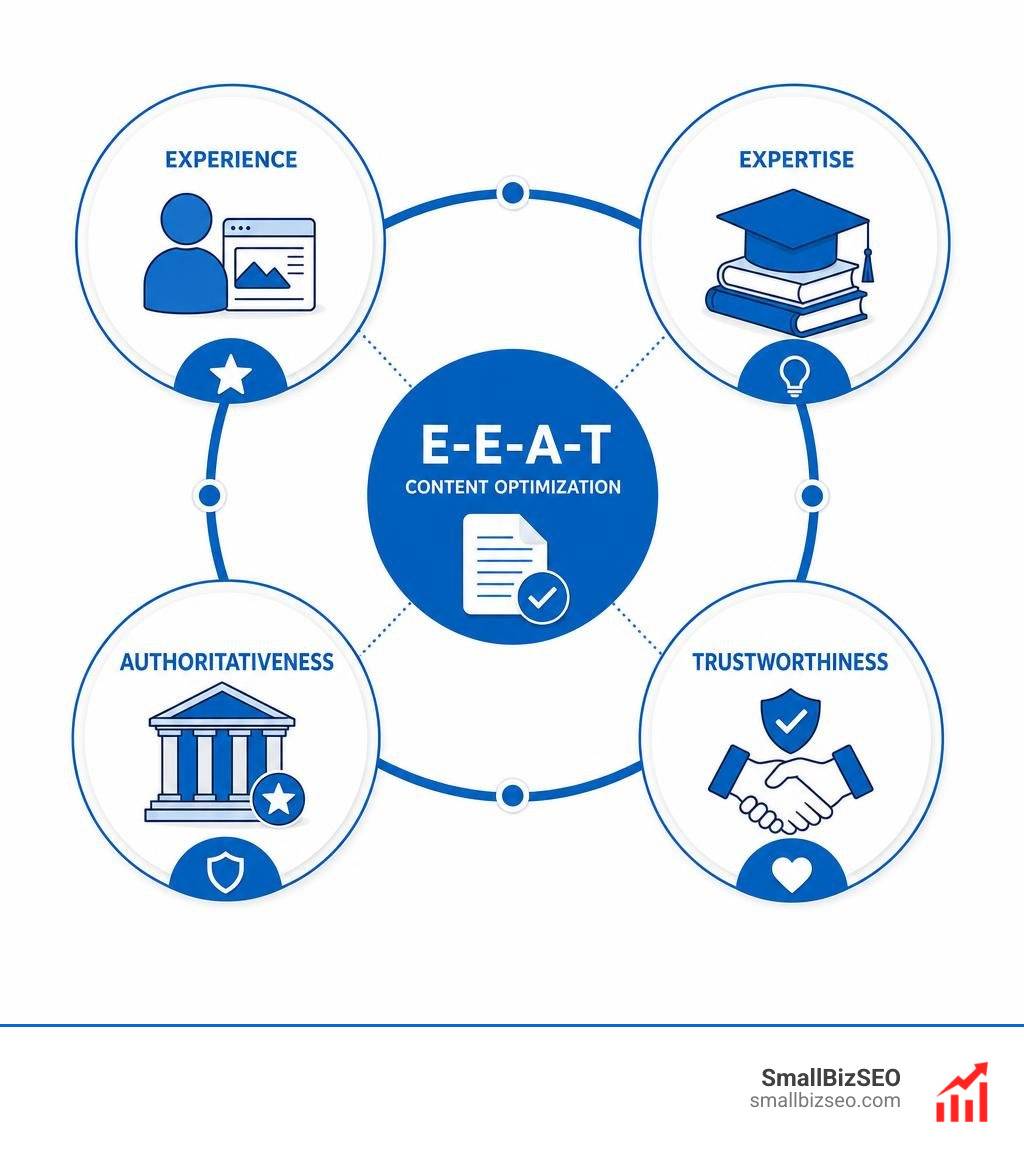
Search engines have come a long way from the days of simple keyword matching. Historically, Google introduced the E-A-T framework (Expertise, Authoritativeness, Trustworthiness) as part of its Search Quality Rater Guidelines. This document serves as a training manual for thousands of human evaluators who grade search results, helping Google refine its automated search algorithms.
To better understand how these pieces fit together, we recommend starting with Google's guide on creating helpful, reliable, people-first content. It lays down the foundation of what search engines expect from modern websites. You can also explore our detailed guide on How to Optimize Your Content for E-E-A-T and Build Real Search Trust to see how these theories translate into practical growth.
Why Google Added Experience to the Quality Equation
In a recent update, Google added a second "E" to the framework: Experience.
Why the sudden shift? The web became saturated with generic, synthesized articles. Anyone (and any AI tool) could rewrite existing content to look "expert." Google realized that users do not just want textbook answers; they want real-world perspective.
First-hand experience is incredibly hard to fake. It is the difference between:
- A product review written by someone who read Amazon descriptions.
- A product review written by an enthusiast who bought the item, tested it for a month, and photographed its flaws.
By rewarding user-generated content, personal anecdotes, and lived experiences, search engines ensure that searchers receive authentic value.
Trustworthiness: The Core Pillar of E-E-A-T Content Optimization
While all four letters matter, they are not equal partners. Google’s guidelines make it clear: Trustworthiness is the central pillar.
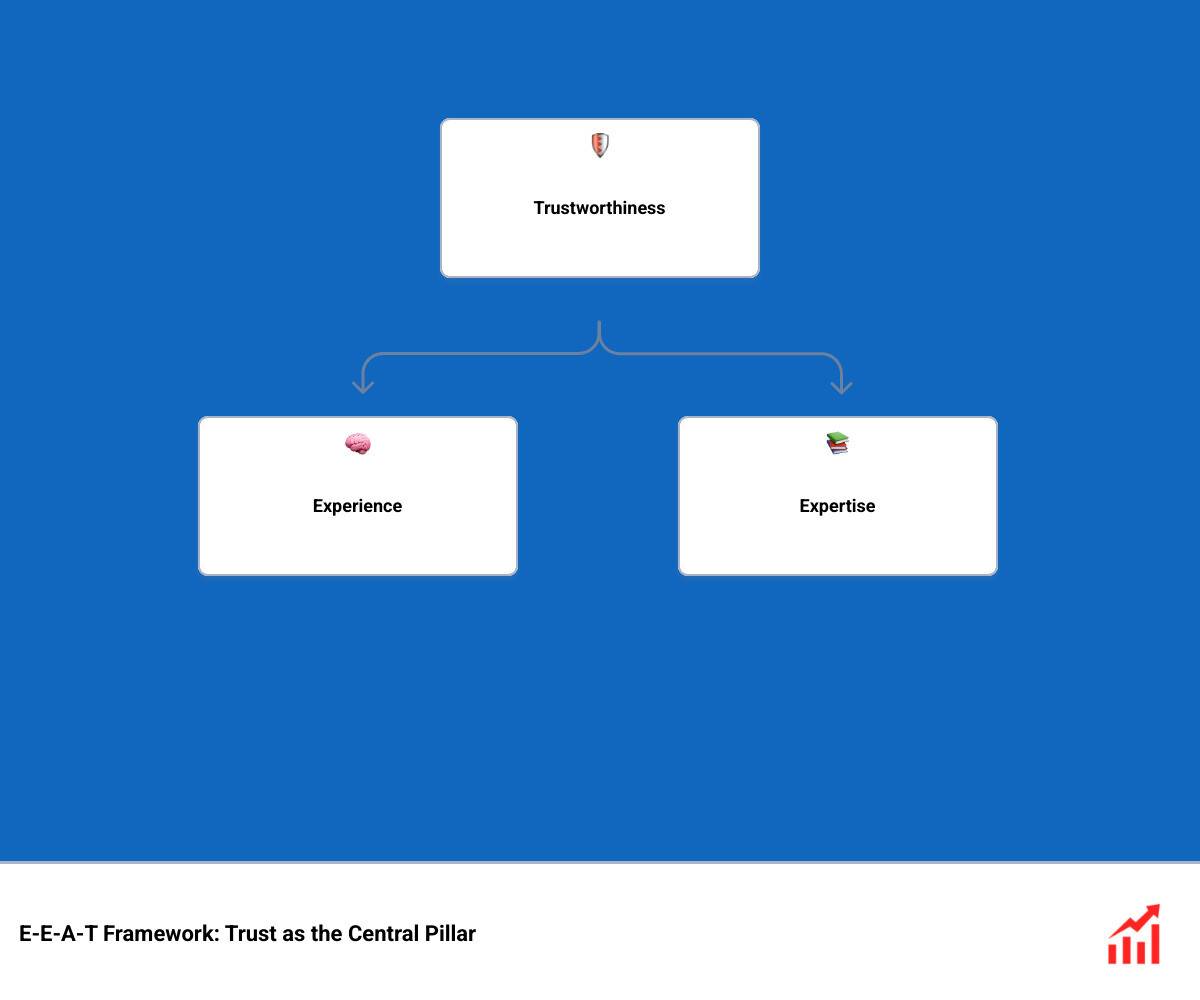
Think of Experience, Expertise, and Authoritativeness as the supporting pillars that feed into Trust. A page can be written by an expert with decades of experience, but if the site lacks secure protocols, hides its contact information, or uses deceptive affiliate links without disclosure, it is untrustworthy.
A lack of trust automatically nullifies the other signals. Protecting your brand reputation and ensuring site security are non-negotiable steps.
The Business Impact: How E-E-A-T Influences SEO and AI Search Visibility
While E-E-A-T is not a direct, algorithmic ranking factor with a single numerical score, it acts as a framework that shapes Google’s automated ranking systems. When a Core Update rolls out, sites with weak trust signals often experience dramatic drops in organic traffic. In a past core update, affected domains lost an average of 38% of their search visibility due to thin content and unverified authorship.
If you are unsure where your site stands, performing an SEO Visibility Audit is a critical first step to identifying weak spots in your digital footprint.
Navigating the Shift from Traditional SEO to AEO and GEO
Search is moving beyond the traditional list of ten blue links. We are now firmly in the era of:
- AEO (Answer Engine Optimization): Optimizing content to be served as direct answers in voice search and smart assistants.
- GEO (Generative Engine Optimization): Structuring content so generative AI models can easily parse, cite, and reference it.
AI Overviews and generative engines prioritize sources that demonstrate ironclad credibility. If your content lacks clear citations, unique data points, or expert verification, AI search engines will bypass your site entirely. Building digital authority is the only way to secure citation likelihood in AI-generated summaries.
Why YMYL Topics Require Heightened Quality Standards
"Your Money or Your Life" (YMYL) topics refer to content that could directly impact a reader's health, financial stability, physical safety, or legal well-being. This includes medical advice, investment tips, tax strategies, and legal information.
For YMYL pages, search engines hold content to the absolute highest standard. A surface-level blog post about diabetes written by an anonymous writer will not rank. It must be written or rigorously reviewed by a certified medical professional. If your business operates in these high-stakes niches, securing a Detailed SEO Analysis can help you construct a bulletproof compliance strategy.
Practical Strategies for E-E-A-T Content Optimization
Optimizing your content is not a one-time trick; it is an ongoing workflow. We need to shift from creating search-engine-first content to building a genuine, expert-led resource.
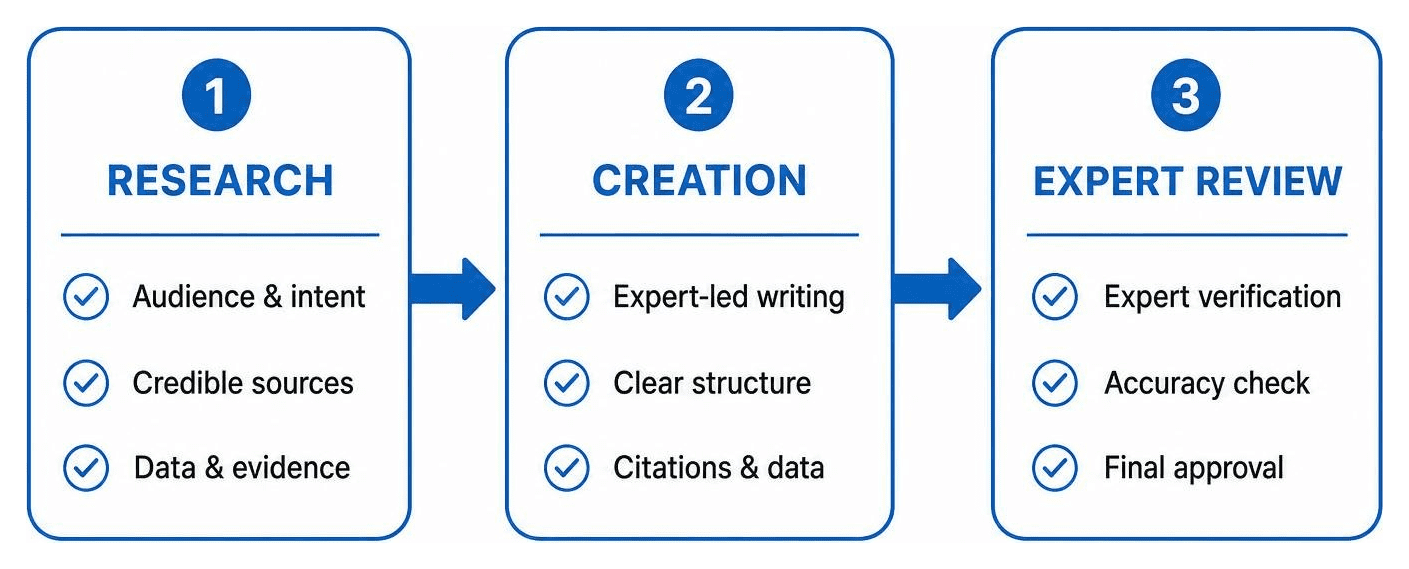
To help your brand stand out, our SEO Content Services focus on injecting genuine authority into every piece of content. Here is how traditional content compares to E-E-A-T-optimized content:
| Feature | Traditional SEO Content | E-E-A-T Optimized Content |
|---|---|---|
| Authorship | Written by "Admin" or anonymous | Written by a named expert with a verifiable bio |
| Media | Stock photos and generic graphics | Original photos, custom diagrams, and screenshots |
| Sourcing | No links or links to low-quality blogs | Links to peer-reviewed studies, government sites, or original data |
| SME Input | Rewritten search results | Direct quotes, interviews, and reviews by specialists |
Demonstrating First-Hand Experience and Expertise in Your Writing
To show real experience, you must "show, don't just tell." If you are writing a guide or a review:
- Use original media: Include unique photos, videos, or screenshots of your team in action.
- Share personal case studies: Discuss what worked, what failed, and the specific metrics you achieved.
- Tell stories: Weave in personal anecdotes that explain the "why" behind your recommendations.
For a deeper dive into how to weave these elements naturally into your copy, check out eesel AI's guide to Google E-E-A-T.
Building Author Credibility and Digital Authority Signals
Every piece of content needs a human face behind it. Anonymous content erodes trust. To fix this:
- Create detailed author bio pages showcasing the writer's credentials, education, and career history.
- Link to their active social media profiles (like LinkedIn) to prove they are a real person.
- Highlight certifications, awards, and industry memberships.
Implementing these practices on your site is a core part of effective On-Page SEO, transforming basic text into a highly credible resource.
Technical and Off-Page Trust Signals You Cannot Ignore
Credibility extends far beyond the words on the page. Search engines evaluate your entire digital ecosystem to determine if you are a legitimate business.

Establishing these fundamental signals is a primary step in our SEO Services Guide. If you ignore these technical baselines, your content optimization efforts will fall flat.
Leveraging Structured Data to Validate Credentials
Search engines are machines; they prefer structured, machine-readable data to understand context. By using schema markup, you can explicitly tell search engines who wrote your content and why they are qualified.
- Person Schema: Apply this to author pages to define their job title, awards, and external profiles (
sameAslinks to LinkedIn or Wikipedia). - Organization Schema: Use this on your "About Us" page to clarify your brand logo, official contact points, and social profiles.
- Article Schema: Ensure every blog post includes
author,datePublished, anddateModifiedfields.
Managing Brand Reputation and External Mentions
Authority is mostly built externally; you cannot simply self-declare it. Google looks at what the rest of the web says about you.
- Unlinked Brand Mentions: When high-quality sites mention your brand name without linking, search engines still register this as a trust signal.
- Review Management: A healthy profile on Google Business Profile, Trustpilot, or other relevant platforms proves you serve real, happy customers.
- Digital PR: Getting featured in industry podcasts, news outlets, and reputable blogs builds your off-page footprint.
Focusing on these off-page signals is essential for aligning your brand reputation with search engine expectations and building long-term digital authority.
How to Audit and Improve Your Site's E-E-A-T Score
Evaluating your current content library is essential for finding and fixing weak trust signals. A systematic approach ensures no page is left behind.
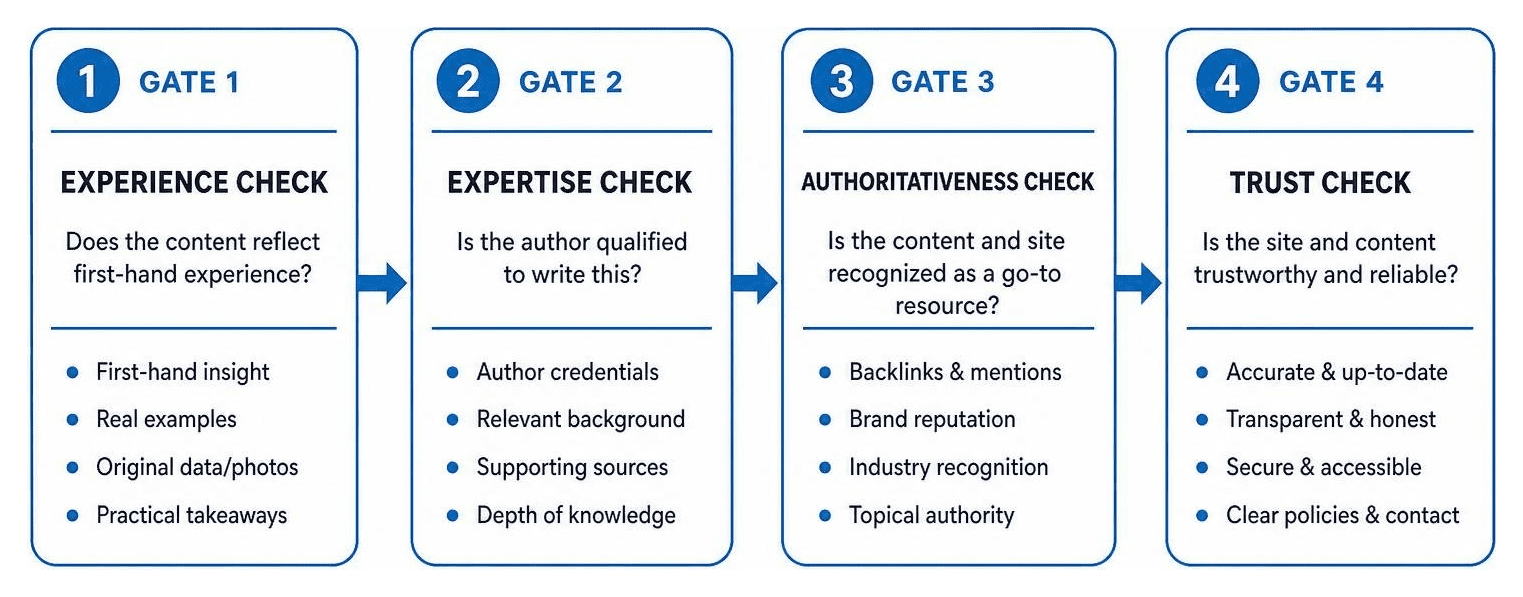
To benchmark your site against the highest standards, we recommend utilizing divide29's CORE-EEAT content benchmark, which separates content body quality from source credibility across 80 unique criteria. Combining this framework with a Keyword Gap Analysis: What It Is and How to Do It Right will help you identify what authoritative topics your competitors are covering that you might have missed.
Step-by-Step Content Quality Assessment
When conducting a content audit, ask your team these evaluation questions:
- Is the author of this page clearly identified with a bio?
- Does the content offer original research, unique insights, or fresh data?
- Are all medical, financial, or technical claims backed up by links to Tier 1 sources (such as
.govor.edusites)? - Has the content been updated recently to reflect current industry standards?
If a page fails these questions, prioritize it for a content refresh rather than deleting it. Add expert quotes, update old statistics, and clean up broken links.
Avoiding Common Pitfalls in E-E-A-T Content Optimization
When optimizing your site, make sure you avoid these common traps:
- Using anonymous "Admin" profiles: Always attribute content to a real person.
- Publishing generic AI content: Ungoverned AI content lacks lived experience and often repeats shallow information. If you use AI tools, ensure they are paired with our AI SEO Services to inject human editorial oversight and expert reviews.
- Letting statistics go stale: Outdated facts signal to search engines that your content is abandoned.
- Overpromising and clickbait: Titles that do not match the content body destroy user trust instantly.
Frequently Asked Questions about E-E-A-T
Is E-E-A-T a direct Google ranking factor?
No, E-E-A-T is not a direct ranking factor with a specific algorithmic score. Instead, it is a conceptual framework used by Google to train human Search Quality Raters. The feedback from these raters is used to refine Google's automated search algorithms, which look for signals that align with E-E-A-T principles.
How long does it take to see results from E-E-A-T optimization?
E-E-A-T optimization is a long-term strategy. While technical fixes (like adding HTTPS or basic schema) can show immediate crawl benefits, building true digital authority, earning backlinks, and establishing brand reputation typically takes three to six months to yield noticeable ranking improvements.
Can AI-generated content meet E-E-A-T standards?
Yes. Google does not penalize AI-generated content simply because it was created by automation. However, raw AI content often lacks original experience and real-world perspective. To meet E-E-A-T standards, AI-drafted content must be reviewed, fact-checked, and enhanced by real subject-matter experts.
Conclusion
Building search visibility is no longer just about matching keywords and acquiring bulk backlinks. It is about proving to search engines and AI models that your business is a legitimate, expert source of information.
At SmallBizSEO, we help small businesses build digital authority through our data-driven Velocity framework. We combine technical SEO, strict editorial standards, and transparent reporting to deliver E-E-A-T-compliant growth that survives algorithm updates.
Ready to close the trust gap and unlock your true search potential? Get started with our SEO services today.