Winning More HOA and Rental Contracts Through Strategic Search Optimization

How Can SEO for Property Management Win More Contracts?
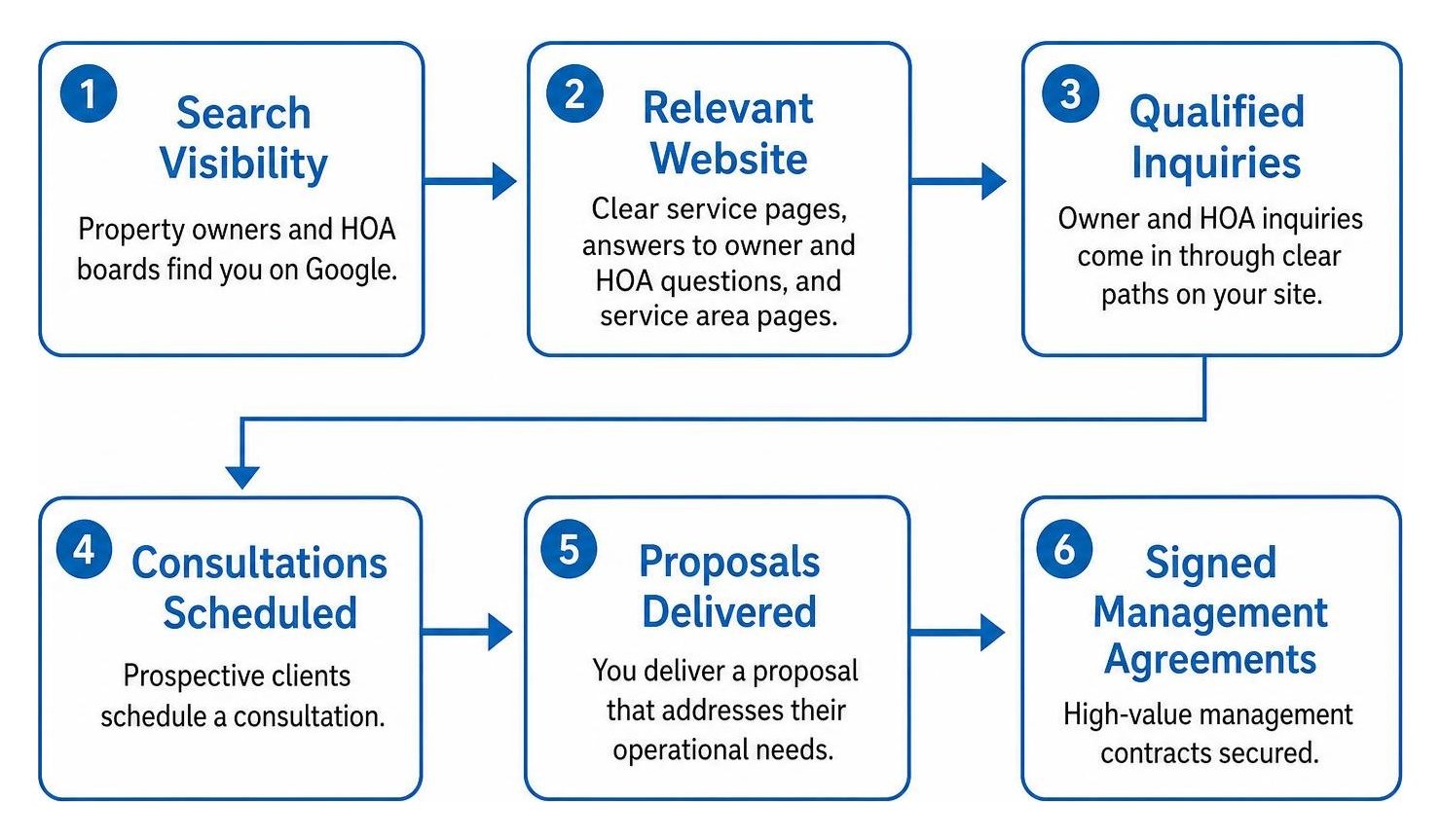
To make SEO for property management work, start with the contracts you want to win. Build pages for the services you offer, answer the questions landlords and HOA boards ask before hiring, and make each service area easy to find on your site. Keep rental listings and renter help separate so owner inquiries do not get lost among tenant traffic.
Then check the basics: your Google Business Profile, reviews, mobile site speed, and whether search engines can reach your key pages. Measure qualified owner and HOA inquiries, not just website visits.
I’m Clayton Johnson, founder of SmallBizSEO. My work in SEO, content strategy, and digital PR informs how I approach SEO for property management: clear answers, credible local information, and paths from search to inquiry.
With over 21 million professionally managed apartment units in the market and roughly 20 million additional rental properties held by individual investors, competition for valuable management agreements is intense. Research shows that 72% of property owners begin their search for a management company on Google. Earning a top organic position yields an average click-through rate of 27.6%, translating directly into predictable door growth, while lower rankings leave valuable contracts on the table.
Core Strategies: How to Master SEO for Property Management to Win Landlord and HOA Contracts
Capturing high-value B2B management contracts requires an organic search pipeline built around owner decision-making. Property investors and community association boards do not browse online casually; they search with specific operational challenges in mind. When you align your website with industry standards—such as National Association of Residential Property Managers (NARPM) operational guidelines and National Apartment Association (NAA) benchmarks—you establish immediate credibility. Exploring modern marketing approaches alongside structured search optimization ensures every digital touchpoint guides prospective clients toward scheduling a consultation. Following Google's established guidance on how Tips to improve your local ranking on Google - Google Business Profile Help work allows your firm to dominate high-intent local map results where property owners make rapid hiring decisions.
Should SEO for Property Management Target Property Owners or Renters?
Direct Answer: SEO for property managers must prioritize property owners and community association boards over prospective tenants. While tenant traffic fills immediate vacancies, signed management agreements produce recurring revenue and build long-term portfolio equity.
Focusing strictly on tenant queries places your website in direct competition with massive Internet Listing Services (ILS) like Zillow and Apartments.com. These aggregators dominate generic rental terms through enormous domain authority. By contrast, owner-intent and community board searches face lower competition and carry exponentially higher lifetime value. Integrating dedicated solutions for condominium and HOA management SEO ensures community associations find tailored service pages rather than mismatched residential rental listings.
| Search Dimension | Owner and HOA Search Intent | Tenant Search Intent |
|---|---|---|
| Primary Audience | Real estate investors, accidental landlords, HOA boards | Prospective renters, student tenants, relocating residents |
| Example Search Queries | "HOA management company reviews", "full service rental property manager" | "2 bedroom apartments near downtown", "pet friendly rentals" |
| Search Volume | Moderate to low volume | Extremely high volume |
| Organic Competition | Local and regional management companies | Massive national ILS platforms (Zillow, Trulia) |
| Business Impact | Multi-year recurring management fee revenue | One-time lease placement or vacancy fill |
| Conversion Goal | RFP submission, consultation request, contract signing | Tour scheduling, rental application submission |
How Can Multi-Market Portfolios Build Scalable Local Hubs and Map Pack Visibility?
Direct Answer: To rank across multiple target areas, build separate, indexable location hubs with unique copy, localized customer testimonials, and distinct Google Business Profiles for each physical office, rather than grouping everything onto a single contact page.

A single "areas we serve" page dilutes geographic relevance. Search engines require distinct regional signals to evaluate local authority. When structuring a multi-market property portfolio, create dedicated landing pages for each municipality and neighborhood you manage. Each page should feature hyper-local content, such as municipal rental regulations, local eviction guidelines, and nearby community case studies. Maintaining consistent Name, Address, and Phone (NAP) details across directories strengthens your map visibility. Implementing proven local SEO strategies connects your regional branches directly to nearby property owners seeking immediate local oversight.
What Schema Markup and Technical SEO Fixes Prevent Lost Rankings?
Direct Answer: Implement structured data such as LocalBusiness, RealEstateAgent, and FAQPage schemas while keeping mobile Largest Contentful Paint (LCP) under 2.5 seconds and systematically redirecting expired rental listing pages.

Technical stability ensures search engines index your service hubs without wasting crawl budget on dead links. Many property management websites run into platform constraints from niche software like AppFolio or Buildium, where dynamic rental pages generate duplicate code. In our experience, addressing these technical roadblocks early provides an immediate competitive advantage over slower local competitors.
Adhering to a comprehensive technical SEO resource helps prevent common crawl errors. Apply these core technical practices:
- Handle Inactive Listings Properly: Avoid letting filled rental listings turn into dead 404 errors. If a property is permanently removed, return a clean 410 Gone status code; if it is temporarily leased, redirect the URL with a 301 redirect to the parent neighborhood landing page to preserve earned link equity.
- Optimize Core Web Vitals: Mobile visitors abandon sites that take longer than 3 seconds to load. Compress high-resolution property imagery using WebP formats and minify script execution to keep Largest Contentful Paint well below 2.5 seconds.
- Deploy Rich Schema Markup: Help search engines interpret your services by structuring schema tags. Applying essential real estate SEO practices allows search algorithms to surface your operational hours, physical address, customer ratings, and service menus directly in rich search results.
Step-by-Step Implementation: Executing Your Search Strategy and Tracking Growth
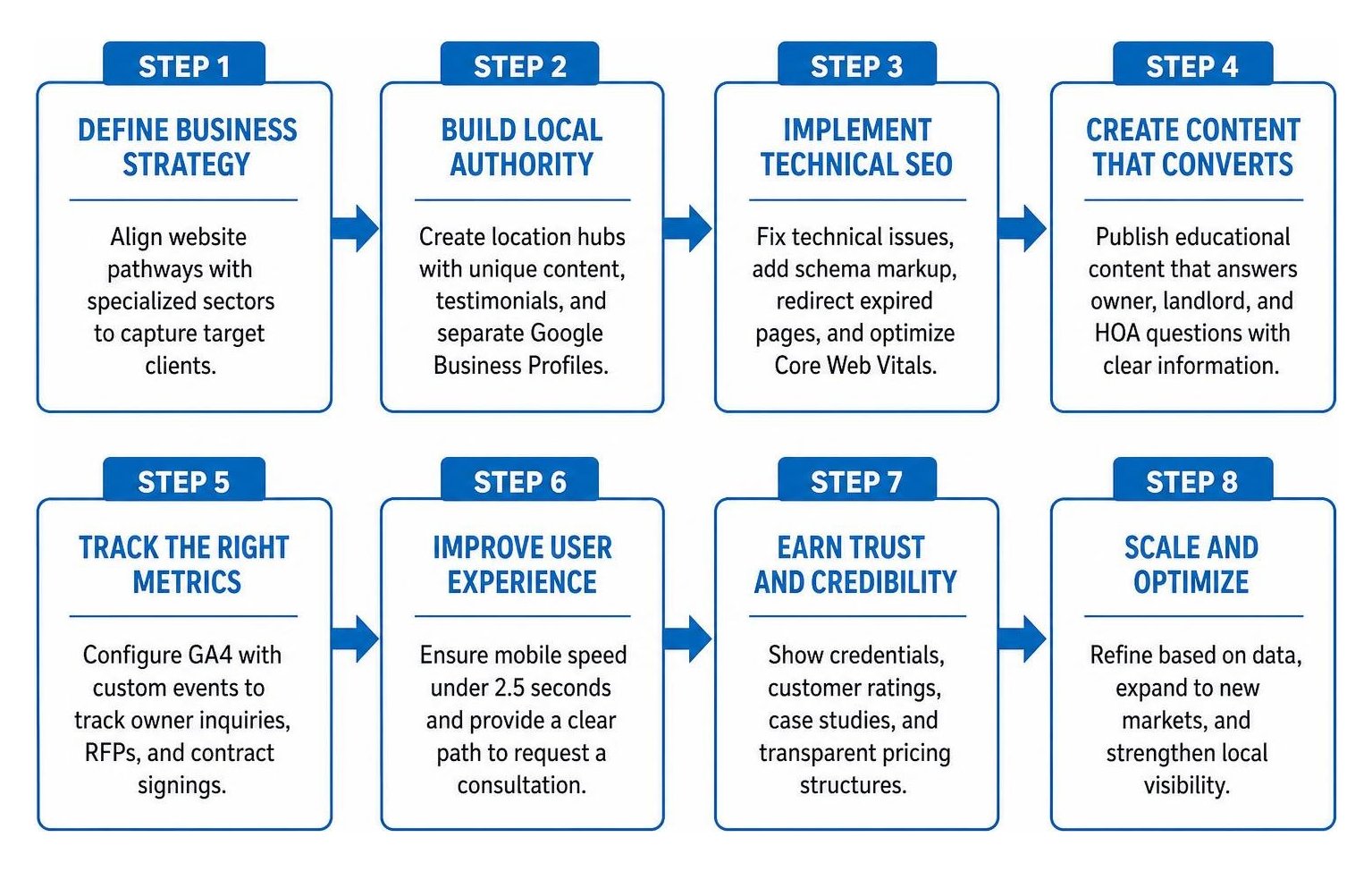
Executing a search optimization strategy requires bridging technical site architecture with owner-focused conversion funnels. Aligning website pathways with specialized sectors such as commercial real estate search optimization ensures your team captures institutional investors alongside single-family residential clients. Configure Google Analytics 4 (GA4) with custom events that distinguish tenant portal logins from owner management inquiries, ensuring your marketing dollars directly support door growth.
How Does Content Marketing and AI Search Impact SEO for Property Management?
Direct Answer: Modern search engines and AI assistants prioritize websites that answer complex landlord and HOA questions with transparent pricing structures, operational steps, and verified industry credentials.
Generative search engines like ChatGPT and Google AI Overviews extract information from pages that provide concise, authoritative answers. Companies that publish regular, educational blog posts earn 55% more traffic than those that rely on static service overviews. Addressing nuanced topics—such as short-term rental compliance through vacation rental management search optimization—positions your firm as the foremost regional expert.
High-converting content clusters to prioritize include:
- Financial & Fee Transparency: "How Much Do Property Managers Charge?", "Understanding Reserve Study Requirements for HOAs"
- Legal & Compliance Guides: "Fair Housing Screening Rules for Landlords", "Local Eviction Moratorium Updates"
- Operational Comparisons: "Self-Managing vs. Hiring a Professional Property Manager", "How to Prevent Tenant Turnover"
How Do You Manage Reviews and Build Local Backlinks to Secure Contracts?
Direct Answer: Build sustainable search authority by securing backlinks from local business organizations and implementing an automated review system that requests feedback during positive operational milestones.

Property management companies face a unique operational hurdle: unhappy tenants frequently leave negative reviews regarding maintenance delays or security deposit disputes. Left unmanaged, these public ratings deter prospective rental owners who research your reputation before signing.
Mitigate negative review bias by triggering automated feedback requests to property owners following successful tenant placements, timely lease renewals, and clean annual financial distributions. Simultaneously, earn authoritative local backlinks by joining regional chambers of commerce, partnering with local real estate brokerages that do not offer property management, and publishing neighborhood economic analyses. Aligning these outreach initiatives with broader facilities management search solutions broadens your regional backlink profile and strengthens overall domain authority.
How Long Does Property Management SEO Take to Deliver a Positive ROI?
Direct Answer: Most property management firms begin seeing initial keyword movements within 3 to 6 months, with consistent lead volume, signed management contracts, and positive ROI appearing between the 6 to 12 month mark.
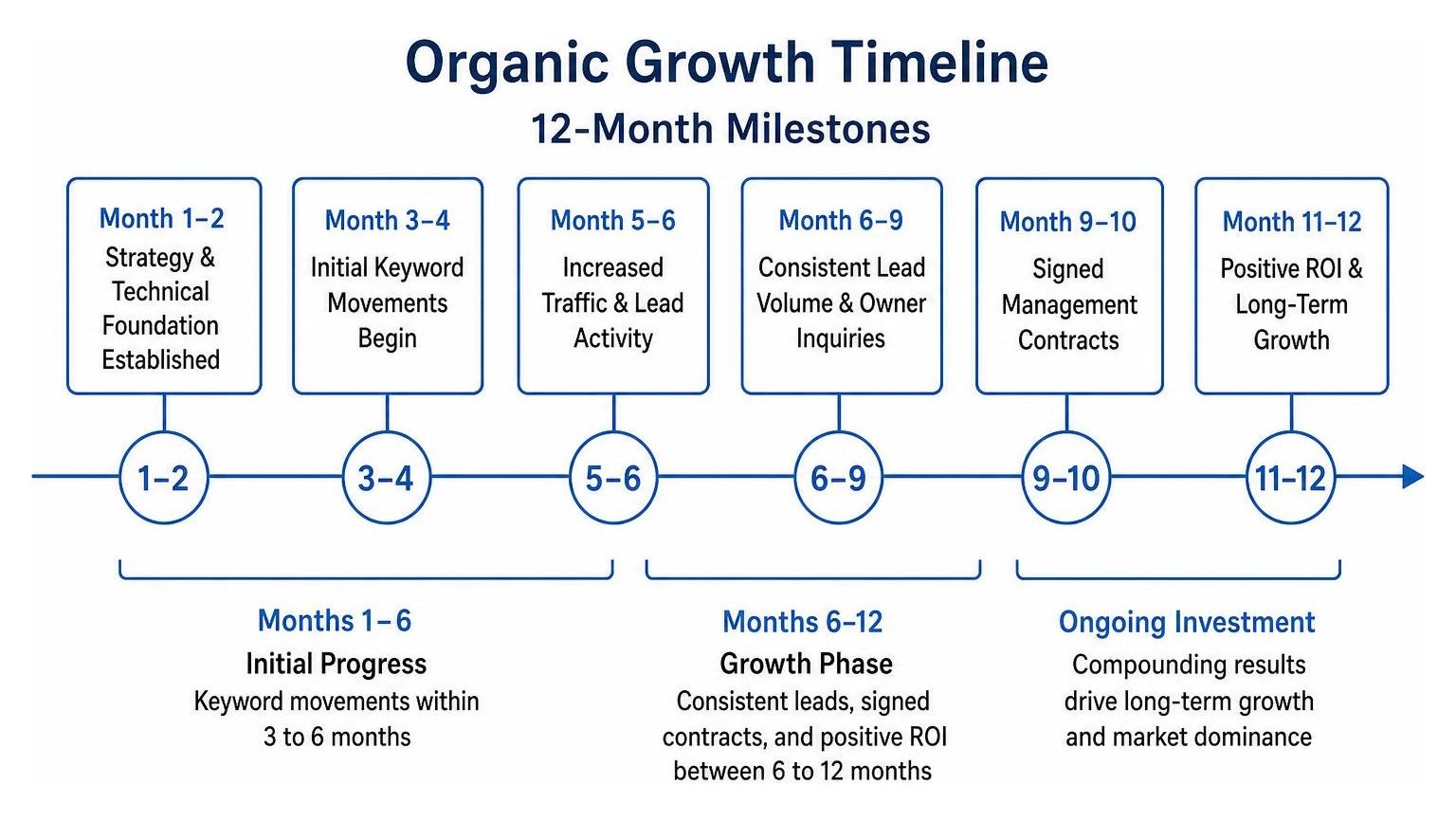
Organic search is a compounding investment. A typical property management campaign requires an ongoing monthly budget between $1,250 and $2,500 depending on market competition and geographic reach. Because a single multi-unit building or HOA contract produces thousands of dollars in annual management fees, signing just one or two new clients routinely covers an entire year of digital optimization. Our data-driven Velocity framework focuses on accelerating indexation and delivering transparent, automated reporting so you can track exact contract acquisitions against your digital investment. Operators managing larger portfolios can further scale their search footprint by leveraging specialized multifamily and apartment building SEO services to secure long-term market dominance.
Ready to Turn Search Visibility into Signed Doors?
Building a dependable acquisition channel through search optimization requires deliberate focus on the audience that drives your business forward: rental owners and community association boards. By maintaining clean site architecture, resolving technical CMS bottlenecks, dominating local map results, and addressing owner concerns directly, your company establishes an organic pipeline that consistently adds doors month after month.