A Practical Guide to Grounding AI Drafts with Original Data

How Do You Add Original Evidence to an AI-Generated Draft?
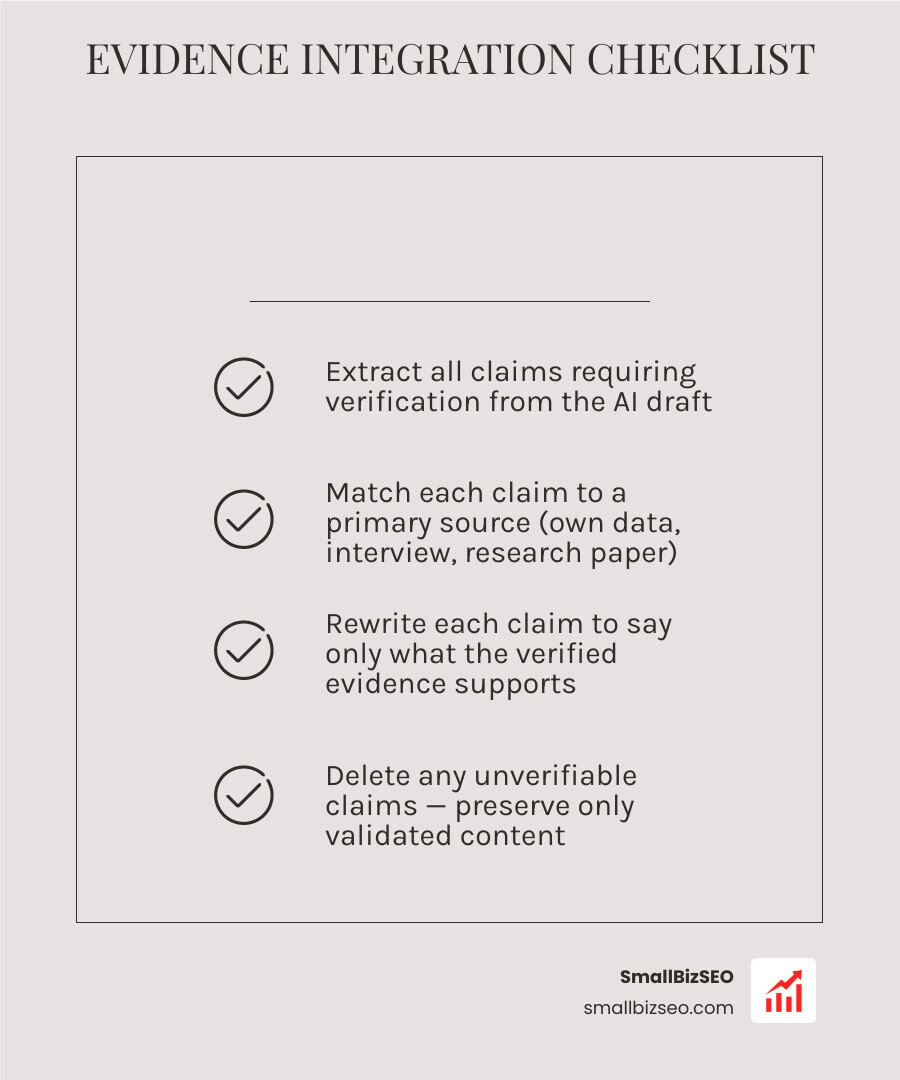
Start by checking the draft's claims, not polishing its prose. When adding original evidence to ai-generated drafts, mark each fact, quote, and statistic that needs proof. Match it to a source you have checked yourself, such as your own data, a customer interview you have permission to use, or a primary research document. Then rewrite the claim to say only what that evidence supports. If you cannot verify it, cut it.
This turns a smooth-sounding draft into something readers can trust. It also gives you room to add the insight AI cannot supply: what you learned from the evidence and why it matters to your audience.
I'm Clayton Johnson, founder of SmallBizSEO, where I help small businesses turn their expertise and original insights into useful content. My approach to adding original evidence to ai-generated drafts starts with a simple question: Can we show readers where this claim came from?
The Step-by-Step Framework for Adding Original Evidence to AI-Generated Drafts
To build authoritative content that ranks and converts, you must transform raw synthetic text into a verified, source-backed piece. Large language models create plausible sentences, but they cannot conduct hands-on experiments or interview your clients.
When your audience is evaluating AI search visibility, they expect authoritative proof, not generic text. Synthetic text predicts words based on statistical probability, while original evidence provides concrete, verifiable reality.
| Content Attribute | Synthetic AI Text Claim | Verified Original Evidence |
|---|---|---|
| Origin | Statistical pattern matching across public web scrapes | Proprietary analytics, field trials, primary interviews |
| Verification | Hallucinated or non-existent URLs and quotes | Direct locators, timestamps, and auditable data logs |
| Freshness | Restricted by static model training cutoff dates | Real-time internal records and current industry measurements |
| Search Trust | Low perceived value; risks algorithmic penalties | Demonstrates high Experience, Expertise, Authoritativeness, and Trustworthiness (E-E-A-T) |
| Copyright Safety | Questionable provenance; non-copyrightable raw text | Human-created intellectual property with clear ownership |
What Is Original Evidence and Why Does Synthetic Text Fall Short?
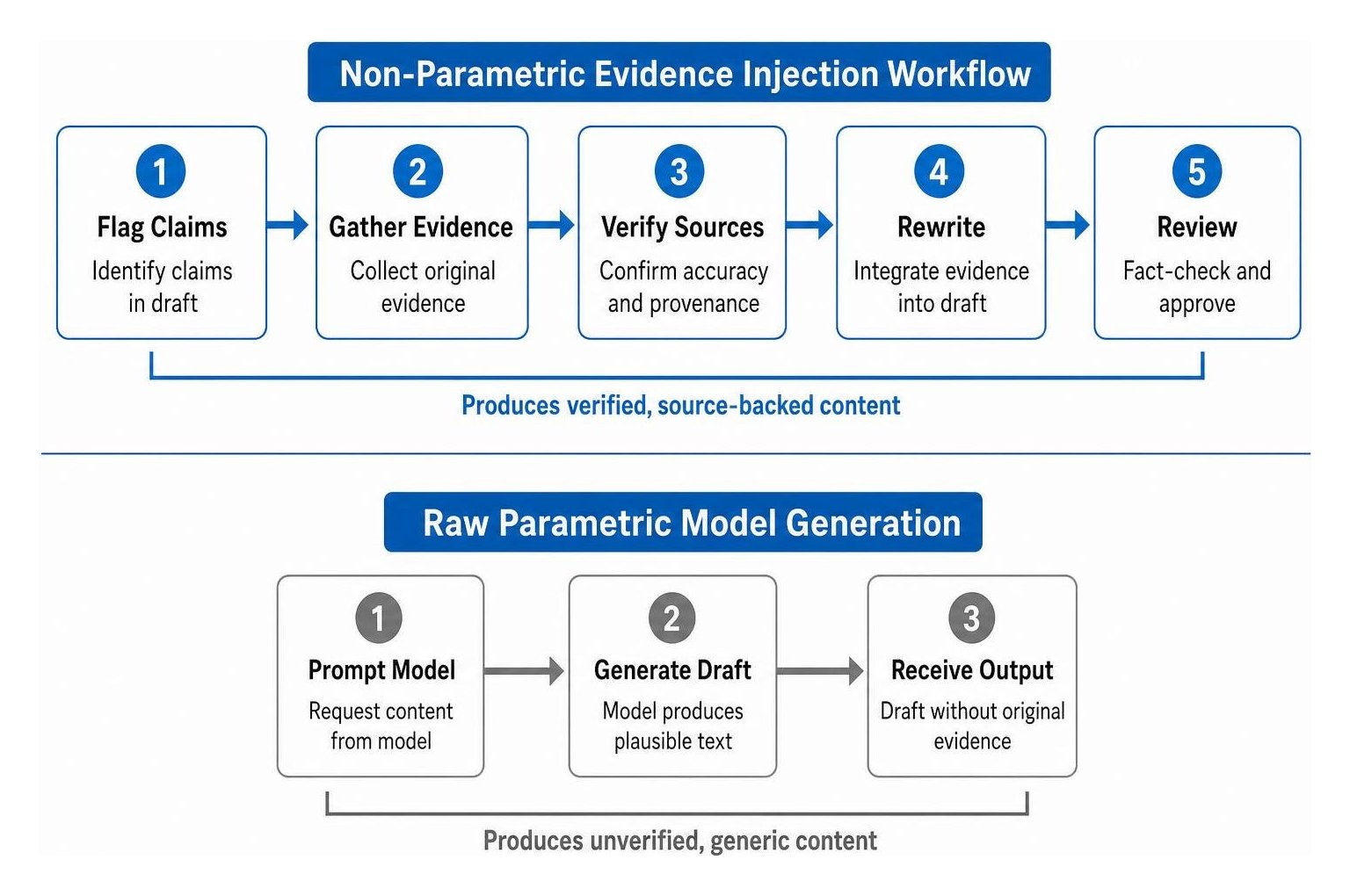
Original evidence consists of first-hand data, proprietary research, customer case studies, and primary source documentation that your business controls and verifies. AI models rely on parametric memory—the frozen knowledge encoded in their neural network weights during training. When asked to produce citations, models often invent convincing titles or link to defunct websites.
Academic research in this evidence-based text generation survey demonstrates that models perform significantly better when restricted to non-parametric retrieval, where the model only references an explicit, provided packet of trusted documents.
Furthermore, foundational models cannot browse behind paywalled journals or hybrid databases, leaving major industry breakthroughs unrepresented. By inserting your own verified findings, you are directly optimizing content for E-E-A-T, ensuring search engines reward your authentic subject-matter expertise while protecting your organization from copyright issues.
How Do You Identify Gaps When Adding Original Evidence to AI-Generated Drafts?
You cannot fix weak claims until you break the text down into atomic statements. An atomic fact is a single verifiable claim, such as "Conversion rates jumped by 42% after updating title tags."

When teams focus on balancing massive AI output with human quality, they often overlook vague buzzwords like "studies consistently show" or "industry leaders agree." These phrases are classic markers of unsupported assertions.
To audit a draft effectively, follow this structured gap-identification routine:
- Extract Atomic Statements: Strip every paragraph down to its factual assertions, separating author opinion from testable claims.
- Flag Hallucination Indicators: Highlight generic filler phrases, superlative adjectives ("seamless," "groundbreaking"), and unlinked numerical data.
- Run Claim-Level Audits: Apply frameworks like FActScore to calculate the proportion of statements that lack direct citation support.
- Isolate Gaps in Context: Identify claims that rely on outdated assumptions caused by training cutoff limitations.
What Is the Exact Workflow for Adding Original Evidence to AI-Generated Drafts?
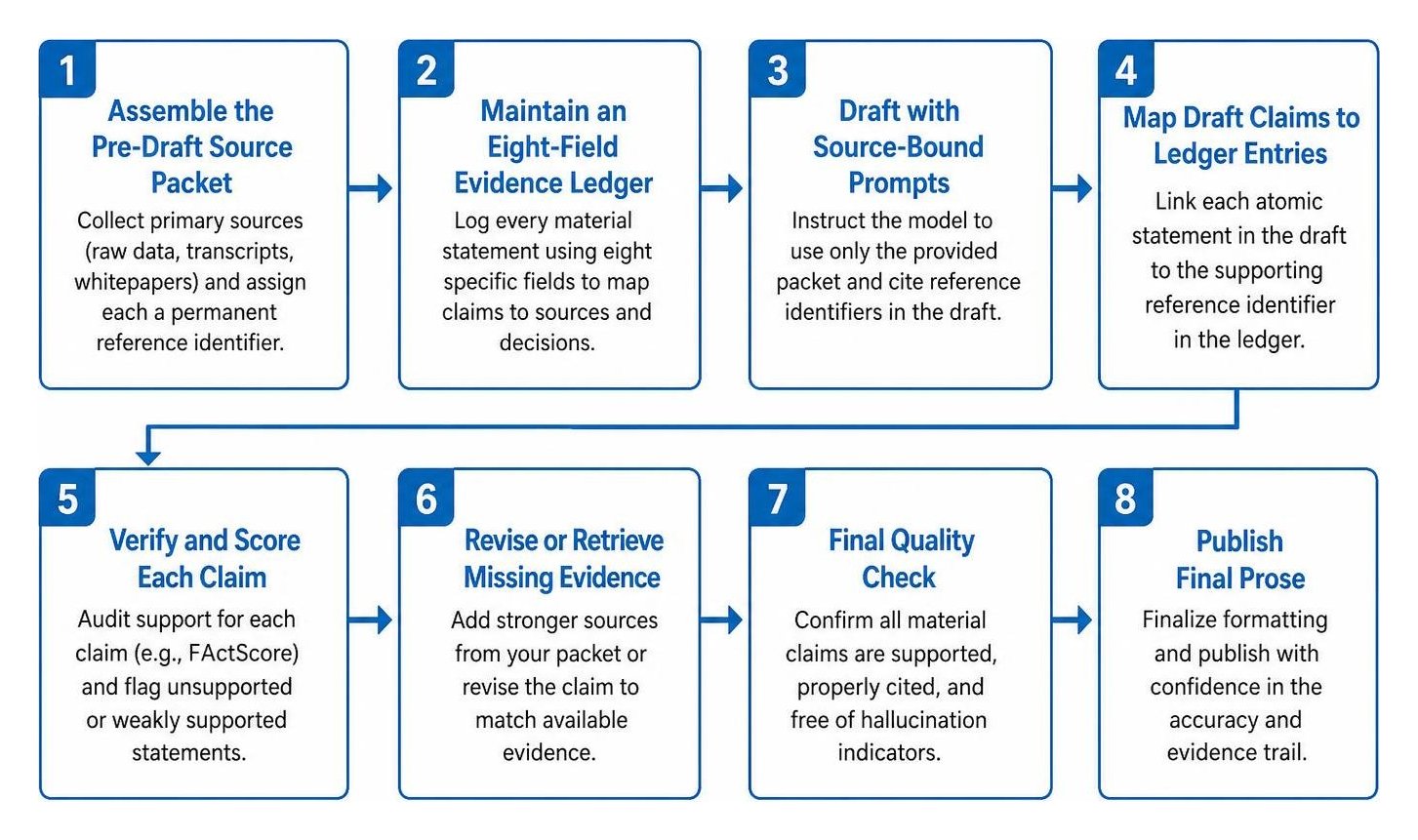
Grounding your writing requires a structured system rather than casual proofreading. At SmallBizSEO, we rely on a systematic, source-grounded approach that ensures every paragraph stands on solid data before publication.
1. Assemble the Pre-Draft Source Packet
Before prompting any tool, collect your primary sources into a dedicated packet. Gather raw CSV analytics, interview transcripts, or whitepapers. Assign each document a permanent reference identifier. When you feed structured materials into your writing tools using proven source-backed AI writing methods, the model acts as an editorial organizer rather than an unguided copywriter.
2. Maintain an Eight-Field Evidence Ledger
Track every material statement in a centralized table using eight specific fields:
- Claim ID: A unique numeric marker (e.g., Claim-101).
- Draft Sentence: The exact wording in the draft.
- Source Identifier: Reference number mapping to your source packet.
- Source Locator: Specific page number, section heading, or video timestamp.
- Verbatim Excerpt: The exact text or data point from the original research.
- Support Level: Fully supported, partially supported, or unsupported.
- Editorial Decision: Keep, rewrite, reclassify as opinion, or delete.
- Reviewer Signature: Initials of the team member who validated the source.
3. Run the Four-Point Acceptance Test
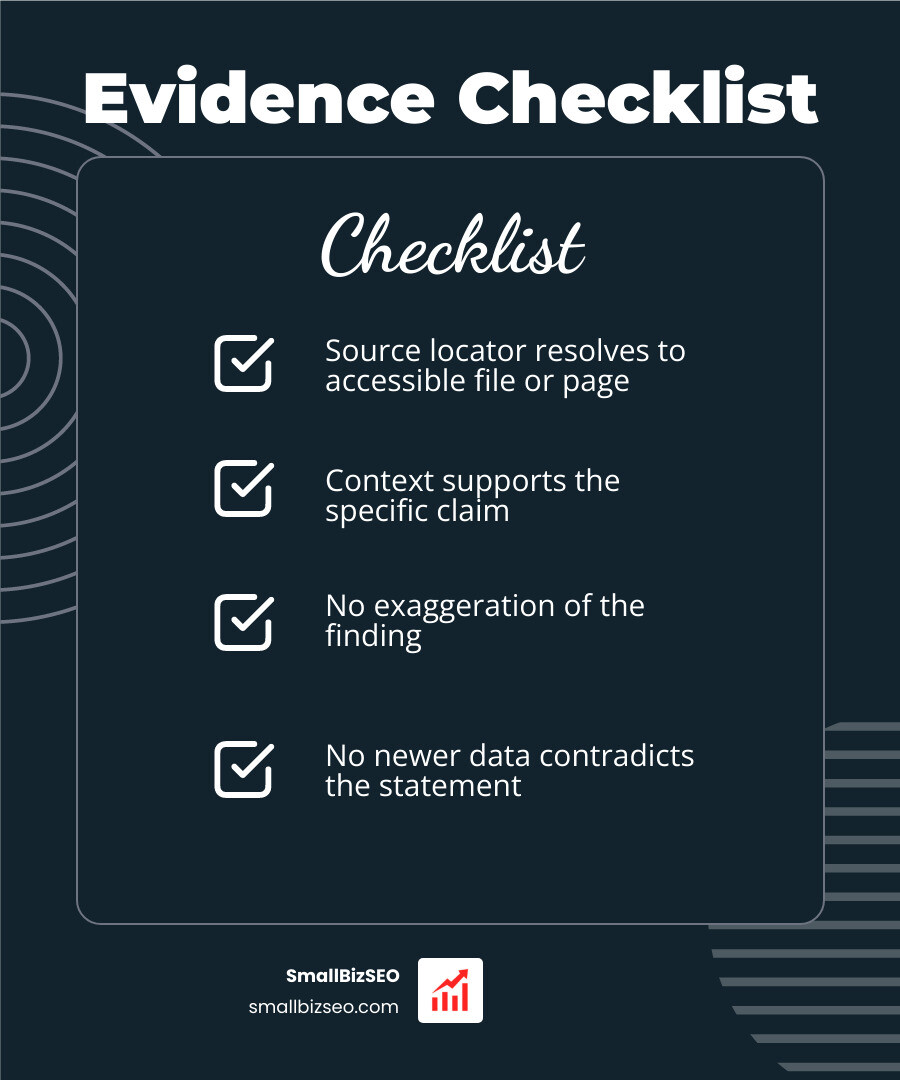
Before approving any sentence into your final draft, confirm four criteria:
- The locator resolves to an accessible, legitimate file or page.
- The surrounding context in the source supports the specific claim.
- The draft wording does not exaggerate or stretch the finding.
- No newer internal data contradicts the statement.
Best Practices and Common Pitfalls to Avoid in Evidence Integration
A solid evidence integration framework protects your brand equity and search rankings. Routine maintenance is critical for preventing content decay, as older links break and research findings evolve over time.
Professional standards, such as official attorney guidelines on AI verification, show that institutions hold authors fully accountable for synthetic text errors. Establishing clear editorial governance ensures your team maintains consistent voice, human oversight, and data integrity across every publication.
How Can You Verify, Replace, and Format Citations Accurately?
A common failure in unguided drafting is citation rot—where links lead to 404 pages, irrelevant websites, or fabricated legal and scientific citations. Managing an evidence ledger workflow prevents these failures by holding every citation to strict verification standards.
- Check Locators Directly: Visit the exact page, table, or timestamp. Never trust an automated summary of a complex study.
- Favor Primary Sources: Replace secondary commentary with original research datasets, government databases, or direct client case studies.
- Use Consistent Numeric Citations: Number your sources consecutively in your working draft to maintain clear traceability during revision rounds.
- Expose Date Stamps: Note publication and access dates to show readers your data reflects current industry realities.
- State Human Verification Clearly: Add a transparent disclosure note explaining that all synthetic outlines or text drafts underwent manual fact-checking and primary source validation.
What Mistakes Disrupt Flow and Search Trust When Grounding Content?
Inserting raw data into an existing draft can make the text feel awkward or disjointed if done carelessly.
Avoid these common editorial pitfalls when integrating evidence:
- Tone Mismatch: Injecting formal academic data into a conversational blog post without adjusting the surrounding phrasing creates a disjointed reading experience.
- Over-Correction and Token Loops: Asking an AI tool repeatedly to "make this sound natural" often introduces new hallucinations and drains your generation limits.
- Over-Quoting: Relying entirely on long, block quotes rather than synthesizing the key findings in your own authorial voice damages flow.
- Logical Drift: Modifying a data point in one paragraph without adjusting related conclusions elsewhere in the draft leads to contradictory claims.
- Data Overload: Cramming multiple citations into a single sentence overwhelms the reader. Keep references clear, focused, and directly relevant.
Turn Your AI Drafts into Authoritative Assets
High-ranking content requires real-world authority that machines cannot fabricate. By anchoring every draft in proprietary datasets, case studies, and structured evidence ledgers, you protect your readers' trust and build lasting search visibility.
If you want to scale your production while ensuring strict factual integrity, explore our tailored SmallBizSEO AI-generated content solutions to build a sustainable, high-growth search strategy for your business.