Scaling AI Content: Balancing Massive Output with Human Quality

Scaling AI Content: Balancing Massive Output with Human Quality
Why AI Content Scaling Is the Biggest Shift in Digital Marketing Right Now
AI content scaling is the process of using artificial intelligence to dramatically increase content output — without a proportional increase in cost, time, or team size — while keeping quality high enough to rank, convert, and build trust.
Here is what you need to know fast:
- What it is: Using AI tools and automated workflows to produce, optimize, and publish content at volume
- What it is not: Simply hitting "generate" in ChatGPT and publishing the result
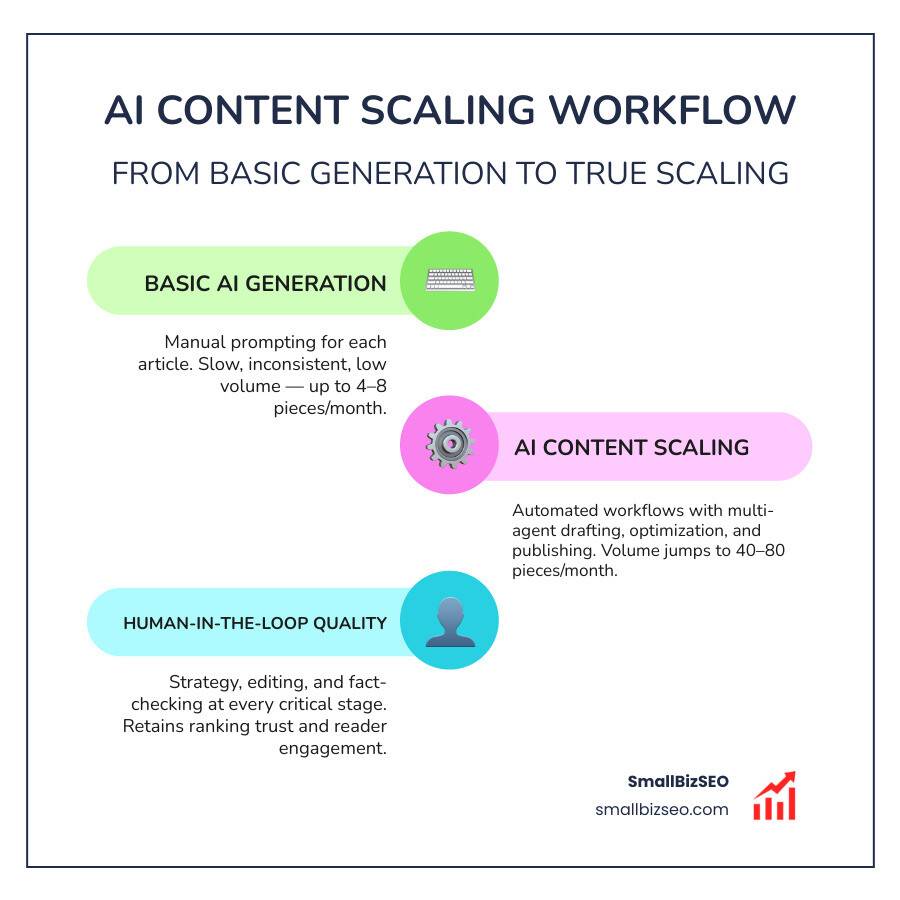
- Why it matters: Teams that do it right can go from publishing 4–8 pieces per month to 40–80, with better SEO scores
- The catch: Volume without quality controls gets your content demoted by Google — or ignored by readers
- The key ingredient: A human in the loop at every critical stage — strategy, editing, and fact-checking
Most small business owners hit the same wall. You know you need more content. More blog posts, more landing pages, more answers to the questions your customers are searching for. But writing takes time you do not have, and hiring writers costs money you cannot always justify.
That is exactly where AI content scaling becomes a game-changer — if you do it correctly.
The problem is that most teams do not. They hand everything to an AI tool, publish in bulk, and wonder why nothing ranks. The research is clear: only 8% of companies are actually scaling AI effectively and embedding it into their core strategy. The rest are experimenting — and leaving serious growth on the table.
This guide cuts through the noise. It shows you how to scale content production intelligently, with the right guardrails, the right workflows, and the right human oversight to make every piece count.
I'm Clayton Johnson, a digital PR and SEO strategist who has spent years building content campaigns that drive real search visibility — and more recently, helping teams implement AI content scaling systems that actually hold up under Google's quality standards. In the sections ahead, I will walk you through exactly how to do this the right way.
The Mechanics of AI Content Scaling
To understand how to scale content successfully, we have to look under the hood. Many people confuse basic AI content creation with true AI content scaling.
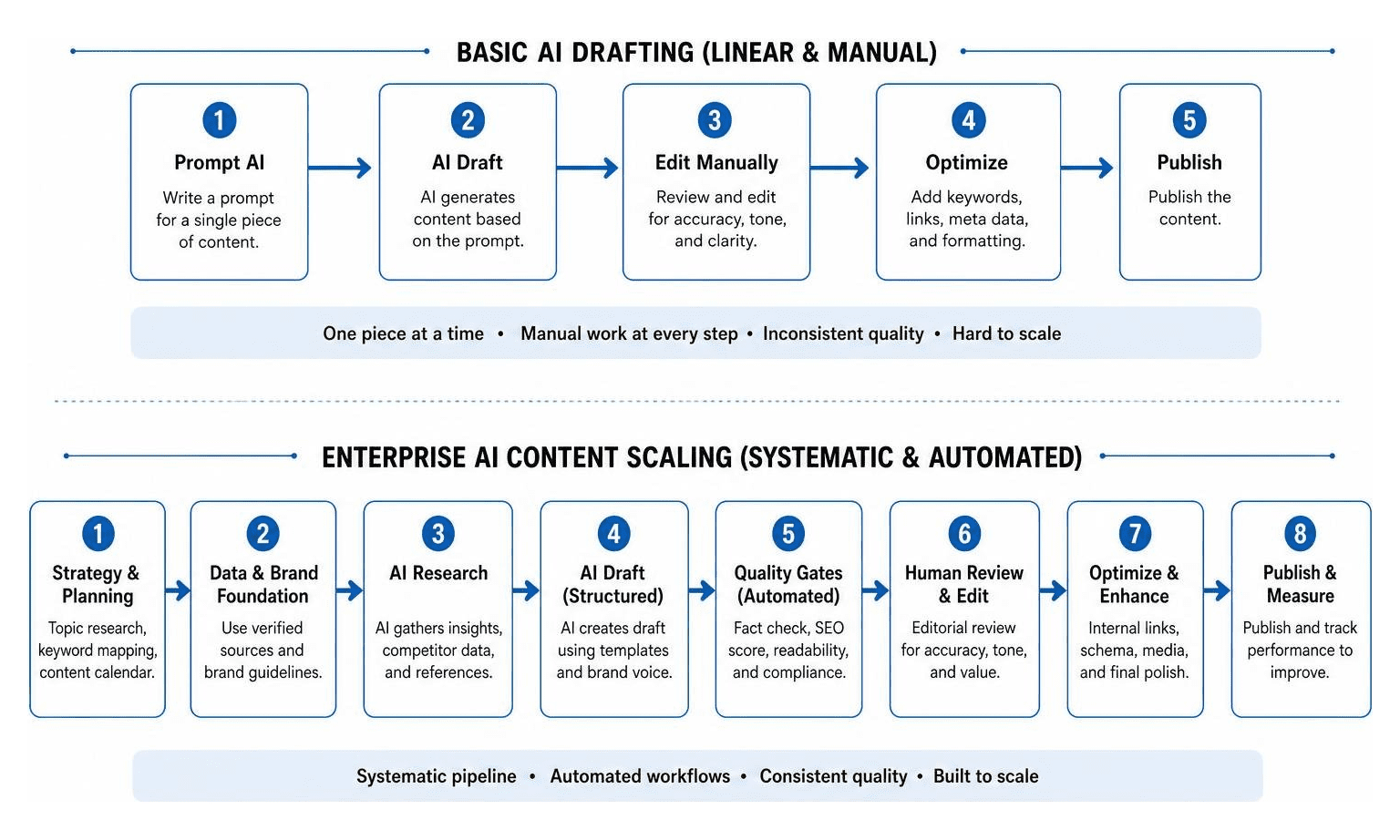
Basic generation is a linear process: you write a prompt, the AI spits out text, and you publish it. If you want ten articles, you have to run that process ten times. It is slow, highly manual, and prone to massive inconsistencies in tone and quality.
True content scaling is an engineering and systems-driven approach. Instead of treating AI as a faster typewriter, we treat it as an engine. We build automated workflows that handle research, drafting, optimization, and publishing as a continuous, interconnected pipeline.
| Feature | Basic AI Generation | Enterprise AI Content Scaling |
|---|---|---|
| Workflow | Manual, one-off prompts | Automated multi-agent pipelines |
| Brand Voice | Inconsistent, generic | Controlled via Brand Identity Hubs |
| Factual Accuracy | High risk of hallucinations | Grounded in verified company databases |
| SEO Optimization | Manual keyword stuffing | Automated schema, linking, and scoring |
| Human Oversight | Often skipped or done late | Built-in quality gates and editorial reviews |
To get a deeper understanding of how these systems outperform basic tools, you can read our guide on Beyond the Hype: Unlocking the True AI SEO Advantage.
Why Basic Generation Fails Without AI Content Scaling
When organizations try to scale content by simply giving everyone a ChatGPT login, they run into what we call "content chaos."
Different team members write different prompts, leading to wild swings in tone, style, and formatting. Some pieces sound like dry textbooks, while others are filled with repetitive, robotic "AI-tell" phrases.
Without a centralized system, you also face severe scaling constraints. Coordinating a team of writers to manually edit and optimize hundreds of individual AI drafts quickly becomes a logistical nightmare. The coordination overhead grows exponentially, eating up any time or cost savings you hoped to achieve.
The Shift from Pods to Centralized Operations
To break through these constraints, successful organizations are shifting away from decentralized "pods"—isolated teams experimenting with different tools—and moving toward centralized content operations departments.
A centralized department standardizes the libraries, frameworks, and MLOps (Machine Learning Operations) pipelines used across the business. This structural shift ensures that every piece of content, regardless of who initiated it, passes through the exact same quality, brand, and factual checks before it ever reaches a staging site. It turns content creation from a chaotic craft into a predictable, high-yield system.
The Strategic Benefits of Scaling Content for Enterprises
When we build a systematic content engine, the business benefits extend far beyond simply having more pages on your website.
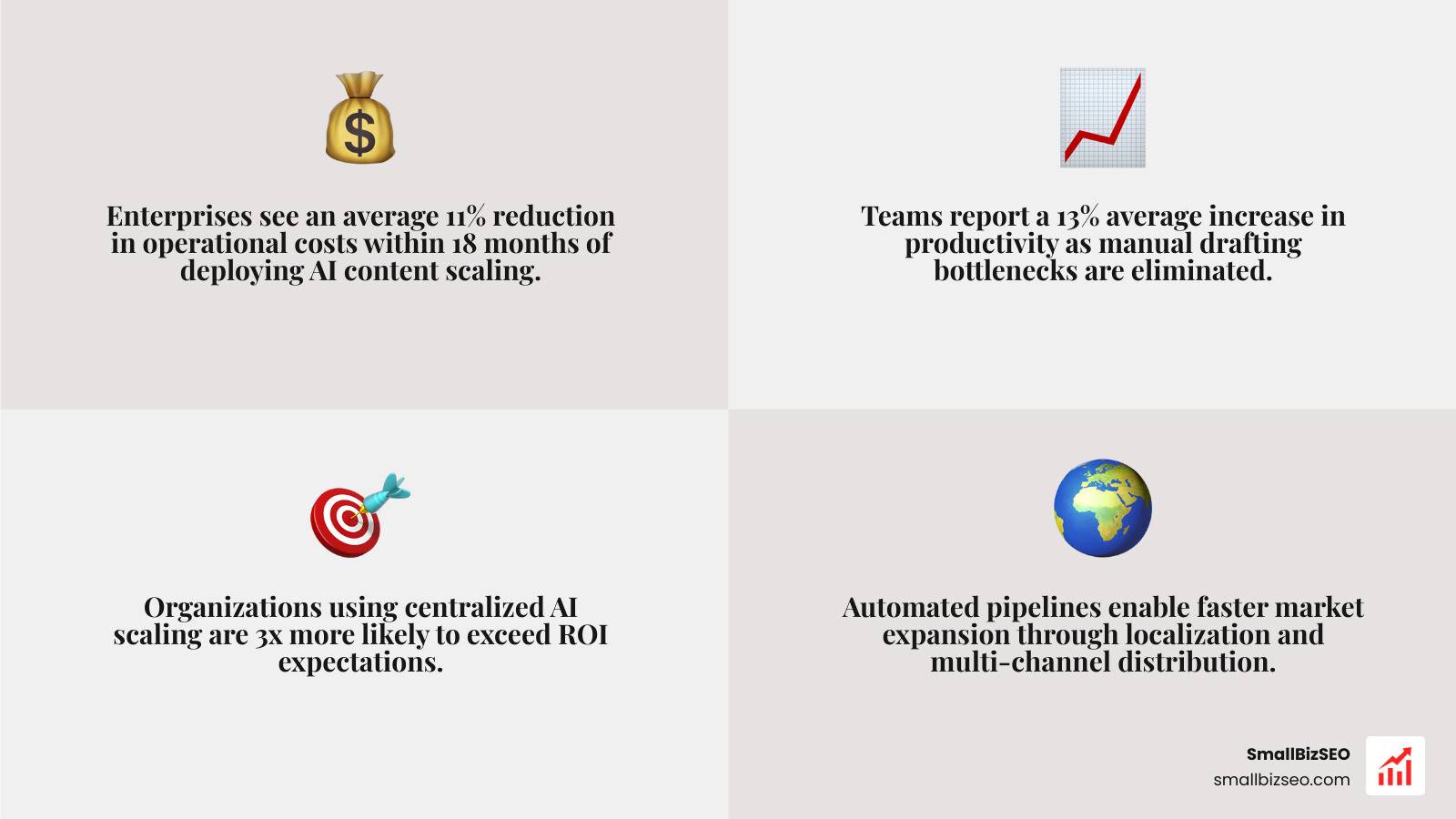
For large organizations and growing enterprises, scaling content with AI delivers measurable, compounding advantages across productivity, cost management, and market reach. When done correctly, businesses can expect:
- An average 11% reduction in operational costs within eighteen months of deployment.
- A 13% average increase in team productivity as manual drafting bottlenecks disappear.
- A 3x higher likelihood of exceeding ROI expectations by focusing resources on a single, well-governed strategic AI bet.
- Faster market expansion through automated localization and structured multi-channel distribution.
To see how these benefits translate into structured growth, explore our comprehensive SEO Content Services.
Cost Reductions and Productivity Gains
The financial math of traditional content scaling simply does not work for modern businesses. Hiring more writers to increase volume scale creates a linear increase in costs.
With an AI-driven system, the cost per published article drops dramatically. Because automated pipelines handle the heavy lifting of research, initial drafting, and basic formatting, your internal team can shift their focus from writing from scratch to high-level editing and strategic direction. This massive boost in content velocity allows you to dominate search categories that were previously too expensive to target.
Accelerating Organic Reach and Revenue
By dramatically increasing your publishing velocity without losing quality, you build a massive footprint in search engines. This footprint does not just drive vanity metrics like page views; it drives revenue.
By integrating payment and customer relationship platforms directly with your content tracking, you can attribute leads, sign-ups, and sales back to the specific content clusters that generated them. This loop allows you to continuously fund and expand the topics that actively grow your bottom line.
Overcoming the Core Challenges of High-Volume Production
Scaling up production is not without its hurdles. If you do not anticipate the pitfalls of high-volume publishing, you risk damaging your brand authority and wasting budget.

To avoid these traps, organizations must carefully balance rapid technological adoption with strict risk management, a challenge detailed in our look at Wall Street's AI Reckoning.
Preventing Hallucinations with Grounded Data
The biggest threat to any automated content program is the tendency of large language models to hallucinate—making up facts, statistics, or product features with complete confidence.
We solve this by grounding our AI engines in verified company data. By building centralized knowledge bases filled with "locked facts"—such as exact product specs, pricing, and certified brand histories—we ensure the AI has a single source of truth. The system is programmed to only pull from these verified databases, eliminating the risk of fabricated claims.
Managing the Technical Debt of AI Content Scaling
Another hidden challenge is the degradation of content quality over time. AI models and the data that feeds them can become stale. If your automated systems rely on static, one-time data pulls, your content will quickly become outdated as market trends shift.
Managing this technical debt requires continuous MLOps. This means setting up automated pipelines that regularly refresh training data, monitor published posts for accuracy, and flag articles that need updates. Treating your content library as active software that requires regular maintenance is the only way to protect your search rankings over the long term.
Infrastructure and Technologies Required for Enterprise Scale
To run a high-volume content program successfully, you cannot rely on free, consumer-grade web interfaces. You need an enterprise-grade technical stack designed for volume, security, and precision.
To understand the broader landscape of these systems, you can read our breakdown of What Are AI SEO Tools.
Multi-Agent Architectures and MLOps
Instead of using a single AI model to write an entire article, modern systems use a multi-agent architecture. In this setup, specialized AI agents are assigned to distinct phases of the content lifecycle:
- The Research Agent: Scrapes search results, analyzes user intent, and extracts key facts.
- The Writing Agent: Uses the research brief to draft the content, adhering to pre-set structural guidelines.
- The Optimization Agent: Automatically injects semantic keywords, builds internal linking networks, and structures schema markup.
- The Publishing Agent: Formats the post in your CMS, generates meta tags, and schedules the piece for review.
By separating these tasks, you achieve far higher precision and quality control at every stage of production.
Brand Identity Hubs and Context Safeguards
To maintain brand consistency across thousands of pages, we utilize Brand Identity Hubs. These platforms digitize your brand's unique DNA, including your specific tone of voice, formatting rules, and style guides.
These hubs use "prompt screening" and safety guardrails to automatically block any AI outputs that sound generic, use banned industry jargon, or fail to match your brand's established personality.
Maintaining Quality, E-E-A-T, and Brand Consistency
Search engines have become incredibly sophisticated at identifying and demoting thin, low-value AI spam. To survive and thrive in this landscape, your scaled content must demonstrate genuine Experience, Expertise, Authoritativeness, and Trustworthiness (E-E-A-T).

To ensure your scaled efforts meet these high standards, we recommend utilizing our comprehensive Guide to AI SEO Audit.
Implementing Automated Quality Gates
Every piece of content generated by your system must clear a series of automated quality gates before it is handed to a human editor. If a draft fails any of these checks, the system automatically holds it for manual review rather than publishing it.
- Readability Scoring: Target a Flesch readability score of 60–70 to ensure the text is clear and engaging.
- AI-Tell Removal: Automatically strip out robotic phrases, excessive em-dashes, and repetitive sentence structures.
- Information Gain Checks: Ensure the draft adds unique value or perspective, rather than just rephrasing existing search results.
- Schema Validation: Automatically verify that structured data and schema markup match the visible text on the page.
The Indispensable Role of Human Editorial Review
No matter how advanced your automated quality gates are, human editorial review remains entirely indispensable. We use AI as a production accelerator—to handle the heavy lifting of research and drafting—but we keep our hands firmly on the wheel.
A human editor must write the introductions and conclusions to anchor the brand's authentic voice. Humans are also uniquely qualified to add real-world anecdotes, personal opinions, and strategic direction that no AI model can replicate. This human-in-the-loop approach is what separates ranking, high-converting content from ignored digital noise.
How Scaled Content Impacts SEO, AEO, and Search Visibility
The rise of generative AI is fundamentally changing how people find information online. Traditional search engine optimization is expanding to include Answer Engine Optimization (AEO)—optimizing your content so that AI engines like ChatGPT, Perplexity, and Gemini cite your brand as their primary source.
To master this shifting landscape, check out our insights on SEO Content Marketing and discover how we turn Data Into Traffic.
Optimizing for Answer Engine Citations
AI answer engines do not look at entire documents; they search for high-density, token-dense passages that directly answer specific grounding queries.
To make your content citation-ready, we structure articles with clear, direct answer blocks. By using stable section anchors, bulleted lists of verified facts, and matching schema markup, we make it incredibly easy for AI crawlers to extract and credit our content in their answers.
Navigating Google's Helpful Content System
Google's ranking algorithms are designed to reward helpful, reliable content created primarily to benefit people. The search engine does not penalize content simply because it was created with the help of AI.
Instead, it penalizes content that lacks effort, accuracy, or original value. By focusing on deep research, strict factual verification, and steady indexing health, we ensure our scaled content programs consistently pass Google's helpfulness bar.
Frequently Asked Questions about AI Content Scaling
Will search engines penalize AI-generated content?
No. Google's official guidelines state that the use of AI is not penalized as long as the content is high-quality, accurate, and written to help users. The focus is entirely on the value and helpfulness of the content, not the tools used to create it.
How do you prevent AI from hallucinating brand facts?
We prevent hallucinations by grounding our systems in "locked-fact" databases. By feeding the AI verified company knowledge bases and using strict prompt screening, we ensure the engine only references verified facts and never fabricates information about your business.
Can we scale content production without increasing headcount?
Yes. By utilizing automated multi-agent workflows and robust quality gates, your existing team can shift from writing drafts from scratch to managing and editing a high-volume pipeline. This allows you to scale your publishing output by 10x or more without adding headcount.
Accelerate Your Growth with the Velocity Framework
Building a sustainable, high-volume content engine requires the right blend of advanced technology and deep SEO expertise. At SmallBizSEO, we have developed our proprietary Velocity framework to help businesses scale their organic visibility safely and rapidly.
We do not believe in mass-producing cheap, robotic spam. Our framework is built from the ground up to ensure strict E-E-A-T compliance, robust brand safety, and complete transparency. Through our automated reporting systems, you will always see exactly how your content is performing, which keywords are driving revenue, and how your search footprint is growing.
Ready to scale your content without losing your authentic brand voice? Explore our specialized AI SEO Services today, and let us help you build a high-performance content engine that drives real, lasting growth.