The Complete Guide to Moz Visibility Score

The Complete Guide to Moz Visibility Score
Understand Your Moz Visibility Score at a Glance
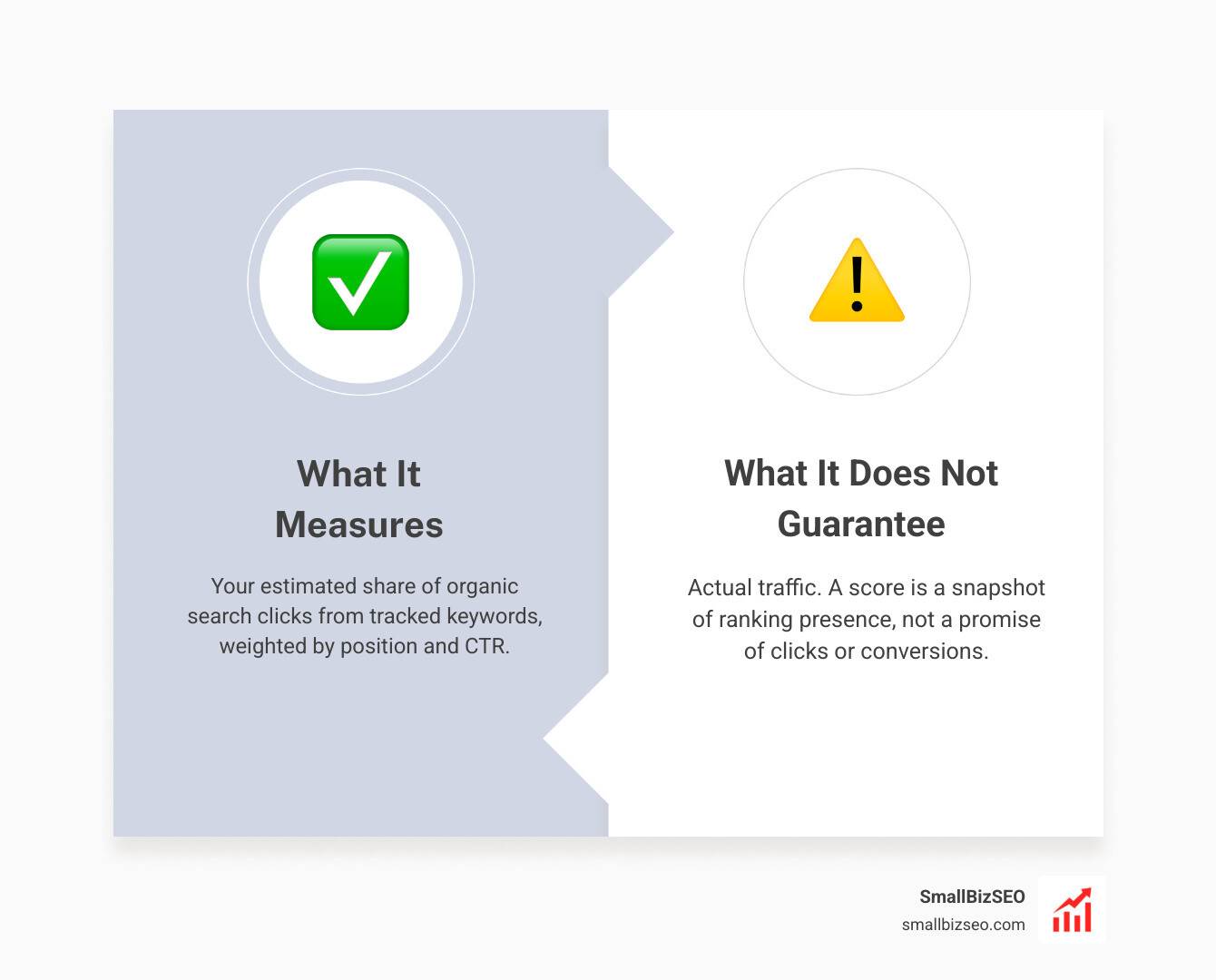
Moz Visibility Score is the estimated percentage of organic search clicks your site could earn from the keywords tracked in a Moz campaign. Moz calculates it by applying an expected click-through rate (CTR) to each ranking position, then combining those results across your keyword set.
| Quick answer | What it means |
|---|---|
| What it measures | Your estimated share of clicks from tracked organic rankings |
| How it is calculated | Ranking positions are weighted by estimated CTR and averaged across tracked keywords |
| Good target for non-branded terms | Roughly 35% to 45% is a strong, realistic range |
| Best way to use it | Compare against competitors and watch the trend over time |
A score is not a traffic guarantee. It is a practical snapshot of how often your business appears where searchers are likely to click. For a small business dealing with uneven leads, it can turn a long keyword report into one clear signal: are your SEO efforts gaining ground or losing it?
The number matters most when your keyword list stays consistent. A sudden change may reflect real ranking losses, but it can also happen after adding or removing tracked keywords, changing locations or search engines, migrating a domain, or following a search algorithm update.
I’m Clayton Johnson, and I use digital PR, SEO campaigns, and competitive search research to help businesses build stronger online visibility. In this guide, I’ll explain how to read a Moz Visibility Score as a useful decision-making metric rather than a number to chase.
Basic moz visibility score terms:
What Is the Moz Visibility Score and How Is It Calculated?
Understanding your organic footprint starts with knowing how software tools evaluate search presence. The moz visibility score is designed to give us an aggregate view of organic real estate on search engine results pages (SERPs). Instead of making us scroll through hundreds of individual keyword positions, it condenses search presence into a single percentage metric.
For detailed documentation on tracking setup, review standard campaign tracking guidelines.
Core Components of the Moz Visibility Score
The core mechanics rely on expected click-through rates. Search engines do not distribute attention evenly across search results; the top organic spot earns significantly more traffic than the tenth spot.
Moz builds an expected CTR model for each ranking position in the top 50 search results:
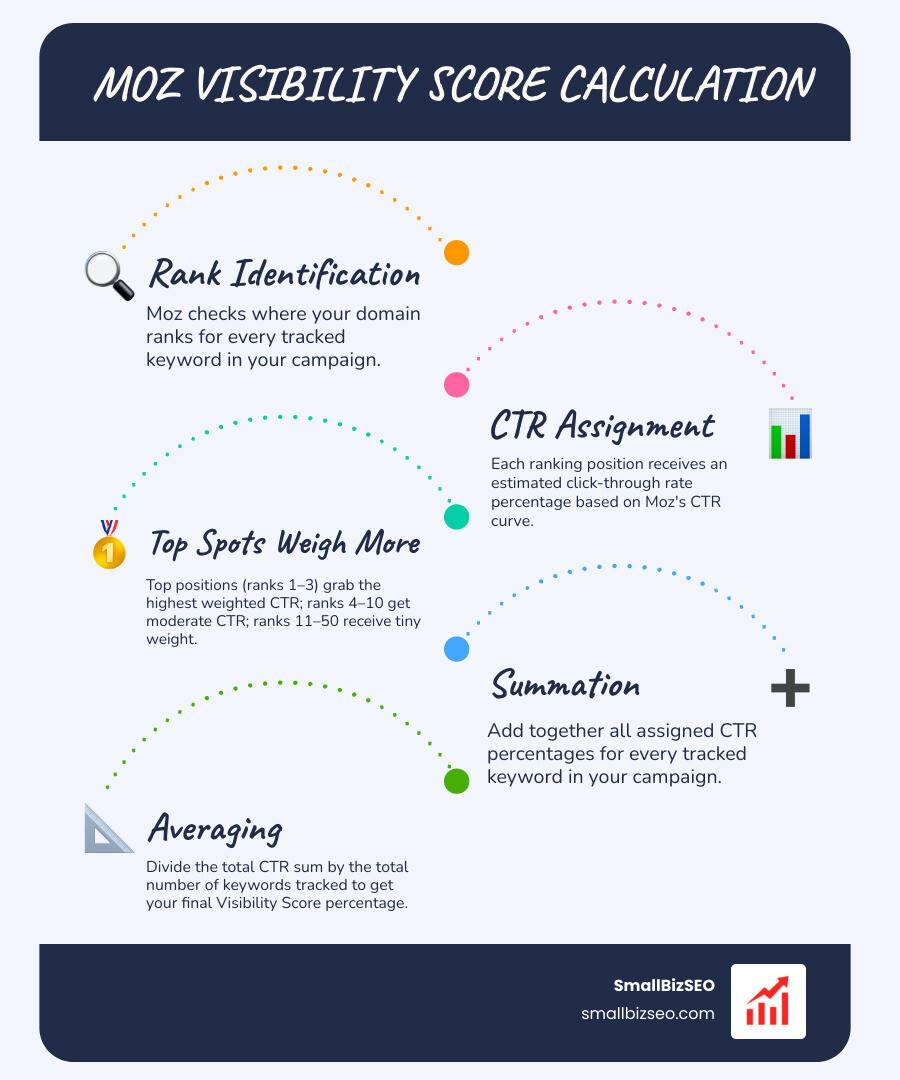
- Top Positions (Ranks 1–3): Grabs the highest weighted CTR percentage.
- Mid-Page Positions (Ranks 4–10): Earns a moderate expected CTR percentage.
- Lower Pages (Ranks 11–50): Receives tiny CTR weightings.
- Beyond Rank 50: Assigned a 0% CTR value.
Step-by-Step Calculation Formula
The calculation follows a straightforward mathematical process across all keywords tracked in a campaign:
- Rank Identification: Moz checks where your domain ranks for every tracked keyword.
- CTR Assignment: Each ranking position receives an estimated click-through rate percentage based on Moz's CTR curve.
- Summation & Averaging: Moz adds together all assigned CTR percentages and divides the total by the overall number of keywords in your campaign.
Mathematically, it looks like this:
Search Visibility Score = (Sum of Estimated CTRs for All Tracked Keywords) / (Total Number of Keywords Tracked)
If a keyword has no ranking data within the top 50 results, it contributes 0% to the calculation. This structure ensures that high search rankings on core terms directly boost your overall percentage score.
Benchmarking Search Visibility: What Target Score Should You Aim For?
A common question small business owners ask us is, "What score should we aim for?" It is tempting to dream of reaching 100%, but in search marketing, 100% is a fantasy land where your site owns every single ranking result on the first page for every single keyword.
Realistic Non-Branded Target Benchmarks
For non-branded commercial keywords, a realistic target range for a top-performing domain is 35% to 45%. Why is this the sweet spot? Because the average click-through rate of a #1 organic ranking URL typically hovers between 35% and 45%.
If your site ranks #1 across your entire list of non-branded campaign terms, your score will naturally cap out near the mid-40s. Scoring above 50% for competitive non-branded keywords is virtually unheard of unless you own multiple ranking URLs in top spots. To learn more about mastering these benchmarks, read the secret sauce to cracking the google visibility score.
Competitive Analysis vs Absolute Scoring
We always advise against treating your visibility percentage as an isolated report card grade. Instead, use it as a comparative market share index.
Tracking your score alongside direct industry rivals provides clear context:
- If your score is 28% and your top competitor is at 18%, you are winning the market share battle.
- If your score drops from 35% to 30%, but your competitors dropped from 30% to 20%, an industry-wide SERP layout shift or algorithm tweak occurred, but your relative position actually strengthened.
How Moz Visibility Score Differs from Domain Authority and Page Authority
Metric confusion is common in SEO. People often mix up authority metrics with visibility scores, but they measure completely different parts of search performance.
| SEO Metric | Primary Focus | What It Measures | Best Used For |
|---|---|---|---|
| Moz Visibility Score | SERP Presence | Estimated CTR share across tracked campaign keywords | Measuring active market share and organic campaign performance |
| Domain Authority (DA) | Domain Link Equity | Predictive ranking strength based on backlink profile | Evaluating relative site authority against competitors |
| Page Authority (PA) | Individual URL Equity | Predictive ranking strength of a specific page | Deciding which individual URLs need external link building |
For further reading on evaluating external metrics, check out what your searchmetrics SEO visibility score is trying to tell you.
Comparing Moz Visibility Score with Domain Authority
Domain Authority (DA) predicts how well a domain can rank based primarily on backlink quality and quantity. It does not look at your active campaign keyword positions. A domain can have a high DA due to strong historical backlinks, yet still have a low moz visibility score if its content is unoptimized or targeting low-volume keywords.
Distinguishing Page Authority from Search Visibility
Page Authority (PA) functions like DA, but focuses on an individual URL. While PA tells us how strong a single page is, your search visibility score reflects aggregate organic real estate across your entire tracked keyword set.
Why Search Visibility Drops and How to Troubleshoot Fluctuations
A sudden decline in visibility can cause instant worry. Before assuming Google penalized your site, it is essential to systematically audit potential causes.
Common Causes of Sudden Score Fluctuations
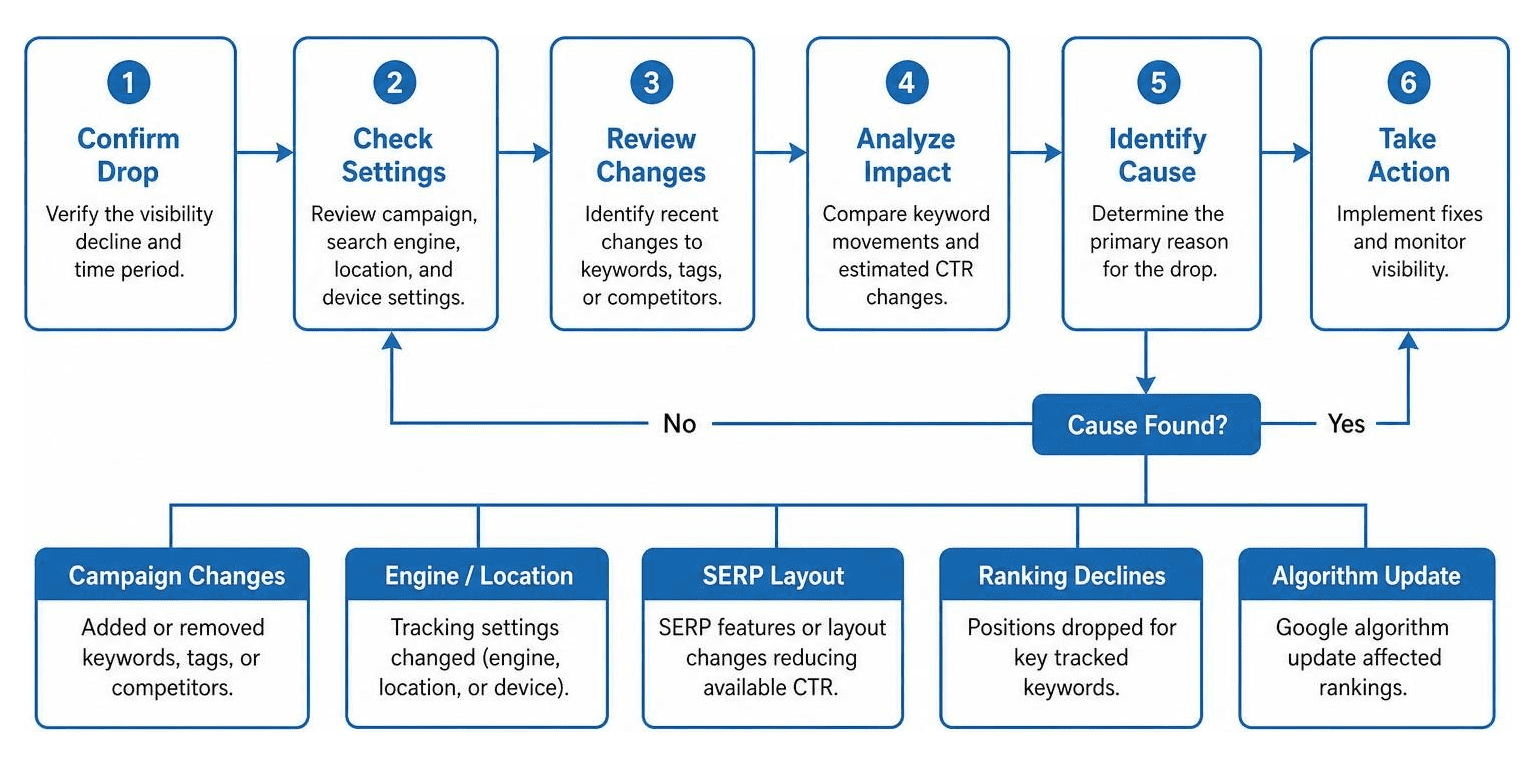
Score changes usually stem from one of five core causes:
- Campaign Keyword Changes: Adding new competitive keywords where you do not rank yet instantly lowers your average score.
- Engine or Location Adjustments: Changing tracking settings from national to local search changes SERP rankings.
- Actual Ranking Losses: Losing top positions on high-volume terms lowers your weighted CTR sum.
- Search Engine Algorithm Updates: Core update rollouts can reorder SERP layouts and positions.
- Domain or Site Migrations: Unresolved 301 redirects during HTTP to HTTPS or domain migrations temporarily disrupt indexation.
If rankings feel stuck despite your efforts, explore our breakdown on why your rankings are still stuck.
Step-by-Step Diagnostic Workflow
When troubleshooting a drop in visibility, follow these steps:
- Audit Campaign Log: Check if team members recently added unranked keywords or altered location tracking filters.
- Review Algorithm Trackers: Check tools like MozCast to see if unannounced Google updates affected your niche.
- Segment Labeled Keywords: Filter campaign views by labeled keyword groups to isolate which specific topic cluster dropped.
- Perform Technical Crawls: Run site audits to check for broken redirects, missing canonical tags, or site speed issues.
Strategic Methods to Improve Organic Search Engine Visibility
Improving your visibility score requires a balanced approach across content relevance, technical infrastructure, and domain authority.
High-Intent Content Optimization
Content remains the foundation of organic visibility. To capture top search positions, focus on satisfying searcher intent better than current top-ranking pages:
- Update existing articles with thorough, high-value information answering common user questions.
- Optimize title tags and meta descriptions to improve organic click-through rates.
- Structure content with descriptive H2 and H3 subheadings for featured snippet opportunities.
For creative ways to improve organic reach naturally, read how to boost your search engine visibility score without selling your soul.
Technical SEO and Page Performance Enhancements
Search engines prioritize sites that deliver smooth user experiences. Excellent technical health keeps your pages indexed and ranking high:
- Maintain Core Web Vitals performance targets: keep Largest Contentful Paint (LCP) under 2.5 seconds and Cumulative Shift (CLS) under 0.1.
- Ensure full mobile responsiveness across all viewport sizes.
- Verify robust HTTPS encryption and clean XML sitemap submission.
Strategic Link Building and Backlink Growth
Backlinks act as trust signals that elevate page authority and push rankings higher up the SERP stack:
- Earn authoritative contextual links through digital PR, guest insights, and original resource assets.
- Clean up toxic link profiles or unnatural link schemes that drag down domain trust.
To expand your technical knowledge, explore official Google Search Central documentation.
The Evolution to AI Visibility Score: Adapting to Generative Search
Search is evolving rapidly beyond traditional static blue links. As users incorporate AI chatbots and generative search engines into their research habits, measuring visibility across Large Language Models (LLMs) has become essential. Gartner projects that traditional search engine volume will drop 25% as user behavior shifts toward AI agents.
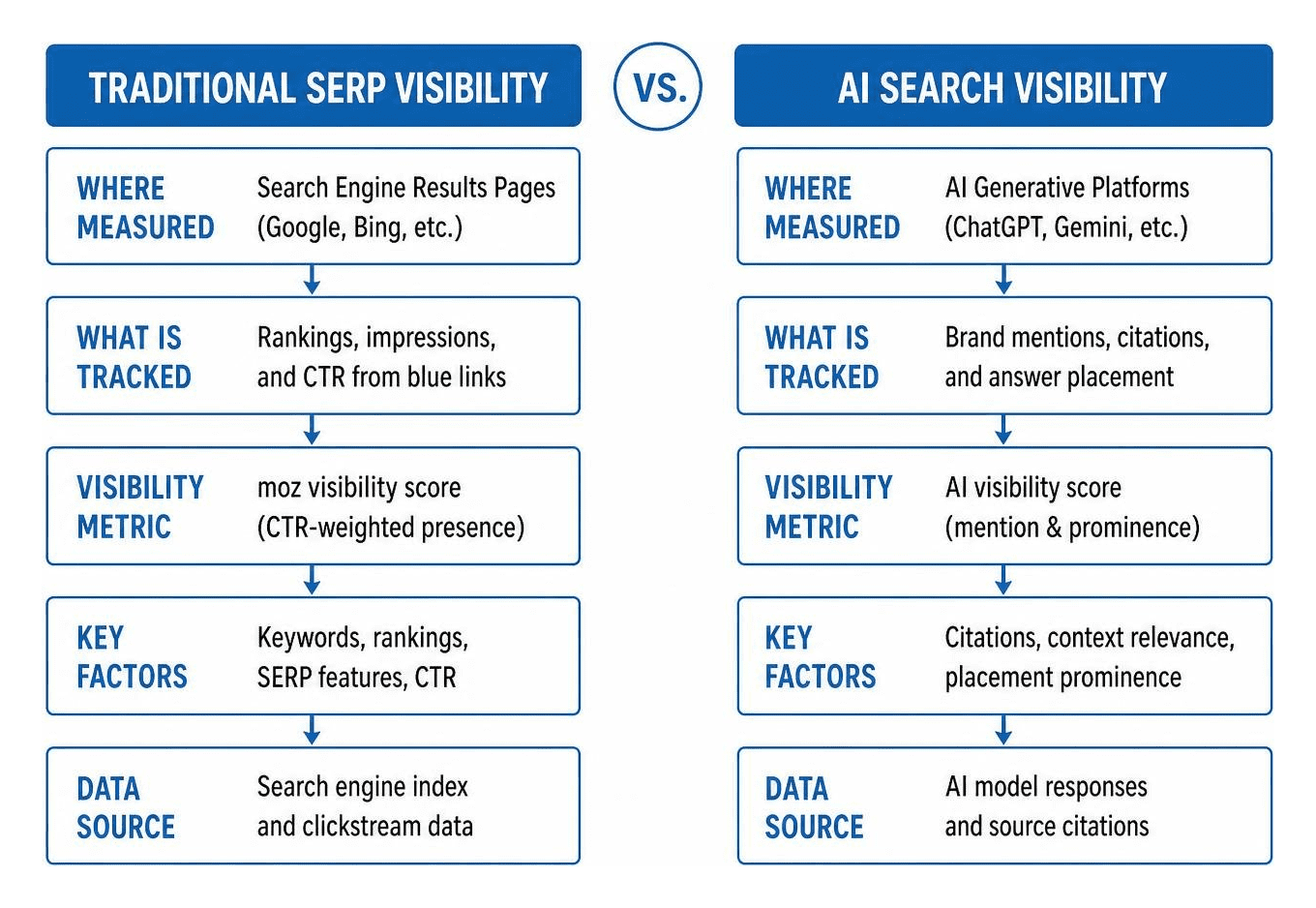
Traditional SERP Visibility vs AI Search Visibility
While traditional moz visibility score tracking calculates CTR presence on standard search engine results pages, AI visibility measures brand mentions, citations, and placement prominence in generative model responses (such as ChatGPT and Gemini).
Because generative models draw from varied source datasets, studies analyzing hundreds of millions of citations show that source citations diverge heavily across AI platforms. A one-size-fits-all approach to AI visibility cannot succeed.
To refine your keyword research for both traditional and modern search models, check our guide on how to use ahrefs for keyword research without losing your mind.
Future-Proofing Strategy for Generative Models
To maintain high brand presence as generative search expands, implement these foundational steps:
- Build E-E-A-T Signals: Establish strong Experience, Expertise, Authoritativeness, and Trustworthiness across digital PR channels so LLMs recognize your brand as an authority.
- Implement Schema Markup: Use structured JSON-LD data (Organization, Product, Article, FAQPage) to help AI crawlers parse content correctly.
- Maintain Accessibility Standards: Ensure WCAG web accessibility trees and site architectures remain clean for automated LLM web bots like GPTBot.
Frequently Asked Questions about Moz Visibility Score
What does a zero percent search visibility score mean?
A 0% score means either your domain has no ranking pages within the top 50 search positions for your tracked keywords, or Moz has not gathered ranking data for your campaign terms yet.
Is a hundred percent search visibility score achievable?
No, a 100% score requires owning every ranking position for every tracked keyword in your campaign. For non-branded commercial keywords, this is virtually impossible due to diverse competitive SERP layouts.
How often should search visibility scores be monitored?
We recommend evaluating visibility scores on a monthly cadence. Daily ranking checks can cause overreactions to minor SERP testing fluctuations, whereas monthly trends highlight genuine growth patterns.
Elevate Your Business Search Presence with SmallBizSEO
Understanding metrics like the moz visibility score provides clarity in a crowded digital marketplace. At SmallBizSEO, we help small businesses convert complex technical data into clear, sustainable growth through our data-driven Velocity framework.
Whether you need deep technical fixes, authoritative link-building campaigns, or content optimizations designed for modern search engines, our team delivers transparent, actionable guidance.
Ready to see where your business stands against competitors? Request a tailored SEO visibility audit from SmallBizSEO today, and let us help you build a dominant organic search footprint.