How to Design a Repeatable AI Citation Rate Test

How can you test AI citation rates without guessing?
A repeatable AI citation rate test uses a fixed, documented prompt panel, a clear rule for what counts as an eligible answer, and consistent coding for every completed observation. The goal is to measure what happened under stated conditions, not to claim a universal ranking factor.
Start with a pilot panel that reflects the questions prospective customers actually ask. For example, 20 prompts split across branded, category, and long-tail intents can be a useful illustrative starting point, not a standardized or sufficient sample. Predefine the panel, preserve its version, and repeat it over time. Add repetitions when the question, platform behavior, or observed variation calls for them.
For each completed eligible answer, record whether the target domain received at least one linked citation. Count the domain once per answer even when the answer includes several target URLs. The denominator is every completed eligible answer, including answers with zero citations. Define exclusions before testing, then report refusals, errors, timeouts, and unavailable answers separately instead of removing them without explanation.
A mention is not a citation, and a citation is not proof that the answer made an accurate claim. Track each outcome separately so the next investigation is based on evidence rather than assumptions.
What does an AI citation rate test measure?
An AI citation rate test measures the share of completed eligible answers that link to a target domain under a documented prompt set and test setup. It can also measure unlinked mentions, citation share, referral sessions, citation-support accuracy, and independently assessed factual accuracy, but those are different metrics and should not be combined.
Use these definitions consistently:
- Domain citation rate: completed eligible answers with one or more links to the target domain, divided by all completed eligible answers.
- Unlinked mention rate: completed eligible answers that name the brand without linking to the target domain, divided by all completed eligible answers.
- Citation share: the target's citations divided by citations to every domain in the defined comparison set. State whether this counts unique domains, unique URLs, or every citation occurrence.
- Referral sessions: analytics sessions attributed to AI referrers. This is traffic behavior, not an answer-level citation measure.
- Citation-support accuracy: the share of reviewed AI assertions for which the cited page supports the assertion under a predefined rubric. Citation support does not by itself establish real-world factual correctness.
- Independent factual accuracy: the share of material AI claims that pass an independent fact-check against appropriate evidence. Define the review rubric and sample before scoring.
A wide difference between mentions and linked citations can suggest hypotheses about brand awareness, page accessibility, source eligibility, content clarity, or the current test design. It does not prove that a model used training memory or that a parser failed.
Treat platform output as an observed result, not a description of a shared underlying retrieval process. Interfaces, search features, citation displays, and model behavior can change, so document what was visible during each run rather than relying on blanket assumptions.
How do you design a repeatable AI citation rate test?
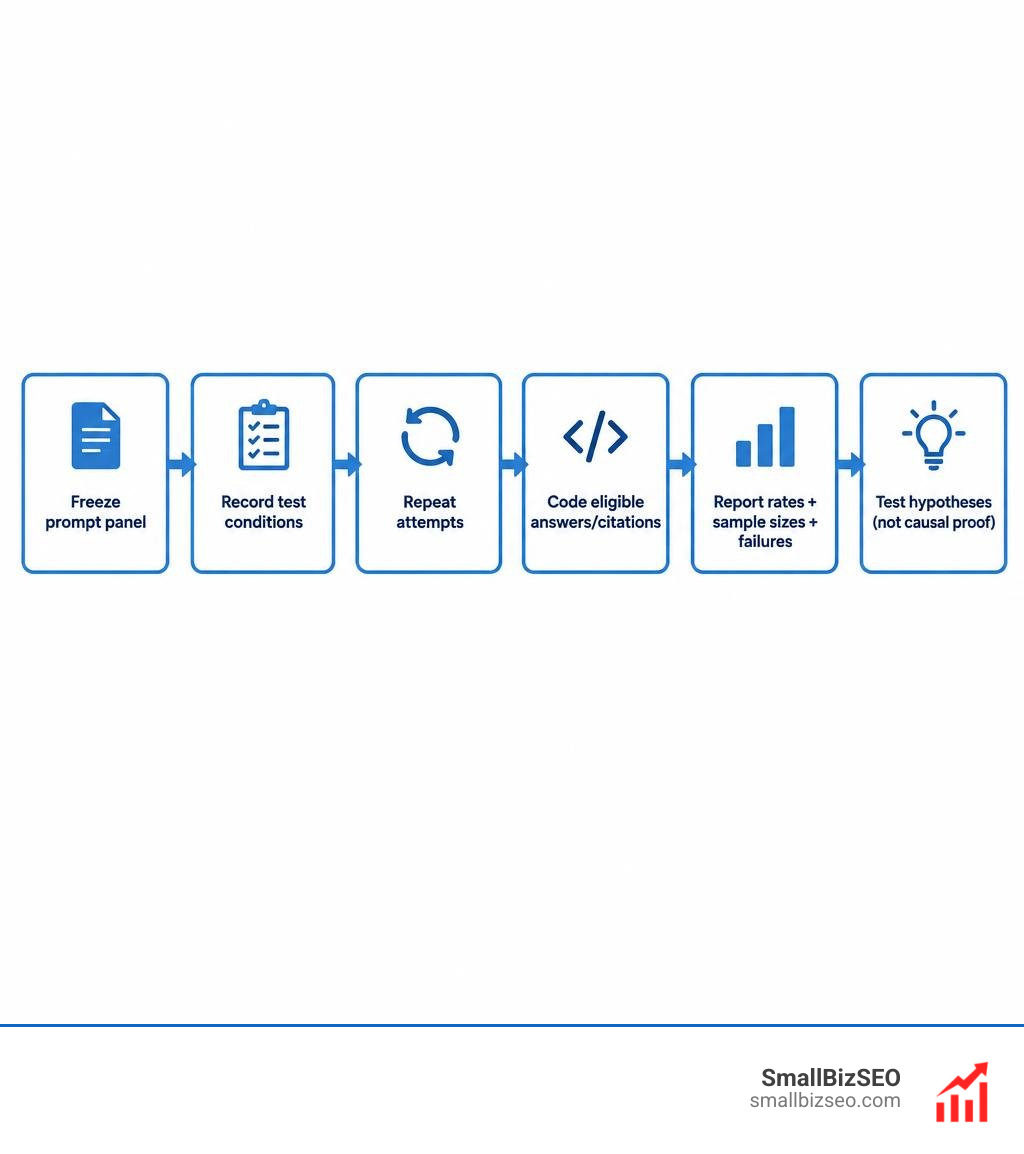
Design the test before collecting results: freeze a prompt-set version, define eligible answers and exclusions, choose the comparison period, and write the coding rules. Keep the test-design decisions in the documented protocol rather than inferring them after results arrive.
Why does query selection matter when designing a repeatable AI citation rate test?
A fixed panel makes repeated observations comparable. Build prompts around customer intent and label each one by intent, such as branded, category, comparison, or problem-solving. Do not treat one convenient prompt mix as representative of every buyer journey.
Keep a prompt-set version and prompt ID for every row. If a prompt changes, create a new version rather than silently overwriting the old wording. If an engine, model, or major interface changes, record the change because it resets direct comparability with earlier runs. This version control also makes AI share of voice comparisons easier to interpret over time.
How do you run clean sweeps across AI systems?
Run the same prompt panel using a documented setup for each system. A fresh chat or private window can reduce carryover from prior conversations, but it cannot eliminate personalization, backend variation, account effects, or changing search behavior.
For every attempt, log the prompt-set version, prompt ID, engine, model name or “unavailable,” mode, interface or API, locale, date, time, session state, known personalization state, search use, raw answer, source URL, and repeat ID. Label API and consumer-interface attempts separately, and do not pool their results without a documented rationale. Also log the response status: completed eligible answer, refusal, error, timeout, or another predeclared exclusion.
What should your tracking matrix record, and how do you calculate the metrics?
Use one row per attempted answer. The following rows are illustrative only and use example.com rather than a real business result:
| Status | Engine | Prompt ID | Intent | Brand Mention | Target Domain Cited | Cited URL | Repeat ID |
|---|---|---|---|---|---|---|---|
| Completed eligible | Example AI | Q-01 | Category | 1 | 0 | None | R1 |
| Completed eligible | Example AI | Q-01 | Category | 1 | 1 | https://example.com/service | R2 |
| Refusal | Example AI | Q-02 | Comparison | Not scored | Not scored | None | R1 |
For a clearly hypothetical example, if 42 attempts yielded 40 completed eligible answers and 2 refusals, and 8 of the 40 eligible answers cited the target domain, the domain citation rate is 20%. Report the 2 refusals separately rather than quietly removing them from the audit trail. Report rates by engine, intent, and interface type, along with the number of completed eligible answers, so readers can see the evidence behind each percentage.
Repeat the fixed panel across runs. When evaluating a site change, avoid calling a simple before-and-after difference causal. Where feasible, compare against an untreated page or prompt group, change one factor at a time, and interpret correlated observations cautiously. Prompt-selection bias and repeated, related observations can make simple binomial intervals misleading. When estimating a rate from completed eligible answers, use NIST guidance on estimating a population proportion to understand confidence-interval assumptions and limitations.
How can you diagnose visibility-to-citation gaps, implement fixes, and scale tracking?
Compare the separately reported rates, review the underlying answers and source URLs, and turn the pattern into testable hypotheses. Do not use a fixed gap threshold as a diagnosis, and do not infer a technical cause from a single measurement period.
A higher mention rate than domain citation rate may justify checking whether relevant pages are accessible, clearly scoped, internally linked, current, and supported by credible external references. It may also reflect the prompt set, the engine configuration, ordinary variation, or changes outside the site.
Use the AI SEO audit tracking the signals that actually matter to LLMs to organize a technical review of relevant pages. Treat empirical tests on AI ranking systems as practical context for designing careful tests, not proof of a universal citation factor.
Audit the pages that should answer the tested prompts. Check canonicalization, crawl and index status, structured data accuracy, direct answer quality, and whether supporting claims have clear sources. These are sensible technical SEO and content-quality checks, not guaranteed citation levers.
Use the test results to prioritize hypotheses such as:
- A page may need a clearer answer, stronger evidence, or a more precise match to the prompt intent.
- Relevant internal links may be missing, making important supporting pages harder to discover within the site.
- An outdated page may need an ongoing content refresh before it is tested again.
- A topic may need earned outreach or stronger independent references, rather than more formatting changes. A clear answer structure can still support reader usefulness, as outlined in AI SEO returns a practical guide to showing up in LLM answers, without guaranteeing a citation outcome.
For implementation context, see technical SEO and book a consultation when expert help is needed to plan or interpret the work. Keep a change log that ties each test run to the exact page, hypothesis, and change under review.
How often should you re-measure, and how can you scale tracking?
Choose a cadence that matches decision-making needs and platform volatility, then keep it stable long enough to compare like with like. Re-test after a documented change only when the page is available to users and the test plan calls for it; there is no universal waiting period that guarantees recrawl, indexing, or retrieval.
For multi-site tracking, preserve the same schema, versioned prompt panels, coding rules, and status fields across properties. Automation can help collect and organize observations, but retain raw outputs and human review for citation-support accuracy, independent fact-checking of material claims, exclusions, and unexpected behavior.
Building a Dependable AI Measurement Program
A dependable measurement program documents the prompt panel, setup, eligibility rules, exclusions, raw outputs, and coding decisions before it interprets rates. Measure domain citations, unlinked mentions, citation share, referral sessions, citation-support accuracy, and independently assessed factual accuracy as distinct signals. Repeat the same panel, report results by engine and intent with their sample sizes, and treat changes as evidence to investigate rather than proof of cause.
That discipline turns AI citation tracking into a useful learning loop: define the method, collect comparable observations, test one hypothesis, and record what changed.