AI SEO Returns: A Practical Guide to Showing Up in LLM Answers

AI SEO Returns: A Practical Guide to Showing Up in LLM Answers
Why Your AI SEO Return Is Now a Two-Channel Game
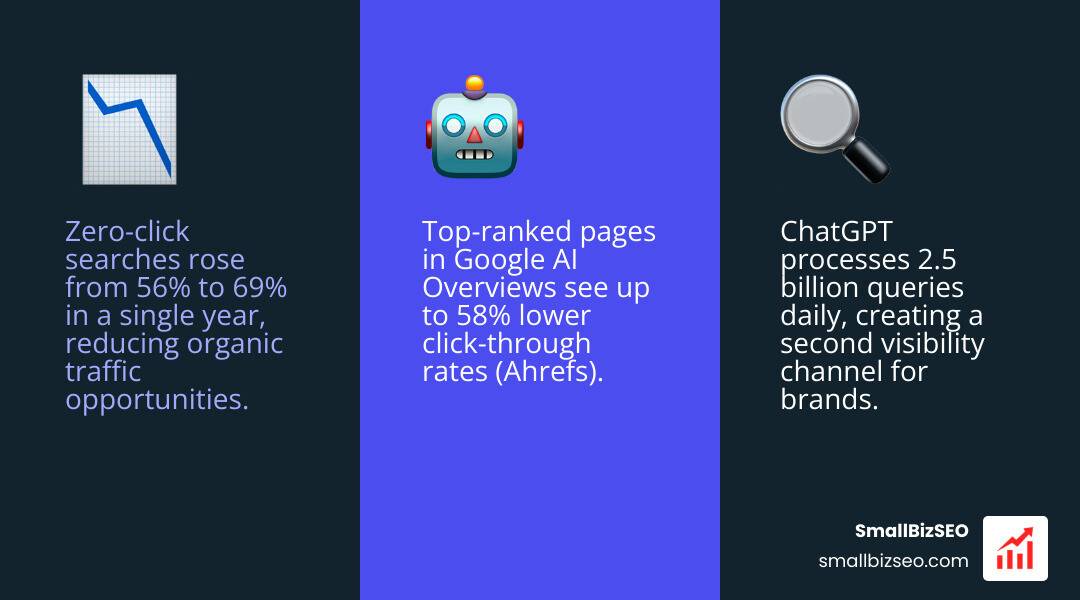
The AI SEO return you get from your marketing spend looks very different today than it did just a couple of years ago. Google now serves AI-generated answers above traditional results. ChatGPT handles around 2.5 billion queries every day. And zero-click searches have jumped from 56% to 69% in a single year, according to Similarweb. If your business relies on organic search traffic for leads and revenue, these numbers directly affect your bottom line.
Here is a quick snapshot of what AI SEO return means in practice:
| Factor | What It Means for You |
|---|---|
| AI Overviews on Google | Top-ranked pages see up to 58% lower click-through rates (Ahrefs) |
| Zero-click searches at 69% | More searchers get answers without ever visiting your site |
| ChatGPT + Perplexity citations | Brands cited in AI answers gain a second visibility channel |
| Traditional SEO still matters | LLMs pull from top-ranked Google pages — rank there first |
| ROI multiplier potential | One well-optimized page can show up in both Google and AI answers |
This is not a signal to abandon SEO. It is a signal to evolve it. The businesses that understand how AI tools source their answers — and optimize for both channels — are the ones protecting and growing their organic revenue right now.
I'm Clayton Johnson, a digital PR and SEO specialist focused on building search visibility that converts. My work in AI SEO return strategy centers on helping businesses show up where it counts — in Google rankings or in the AI-generated answers that are rapidly reshaping how people find products and services. The next sections break down exactly how to calculate what's at risk, and what to do about it.
The Shift: Traditional SEO ROI vs. Generative Engine Optimization
Traditional SEO has always focused on a relatively simple equation: rank higher on the search engine results page, secure a higher click-through rate, and drive visitors to your website. If you ranked first, you could expect to capture roughly 27.6% of those clicks.
However, the rise of AI-driven search features has altered this dynamic. When Google places an AI summary at the top of a results page, the click-through rate for the top organic link can drop from 15% to 8%. This click erosion means that simply ranking high is no longer enough to guarantee the traffic volume you once enjoyed.
To protect your organic pipeline, your digital strategy must expand to include Generative Engine Optimization (GEO) and Answer Engine Optimization (AEO). While traditional SEO aims to rank pages in standard listings, GEO and AEO focus on making your brand the primary cited source inside AI answers. By updating your approach with modern SEO Services, you ensure that your business remains visible whether a user reads a traditional snippet or a conversational AI summary.
How AI Search Visibility Multiplies Your AI SEO return
Optimizing for AI search engines is not an entirely separate chore; it is a dual-channel multiplier. Large language models (LLMs) like ChatGPT, Gemini, and Perplexity do not invent their recommendations out of thin air. They gather their facts, brand citations, and product recommendations by scraping top-ranking Google search results.
If your brand is completely invisible in traditional search, it will be completely invisible to AI engines. But when you build a strong organic foundation, you unlock two distinct visibility channels for the price of one:
- You capture standard search engine traffic from users who scroll past the AI boxes.
- You earn authoritative citations and active links inside the AI summaries themselves.
This dual-channel exposure significantly multiplies your AI SEO return by capturing high-intent searchers across multiple platforms. To achieve this level of cross-channel authority, many brands collaborate with specialized teams or work with expert SEO services to align their content with how machine models retrieve information.
The Role of Autonomous AI Agents in Future Search Value
The search landscape is shifting from simple text queries to autonomous AI agents that perform multi-step research on behalf of users. When a user asks an AI agent to find the best tool or service for their business, the agent does not just run a single search. It executes dozens of concurrent searches, cross-checks multiple websites at machine speed, and synthesizes its findings into a single recommendation.
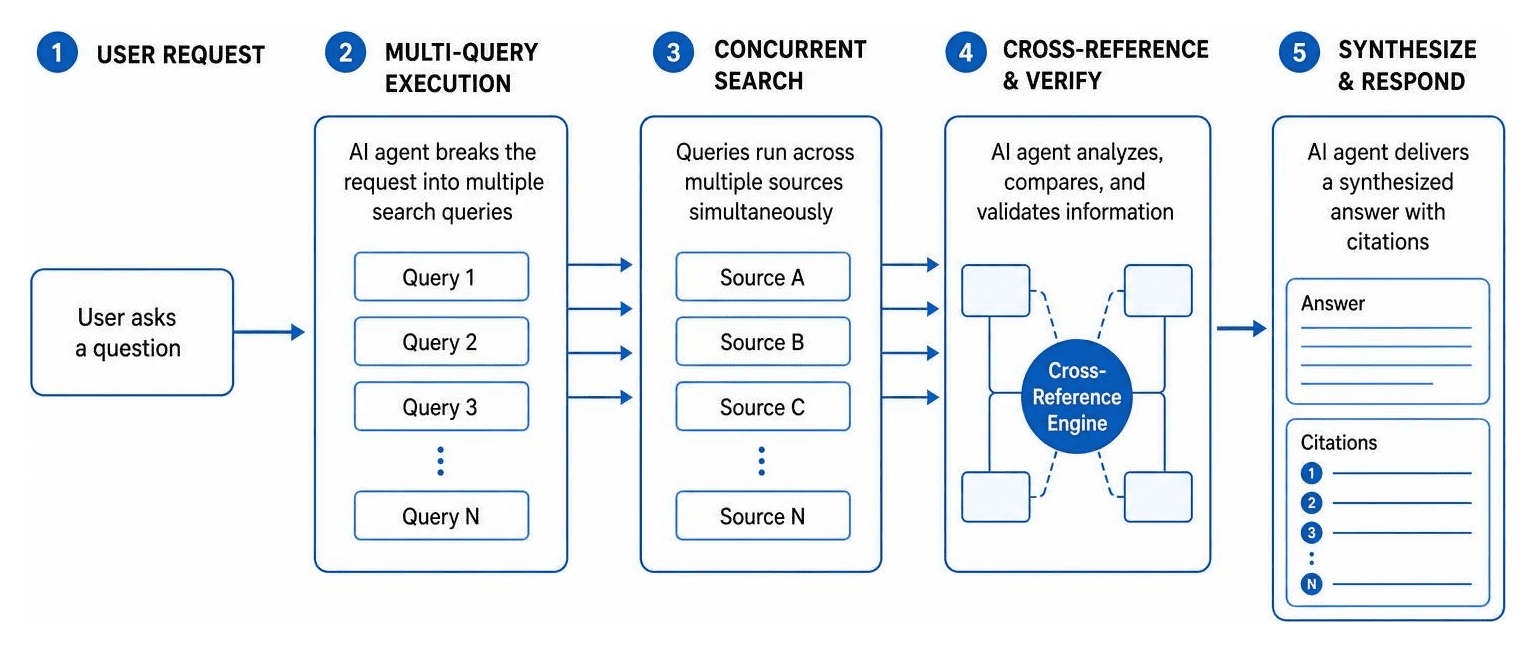
To win recommendations from these digital assistants, your website must serve as an easily discoverable knowledge ecosystem. AI agents favor structured, citable content that is semantically connected. If your brand's expertise is scattered across disorganized pages, an agent's reasoning loop may bypass your site entirely. By structuring your content clearly, you ensure that these automated searchers can easily parse, verify, and cite your brand.
Calculating Your AI SEO return: The Modern ROI Formula
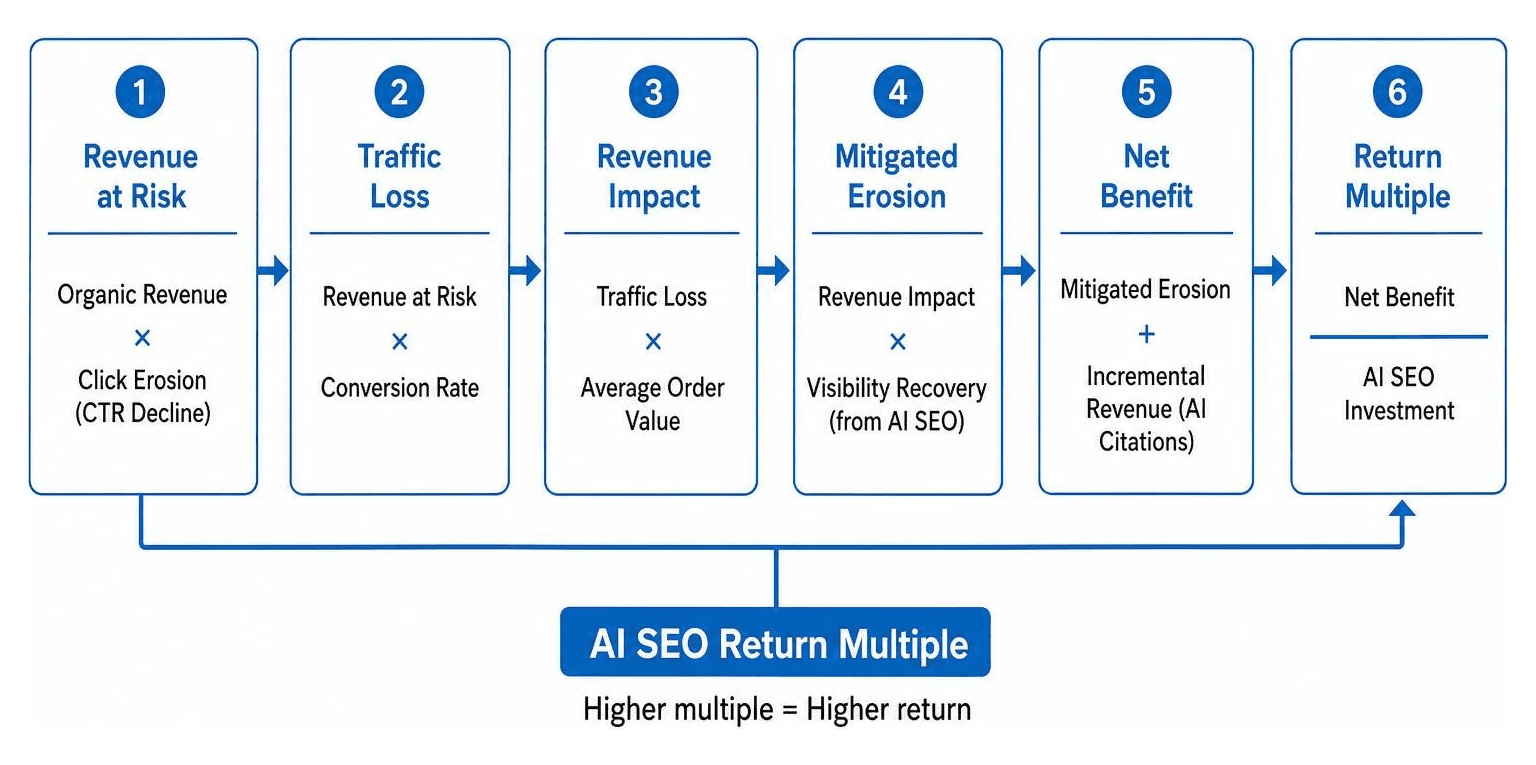
Measuring your returns in the AI era requires a shift from tracking raw traffic volume to calculating revenue protection and brand share of voice. The traditional ROI formula compares your organic revenue growth against your SEO spend. The modern AI SEO return formula, however, factors in "revenue at risk" and "mitigated erosion."
Here is how the two calculation models compare:
| Metric | Traditional SEO ROI | Modern AI SEO ROI |
|---|---|---|
| Primary Focus | Net-new traffic and sales | Revenue protection + new citations |
| Key Formula | (Revenue - Cost) / Cost x 100 |
(Revenue at Risk x % Mitigated) / Investment |
| Risk Factor | Competitor movement | AI click erosion and zero-click search growth |
| Success Indicator | Higher keyword rankings | High share of voice in LLM responses |
By shifting your metrics to focus on how much revenue you protect from click erosion, you can calculate a highly accurate return multiple that justifies your digital marketing budget.
Quantifying Revenue at Risk and the Cost of Inaction
If your business does nothing to adapt to generative search, you face a compounding cost of inaction. As zero-click searches grow and AI summaries dominate search results, your traditional click-through rates will naturally decline.
For example, if your business generates $5 million in annual organic revenue, even a conservative 15% erosion in clicks represents $750,000 in revenue at risk. If you do not actively mitigate this loss, you will be forced to rely on paid advertising channels, which drives up your overall cost per acquisition (CPA).
To prevent this downward spiral, you must turn your raw search Data Into Traffic by optimizing for AI citations. Working with leading agencies or consulting with optimization experts can help you audit your current search footprint and establish a defensive strategy before competitors lock in their citation authority.
Building a Business Case to Secure Your AI SEO return
To secure executive buy-in for AI-focused marketing, you must frame the investment as capital efficiency and risk management rather than an experimental project. CFOs and leadership teams are far more likely to fund strategies that preserve existing profit margins than speculative growth hacks.
When presenting your business case, use the return multiple formula to highlight the defensive value of your budget. If a $60,000 annual investment in specialized SEO Packages mitigates 50% of a projected $750,000 revenue erosion, you are delivering a 6.25x return multiple on that spend. Presenting the numbers through this risk-mitigation framework makes the decision to invest clear and logical for decision-makers.
Actionable Strategies to Optimize for AI Citations and Protect Revenue
Winning citations in AI search engines requires a combination of technical optimization and precise content formatting. Because AI engines rely heavily on machine-readable signals, implementing structured data and schema markup is essential. These technical tags help search crawlers easily interpret the entities, relationships, and facts on your web pages.
At the same time, your content must demonstrate strong E-E-A-T (Experience, Expertise, Authoritativeness, and Trustworthiness) signals. AI engines prioritize content that features real-world experience, expert quotes, and authoritative citations over generic information. For a deeper look at these optimization concepts, you can explore the LLM Pulse AI Overviews Playbook or read about strategies that go Beyond Content Optimization.
Formatting Content for Retrieval-Augmented Generation and AI Overviews
Google AI Overviews and other LLMs use Retrieval-Augmented Generation (RAG) to pull specific passages from indexed web pages to construct their answers. The retrieval layer of these models favors content structured around short, clear formatting boundaries.
To format your pages for RAG and AI Overviews, focus on these tactical steps:
- Use Direct Q&A Structures: Place a concise, direct answer of 40 to 80 words immediately below your H2 or H3 question headings.
- Incorporate Bulleted Lists and Tables: Format comparisons, steps, and data points into structured elements that AI scrapers can easily extract.
- Keep Paragraphs Short: Limit paragraphs to 2 to 4 sentences to make them easy for retrieval models to chunk and cite.
- Establish Entity Consensus: Use clear, unambiguous noun-based sentences to state facts, making it easy for models to verify your claims.
For those interested in technical automation, open-source tools like the new7start7/SEO-agi repository demonstrate how AI agents can build pages designed for both Google ranks and LLM citations. Pairing these technical structures with high-quality SEO Content Services ensures your pages are highly eligible for conversational search features.
Leveraging AI SEO Tools for Measurement and Optimization
Manually checking your brand's visibility across multiple AI search platforms is highly inefficient. Instead, modern marketing teams use advanced AI SEO tools to track their share of voice, monitor citation frequency, and identify optimization opportunities.

Platforms like Profound, Surfer SEO, and Ahrefs offer dedicated tracking features to monitor your brand's presence across ChatGPT, Perplexity, and Google AI Overviews. These tools help you see exactly where your brand is being cited, which competitors are earning recommendations, and where your content has gaps. To understand how to choose the right software for your business, check out our guide on What Are AI SEO Tools.
Frequently Asked Questions About AI Search and SEO ROI
How long does it take to see returns from AI SEO?
While paid advertising campaigns can drive immediate traffic, organic search strategies require a ramp-up period to build authority. Typically, meaningful results from AI-optimized campaigns begin to compound within 4 to 9 months. During this time, search engines index your updated technical structures, and AI models begin to recognize and cite your brand's content.
What happens to my traffic if I do nothing to adapt to AI search?
If you do not adapt, your organic search traffic will likely face a steady decline. As Google rolls out more AI Overviews and zero-click searches rise, traditional click-through rates will drop. Over time, your brand will lose familiarity with searchers, forcing you to rely more heavily on expensive paid search channels to sustain your lead generation.
Do I need special technical files like llms.txt to rank in AI Overviews?
No. Google has officially stated that its generative search features rely on standard search indexing and snippet eligibility. Special markdown files like llms.txt are ignored by Google's main search crawlers. To appear in AI Overviews, focus on standard technical SEO, schema validation, and high-quality passage formatting.
Maximize Your Search Value with the Velocity Framework

Navigating the intersection of traditional search and generative AI does not have to be an overwhelming guessing game. At SmallBizSEO, we help businesses secure a strong AI SEO return through our data-driven "Velocity" framework. This approach combines technical SEO, expert content strategy, and authoritative link-building to deliver fast rankings and transparent, automated reporting.
By focusing on E-E-A-T-compliant content and clear, machine-readable site structures, we make sure your brand is positioned to win both standard Google searchers and conversational AI citations. Ready to protect your organic search revenue and scale your digital footprint? Explore our specialized AI SEO Services and let us help you turn search evolution into a powerful competitive advantage.