Analyze Your Way to the Top: SEO Analysis for Better Rankings

Analyze Your Way to the Top: SEO Analysis for Better Rankings
Why Your SEO Analysis Rank Decides Whether Customers Find You or Your Competitors
Understanding your SEO analysis rank is the first step toward getting your small business found online. Here's a quick snapshot of what it involves and how to improve it:
How to improve your SEO analysis rank:
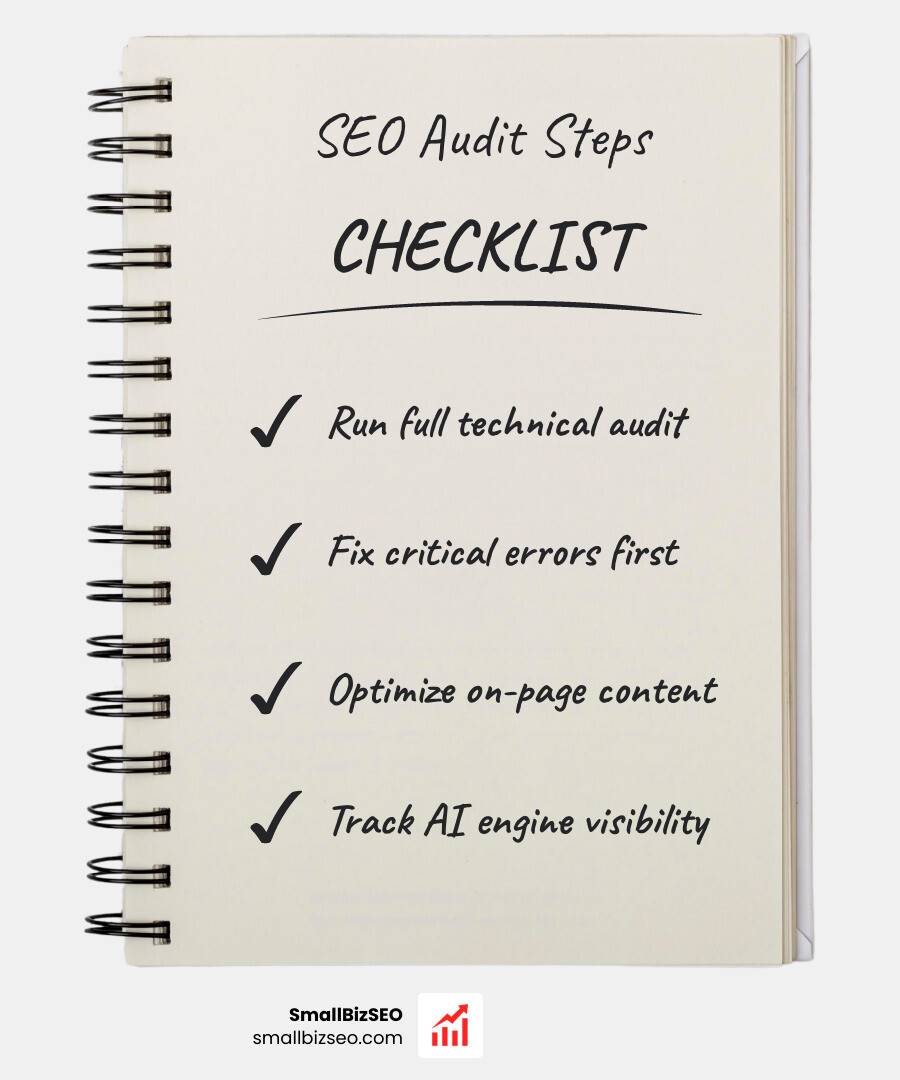
- Run a full SEO audit - Check your site for technical errors, missing metadata, and crawl issues
- Fix critical issues first - Focus on red-flagged problems like broken pages, slow load times, and missing title tags
- Optimize on-page content - Align your headings, meta descriptions, and keywords with what searchers want
- Build authority - Earn quality backlinks and strengthen your internal linking structure
- Track AI visibility - Ensure AI engines like ChatGPT and Perplexity can read, understand, and cite your content
- Monitor and repeat - SEO is ongoing; re-audit after every major site change
Getting found on Google used to mean checking a handful of boxes. Today, it's more complex. Search engines evaluate hundreds of signals — from page speed and structured data to how well your content answers real questions.
And it's not just Google anymore. 40% of searches now happen in AI engines, meaning your visibility in tools like ChatGPT, Perplexity, and Gemini matters just as much as your traditional rankings.
The good news? A solid SEO analysis tells you exactly what's holding your site back — and what to fix first.
I'm Clayton Johnson, a digital PR and SEO specialist who has built and managed campaigns specifically around improving SEO analysis rank for businesses that need real, measurable visibility growth. In the sections below, I'll walk you through every layer of a modern SEO analysis so you can stop guessing and start ranking.
Must-know SEO analysis rank terms:
Demystifying the SEO Analysis Rank: How Search Engines Evaluate Your Site
When we talk about your SEO analysis rank, we are looking at how search engine crawlers and algorithms perceive your website's overall health and authority. Modern search engines do not just look at keywords stuffed into a page; they evaluate hundreds of complex, overlapping signals to determine if your site deserves the top spot.

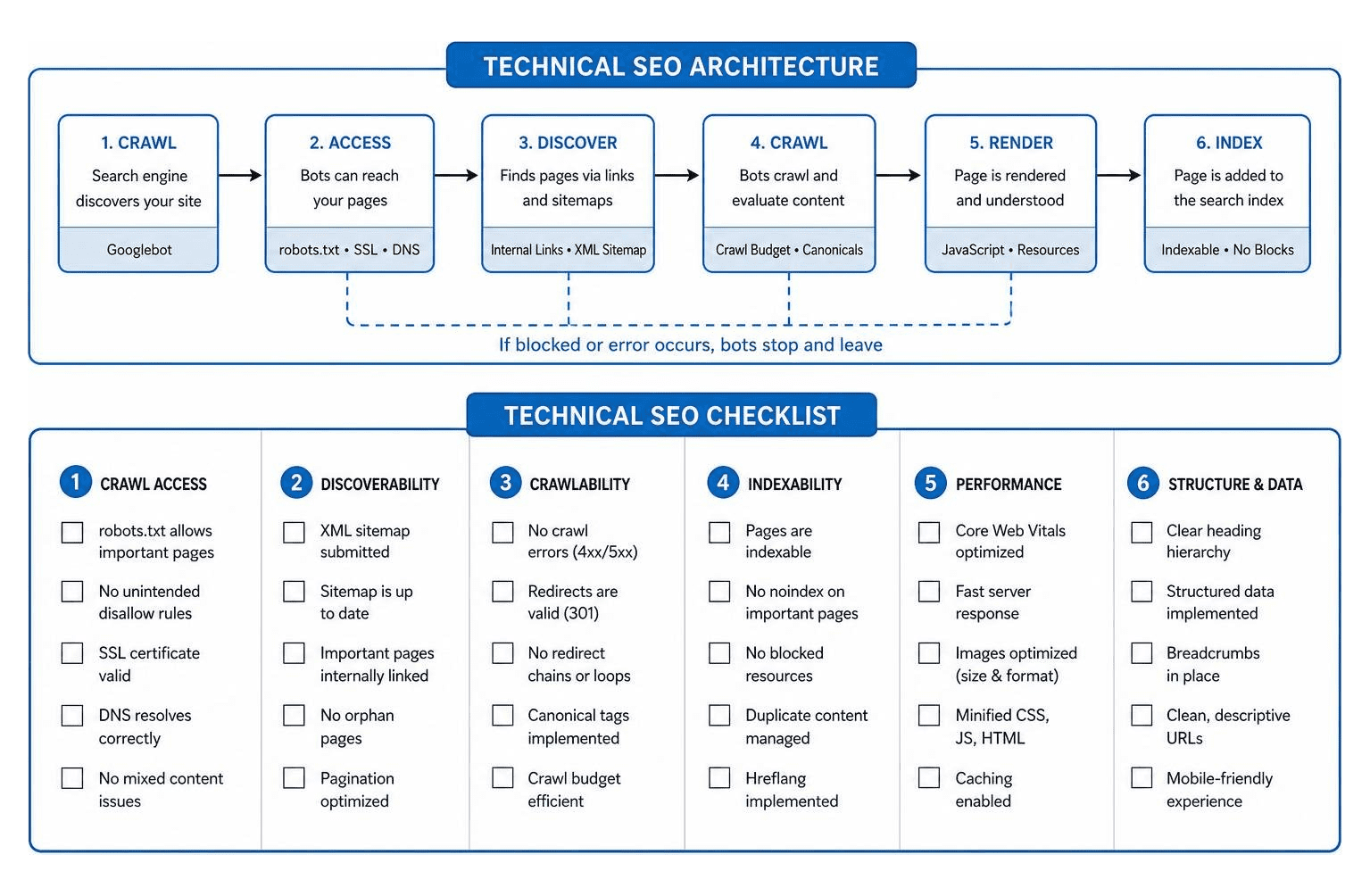
To get a true picture of your standing, you need a Detailed SEO Analysis. This analysis evaluates how easily search engine bots can discover, crawl, and index your pages. If your site has crawl blocks or broken redirect chains, search bots will simply turn around and leave, dragging down your rankings.
To go deeper than traditional proxy metrics, we can look at actual quality signals. Tools like the SEO Scanner — Godrank allow us to look at 12 ranking signals directly connected to Google's leaked Content Warehouse API, the Panda patent, and the Information Gain patent. By analyzing how engines evaluate these signals, we can align our sites with how search algorithms actually operate.
Key Metrics That Determine Your SEO Analysis Rank
When you open a comprehensive SEO report, the sheer volume of data can feel overwhelming. To keep your sanity intact, we recommend focusing on these core pillars:
- SEO Score: Most tools generate an overall health score from 0 to 100. A score of 80% or higher indicates a strong foundational setup. A score between 30% and 79% means you have significant room for optimization, while a score below 30% indicates critical issues that require immediate attention.
- Core Web Vitals: These are Google's real-world speed and usability metrics. If your pages load slowly or elements jump around as they load, your rankings will suffer.
- Backlink Profile: The quality, quantity, and relevance of other websites linking to yours. Think of backlinks as digital votes of confidence.
- Keyword Rankings: Where your pages currently sit in search results for your target search terms.
How to Improve Your SEO Analysis Rank with Actionable Fixes
The best SEO tools do not just hand you a list of problems; they provide a prioritized task list so you know where to start.
To boost your SEO analysis rank quickly, start by tackling high-impact, low-effort on-page fixes. First, ensure your metadata is optimized. This means writing descriptive, concise title tags and meta descriptions that fit within recommended character lengths. Next, check your heading hierarchy. Every page should have exactly one H1 heading that contains your primary keyword, followed by logically structured H2 and H3 subheadings.
Finally, do not ignore your images. Adding descriptive alt attributes to your images helps search engines understand what the visuals represent, while also improving web accessibility.
Technical SEO: The Foundation of Modern Website Audits
Think of technical SEO as the plumbing of your website. If the pipes are leaking, it does not matter how beautiful the wallpaper is. A technical audit ensures that search engines can access, read, and index your content without friction. If you want to make sure your site is fully compliant, learning How to Pass Google's Own SEO Analysis Audits is essential for long-term organic growth.
Key technical factors we evaluate during an audit include your robots.txt file (ensuring it is not accidentally blocking important pages), XML sitemaps, crawl budget efficiency, and SSL health.
Core Web Vitals and Page Performance
Page speed is a direct ranking factor. Google measures user experience through three main metrics known as Core Web Vitals:
- Largest Contentful Paint (LCP): How fast the main content of a page loads.
- Interaction to Next Paint (INP): How quickly a page responds when a user clicks or taps on it.
- Cumulative Layout Shift (CLS): How visually stable the page is as it loads.
Improving your Time to First Byte (TTFB) by using fast hosting and clean code is one of the most effective ways to satisfy these performance benchmarks.
Schema Markup and Structured Data
Structured data (usually written in JSON-LD format) acts as a direct translator for search engines. It explicitly tells search bots what your content is about, making your site eligible for eye-catching rich snippets in search results.
The real-world impact of structured data is massive. For instance, implementing JobPosting structured data has helped job boards grow their conversion rates by 4.5x. Similarly, adding video structured data has helped major streaming platforms boost their organic traffic by 3x. For local businesses, using LocalBusiness schema and FAQPage schema ensures that your physical location, operating hours, and quick answers are displayed directly on the search results page.
Traditional SEO vs. Generative Engine Optimization (GEO)
The search landscape is undergoing a massive shift. While traditional SEO focuses on ranking blue links on Google, Generative Engine Optimization (GEO) focuses on getting your brand cited inside AI-generated answers.

With 40% of searches now happening in AI engines, optimizing for Large Language Models (LLMs) like ChatGPT, Gemini, and Perplexity is no longer optional. AI engines evaluate websites differently than Google. They prioritize LLM accessibility, topical depth, and explicit citability. To help AI agents crawl your site, validating your llms.txt file and ensuring your content can be read without complex JavaScript rendering is crucial.
Optimizing for AI Search Engines and Answer Engines
To win citations in AI search, we must optimize for "answer capsules." These are concise, direct answers placed in the very first paragraphs of your content. AI crawlers love clear facts and unique data.
This is where "Information Gain" comes in. AI engines do not want to synthesize ten articles that all say the exact same thing. They prefer to cite sources that offer original research, proprietary data, or unique expert insights. By tracking your brand mentions and monitoring how AI agents perform site: queries to evaluate your business, you can protect and grow your AI search visibility.
Content Optimization and Competitor Benchmarking
High-quality content is still the ultimate ranking factor. However, modern content optimization requires matching search intent perfectly. If a user is searching for a quick tool, but you present them with a 3,000-word blog post, they will click away instantly.
During our audits, we analyze user engagement signals like dwell time and click behavior (often referred to as NavBoost signals, which track "good clicks" versus quick bounces). We also check keyword density to make sure your primary terms are used naturally without over-optimization. To find out exactly where your content is falling short, running a Keyword Gap Analysis will show you the exact topics your competitors are ranking for that you have missed.
Analyzing Competitor Rankings and SERP Data
You do not rank in a vacuum. To claim the top spot, you must understand who currently holds it. Using a Free Google SERP Checker for Accurate Keyword Ranking Data allows you to analyze the top-ranking pages for any keyword, calculate keyword difficulty, and spot the weakest competitors in the search results.
If you have a page that simply refuses to move up, you can use the SEO Never Rank Diagnosis Tool | Find Why Pages Don’t Rank to identify format mismatches, trust issues, or authority gaps that are holding your page back.
For local businesses in highly competitive areas, studying the landscape is key. Whether you are benchmarking against top SEO agencies in New York or analyzing local search patterns, understanding competitor strengths helps you build a smarter campaign.
Free vs. Paid SEO Suites: Choosing the Right Tool
When starting out, free SEO checkers are fantastic for quick, surface-level diagnostics. However, as your business grows, you will likely run into the limitations of free tools.
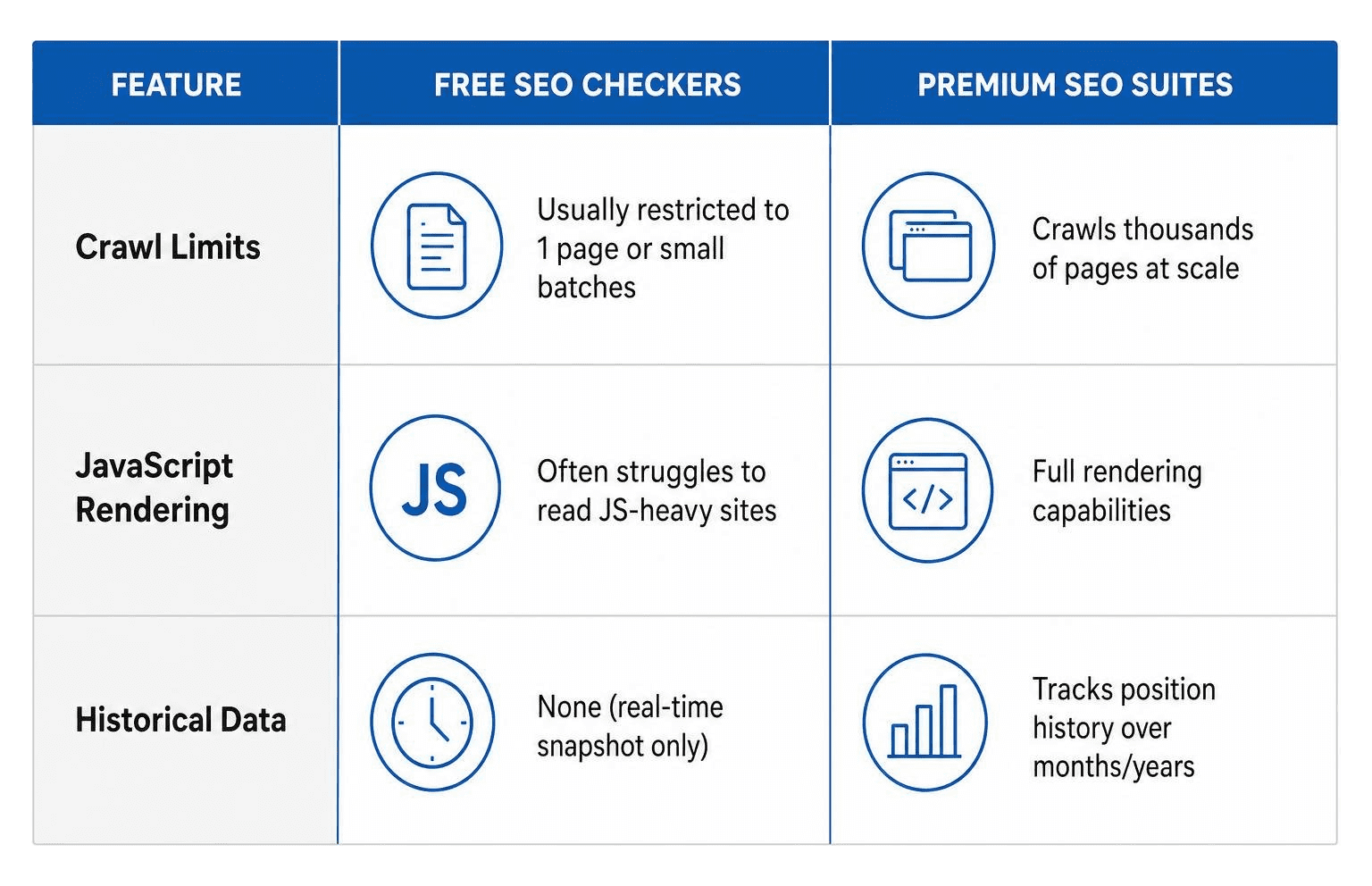
| Feature | Free SEO Checkers | Premium SEO Suites |
|---|---|---|
| Crawl Limits | Usually restricted to 1 page or small batches | Crawls thousands of pages at scale |
| JavaScript Rendering | Often struggles to read JS-heavy sites | Full rendering capabilities |
| Historical Data | None (real-time snapshot only) | Tracks position history over months/years |
| GEO & AI Visibility | Rarely included | Tracks AI citations and LLM accessibility |
| White-Label Reporting | Not available | Custom-branded PDF reports for clients |
| Lead Generation | Basic | Embeddable audit tools to capture inbound leads |
If you are a marketing agency or a growing business in New York, upgrading to a premium suite or partnering with a professional agency allows you to automate hundreds of hours of manual auditing. Agencies frequently use embeddable audit tools on their websites to generate high-quality inbound leads, providing prospective clients with white-label, beautifully branded PDF reports in seconds.
Whether you are looking for a New York SEO company, searching for the best SEO services in New York, or seeking a professional SEO analysis in Manhattan, having access to enterprise-grade data makes all the difference.
Frequently Asked Questions about SEO Analysis
What is the difference between SEO and GEO?
Traditional SEO (Search Engine Optimization) focuses on optimizing your website to rank higher in traditional search engines like Google by improving backlinks, keywords, and technical site health. GEO (Generative Engine Optimization) is the process of optimizing your content so that AI-powered answer engines like ChatGPT and Perplexity easily understand, trust, and cite your website as a source in their generated answers.
How often should I run an SEO audit on my website?
We recommend running a comprehensive technical audit at least once a quarter. However, if you are actively publishing new content, launching new products, or making code changes, continuous monitoring is highly beneficial. Running a quick check after any major site update ensures that you catch indexing or crawl errors before they impact your rankings.
Can a free SEO checker detect all technical issues?
Free SEO checkers are excellent for identifying basic on-page issues, such as missing title tags, broken links, or slow load times. However, they often miss deeper technical issues like complex JavaScript rendering errors, indexation bugs, schema markup mismatches, and comprehensive backlink health. For a deep, site-wide diagnosis, a premium crawler or a professional manual audit is required.
Conclusion
Improving your SEO analysis rank is not a one-time project; it is an ongoing strategy. By combining technical SEO, high-quality content optimization, and forward-looking GEO strategies, you can build a sustainable source of organic traffic that outlasts algorithm updates.
At SmallBizSEO, we help small businesses in New York, NY, scale their online presence. Our data-driven "Velocity" framework is designed to deliver fast rankings and E-E-A-T-compliant growth through transparent, automated reporting.
Ready to see how your website stacks up in both Google and AI search engines? Check out our SEO Services and claim your Free SEO Visibility Audit today to start optimizing your path to the top!