Keyword Gap Analysis: What It Is and How to Do It Right

Your Competitors Are Ranking for Keywords You Don't Even Know You're Missing
Keyword gap analysis is the process of comparing your website's keyword rankings against your competitors' to find valuable search terms they rank for that you don't.
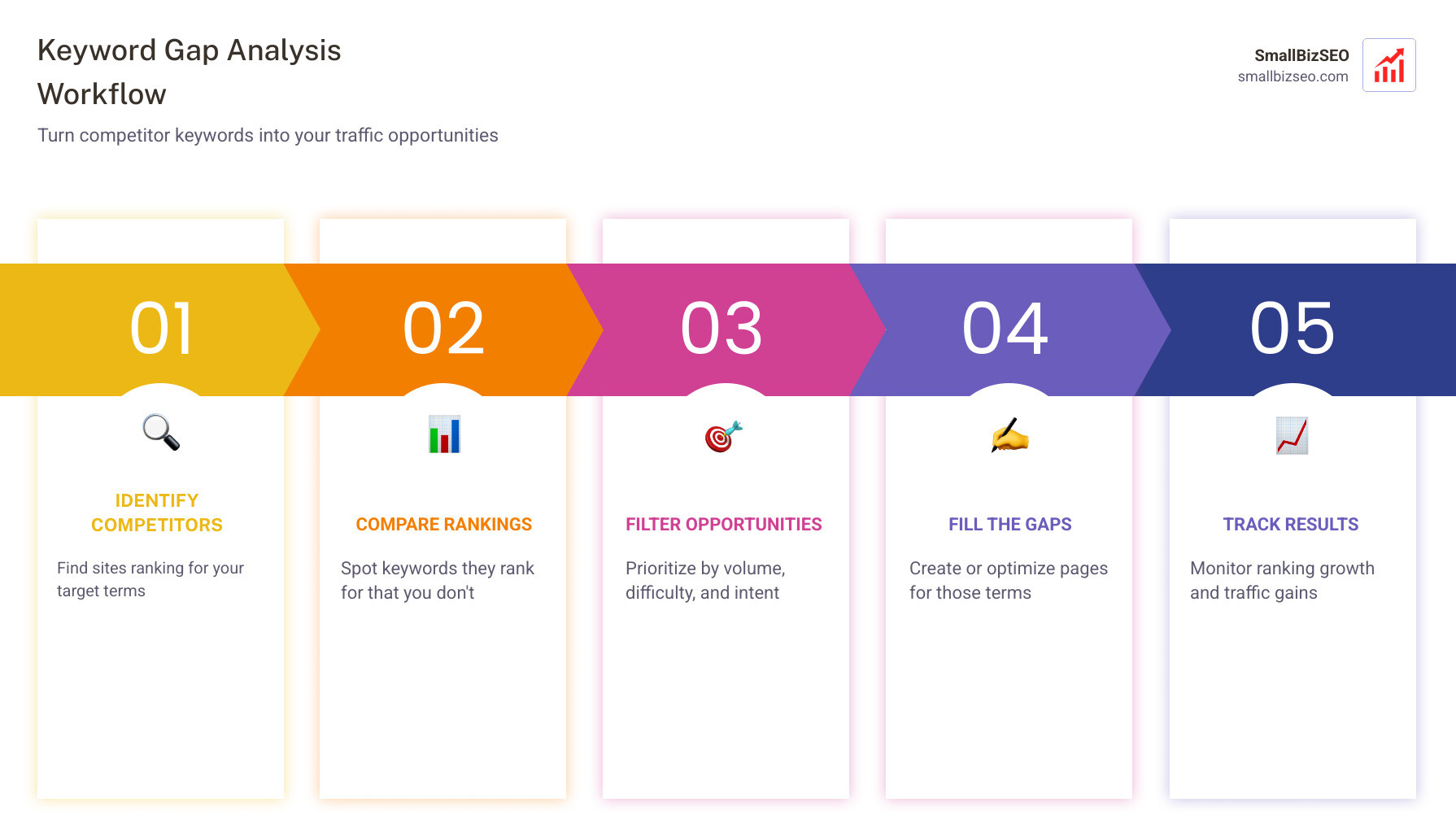
Here's a quick summary of what it involves:
- Identify your SEO competitors - who ranks for the terms you want to own
- Compare keyword rankings - find terms they rank for that you don't
- Filter for opportunity - prioritize by search volume, difficulty, and intent
- Fill the gaps - create new content or optimize existing pages
- Track your results - monitor rankings after publishing
Every keyword your competitor ranks for — and you don't — is traffic going to them instead of you. For a small business with limited time and budget, that's a real cost.
The good news? You don't need to guess. Keyword gap analysis shows you exactly where the opportunities are, based on what's already working for competitors in your space.
51% of all website traffic comes through organic search. And 81% of customers search online before making a purchase. If you're not showing up for the right terms, someone else is.
I'm Clayton Johnson, a digital PR and SEO strategist who has used keyword gap analysis to help businesses identify missed ranking opportunities and build content strategies that drive real organic growth. In the sections below, I'll walk you through the full process — step by step, without the jargon.
What is Keyword Gap Analysis and How Does It Differ from Content Gap?
To build a winning search strategy, you must understand the difference between finding specific search queries and planning broader content topics. While they sound similar, keyword gap analysis and content gap analysis serve two distinct purposes in your SEO journey.
A keyword gap analysis is a highly tactical process. It focuses on finding specific search queries that your competitors rank for, but your website does not. By looking at direct competitor rankings, you can identify immediate, low-hanging fruit to optimize your existing pages or write highly targeted new posts.
On the other hand, a content gap analysis takes a broader view of the customer journey. It looks at entire topics, content formats, or informational areas that are completely missing from your site. Instead of just looking at specific search phrases, it helps you build overall topical authority by mapping out what your audience needs at every stage of their buying decision. To dive deeper into how to map out these larger thematic elements, you can learn more about content gap analysis to see how it shapes long-term brand authority.
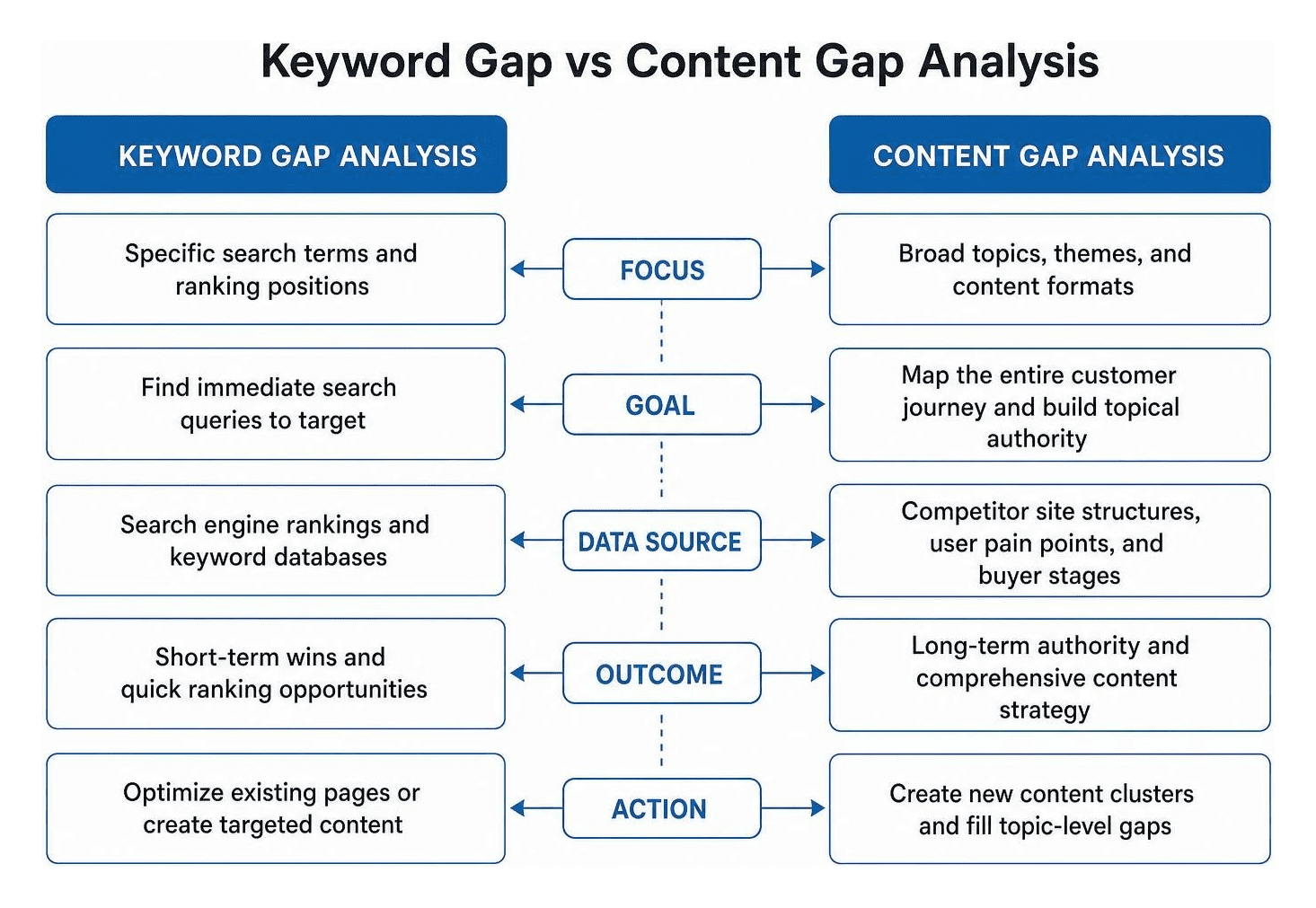
| Feature | Keyword Gap Analysis | Content Gap Analysis |
|---|---|---|
| Primary Focus | Specific search terms and ranking positions | Broad topics, themes, and content formats |
| Goal | Find immediate search queries to target | Map the entire customer journey and build topical authority |
| Data Source | Search engine rankings and keyword databases | Competitor site structures, user pain points, and buyer stages |
| Action Plan | Optimize metadata, add keywords, write targeted posts | Build new content hubs, resource sections, or video libraries |
By combining both approaches, you ensure your website covers both the micro-level search queries and the macro-level topics your audience cares about.
Why You Must Perform a Competitive Gap Analysis
If you are not actively looking at what your competitors are doing, you are operating in the dark. SEO is a zero-sum game: for your website to move up in rankings, another site has to move down. Performing a regular competitive gap analysis gives you the data you need to make smart, calculated moves that grow your traffic.
Analyzing competitor search volume and rankings helps you understand your digital Share of Voice. This metric tells you how much of the online market you actually own compared to your competitors. If you want a clear picture of how your site currently stacks up, starting with a Detailed SEO Analysis is the best way to uncover hidden issues and benchmark your current performance.
How Keyword Gap Analysis Empowers Organic SEO
For organic SEO, a keyword gap report is like a treasure map. It reveals the exact search visibility gaps that are keeping you from reaching your audience. Instead of guessing what topics to write about, you can see which search queries are already driving traffic to your competitors.
Once you identify these gaps, you can apply smart On-Page SEO techniques to optimize your current pages or structure new content to perfectly match the user's search intent. This targeted approach ensures you do not waste time creating content that no one is searching for.
Leveraging Keyword Gap Analysis for PPC Campaigns
Keyword gap analysis is not just for organic search; it is also a secret weapon for paid search (PPC) campaigns. By comparing your paid keyword footprint with your competitors, you can uncover high-performing, commercial intent keywords that you might be missing.
This analysis helps you spot transactional keywords where competitors are paying for ads but you have no organic or paid presence. Finding these gaps allows you to optimize your CPC (cost-per-click) ad spend by bidding on highly relevant, lower-competition terms, ultimately improving your overall ad spend efficiency.
Step-by-Step Guide to Conducting a Gap Analysis
Running a gap analysis does not have to be complicated. With the right tools and a structured process, you can find hundreds of valuable search terms in minutes.

Whether you use premium platforms or specialized tools like the Similarweb Keyword Gap and Overlap Analyzer or the Link-Assistant Keyword Gap Analysis Tool, the basic steps remain the same.
Step 1: Identify Your True Search Competitors
The first step is to figure out who you are actually competing against in search results. Your search competitors are not always the same as your direct, physical business competitors.
- Direct Competitors: Businesses that sell the exact same products or services in your local area, such as New York, NY.
- Indirect Competitors: Businesses that solve the same problem but with a different product or service.
- Organic Search Competitors: Websites, blogs, or directories that rank for your target keywords, even if they do not sell a competing product.
If you are a local business, focusing on the right regional competitors is critical. You can check out our Local SEO Guide to learn how to identify and outrank local search competitors in your specific market.
Step 2: Run the Analysis and Filter the Metrics
Once you have identified 3 to 5 key competitors, enter your domain and theirs into your chosen keyword gap tool. Most tools, such as the Semrush Keyword Gap Tool, allow you to compare multiple domains side-by-side.
After running the comparison, you will be greeted with thousands of keywords. To find the best opportunities, you need to filter the metrics:
- Search Volume: Look for keywords with enough monthly searches to make them worth your time (usually 50+ monthly searches for niche topics).
- Keyword Difficulty (KD): If your website is newer, filter for lower difficulty scores (under 30 or 40) so you can rank faster.
- Search Intent: Pay attention to whether the intent is informational (users looking for answers) or transactional (users ready to buy).
- SERP Features: Note if the keyword triggers featured snippets, local packs, or image carousels, as this affects how you should format your content.
Step 3: Classify Shared, Missing, Weak, and Untapped Keywords
To make your data actionable, group the discovered keywords into clear buckets based on how you currently rank compared to your competitors:
- Shared Keywords: Terms where both you and your competitors rank. Use these to monitor your positions and ensure you do not lose ground.
- Missing Keywords: Search queries where multiple competitors rank in the top 100, but your website does not rank at all. These are your biggest immediate content opportunities.
- Weak Keywords: Terms where you rank, but your competitors rank significantly higher. These pages are perfect candidates for on-page optimization.
- Untapped Keywords: Keywords where at least one competitor ranks, but you do not. These represent excellent ideas for brand-new blog posts or service pages.
- Unique Keywords: Terms where only you rank. Keep these safe, as they represent your unique competitive advantage!
To learn more about analyzing and filtering these categories, you can read the Semrush Guide to Keyword Gap Analysis for advanced filtering workflows.
Prioritizing and Grouping Your New Keyword Opportunities
Once you have your list of missing and weak keywords, you cannot just write a single, massive blog post and hope for the best. You need a structured plan to turn these raw terms into organized, high-ranking content.
The most effective way to do this is by creating topic clusters. A topic cluster consists of a single, comprehensive "pillar page" that covers a broad topic in detail, surrounded by multiple, shorter "supporting pages" that target specific, long-tail keywords.
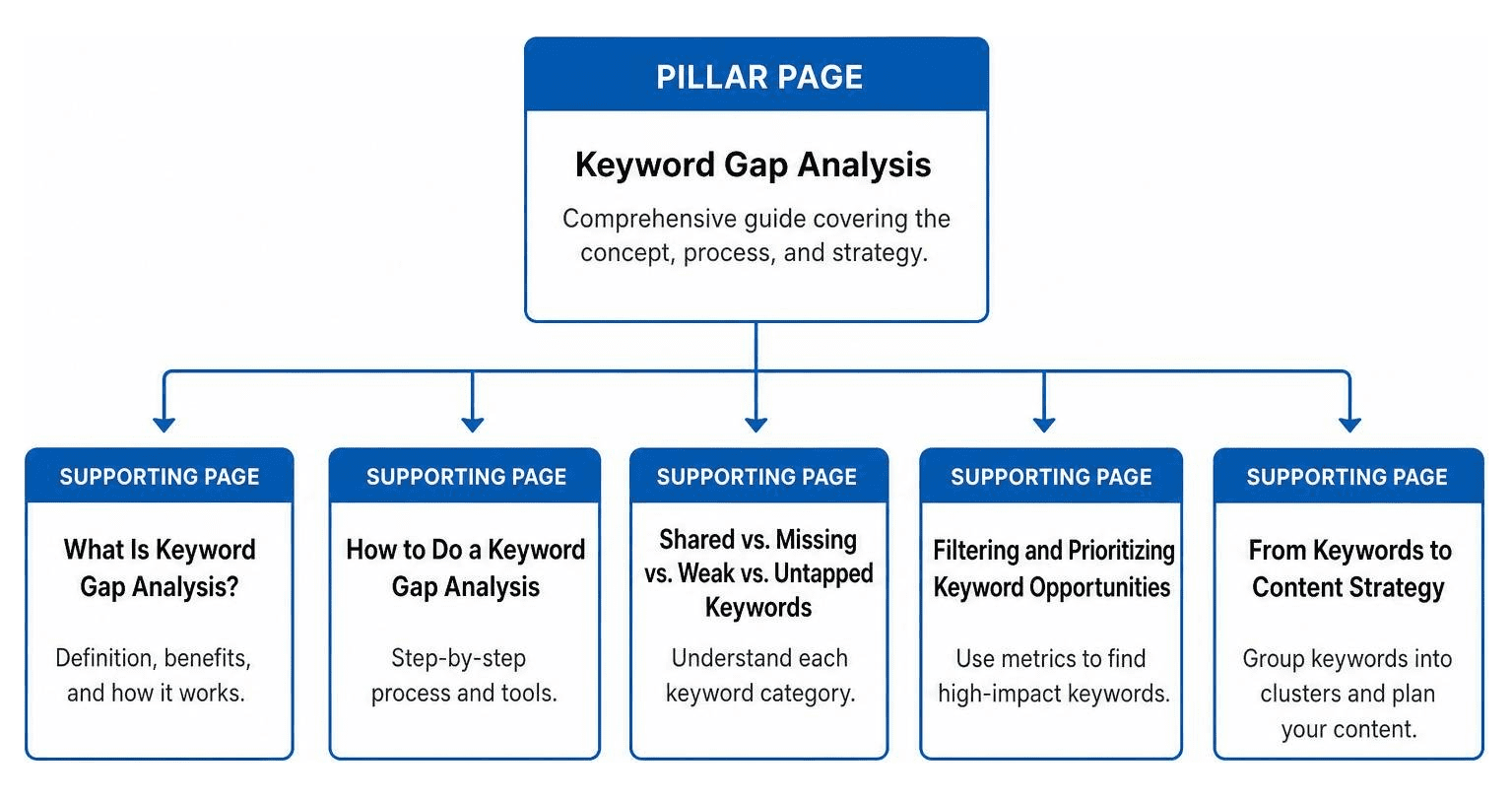
By grouping your gap keywords into topic clusters, you show search engines that your site has deep topical authority on the subject. Work these clusters directly into your editorial calendar so your team has a clear content plan to follow. If you need expert help organizing these clusters and executing a high-velocity content strategy, explore our comprehensive SEO Services Guide to see how we build customized growth plans.
Frequently Asked Questions About Competitor Keyword Gaps
How often should you perform a keyword gap analysis?
We recommend running a keyword gap analysis at least quarterly. The search landscape shifts constantly as competitors publish new content, update old pages, and launch new products. Regular quarterly audits ensure you stay ahead of these shifts and spot new competitor tracking opportunities before they turn into lost traffic.
What are the best free tools for finding keyword gaps?
If you are working with a tight budget, you can still perform a highly effective gap analysis using free tools:
- Google Search Console: Export your own keyword rankings to see what you currently rank for.
- Google Keyword Planner: Enter competitor URLs to see the primary keywords Google associates with their pages.
- Manual SERP Analysis: Search your target terms directly in Google to manually inspect who is ranking in the top positions and identify what content formats they are using.
- For a complete, step-by-step manual workflow, you can check out the RankYak Free Keyword Gap Guide for templates and spreadsheet formulas.
How do you track the impact of your keyword gap fixes?
After you optimize your weak pages or publish new content to fill your keyword gaps, you need to monitor your progress. Use rank tracking tools to watch your keyword positions weekly. Additionally, monitor your organic traffic growth and overall search visibility metrics in Google Search Console to ensure your fixes are driving real, qualified visitors to your site.
Conclusion
Finding and filling your keyword gaps is one of the fastest ways to grow your organic traffic and outsmart your competitors. Instead of guessing what content to create, a keyword gap analysis gives you a data-driven roadmap based on what is already working in your industry.
At SmallBizSEO, we specialize in helping small businesses in New York, NY, and across the country scale their search visibility. Using our proprietary "Velocity" framework, we deliver fast, E-E-A-T-compliant rankings backed by clear, transparent reporting.

Ready to stop guessing and start growing? Get a complete look at your site's search health and find your biggest traffic opportunities today with our custom SEO Visibility Audit.