How to Use Ahrefs for Keyword Research Without Losing Your Mind
How to Use Ahrefs for Keyword Research Without Losing Your Mind
Ahrefs keyword research is the process of finding the exact search terms your target customers type into Google — and then using Ahrefs' tools and data to decide which ones are actually worth chasing.
Here's a quick breakdown of how it works:
- Enter seed keywords into Ahrefs' Keywords Explorer or free Keyword Generator
- Review keyword ideas across six report types (matching terms, related terms, questions, and more)
- Check key metrics — search volume, Traffic Potential, and Keyword Difficulty (KD)
- Assess business fit using the Business Potential score (0–3 scale)
- Group keywords into clusters using the Parent Topic feature to avoid duplicate content
- Prioritize and target keywords that balance traffic opportunity with realistic ranking difficulty
Here's a sobering fact: 90.63% of pages on the internet get zero organic traffic from Google. Not a little traffic — zero. That's from a study of over one billion pages.
The reason? Most of those pages target topics that nobody is actually searching for. Or they go after keywords so competitive that ranking without a massive backlink profile is nearly impossible.
Keyword research is the step that prevents both mistakes. It's how you find out what your potential customers are actually searching for, and whether you have a realistic shot at showing up.
Ahrefs makes this process faster and more data-driven than almost any other tool available — but it can feel overwhelming if you don't know where to start.
I'm Clayton Johnson, a digital PR and SEO specialist focused on building search visibility through smart content and link-building campaigns — including hands-on experience with Ahrefs keyword research as a core part of every strategy. In this guide, I'll walk you through exactly how to use Ahrefs without the confusion, even if you're new to SEO.
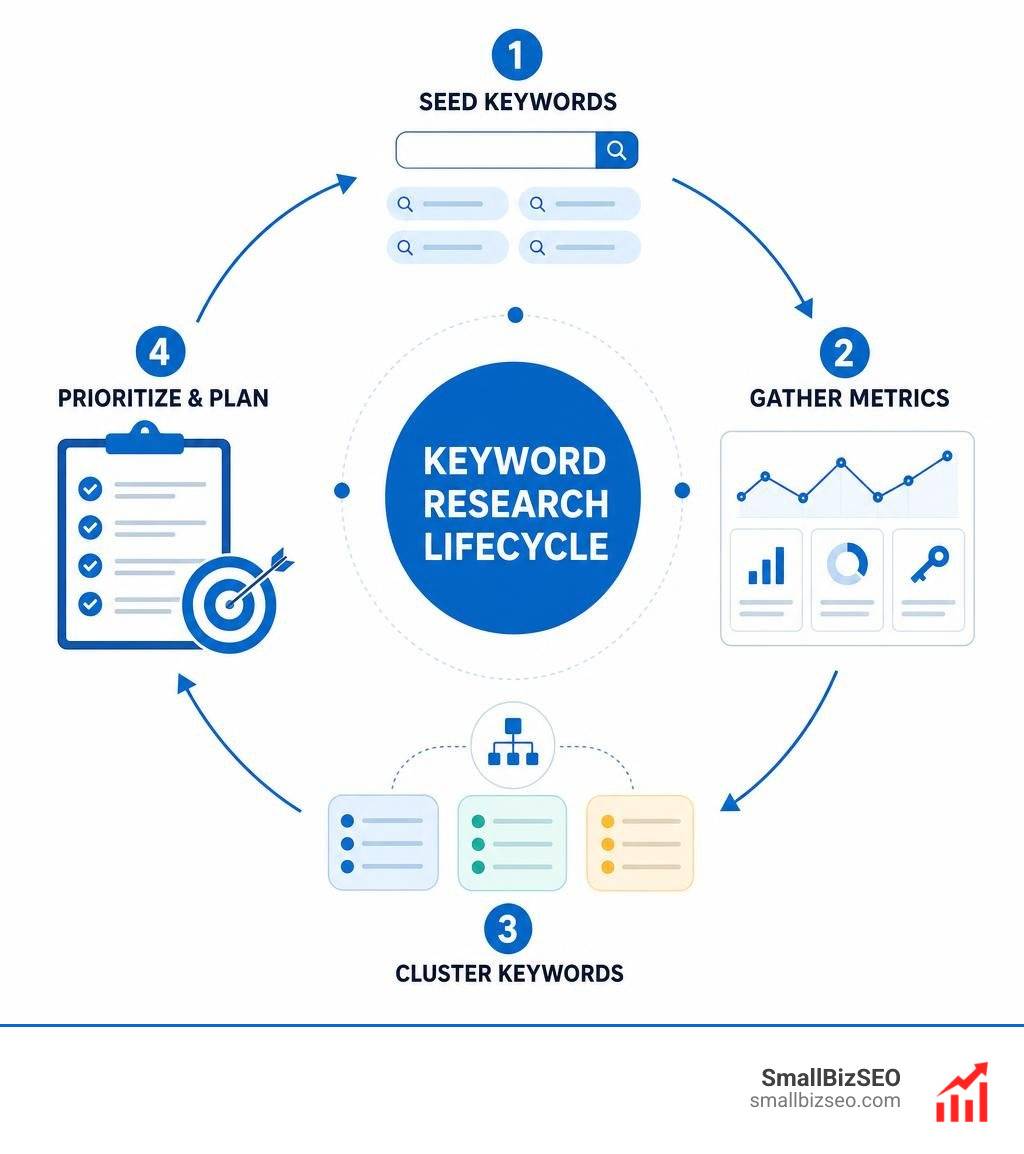
Why Keyword Research is the Foundation of SEO Success
At its core, keyword research is about understanding user psychology. Before we can optimize our websites or write a single line of copy, we must know what our audience actually wants.
By analyzing search intent—the underlying reason why someone types a specific query into a search engine—we can align our content with their expectations. When you match search intent, you earn Google's trust, which leads to sustainable organic traffic and higher Google rankings.
Many beginners focus purely on search volume, which is the average number of times a keyword is searched per month. However, search volume doesn’t tell the whole story.
As explained in Keyword Research: The Beginner’s Guide by Ahrefs, we must also look at "Traffic Potential." This metric estimates how much total search traffic the top-ranking page actually gets, which is often much higher than the volume of a single keyword because a single page can rank for thousands of related search terms.
To build a solid foundation for your overall SEO strategy, you must look at these metrics together rather than relying on search volume in a vacuum.
The Cost of Targeting the Wrong Keywords
What happens when you skip this process? You waste time and money. Publishing articles based on gut feeling alone often leads to the "zero-traffic trap." If there is no search demand for a topic, even the most beautifully written page will sit invisible in Google's index.
Targeting highly competitive terms without the budget to build backlinks is equally painful. If you target keywords with a Keyword Difficulty (KD) score of 80+ when your website is brand new, you will struggle to break into the top 10 search results.
Smart keyword selection feeds directly into your On-Page SEO and broader content strategy, ensuring that every page you publish has an achievable path to organic visibility.
A Step-by-Step Guide to Ahrefs Keyword Research
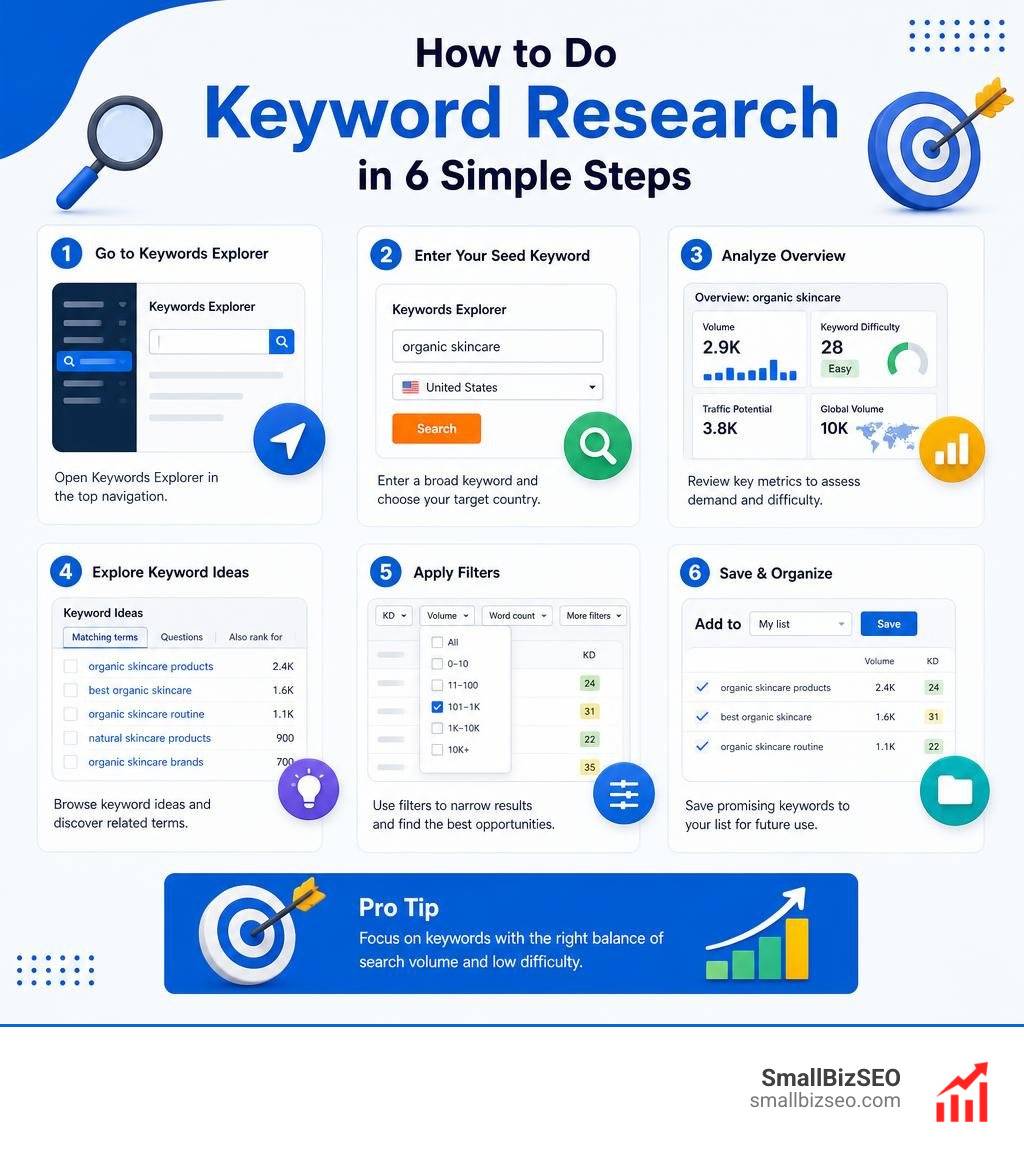
Now that we understand why it matters, let's look at how to actually do it. Ahrefs provides a massive database of over 19.2 billion keywords across hundreds of locations (including 2.6 billion keywords in the US alone). Navigating this sea of data requires a structured workflow.
Step 1: Brainstorming Seed Keywords
Seed keywords are the starting point for your research. They are broad, high-level terms that describe your niche, products, or services.
To brainstorm your seeds, think about the language your customers use. If you run a coffee equipment business, your seed keywords might include:
- coffee maker
- french press
- espresso machine
- cappuccino
Avoid overcomplicating this step. Enter these broad terms into Keywords Explorer to generate thousands of matching terms, search suggestions, and questions. This raw list of ideas is what we will refine into a high-performing content plan using professional SEO Content Services.
Step 2: Finding Competitor Gaps
One of the fastest ways to find valuable keyword opportunities is to look at what is already working for your competitors.
By entering a competitor's domain into Ahrefs Site Explorer, we can see exactly which keywords bring them the most organic traffic. To take this a step further, use the Content Gap tool. This feature shows you the exact keywords your competitors rank for, but your website does not.
Running a systematic gap analysis helps you find low-hanging fruit—valuable terms your competitors may have overlooked or keywords where you can easily compete. You can learn the complete process in our guide on Keyword Gap Analysis: What It Is and How to Do It Right.
Step 3: Clustering and Organizing Your Keywords
Once you have a list of hundreds of keyword ideas, you need to organize them. A common mistake is creating a separate page for every single keyword variation. This leads to keyword cannibalization, where your own pages compete against each other in search results.
Instead, we use keyword clustering. The average top-ranking page ranks for about 1,000 similar keywords. Ahrefs groups these variations under a single "Parent Topic"—the keyword that sends the most search traffic to the top-ranking page for your target query.
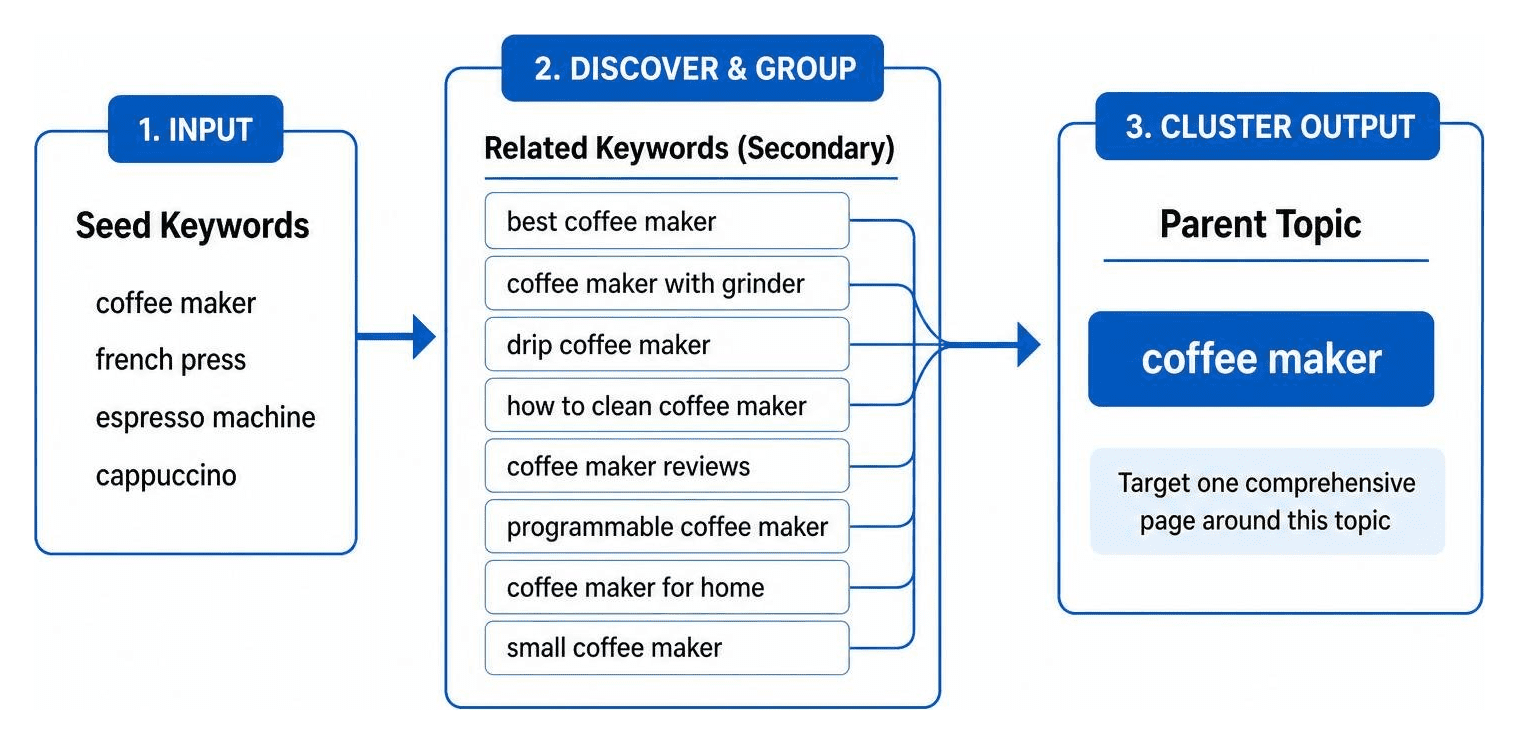
By grouping keywords with the same Parent Topic into clusters, you can target dozens of related search terms with a single, comprehensive page.
Understanding Key Ahrefs SEO Metrics and Search Intent
To prioritize your clustered keywords, you must understand how to read Ahrefs' metrics. Here are the core data points you will encounter in Ahrefs:
- Search Volume: The average number of monthly searches for a keyword in a specific country.
- Traffic Potential: The total organic traffic the top-ranking page gets from all the keywords it ranks for. This is often a much more accurate representation of real-world traffic.
- Keyword Difficulty (KD): A score from 0 to 100 estimating how hard it will be to rank in the top 10 search results.
- Cost Per Click (CPC): The average price advertisers pay for a click on paid search results, which indicates the commercial value of a keyword.
- Business Potential: A 0–3 scale we use to score keywords based on how easily we can pitch our product or service within the content (3 being highly relevant, 0 being irrelevant).
Search Volume vs. Traffic Potential
The table below illustrates why we prioritize Traffic Potential over traditional search volume:
| Keyword | Monthly Search Volume | Traffic Potential (Top Page) | Why the Difference? |
|---|---|---|---|
| submit website to search engines | 500 | 6,200 | The top page ranks for 400+ closely related long-tail variations. |
| sales page | 1,200 | 1,100 | High competition and fewer related search term variations. |
| dumbbell lunges | 5,200 | 6,800 | Users search for various weights, steps, and forms that all map to one page. |
Leveraging Keywords Explorer for Advanced Ahrefs Keyword Research
Ahrefs Keywords Explorer runs on a vast database powered by clickstream data, which allows it to show you not just search volume, but how many searches actually result in clicks. Some keywords have high search volume but very low clicks because Google answers the query directly on the search results page (zero-click searches).
Using Keywords Explorer by Ahrefs: Find Winning Keyword Ideas. At Scale., we can also review historical SERP rankings to check for search volatility. If the top 10 positions change constantly, it indicates that Google is still trying to figure out what searchers want, making it a harder target for stable rankings.
Matching Keyword Intent to Content Types
To rank on the first page, your content must match the search intent of the user. Search intent generally falls into three main buckets:
- Informational Intent: The searcher wants to learn something (e.g., "how to clean a french press"). These are best targeted with blog posts, guides, or tutorials.
- Commercial Intent: The searcher is researching options before buying (e.g., "best espresso machines"). These are best targeted with comparison articles or roundups.
- Transactional Intent: The searcher is ready to buy (e.g., "buy aeropress filters"). These require product pages or landing pages.
Matching search intent is also a key component of Google's E-E-A-T (Experience, Expertise, Authoritativeness, and Trustworthiness) guidelines. To learn how to structure your content to build real trust with both users and search engines, check out our guide on How to Optimize Your Content for E-E-A-T and Build Real Search Trust.
Frequently Asked Questions About Ahrefs Keyword Research
Is there a free tool for Ahrefs keyword research?
Yes! If you are working with a limited budget, you can start with Ahrefs' free tools. The Free Keyword Generator Tool: Find 100+ Keyword Ideas in Seconds allows you to enter up to ten seed words and get over 100 keyword ideas instantly. Ahrefs also offers a free Keyword Difficulty Checker to help you analyze search competition directly from your browser.
How is Keyword Difficulty calculated in Ahrefs?
Ahrefs calculates Keyword Difficulty (KD) based solely on the average number of unique websites (referring domains) linking to the top 10 ranking pages. A KD of 0 means the top pages have almost no backlinks, while a KD of 80+ means you will likely need hundreds of quality referring domains to compete in the top 10.
Why does search volume not equal actual organic traffic?
Search volume is an annual average of searches, not a guarantee of visits. Even if you rank #1, you will rarely capture more than 30% of the clicks. Additionally, SERP features (like featured snippets, ads, and AI overviews) often answer queries directly, resulting in zero-click searches where users leave without visiting any website.
Conclusion
Mastering Ahrefs keyword research is the single best way to ensure your content investment actually pays off. By analyzing search intent, targeting high Traffic Potential keywords, and grouping your ideas into smart clusters, you can build an organic search presence that consistently drives leads and sales.
At SmallBizSEO, we build custom content strategies around our data-driven "Velocity" framework to deliver fast rankings and transparent, automated reporting.

Ready to stop guessing and start growing your search visibility? Explore our professional SEO Services today, and let us build a high-impact strategy tailored to your small business.