Audit Your AI Presence: Tracking Inaccurate Business Details Across Search Models

How Can You Catch Incorrect Business Details in AI Answers?
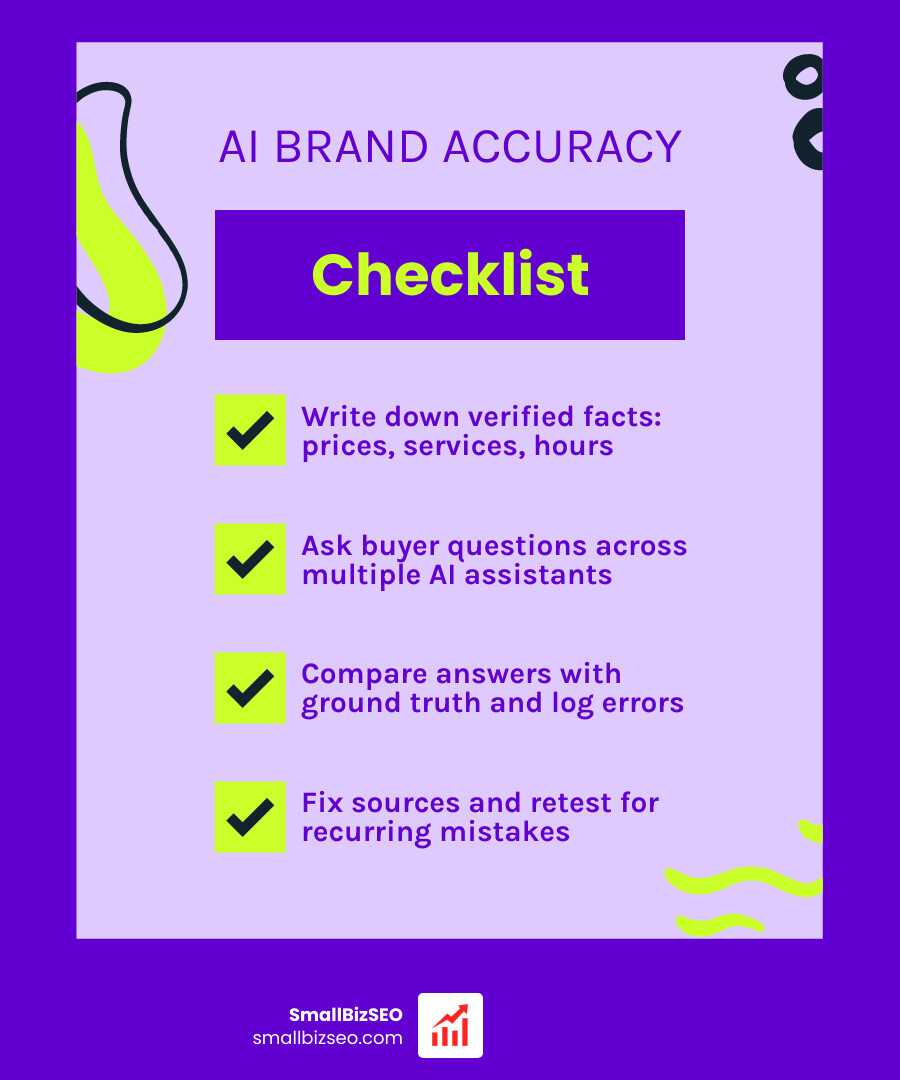
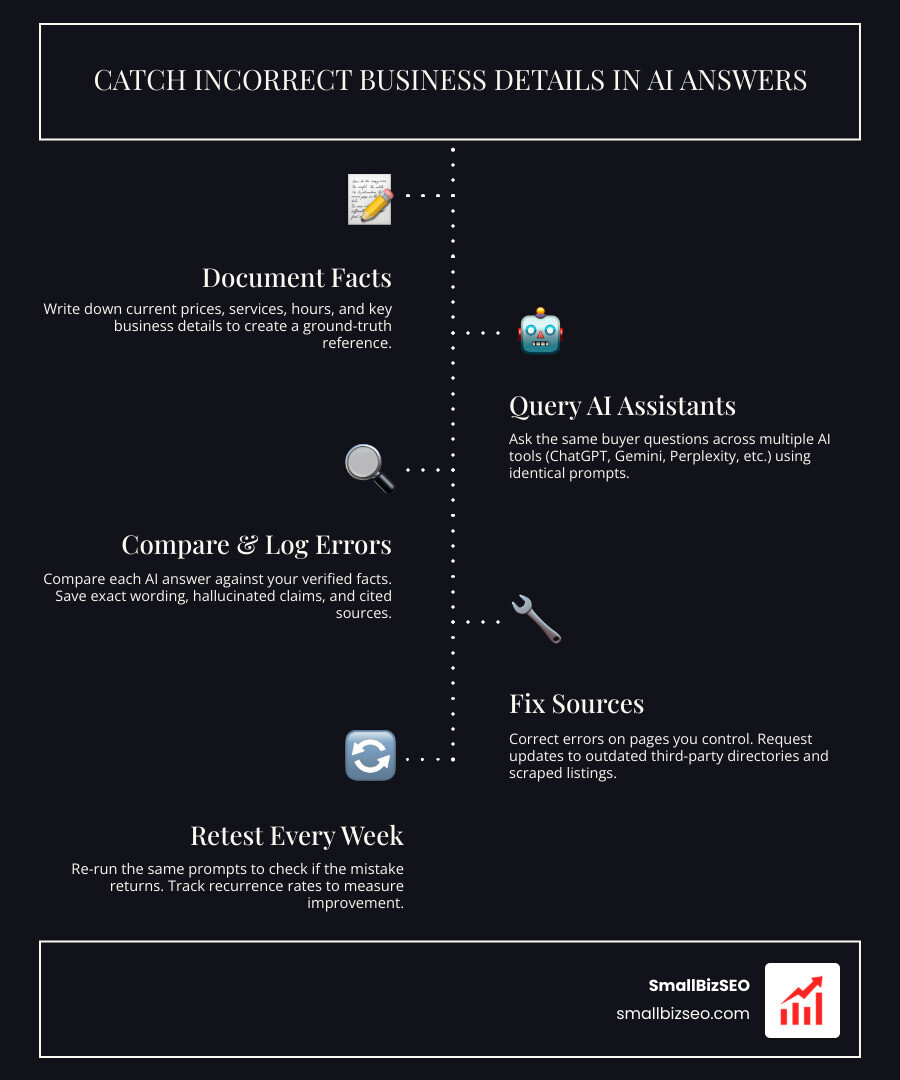
Start monitoring incorrect business details in AI brand mentions by writing down your current prices, services, hours, and other key facts. Ask the same buyer questions in several AI assistants, then compare each answer with those verified facts. Save the exact wording and any cited pages. Fix errors on pages you control, request corrections to outdated third-party pages, and retest to see whether the mistake returns.
This matters because an AI answer can name your business while getting a detail wrong. A false price or service claim may change a buyer’s decision before they visit your website.
I’m Clayton Johnson, founder of SmallBizSEO. My work in SEO, content, and Answer-Ready SEO focuses on making business information clear across search and AI answers, which guides my approach to monitoring incorrect business details in AI brand mentions.
Why Should You Monitor Incorrect Business Details in AI Brand Mentions?
Monitoring AI answers helps you find and fix errors that can weaken brand perception, reduce customer acquisition, and cause conversion drop-off.
Generative search engines compile answers dynamically. When potential buyers query AI assistants about your market, they often rely on the summarized output directly rather than clicking through multiple links. In an audit across 2,961 prompts, researchers at SparkToro found near-zero repeatability in brand recommendation lists. Similarly, a local discovery study from Yext found four major AI engines agreed on a single top local business only 4 percent of the time.
When an answer presents corrupted details about your services or pricing, prospective customers make purchasing decisions based on falsehoods. For example, research shows that AI knows what your brand does, but not who it's for, frequently misdirecting high-intent buyers toward the wrong products.
What Types of AI Brand Inaccuracies Cause the Most Revenue Damage?
The most damaging AI inaccuracies involve pricing distortions, attribute degradation, entity confusion, and fabricated capabilities.
- Pricing Distortions: Quoting expired discounts or inflated subscription rates misleads buyers before they reach your checkout page.
- Attribute Degradation: Large language models degrade complex sentences into oversimplified, incorrect summaries. An audit by AIMCLEAR revealed that six out of seven brand distortions stemmed from models misinterpreting real web pages rather than making up facts from nothing.
- Entity Confusion: AI engines often merge your services with another business sharing a similar name. You can stop identity confusion by cleaning up ambiguous online brand profiles across public registers and directories.
- Fabricated Features: Assistants sometimes invent certifications, refund policies, or integrations your business does not support.
- Citation Mismatch: In testing by the Tow Center, ChatGPT produced incorrect citations in roughly one-third of evaluated responses while acknowledging uncertainty only seven times across 200 tests.
Understanding how to find and fix wrong AI information about your brand ensures these distortions do not quietly drain your qualified pipeline.
How Does AI Brand Visibility Differ From Factual Citation Accuracy?
AI visibility measures how often your business appears in AI-generated answers, whereas factual accuracy measures whether the statements made about your business are true.
A company may boast high visibility across generative queries while suffering from severe factual corruption. The table below outlines how these two concepts diverge in practice:
| Metric Category | Primary Focus | Key Performance Signals | High Score Impact |
|---|---|---|---|
| AI Brand Visibility | Frequency of appearance | Mention volume, share of voice, prompt rank | Broad market awareness and top-of-funnel reach |
| Factual Citation Accuracy | Truthfulness of details | Citation accuracy, hallucination rate, ground-truth alignment | Higher conversion rates and protected buyer trust |
Visibility without accuracy leads to lost revenue. If an engine mentions your company in ten out of ten prompts but quotes incorrect pricing tiers in eight of them, that high visibility actively works against your bottom line.
How Should You Monitor Incorrect Business Details in AI Brand Mentions Across LLMs?
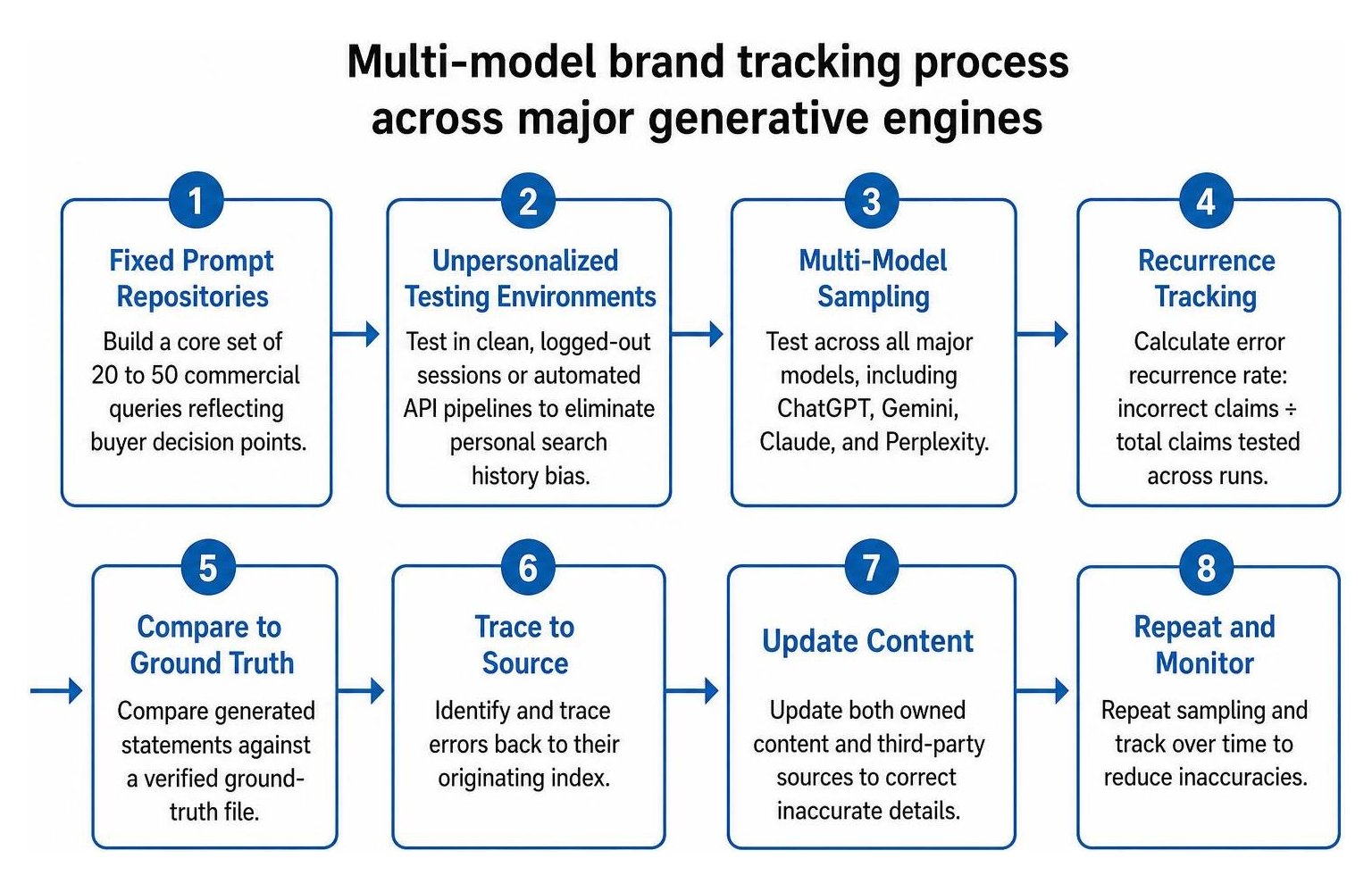
To monitor AI brand mentions accurately, establish a standardized prompt set, sample answers in clean sessions, and track recurrence rates over time.
Relying on a single prompt or screenshot produces unreliable data because generative models are non-deterministic. A dependable tracking workflow requires:
- Fixed Prompt Repositories: Build a core set of 20 to 50 commercial queries that reflect actual buyer decision points.
- Unpersonalized Testing Environments: Always test inside clean, logged-out browser sessions or automated API pipelines to eliminate personal search history bias.
- Multi-Model Sampling: Test across all major models, including ChatGPT, Gemini, Claude, and Perplexity. Market data from Similarweb shows market shares shifting across generative platforms, making single-engine monitoring obsolete.
- Recurrence Tracking: Calculate your error recurrence rate by dividing the number of incorrect claims by the total number of claims tested across repeated runs.
How Can You Detect, Audit, and Correct Inaccurate AI Brand Information?
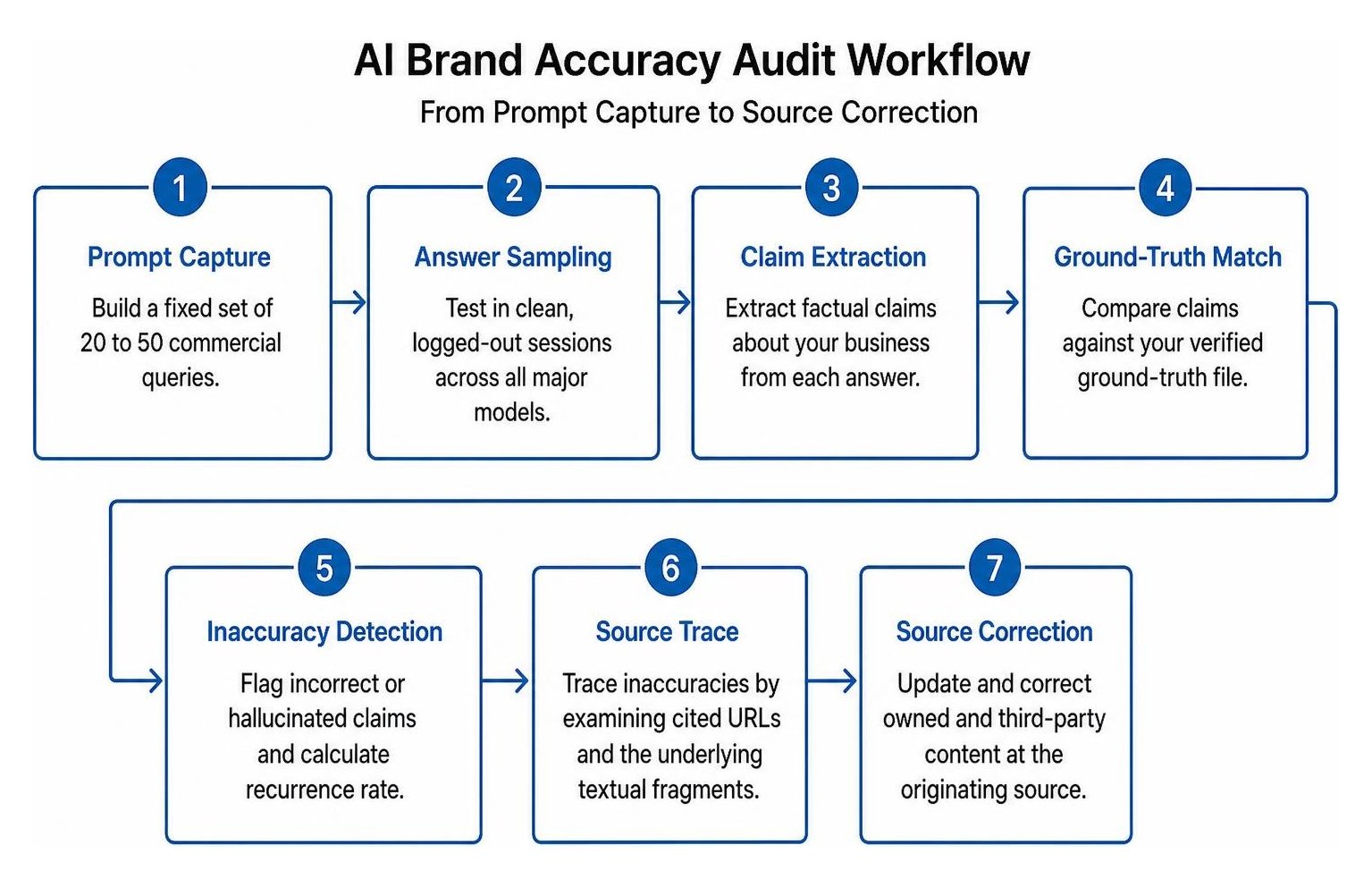
To detect and correct inaccurate AI brand information, compare generated statements against a verified ground-truth file, trace errors back to their originating index, and update both owned and third-party content.
How Can You Trace AI Hallucinations to Source Pages and Data Corruptions?
Trace inaccuracies by examining cited URLs and identifying the underlying textual fragments the model retrieved to build its response.
When an AI engine generates a grounded answer, it relies on retrieval-augmented generation (RAG) to scan web pages, news articles, and directories. Inaccuracies typically originate from three locations:
- Stale Third-Party Publications: Old press releases, outdated software reviews, or obsolete blog posts containing retired offers.
- Corrupted Directory Profiles: Inconsistent business listings across the web. Reviewing NAP consistency explained helps ensure your name, address, and operational details match across every index.
- Ambiguous Owned Content: Poorly structured product pages that allow models to confuse separate tiers or service offerings.
What Steps Can You Take to Monitor Incorrect Business Details in AI Brand Mentions and Fix Them?
Follow a structured claim extraction and correction process to isolate and resolve errors effectively:
- Build a Ground-Truth File: Document your verified product descriptions, exact pricing structures, supported capabilities, and operational policies in a single internal document.
- Perform Atomic Claim Extraction: Break down complex AI answers into individual, testable claims (for example: "[Company] offers 24/7 phone support" or "[Company] costs $49/month").
- Score Severity by Commercial Impact: Prioritize errors that directly stop sales, such as wrong prices, over minor cosmetic phrasing.
- Deploy Source Corrections: Update the source page on your own website, or submit factual correction requests to third-party webmasters hosting outdated claims.
- Submit Model Feedback: Use the built-in feedback and reporting channels inside AI interfaces, providing the exact query, the inaccurate response, the corrected fact, and a direct link to your authoritative source.
How Can You Fix Distorted Business Information and Protect Your Brand Entity?
Strengthen your online footprint with clear schema markup, unified entity references, and targeted content updates to establish an authoritative source of truth for AI models.
Generative models rely on clear knowledge graphs to understand a business. Establishing an unambiguous brand entity ensures algorithms do not cross-contaminate your commercial details with third-party data.
At SmallBizSEO, we implement our data-driven Velocity framework to improve visibility and protect informational integrity across modern search engines. Our structured AI SEO services help small businesses deploy clean schema.org markup, optimize knowledge entity connections, and eliminate contradictory online data so AI search engines accurately present your brand to potential customers.
How to Keep Your AI Brand Presence Accurate Moving Forward
Maintaining an accurate AI footprint requires an ongoing audit system rather than a one-time check. By standardizing your buyer prompts, logging responses across major engines, and promptly updating outdated source pages, you ensure search models represent your services truthfully. Implement these monitoring steps today to secure your digital presence and turn AI search visibility into dependable business growth.