Stop Identity Confusion by Cleaning Up Ambiguous Online Brand Profiles

How Do You Fix Ambiguous Online Brand Profiles?
Start resolving brand-name ambiguity across online profiles by listing every name your business uses, including acronyms and former names. Check your website, social accounts, and business listings for outdated or conflicting details. Then choose one primary name, correct the profiles you control, and link those official profiles from your website.
This gives search engines and AI systems clearer evidence that those profiles belong to the same business. If another company has a similar name, make the difference clear with your industry, location, website, and a plain-language description of what you do.
I’m Clayton Johnson, founder of SmallBizSEO. My work connecting SEO, content, and digital PR shapes my approach to resolving brand-name ambiguity across online profiles: make the facts clear on your site, then keep them consistent wherever customers find you.
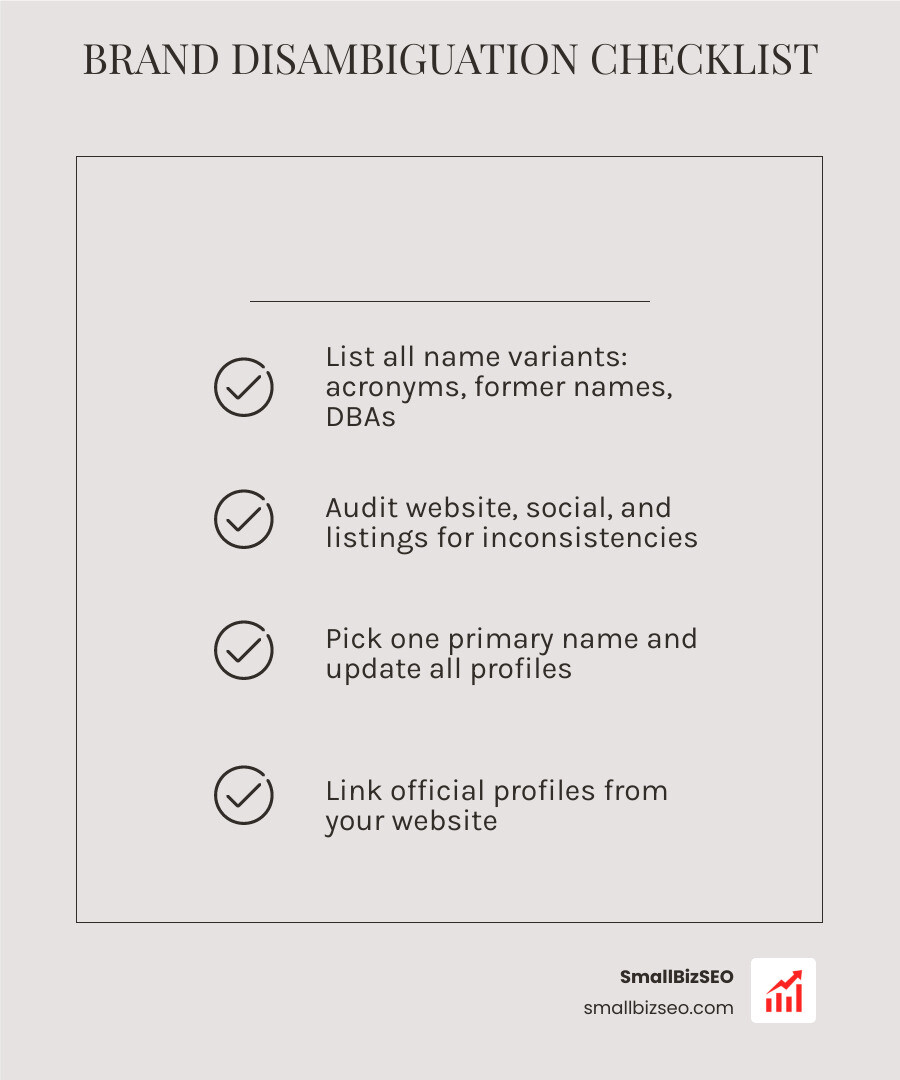
Step-by-Step Framework for Resolving Brand-Name Ambiguity Across Online Profiles
To eliminate confusion across the web, your business must establish a single source of truth that machines can verify. Search engines and AI models rely on semantic search algorithms to connect isolated mentions of your business into a unified entity node. When your brand's digital footprint contains conflicting names, missing links, or fragmented profiles, automated crawlers struggle to match your company to user queries.
Approximately 15% of daily web searches are completely new queries, and roughly 16% of search queries in real-world logs contain ambiguous phrasing. Fortunately, research demonstrates that at least 87% of ambiguous queries can be resolved using supervised machine learning when provided with clean contextual signals. Implementing explicit structured data, such as Organization Schema Markup, gives search engines the direct evidence needed to normalize your records and consolidate your digital authority.
Why is Resolving Brand-Name Ambiguity Across Online Profiles Essential for AI Search?
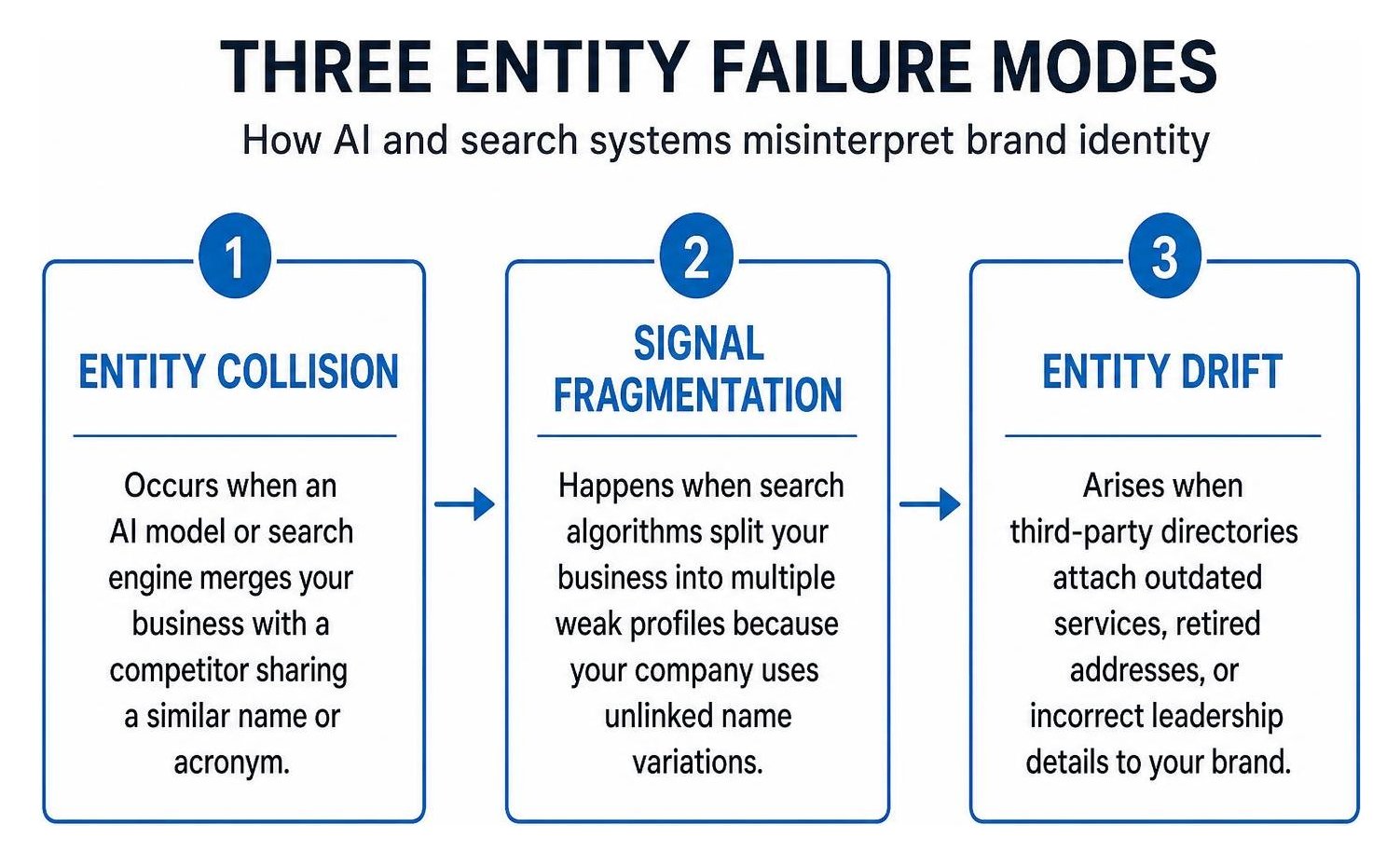
Ambiguous brand signals cause artificial intelligence systems to make three distinct errors: entity collision, signal fragmentation, and entity drift.
- Entity Collision: Occurs when an AI model or search engine merges your business with a competitor sharing a similar name or acronym.
- Signal Fragmentation: Happens when search algorithms split your business into multiple weak profiles because your company uses unlinked name variations.
- Entity Drift: Arises when third-party directories attach outdated services, retired addresses, or incorrect leadership details to your brand.
These errors directly harm your search visibility. In modern search environments, roughly 77% of URLs cited in generative AI answers sit outside the traditional organic top 10 search results. AI engines prioritize high-confidence entity understanding over simple keyword density. When you master identity resolution, you ensure that your authoritative facts feed into algorithms accurately.
When an AI engine understands your distinct identity, it accurately populates your brand SERP and integrates your business into the global Knowledge Graph. One enterprise organization successfully resolved 297 million fragmented records into 4.1 million verified profiles across 37 separate data sources, eliminating 50 hours of weekly manual fixes. Clear entity boundaries ensure AI engines cite your actual products rather than attributing your achievements to a rival.
How Do You Audit Fragmented Name Variants and Disambiguate Similar Competitors?
To audit your brand's presence, create a comprehensive brand inventory that captures every legitimate name variation your company has ever used.
Start by documenting your legal registered name, primary customer-facing trade names, "doing business as" (DBA) filings, common acronyms, and retired legacy brand names. Next, identify external collisions. Search for exact matches and near-match variations of your name across social media networks, domain registries, and business registries.
- Check domain overlap to ensure no confusing squatters dilute your brand, consulting specialized domain dispute attorneys if trademark infringement occurs.
- Programmatically audit social handles across dozens of networks using tools like a cross-platform identity API to identify abandoned accounts or unofficial brand profiles.
- Verify your Google Business Profile to ensure your core details match your public profile data.
- Enforce rigorous NAP consistency across all primary citation platforms, confirming your business name, address, and phone number match byte-for-byte.
What Schema Markup and Knowledge Graph Assets Anchor Your Brand Entity?
Structured data acts as a machine-readable passport for your business. By embedding JSON-LD markup on your website, you provide explicit semantic triples (subject-predicate-object statements) that search crawlers parse without guesswork.
Your structured data must establish a permanent entity identifier using the canonical @id property. Pair this with the sameAs array, which points search engines directly to authoritative third-party pages confirming your identity.
| Entity Anchor Signal | Primary Function | Key Technical Attributes |
|---|---|---|
| JSON-LD Schema | Provides machine-readable facts directly on your site | @id, name, alternateName, sameAs |
| Wikidata Entry | Serves as an open knowledge repository for search crawlers | Unique QID, Official Website (P856), Parent Org |
| Authoritative Directories | Confirms real-world existence and operations | Verified profiles, Industry licenses, Registries |
When configuring schema markup, use alternateName to declare known abbreviations, acronyms, and former names. This signals to search engines that mentions of those variants refer back to your main business.
Securing a structured entry on open knowledge repositories like Wikidata gives search engines an independent entity reference point, which accelerates the generation of a dedicated Knowledge Panel. Every high-trust local citation you earn reinforces this structured foundation.
What is the Step-by-Step Technical Workflow for Resolving Brand-Name Ambiguity Across Online Profiles?
To eliminate identity confusion permanently, implement this systematic five-step technical workflow:
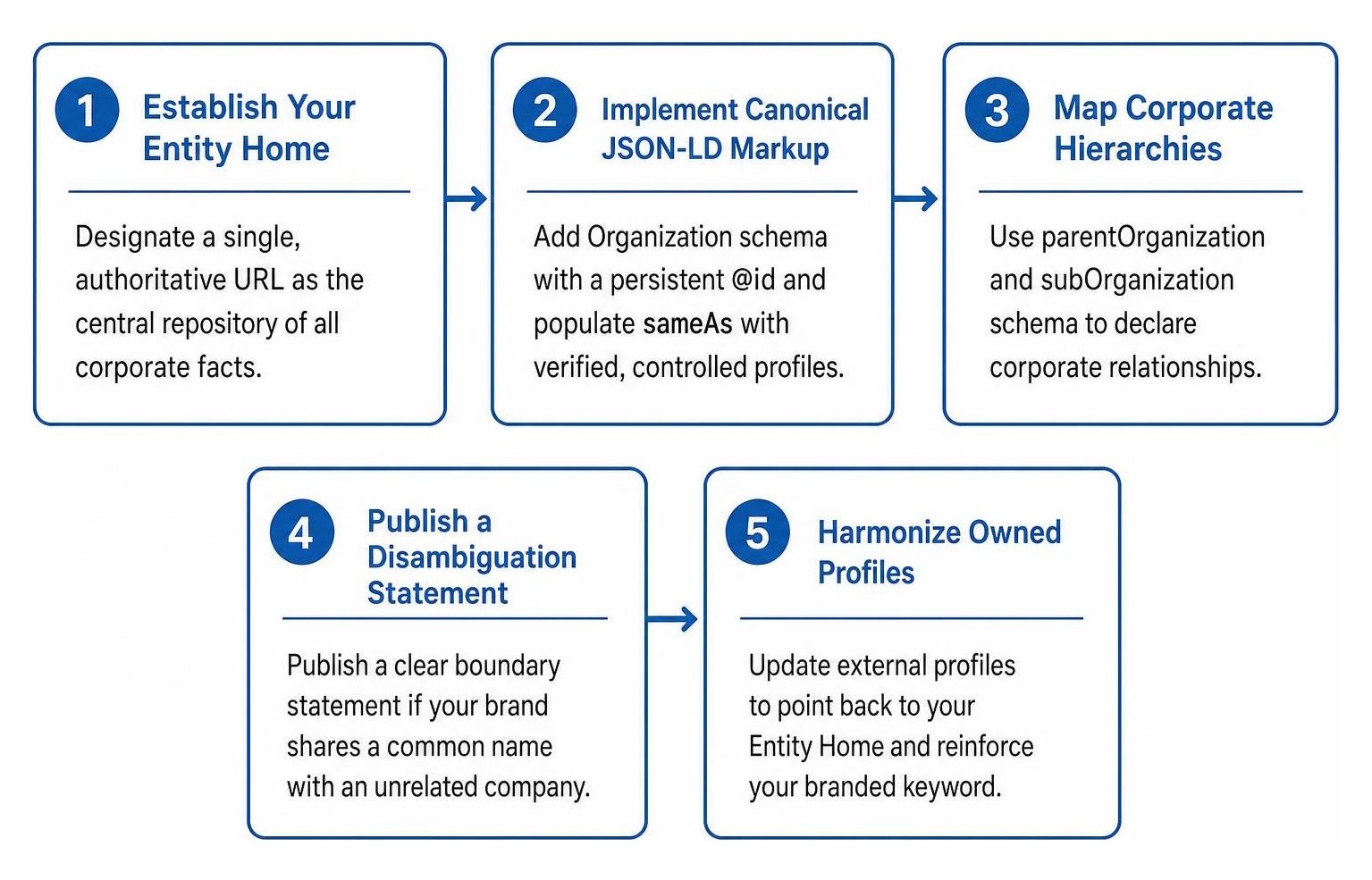
- Establish Your Entity Home: Designate a single, authoritative URL on your website (typically your primary About page or homepage) as the central repository of all corporate facts. Ensure this page contains a concise, factual description of your company, its leadership, and its precise industry focus.
- Implement Canonical JSON-LD Markup: Add comprehensive Organization schema to your Entity Home. Assign a persistent
@idURL fragment (such as your domain followed by an organization hash) and populate thesameAsarray exclusively with verified, controlled profiles like LinkedIn, official social pages, and business registry entries. - Map Corporate Hierarchies: If your business manages multiple product lines, regional offices, or holding companies, use
parentOrganizationandsubOrganizationschema markup. Explicitly declare these relationships on your corporate pages so algorithms do not treat your subsidiary brands as unrelated competitors. - Publish a Disambiguation Statement: If your brand shares a common name with an unrelated company in another sector, publish a clear boundary statement on your Entity Home (for example, stating your company provides B2B software and is unaffiliated with consumer apparel brands sharing the same word).
- Harmonize Owned Profiles: Systematically update external profile descriptions, logos, and header links across your entire digital footprint to point directly back to your Entity Home. This alignment reinforces your primary branded keyword across every index.
Measuring Success, Monitoring Drift, and Long-Term Entity Governance
Resolving identity ambiguity requires ongoing governance. Digital profiles naturally drift as organizations launch new products, update branding, or expand team rosters. Establishing automated monitoring ensures search engines maintain an accurate understanding of your brand entity over time.
How Long Do AI Models and Search Engines Take to Update Brand Entities?
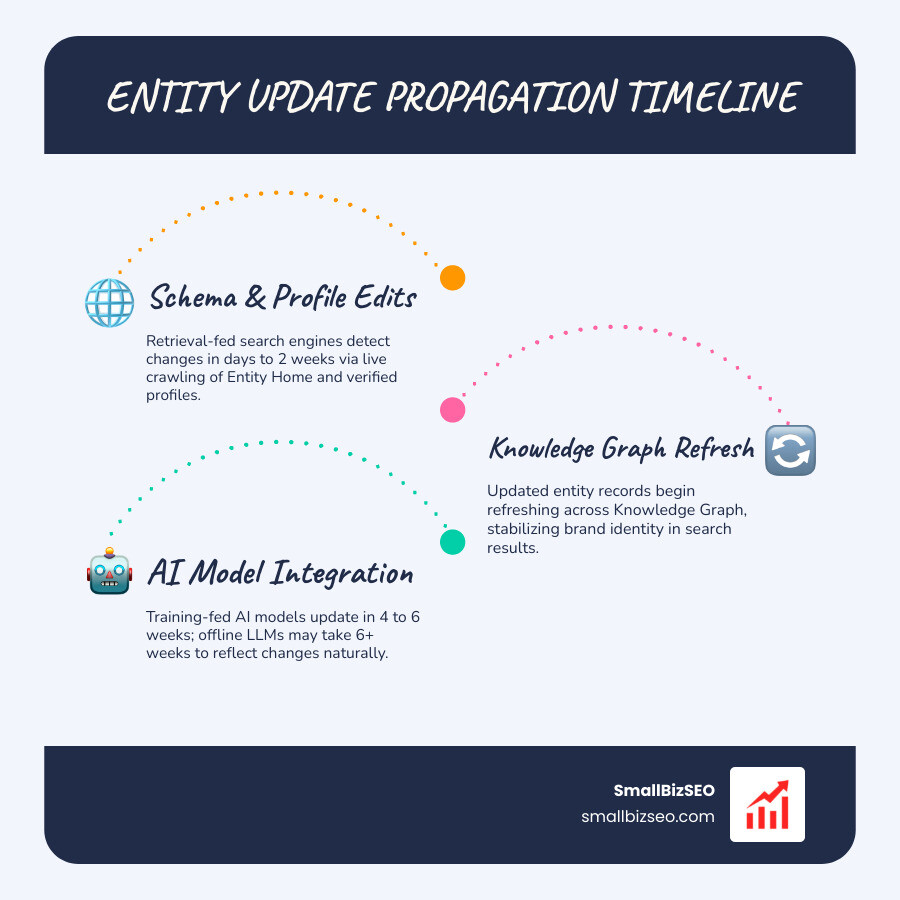
Search systems update entity data along two distinct timelines:
- Retrieval-Fed Search Engines: Platforms that rely on live web crawling typically detect schema updates, canonical links, and profile edits within days to two weeks. As search bots re-crawl your Entity Home and verified profiles, your updated entity records begin refreshing across the Knowledge Graph.
- Training-Fed AI Models: Offline large language models rely on periodic pre-training datasets. Changes implemented on your web properties may take six weeks to several months to surface naturally inside standalone AI model responses that do not use live web retrieval.
Building consistent signals accelerates this process. A focused brand entity optimization campaign typically stabilizes within 4 to 6 weeks, driving measurable gains in your overall branded search demand and strengthening your foundational local SEO presence.
Which Metrics and Automated Tools Prove Your Brand Confusion is Resolved?
Track your reconciliation progress using both automated tools and search engine validation metrics.
You can test how search algorithms interpret your brand text by running your Entity Home copy through natural language tools such as the Google Cloud NLP API. This reveals whether algorithms recognize your business as a distinct organization entity with a high salience score rather than miscategorizing it as a generic term.
Keep your brand health steady by tracking these primary metrics:
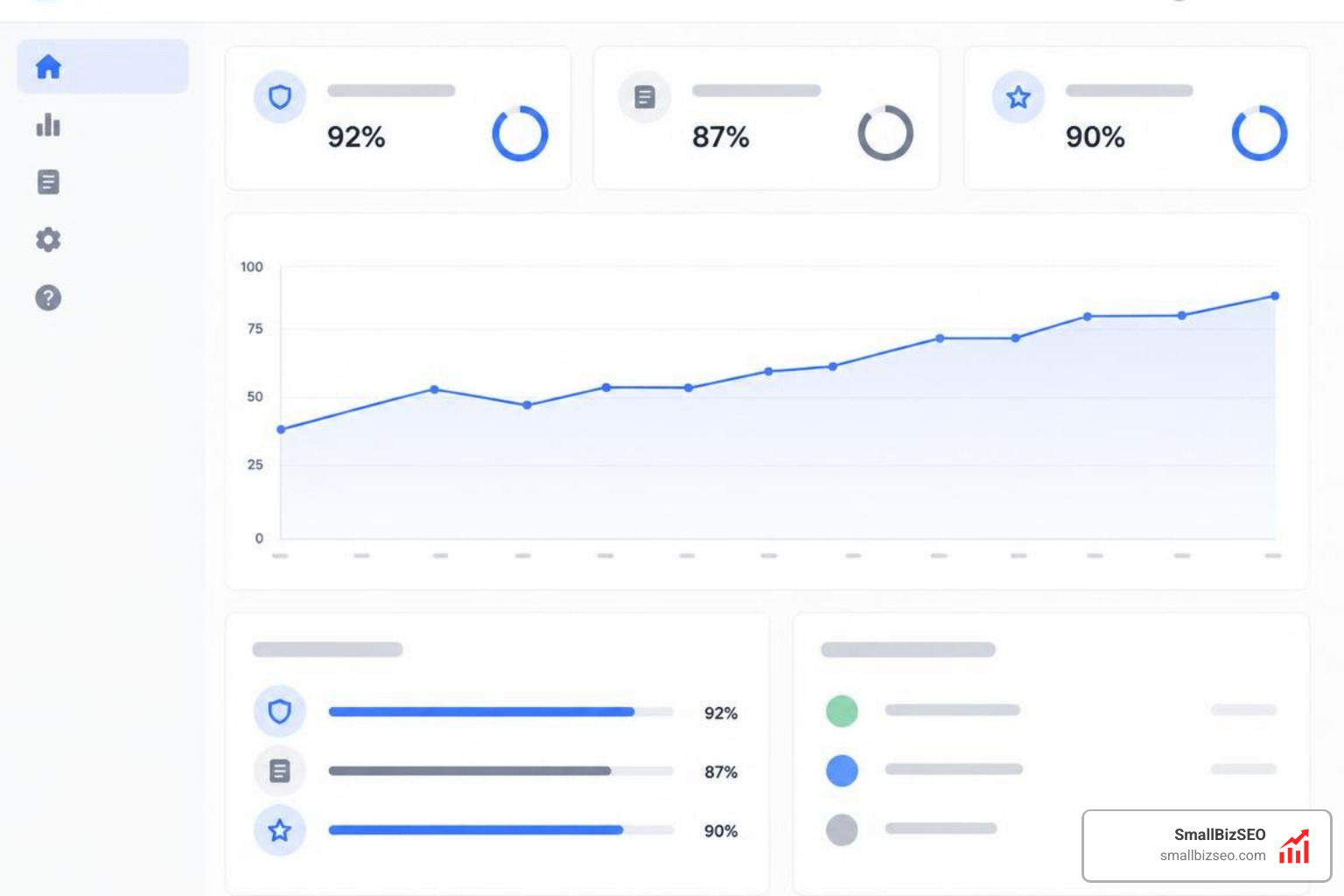
- Disambiguation Confidence Scorecard: Track the percentage of your profiles that share identical name strings, active
sameAslinks, and matching business categories. - Knowledge Panel Stability: Monitor whether your business Knowledge Panel appears consistently for branded searches without displaying competitor products or unrelated imagery.
- AI Model Retrieval Accuracy: Regularly prompt conversational search engines with your brand name to confirm they return your correct industry, website, and product offerings without hallucinated details.
Keep Your Brand Identity Crystal Clear
When search engines and artificial intelligence tools understand exactly who you are, what you offer, and where you operate, your entire digital footprint performs better. Eliminating brand-name ambiguity protects your hard-earned reputation, prevents lost search traffic, and ensures prospective clients find your authentic business every time.
At SmallBizSEO, we help businesses eliminate digital confusion through our data-driven "Velocity" framework. Our team audits your digital footprint, deploys advanced structured data, and aligns your digital properties to deliver measurable growth and bulletproof E-E-A-T signals. Discover how our dedicated brand entity optimization services can solidify your authority across search engines and AI platforms today.