Audit Your Research: A Practical Guide to Verifying Claim Alignment

How Do You Check Whether a Source Supports the Exact Claim?
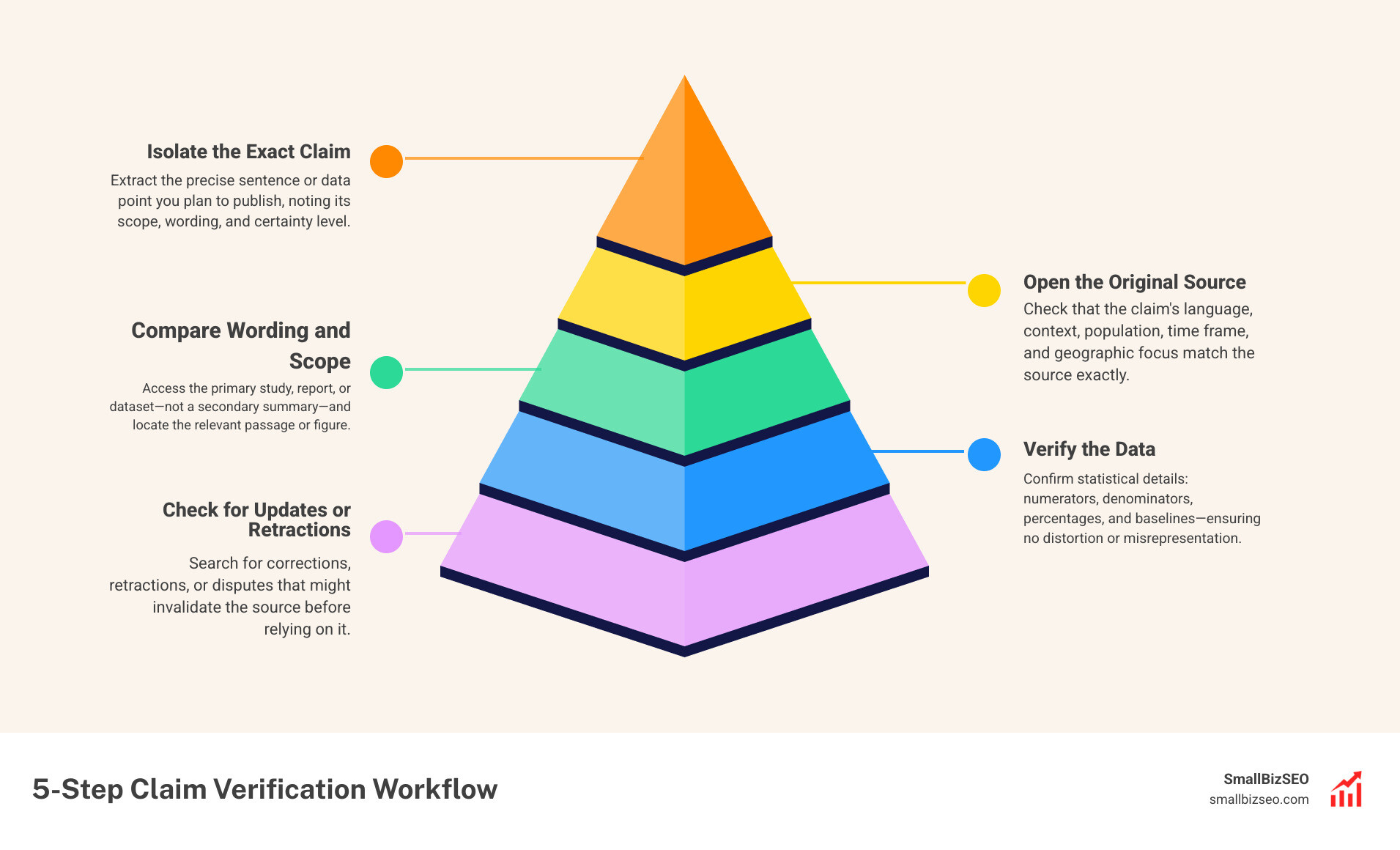
To learn how to check whether a source supports the exact claim, start with the sentence you plan to publish. Open the original source and find the passage or data behind it. Then ask: Does it say the same thing, with the same level of certainty, about the same people, place, and time? If the source only supports a narrower point, revise the claim.
I’m Clayton Johnson, founder of SmallBizSEO. My work in SEO and content strategy has taught me the value of clear, well-supported answers, including how to check whether a source supports the exact claim before publishing.
How Can You Check Whether a Source Supports the Exact Claim?
To verify that a source supports a statement, match each claim directly to the source’s original evidence and confirm that the wording, context, and citation accurately represent it. When you evaluate sources properly, you ensure that every published sentence reflects the actual findings of the cited study or report rather than a generalized summary.

Proper verification requires careful attention to source attribution, verbatim evidence, and lateral reading. Instead of assuming a high-ranking webpage or linked PDF is accurate, examine the exact sentences backing up your assertions.
| Claim Type | Core Definition | Required Evidence Standard | Common Verification Risk |
|---|---|---|---|
| Empirical | Verifiable observation or measurement | Direct data, measurements, or raw records | Misinterpreting sample parameters |
| Causal | Asserts variable X produces outcome Y | Controlled trials or longitudinal designs | Conflating correlation with causation |
| Predictive | Forecasts future events or outcomes | Probabilistic models or historical baselines | Treating speculative forecasts as facts |
| Value | Evaluates worth, ethics, or policy | Explicit criteria and normative analysis | Presenting opinions as empirical truth |
What Type of Claim Are You Evaluating and What Evidence Does It Require?
Every factual statement falls into a specific category, and each category demands a distinct level of evidence. When we audit research, we first determine whether a statement makes an empirical, causal, predictive, or value-based assertion.
- Empirical Claims: These statements report measurable realities, such as historical events, financial records, or survey outcomes. They require direct records or observational datasets.
- Causal Claims: Stating that one factor causes another requires controlled experiments or rigorous statistical controls. In scientific literature, about 50% of published psychology findings fail to replicate, and approximately 85% of Phase II clinical trials fail. Because of these high baseline failure rates, treating an isolated correlation as definitive causation introduces major inaccuracies.
- Predictive Claims: Forecasts about industry trends, economic shifts, or technological adoption are inherently uncertain. Research on expert forecasting shows that social science and economic predictions are accurate only about 60% to 70% of the time for short-term horizons, and perform no better than chance over long timeframes.
- Value Judgments: Statements that categorize something as beneficial, harmful, or superior rely on qualitative criteria and cannot be defended by raw data alone.
How Can You Check Whether a Source Supports the Exact Claim in Context?

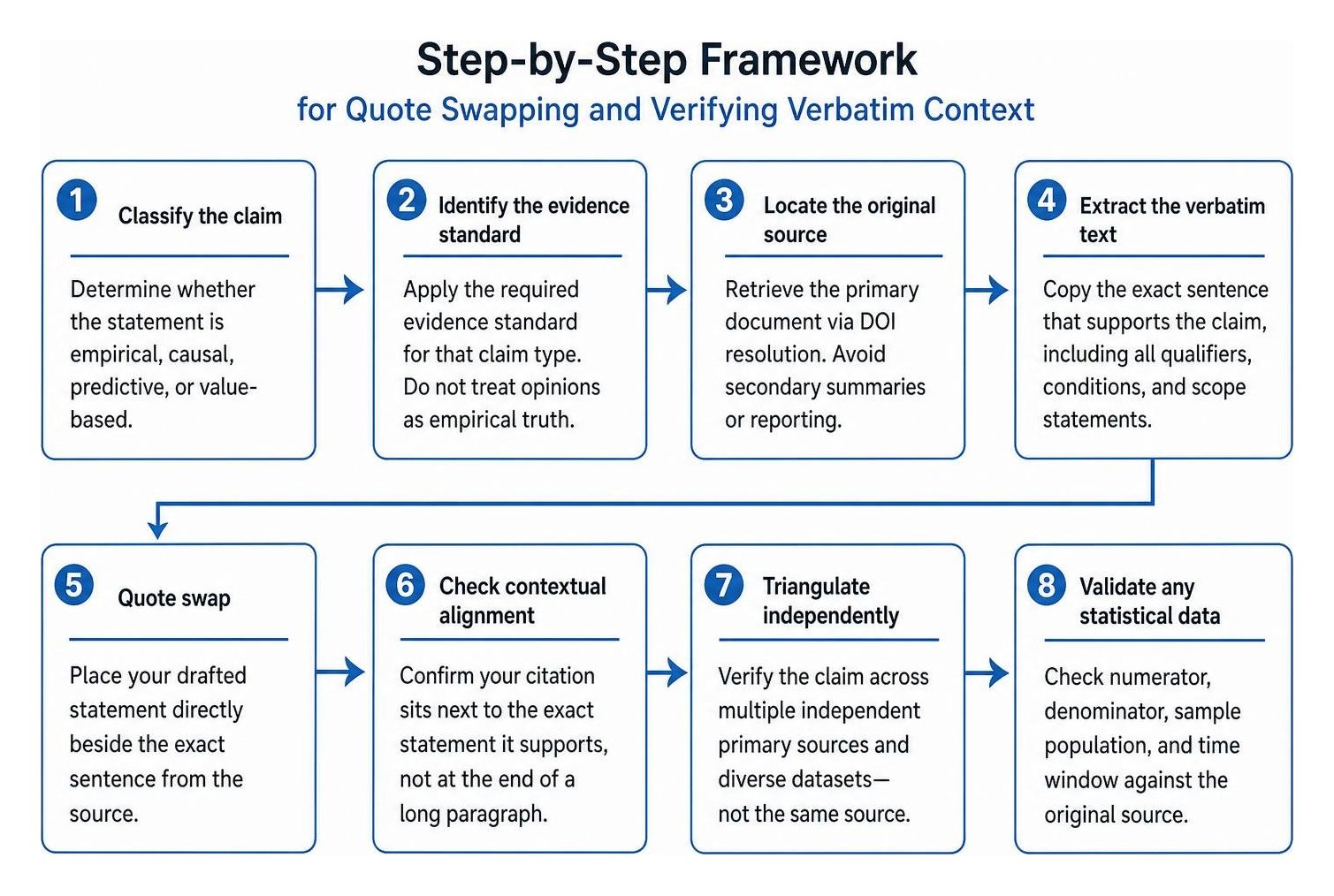
To verify contextual alignment, extract the verbatim text from the original document using Digital Object Identifier (DOI) resolution rather than relying on secondary reporting. Secondary summaries often remove crucial qualifiers or introduce unverified interpretations.
Use the "quote swap" method: take the exact sentence from your draft and place it directly alongside the corresponding sentence in the cited paper. Confirm that your citation sits next to the exact statement it supports rather than at the end of a long paragraph where its scope becomes ambiguous.
When reviewing external literature, look for independent triangulation across multiple primary sources. A comprehensive argument audit shows that true corroboration requires diverse, independent datasets rather than multiple blogs citing the same original press release.
How Can You Check Whether a Source Supports a Claim About Statistical Data?
Statistical claims require validating the numerator, the denominator, the sample population, and the time window. A common research error occurs when writers extract a raw figure while misidentifying the baseline population.
Consider a notable case from medical research: among 827 completed pregnancies analyzed in an early registry extract, 104 spontaneous abortions were recorded. Commentators initially calculated this as a 12.6% risk by dividing 104 by 827. However, official corrections clarified that this calculation was invalid because the denominator excluded ongoing pregnancies that had not yet reached the observation window. A later, comprehensive registry study of 12,097 participants vaccinated before 20 weeks determined the cumulative risk of spontaneous abortion to be 10.79% (with a 95% confidence interval of 10.01% to 11.56%), falling squarely within historical baseline ranges.
Similarly, dataset structures can lead to corpus boundary fallacies. For example, in the Fake.Br research dataset, exactly 3,600 files are categorized as fake and 3,600 as true, creating a 50% split. Citing this figure to claim that half of all news in Brazil is fake represents a severe error, as the percentage reflects the construction of the test corpus, not the external world.
How Can You Audit Claims and Avoid Common Research Pitfalls?
To protect your content integrity, check a source’s credibility, methodological limits, and publication history before relying on it to support a core assertion. Evaluating the motives of the author, publisher, and funding entity helps prevent corporate bias from distorting factual reporting.

Following a systematic process to catch fake references ensures that unverified summaries or machine-generated mistakes do not compromise your editorial authority.
How Do Scope, Sample, and Wording Strength Affect Defensibility?
Your claim's wording must never exceed the strength of the source's actual evidence. If a scientific study "suggests a positive correlation within adult males," your article cannot state that the intervention "proves effective for all people."
- Match Hedging Language: When researchers write that a compound "may indicate" an outcome, maintain those same qualifiers rather than asserting certainty.
- Respect Sample Boundaries: A trial conducted on 40 university athletes cannot support broad claims about the general population.
- Account for Media Amplification: Roughly 90% of breakthrough claims reported in general press releases are overblown or fail to hold up under peer review. Always bypass the press release and inspect the primary study.
- Maintain Factual Skepticism: Fact-checking organizations report that claims made by public officials and political campaigns are false or misleading roughly 30% to 50% of the time. Independent cross-verification is essential.
Has the Cited Source Been Retracted, Corrected, or Disputed?
Academic and industry literature evolves constantly. A study that appeared solid at publication may later be corrected, disputed by follow-up trials, or formally retracted.
Checking post-publication tracking databases prevents you from citing invalid research. When utilizing artificial intelligence tools for research drafting, exercise extreme caution regarding AI citation generation.
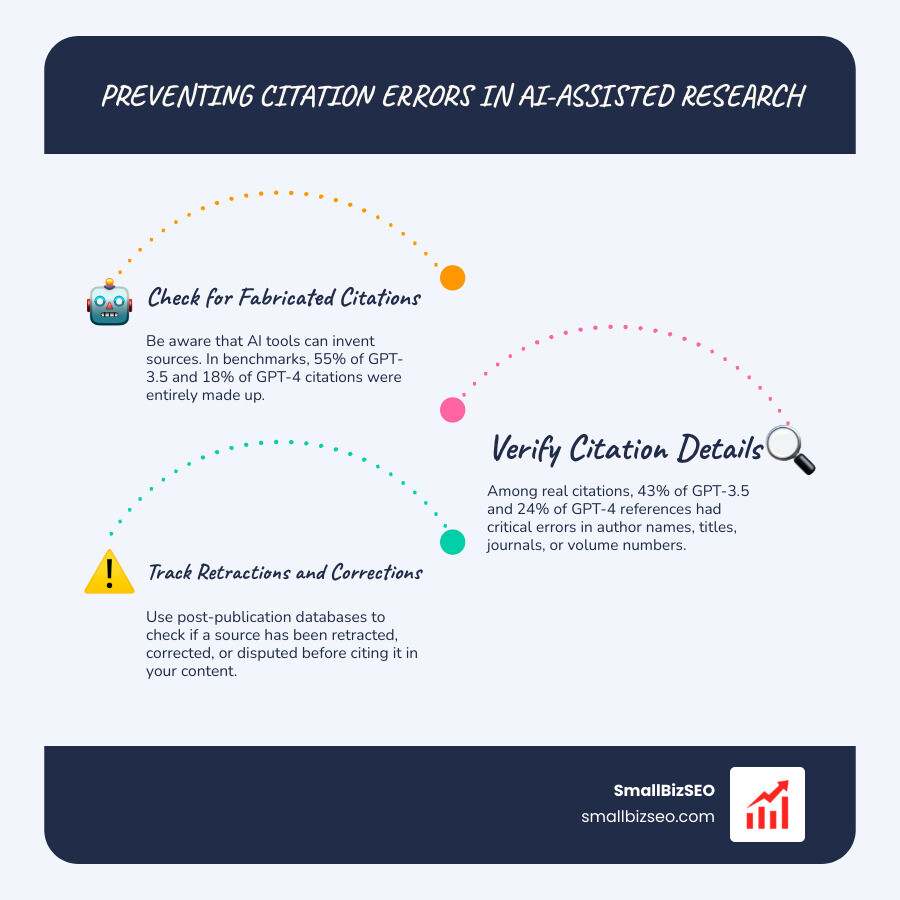
Benchmark studies reveal that 55% of citations generated by GPT-3.5 and 18% of citations from GPT-4 are entirely fabricated. Furthermore, among real citations that were not fabricated, 43% of GPT-3.5 references and 24% of GPT-4 references contained critical errors in author names, titles, journal names, or volume numbers.
Build Long-Term Authority with Bulletproof Citation Audits
Verifying factual claims protects your brand reputation, supports search visibility, and builds lasting user trust. At SmallBizSEO, our Velocity framework prioritizes rigorous content standards, technical excellence, and transparent verification. By applying systematic source checks, verifying exact numbers, and validating claim boundaries, you ensure that every piece of published content stands on rock-solid evidence. To improve your search presence with fully verified, search-optimized content, explore our citation accuracy standards or connect with our team today.