Catch Fake References Before Publishing: An Actionable AI Citation Checklist

How do you check citations in an AI-assisted draft?
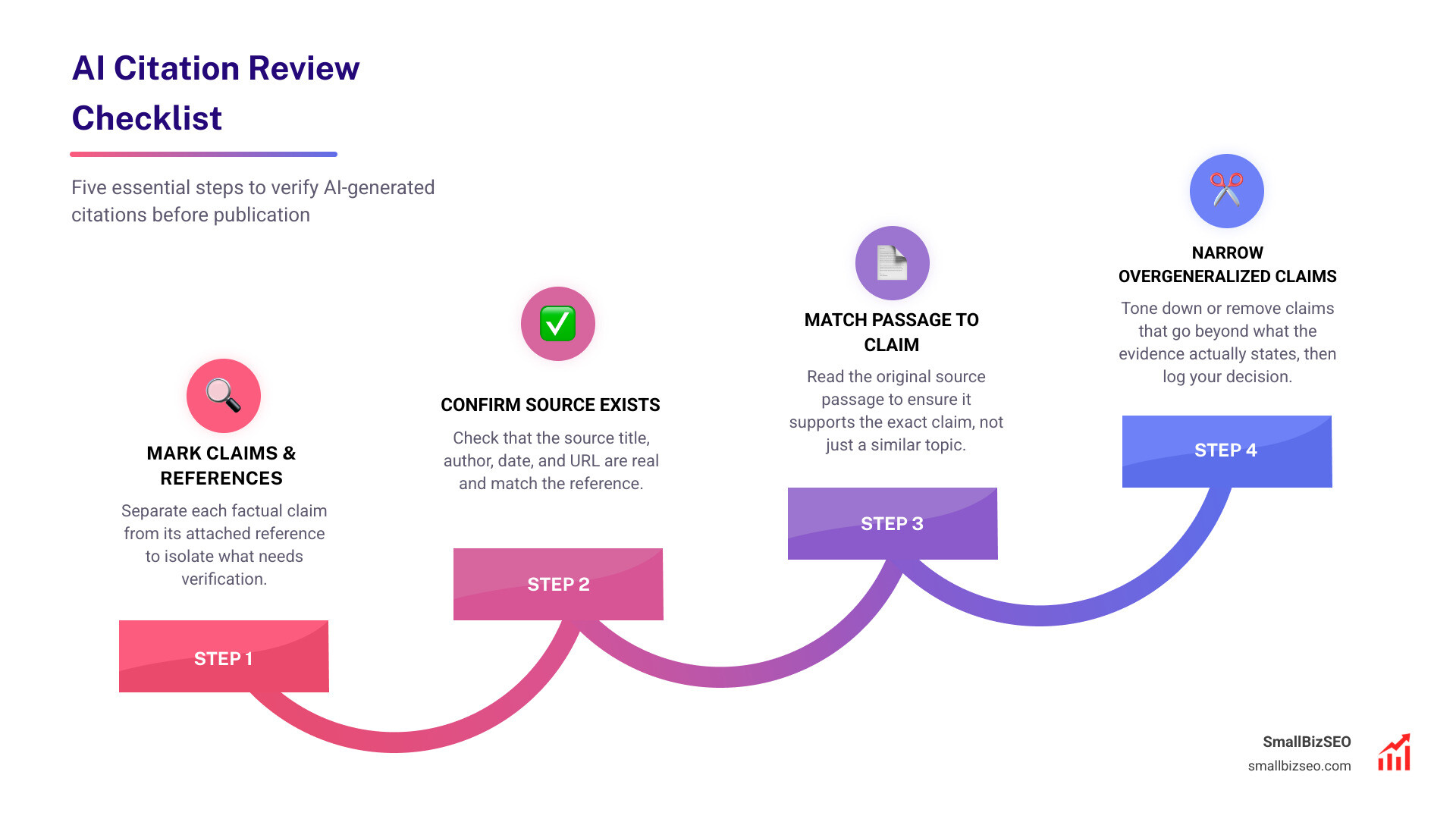
Use a citation review checklist for AI-assisted article drafts before you publish:
- Mark each factual claim and the reference attached to it.
- Confirm the source exists and its title, author, date, and link match.
- Read the source passage to check that it supports the exact claim.
- Narrow or remove claims that go beyond the evidence.
- Log what you verified and what still needs fixing.
A real source can still be the wrong source for a sentence. That is why checking the reference list alone is not enough.
I'm Clayton Johnson, founder of SmallBizSEO. My work in SEO and evidence-backed content informs this citation review checklist for AI-assisted article drafts.
The Essential Citation Review Checklist for AI Assisted Article Drafts
Generative AI tools predict plausible words based on statistical patterns rather than retrieving verified database records. Because large language models assemble text based on likelihood, they frequently produce phantom citations, real studies attached to the wrong claims, or invented digital object identifiers (DOIs) that appear genuine at first glance.

To protect your search visibility and brand authority, every AI-assisted draft requires structured verification. A proper audit begins by grounding AI drafts with original data and isolating primary evidence before prose generation even starts.
What Are the Core Steps in a Citation Review Checklist for AI Assisted Article Drafts?
An effective audit follows a disciplined five-step sequence:
- Separate generated claims from generated references: Highlight every factual assertion, statistic, causal claim, and date independently from the citation tag attached to it.
- Verify the source record metadata: Confirm that the publication title, first author, publication year, journal or publisher name, and DOI/URL point to a real document.
- Inspect the exact evidence passage: Open the primary document and locate the specific paragraph containing the asserted data.
- Calibrate and narrow overgeneralized phrasing: Adjust absolute language so that the sentence does not claim broader findings than the source data supports.
- Record actions in a citation decision log: Assign a clear status to every citation to maintain accountability across your editorial pipeline.
Establishing strong editorial safeguards for AI editing ensures that automated drafting never bypasses human judgment. Reviewing against established AI source verification standards prevents hallucinations from entering published material.
Why Is Source Existence Only the First Layer of Citation Auditing?
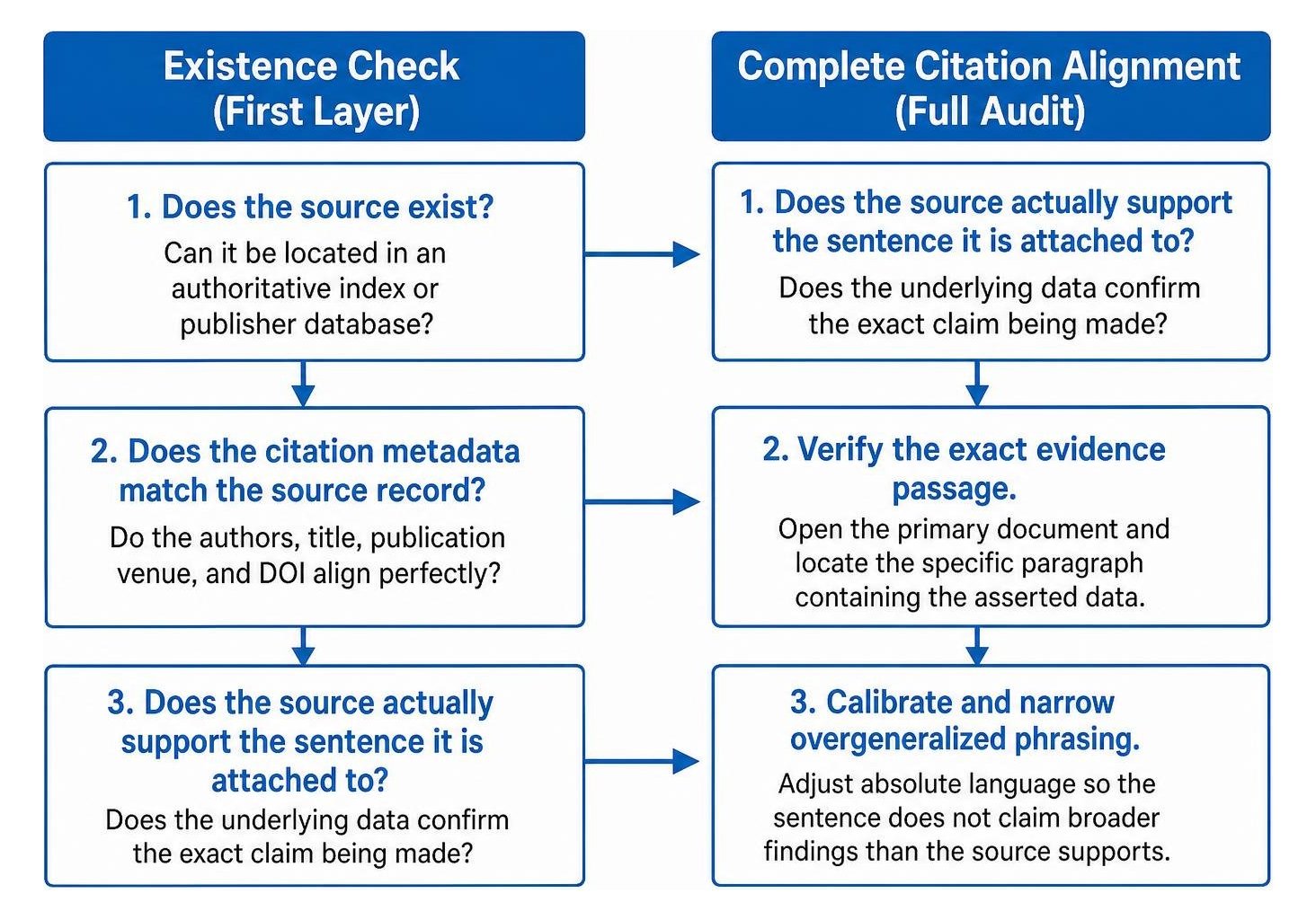
A complete citation review must answer three critical questions for every single reference:
- Does the source exist? (Can it be located in an authoritative index or publisher database?)
- Does the citation metadata match the source record? (Do the authors, title, publication venue, and DOI align perfectly?)
- Does the source actually support the sentence it is attached to? (Does the underlying data confirm the exact claim being made?)
Stopping at simple existence checks exposes your content to significant errors. AI systems often invent phantom DOIs that match official format strings but resolve nowhere. Alternatively, models might cite a real 200-patient clinical trial or niche market report to back a claim about an entirely different demographic or broad industry trend.
Overlooking these mismatches creates serious risks; understanding why unchecked AI errors threaten compliance is vital for maintaining publication integrity.
| Verification Dimension | Traditional Reference Checker | AI Citation Checker Workflow |
|---|---|---|
| Primary Focus | Syntax, bibliography style, and link status | Semantic truth, evidence alignment, and fact validity |
| DOI Resolution | Confirms URL string resolves to any HTTP 200 page | Confirms DOI resolves to the exact cited title and author list |
| Claim Alignment | Assumes author verified underlying evidence | Audits whether source text directly proves the draft sentence |
| Hallucination Detection | Cannot identify plausible-sounding fake studies | Flags fabricated sources and phantom attribution patterns |
| Scope Assessment | Ignores broad generalizations | Identifies causal inflation and requires wording adjustments |
How Do You Inspect Evidence Passages and Narrow Overgeneralized AI Claims?
AI models routinely inflate narrow findings into sweeping generalizations. For instance, a model might draft: "Digital interventions improve outcomes in chronic disease." Upon inspecting the source passage, you might discover the study only evaluated text-message reminders among a small group of adult diabetes patients.

To maintain factual integrity, narrow the claim: "Some digital messaging interventions can improve short-term adherence in specific adult chronic disease settings."
Following structured editorial fact-check workflows helps eliminate phantom quotations and unsupported consensus claims. Tracking your AI citation accuracy guarantees that search engines and readers find reliable, defensible information.
What Status Categories Belong in Your Citation Decision Log?
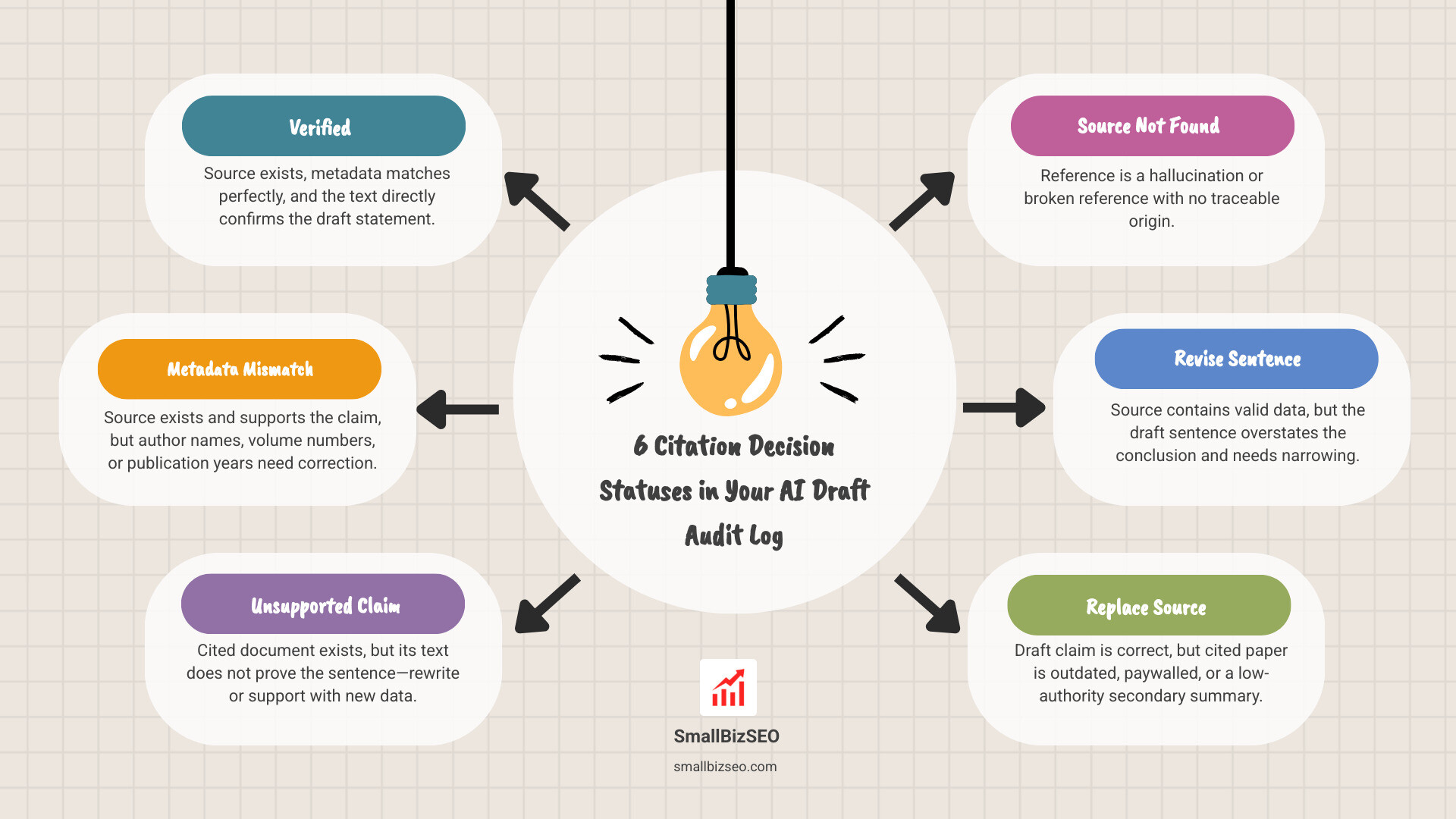
Every audited reference in your draft should be tagged with one of six standardized statuses:
- Verified: The source exists, metadata matches perfectly, and the text directly confirms the statement.
- Metadata Mismatch: The source exists and supports the claim, but author names, volume numbers, or publication years require correction.
- Unsupported Claim: The cited document exists, but its text does not prove the sentence. The sentence must be rewritten or supported with new data.
- Source Not Found: The reference is a hallucination or broken reference with no traceable origin.
- Revise Sentence: The source contains valid data, but the draft sentence overstates the conclusion and needs narrowing.
- Replace Source: The draft claim is correct, but the cited paper is outdated, paywalled, or from a low-authority secondary summary.
Maintaining this structured log provides an auditable trail for each grounded answer you publish.
When in the Workflow Should You Apply a Citation Review Checklist for AI-Assisted Article Drafts?
Citation verification must occur as a dedicated quality-assurance pass after structural editing and before final proofreading. Running a citation check too early leads to wasted effort on paragraphs that might be cut during structural reorganization. Conversely, waiting until the final proofreading pass increases the risk of rushed, superficial checks.
When incorporating AI-assisted revisions into existing copy, use difference-checking tools to compare the new text against the original. This ensures the model did not introduce unverified statistics while refining tone or grammar.
Building Lasting Authority with Verified AI Content
Publishing reliable content requires transparent standards and rigorous verification. As major research organizations and publishers establish clear guidelines for using AI tools responsibly, digital publishers must maintain the same commitment to factual accuracy.
At SmallBizSEO, our data-driven Velocity framework pairs rapid content production with transparent, automated reporting and systematic quality gates. Conducting regular citation accuracy audits protects your brand's reputation, satisfies search quality standards, and builds genuine reader trust.