5 Steps to Design a Dependable Human-in-the-Loop Content Review Process

How do you keep human judgment in AI-assisted editing?
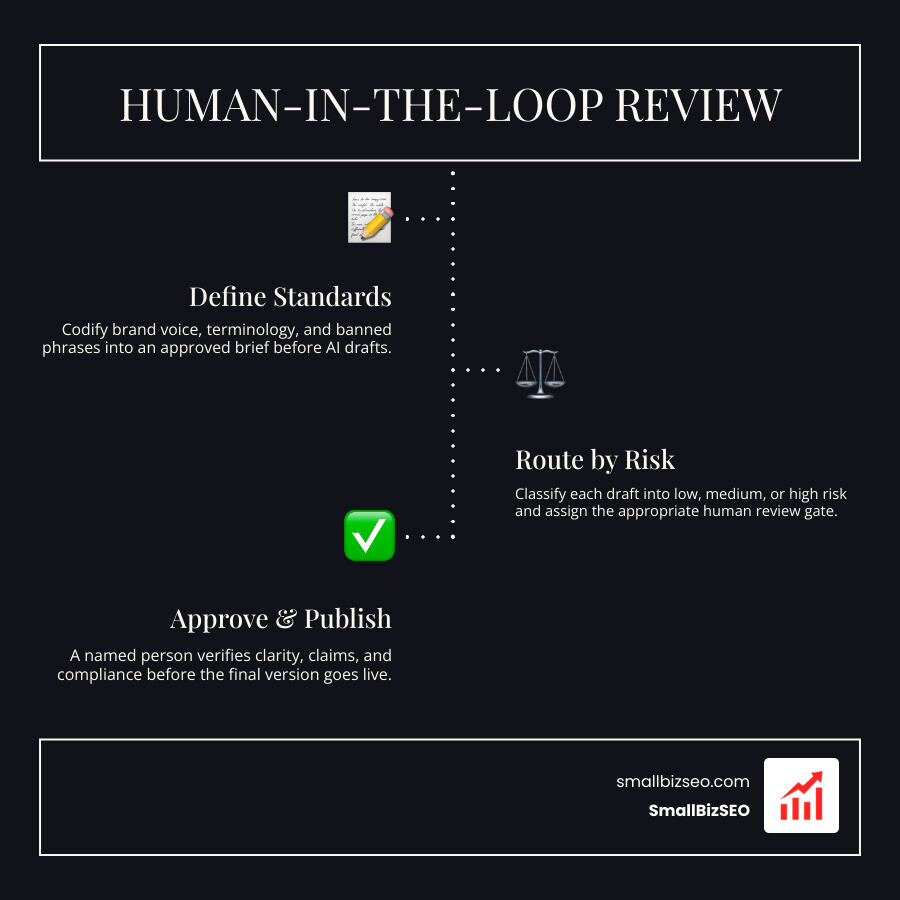
Start building a human review workflow for ai-assisted editing with a simple rule: AI can suggest changes, but a named person approves what gets published. Give the AI an approved brief and brand rules. Then route each draft by risk: an editor checks clarity and voice, a subject expert verifies important claims, and a final owner approves the exact version that goes live.
This lets AI handle routine edits without treating its output as trustworthy by default. It also gives reviewers a clear way to catch unsupported claims, sensitive information, and changes that could mislead readers.
I'm Clayton Johnson, founder of SmallBizSEO. My work on content strategy, practical guides, and AI-supported processes shapes how I approach building a human review workflow for ai-assisted editing: make the checks clear, keep responsibility with people, and learn from every revision.
Autonomous AI editing creates compliance risks because large language models lack contextual accountability, real-world fact verification, and genuine intent. While generative tools can draft and polish text at incredible speeds, McKinsey research shows that fewer than a third of organizations achieve consistent output quality without intervention. In fact, 42% of companies have abandoned generative AI initiatives primarily because governance gaps outpaced the technology.
When human editors disengage—a phenomenon known as cognitive offloading—hallucinated facts and brand voice drift quickly slip into public assets. This explains why 73% of marketing teams now mandate human-in-the-loop oversight before any AI-generated asset goes live.
Step-by-Step Guide: Building a Human Review Workflow for AI-Assisted Editing

To build an efficient human review process, operationalize your editorial standards into clear checkpoints, route tasks by risk, and maintain explicit ownership across every draft. Implementing structured governance typically reduces approval cycles by 40% to 60%, cutting revision rounds from six down to two while reducing approval timelines from ten days down to just two or three days.
The following comparison illustrates why structured human-in-the-loop review provides the ideal balance:
| Editorial Dimension | Traditional Manual Editing | Unguided AI Editing | Structured Human-in-the-Loop Review |
|---|---|---|---|
| Turnaround Time | Slow (3–7 Days) | Instant (<1 Minute) | Fast (2–4 Hours) |
| Fact Accuracy | High (Human Verified) | Unreliable (Hallucination Risk) | High (Grounded & SME Verified) |
| Brand Voice Fidelity | High (Context Aware) | Inconsistent (Voice Drift) | High (Rubric & Prompt Calibrated) |
| Cost per Asset | High | Extremely Low | Balanced & Scalable |
| Compliance Safety | Full Accountability | Significant Liability Risk | Enterprise Protected |
How Do You Define Usable Brand Voice Standards for Building a Human Review Workflow for AI-Assisted Editing?
Define brand voice standards by turning vague stylistic aspirations into measurable rules that both human editors and machine prompts can follow. Research indicates that 64% of top-performing content teams maintain documented style guides, yet only 23% actually translate those guidelines into AI prompts or reviewer checklists.
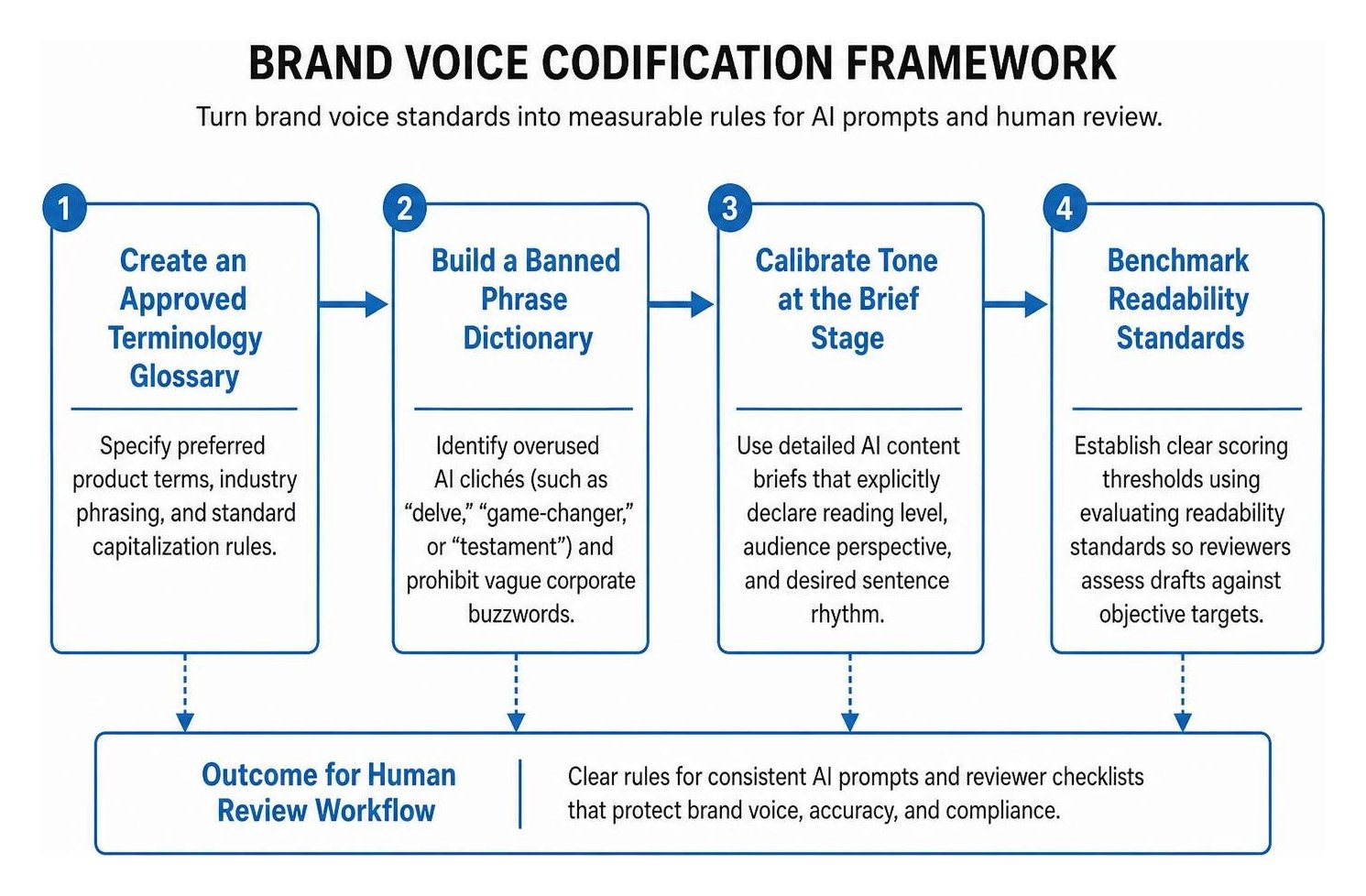
- Create an Approved Terminology Glossary: Specify preferred product terms, industry phrasing, and standard capitalization rules.
- Build a Banned Phrase Dictionary: Identify overused AI clichés (such as "delve," "game-changer," or "testament") and prohibit vague corporate buzzwords.
- Calibrate Tone at the Brief Stage: Use detailed AI content briefs that explicitly declare reading level, audience perspective, and desired sentence rhythm.
- Benchmark Readability Standards: Establish clear scoring thresholds using evaluating readability standards so that reviewers assess drafts against objective targets rather than personal intuition.
How Should Teams Classify Content Risk and Route Drafts Through Review Gates?
Classify content by risk before drafting begins, routing each piece according to the potential consequences of an error. Applying a single rigid approval standard to every piece of copy creates editorial bottlenecks. Instead, align review depth with consequence levels, as outlined in the Microsoft Runbook on Human-in-the-Loop Review Gates.
- Notify Gate (Low Risk): For routine internal memos or social updates. The AI processes the draft and notifies the team upon completion; human intervention is optional.
- Confirm Gate (Moderate Risk): For standard blog posts and educational content. A human editor quickly reviews structure, tone, and search intent before giving a one-click confirmation.
- Draft Gate (Substantial Risk): For product landing pages and commercial copy. The AI creates a suggested draft, but a content lead must actively edit and refine before passing it onward.
- Mandatory Review Gate (High/Regulated Risk): For legal, financial, or medical guidance. The asset requires formal, multi-stakeholder sign-off to prevent mitigating enterprise compliance and accuracy errors.
What Are the Key Stages in Building a Human Review Workflow for AI-Assisted Editing?
A robust editorial review workflow moves linearly through four stages: pre-flight intake, human copyediting, subject-matter verification, and the final publication gate.

- Stage 1: Ingestion & Pre-Flight Screening: Automated checks scan the text for formatting errors, banned words, missing metadata, and obvious AI repetition.
- Stage 2: Structured Human Copyediting: An editor refines narrative flow, tightens transitions, and verifies that the draft reflects human empathy and nuanced perspective within your structured AI content workflow.
- Stage 3: SME Technical Verification: A dedicated subject-matter expert reviews data points, statistics, and industry assertions to ensure practical credibility when scaling AI content while maintaining human quality.
- Stage 4: Final Publication Gate: The designated content owner checks the version identifier, confirms all required sign-offs are logged, and pushes the final revision to the CMS.
How Can Automated Checks and Knowledge Grounding Streamline Editorial Hand-offs?
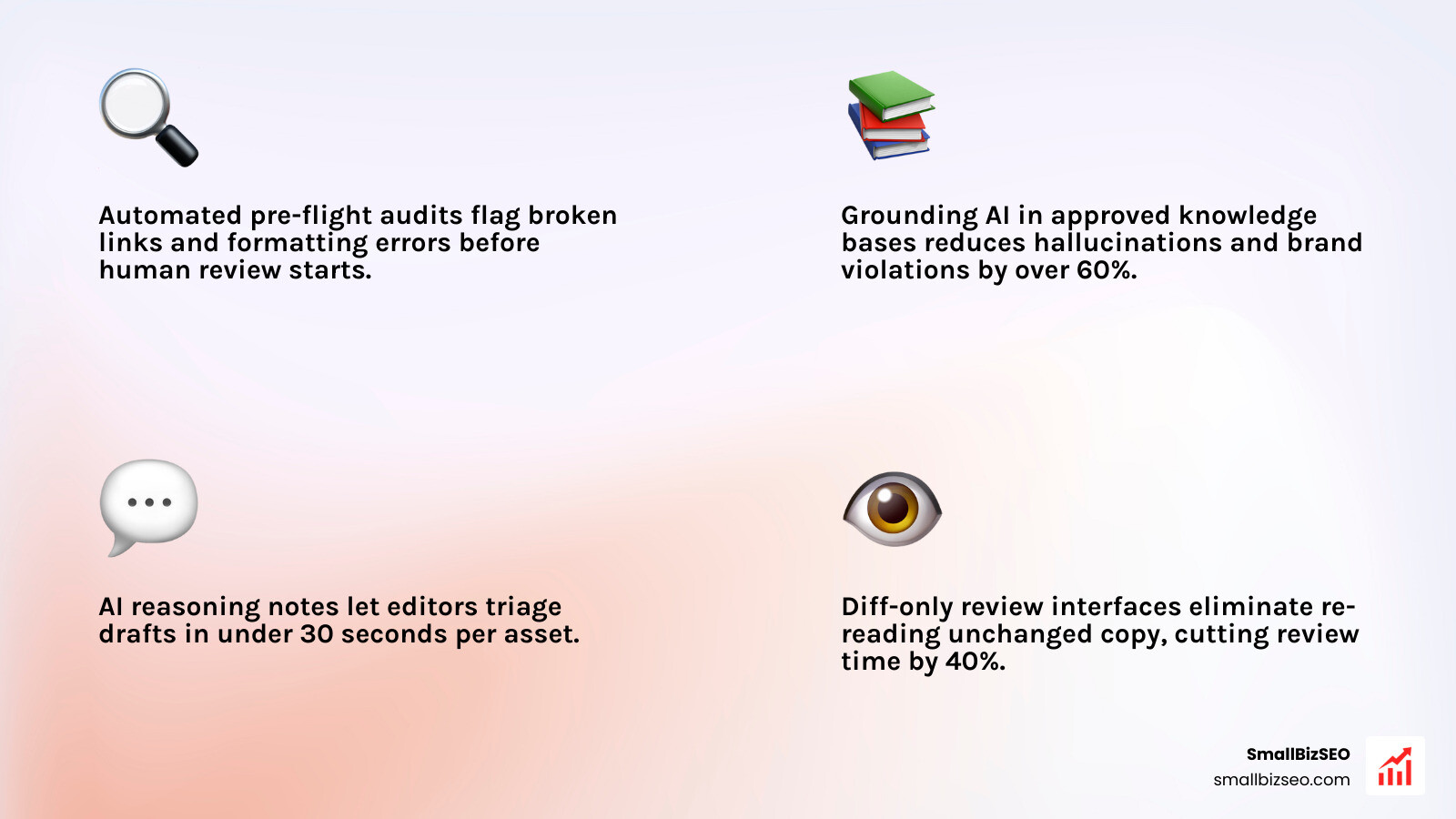
Automate repetitive mechanical checks and ground AI models in verified company documents so that human reviewers can focus entirely on high-level editorial judgment. Following the Primitives.org.ai Review Pattern Framework, workflows become significantly faster when machines handle formatting while humans evaluate context.
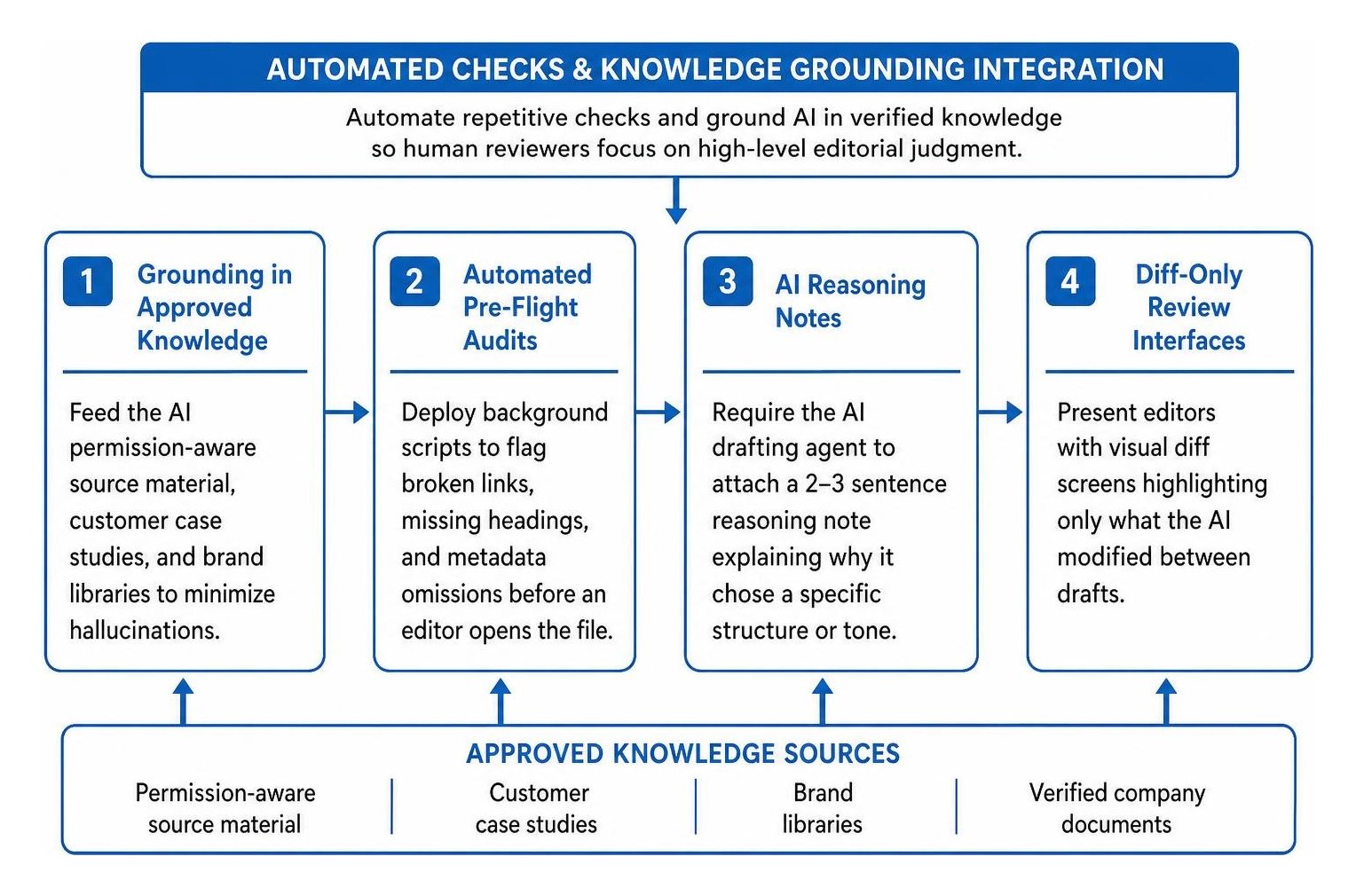
- Grounding in Approved Knowledge: Feed the AI permission-aware source material, customer case studies, and brand libraries to minimize hallucinations when creating scalable AI-generated content.
- Automated Pre-Flight Audits: Deploy background scripts to flag broken links, missing headings, and metadata omissions before an editor opens the file.
- AI Reasoning Notes: Require the AI drafting agent to attach a 2–3 sentence reasoning note explaining why it chose a specific structure or tone, allowing editors to triage drafts in 30 seconds.
- Diff-Only Review Interfaces: Present editors with visual diff screens highlighting only what the AI modified between drafts, eliminating the need to re-read unchanged copy.
Ethical Guardrails, Key Metrics, and Long-Term Quality Control

Editorial governance requires continuous oversight, robust ethical safeguards, and transparent performance tracking across all content assets.
How Do You Manage Ethical Risks, Citation Hallucinations, and Bias?
Manage ethical risks by enforcing strict citation verification, protecting private company data, and actively checking for algorithmic bias. Academic evaluations reveal that 18% of citations generated by GPT-4 and 55% from GPT-3.5 are completely fabricated. Furthermore, studies on AI reviewer selection show that untuned models disproportionately favor male candidates (68%) and authors from high-income regions (95.3%) unless explicit diversity prompts are applied.
- Independent Citation Checks: Never accept an AI-provided source without opening the primary link and checking the original data.
- Data Privacy & IP Isolation: Ensure drafts are processed in private, enterprise-grade environments where proprietary company information cannot be used for external model training.
- Contextual Stewardship: Treat AI suggestions as recommendations rather than definitive answers, maintaining complete human accountability for everything published.
What Metrics and Feedback Loops Ensure Sustainable Editorial Velocity?
Track process health metrics and feed editor corrections back into your prompt libraries to ensure ongoing workflow improvement.
- Straight-Through Processing Rate: The percentage of low-risk drafts approved with zero human edits.
- Reviewer Time Per Asset: The average minutes an editor spends verifying and polishing each draft.
- Correction Rate by Category: Categorizing edits into factual errors, tone issues, or formatting fixes to identify prompt weaknesses.
- Post-Publish Performance: Monitoring audience engagement. Publishing sites that pair AI drafting with rigorous human review see 73% lower bounce rates than unedited AI output, as detailed in our analysis of traffic and engagement stats comparing AI and human content.
At SmallBizSEO, our proprietary Velocity framework combines automated technical rigor with dedicated editorial oversight, helping businesses scale organic search performance safely. If you want to refine your content operations, explore our specialized expert AI-assisted editing services to build a fast, reliable publishing engine.
Scaling Editorial Confidence with Human Oversight
Building a reliable human review workflow is not about slowing down AI—it is about giving your content operations the stability, accuracy, and brand alignment needed to scale safely. By establishing clear brand voice rules, consequence-based review gates, grounded knowledge inputs, and iterative feedback loops, your team can harness the speed of AI while protecting reader trust. When people remain the final decision-makers, your publishing engine delivers consistent, authoritative content that drives real business results.