AI vs. Human Content: Traffic, Engagement & Conversion Stats

AI vs. Human Content: Traffic, Engagement & Conversion Stats
What do human vs. AI content statistics mean for your business?
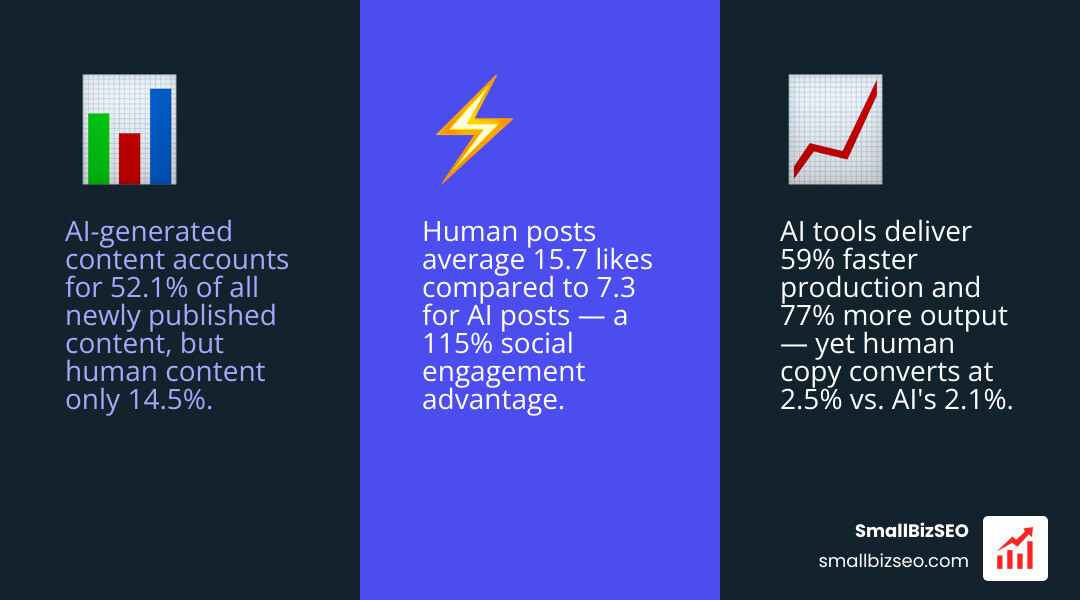
Human-written content leads in several reported engagement and conversion benchmarks, while AI helps teams publish faster. In one social content comparison, human posts averaged 15.7 likes versus 7.3 for AI-generated posts. A separate sales-copy benchmark reported conversion rates of 2.5% for human copy and 2.1% for AI copy. These are useful starting points, not guarantees for every business.
For a small team, the practical choice is often AI-assisted drafting with human review. Use the time saved to add knowledge, check facts, and make each page useful to the people you want to reach.
I'm Clayton Johnson, an SEO and digital PR strategist. My work on Human vs. AI-Generated Content: Traffic, Engagement, and Conversion Statistics connects search visibility with the trust and credibility that help turn readers into customers.
What do the statistics show about human vs. AI-generated content?
AI tools now produce the absolute majority of digital content, but human-created assets consistently drive stronger audience engagement and long-term search performance. Recent publishing market analysis reveals that AI-generated content accounts for 52.1% of all newly published content, representing the single largest share across web and social channels. In contrast, pure human-generated content represents only 14.5% of total publishing volume.
Despite producing lower volume, human-authored copy secures an outsized share of audience interaction and revenue outcomes. Businesses leveraging artificial intelligence achieve 59% faster content production times and a 77% increase in total output volume, but publishing volume alone does not translate to bottom-line success.
| Performance Benchmark Metric | Pure AI-Generated | Hybrid (AI Draft + Human Edit) | Pure Human-Written |
|---|---|---|---|
| Share of Published Content | 52.1% | 33.4% | 14.5% |
| Average Organic Traffic Differential | 1.0x (Baseline) | 3.8x Baseline | 5.44x Baseline |
| Average Social Media Likes | 7.3 | 6.8 | 15.7 |
| Average Social Media Saves | 0.1 | 0.2 | 0.3 |
| Direct Sales Conversion Rate | 2.1% | 2.4% | 2.5% |
| Average Session Duration Lift | Baseline | +28% | +41% |
What are the key benchmarks for human vs. AI-generated content?
The most critical benchmark across digital channels is the traffic disparity over time. Multi-month tracking studies show that human-written articles generate 5.44 times more organic traffic over a five-month span compared to purely machine-generated equivalents.
When visitors land on a page, human writing achieves 41% longer session durations. Overall user engagement scores show human writing outperforming pure AI generation by roughly 47%. In direct sales copy environments, human-crafted messaging delivers a 2.5% conversion rate compared to 2.1% for automated copy—a measurable gap that compounds into substantial revenue differences over large transaction volumes.
How do human and AI content compare in traffic and organic search visibility?
Search engines prioritize content quality, user satisfaction, and unique information rather than penalizing or rewarding the specific tool used to create the text. In head-to-head testing where informational quality is matched, 57% of AI articles and 58% of human articles successfully secure positions within Google's top 10 search results.
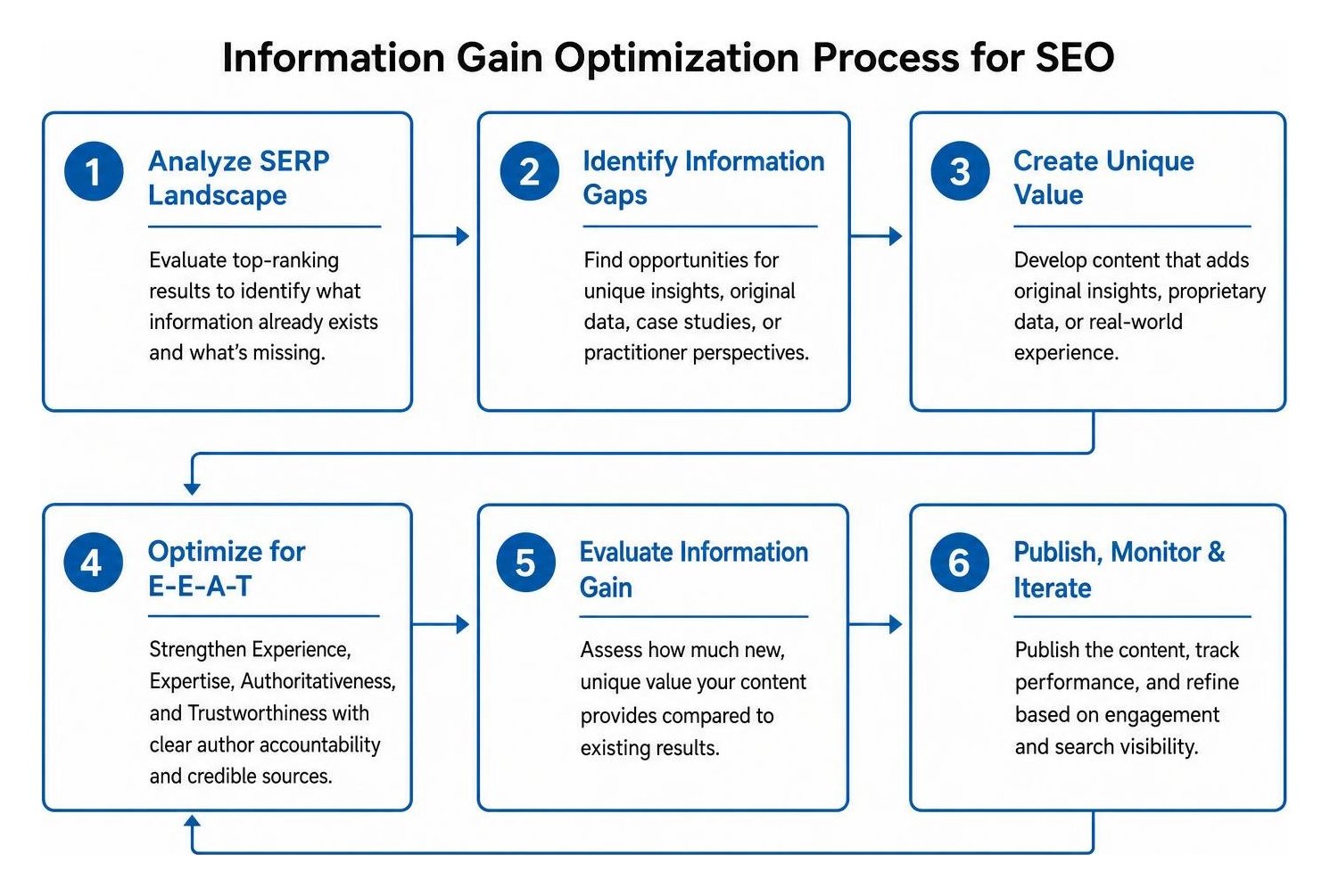
However, search algorithms actively reward pages that offer demonstrable Information Gain—original insights, proprietary data, or unique perspectives not already present across index results. When teams focus entirely on scaling AI content without losing human quality, they avoid the trap of regurgitating existing SERP consensus. Search engines and answer engines look for fresh signals when optimizing for generative search visibility, making purely automated summaries increasingly susceptible to indexing decay.
How should these statistics shape an SEO strategy?
Mass publishing unedited automated drafts exposes websites to extreme volatility and severe algorithm penalties. Case data shows that websites deploying thousands of unreviewed AI articles often experience sudden traffic collapses when search updates target unoriginal pages.
Modern strategies must align with modern AI SEO best practices, which prioritize Google's Experience, Expertise, Authoritativeness, and Trustworthiness (E-E-A-T) guidelines. By introducing original case studies, practitioner commentary, and clear author accountability, brands satisfy user intent while safeguarding their search visibility against automated quality sweeps.
How do human and AI content affect reader engagement and brand trust?
While blind tests show that 84% of readers cannot consciously tell the difference between human and AI writing, 52% of consumers immediately disengage if they suspect a piece is machine-generated. Authenticity remains the primary currency of digital engagement.
According to empirical research on social media engagement outcomes, human-crafted social posts generate an average of 15.7 likes, compared to 7.3 likes for AI-generated posts and 6.8 likes for lightly modified AI posts. On high-intent metrics like saves—which signify long-term value to the user—human posts average 0.3 saves per post, triple the 0.1 save rate of pure AI assets.
Visual authenticity mirrors these textual dynamics. As highlighted in scientific research on AI vs human visuals in advertising, consumers often experience an "Uncanny Valley" reaction to overly polished or artificial media. When text or imagery feels synthetic, audience trust diminishes, directly lowering overall brand affinity.
How does personal expertise affect audience retention?
Readers are 2.5 times more likely to engage deeply with articles that incorporate authentic personal expertise and real-world experience. Practical problem-solving, acknowledgment of operational mistakes, and specific, localized examples keep bounce rates low and recirculation rates high. Machine models naturally gravitate toward average sentence patterns and generic solutions, whereas human narrative nuance validates the reader's lived experience.
How do conversion rates and revenue impact vary across marketing channels?
Conversion performance varies widely by channel, with human copy dominating high-consideration purchases and AI delivering efficiency on structured, high-volume assets. Machine generation provides a 43% increase in an organization's ability to create personalized variations across segments, but conversion efficiency requires precise human alignment.
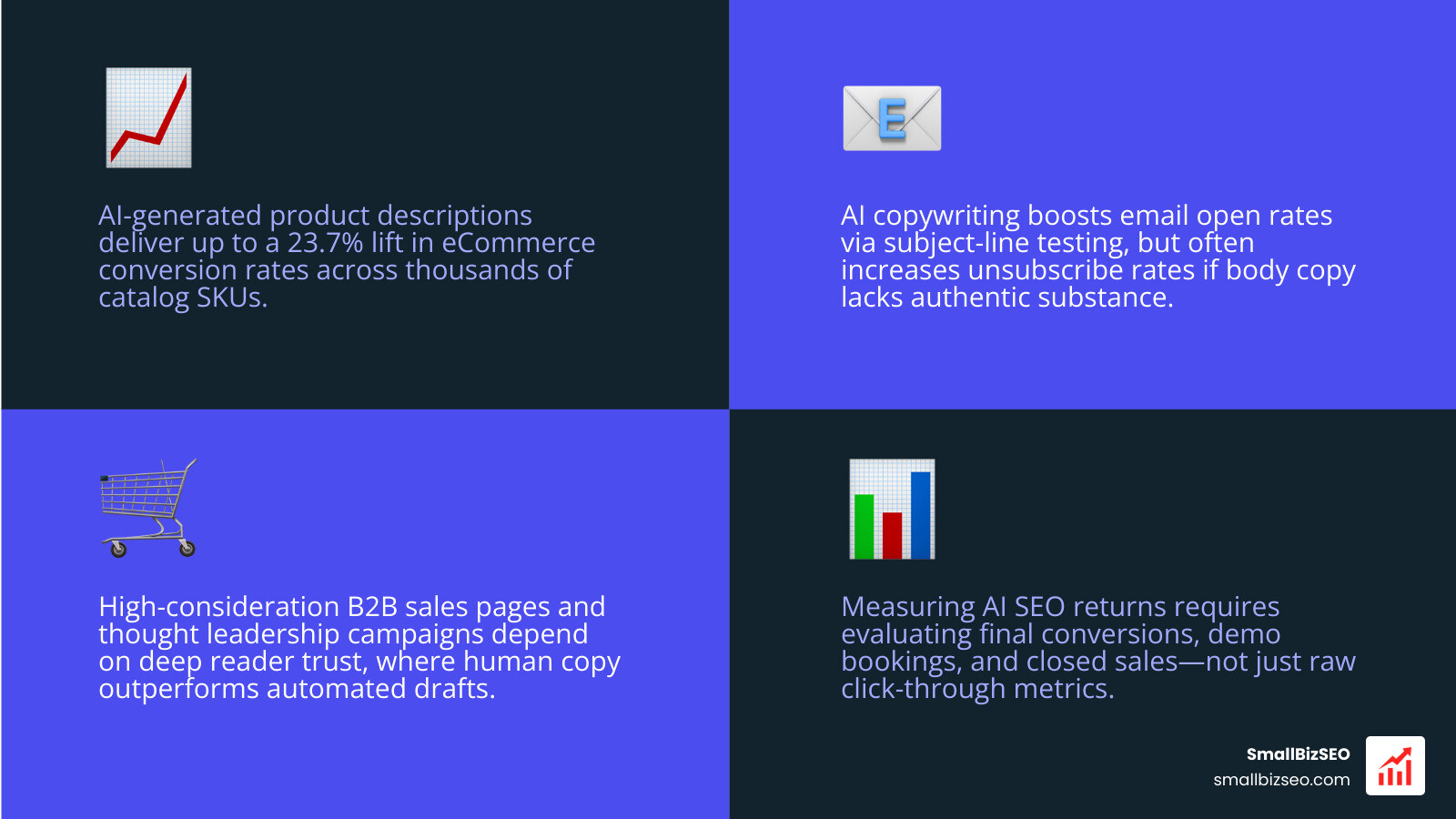
In direct eCommerce applications, AI excels at scaling structured data. Automated, intent-optimized product descriptions have delivered up to a 23.7% lift in product-page conversion rates across thousands of catalog SKUs. Conversely, high-consideration B2B sales pages, email newsletters, and thought leadership campaigns depend on deep reader trust.
In email channels, automated copywriting often boosts open rates by testing multiple subject-line permutations, yet it frequently produces higher unsubscribe rates if the body copy lacks authentic substance. Accurately measuring AI SEO returns requires evaluating final conversions, demo bookings, and closed sales rather than relying solely on raw click-through metrics.
How does conversion performance differ by channel?
- eCommerce Product Detail Pages: AI drafting delivers strong returns by optimizing keyword coverage and structural consistency across massive inventories.
- Email Marketing: AI subject lines improve initial click-through rates, while human-written bodies maintain subscriber retention and lower spam complaints.
- B2B Lead Generation: Human-written collateral reduces customer acquisition cost by directly addressing buyer skepticism with concrete proof points.
- Paid Search Ad Creative: Automated variation testing increases ad CTR while reducing cost-per-click, provided human editors ensure clear message-to-landing-page consistency.
How can teams balance content scale with editorial quality?
The most effective content operations deploy a collaborative hybrid model that pairs algorithmic speed for research and drafting with experienced human editorial oversight. Approximately 62% of high-performing marketing teams use a hybrid workflow, and 73% of marketers who report AI content outperforming human baselines attribute that success directly to human editors refining the initial drafts.

Articles produced through an integrated hybrid workflow rank 34% higher on average than unedited AI outputs. By standardizing an editorial pipeline, organizations capture the efficiency dividends of automation—reducing overall production costs by up to 42%—while protecting brand integrity through an established AI content optimization framework.
What editorial safeguards and review standards should teams use?
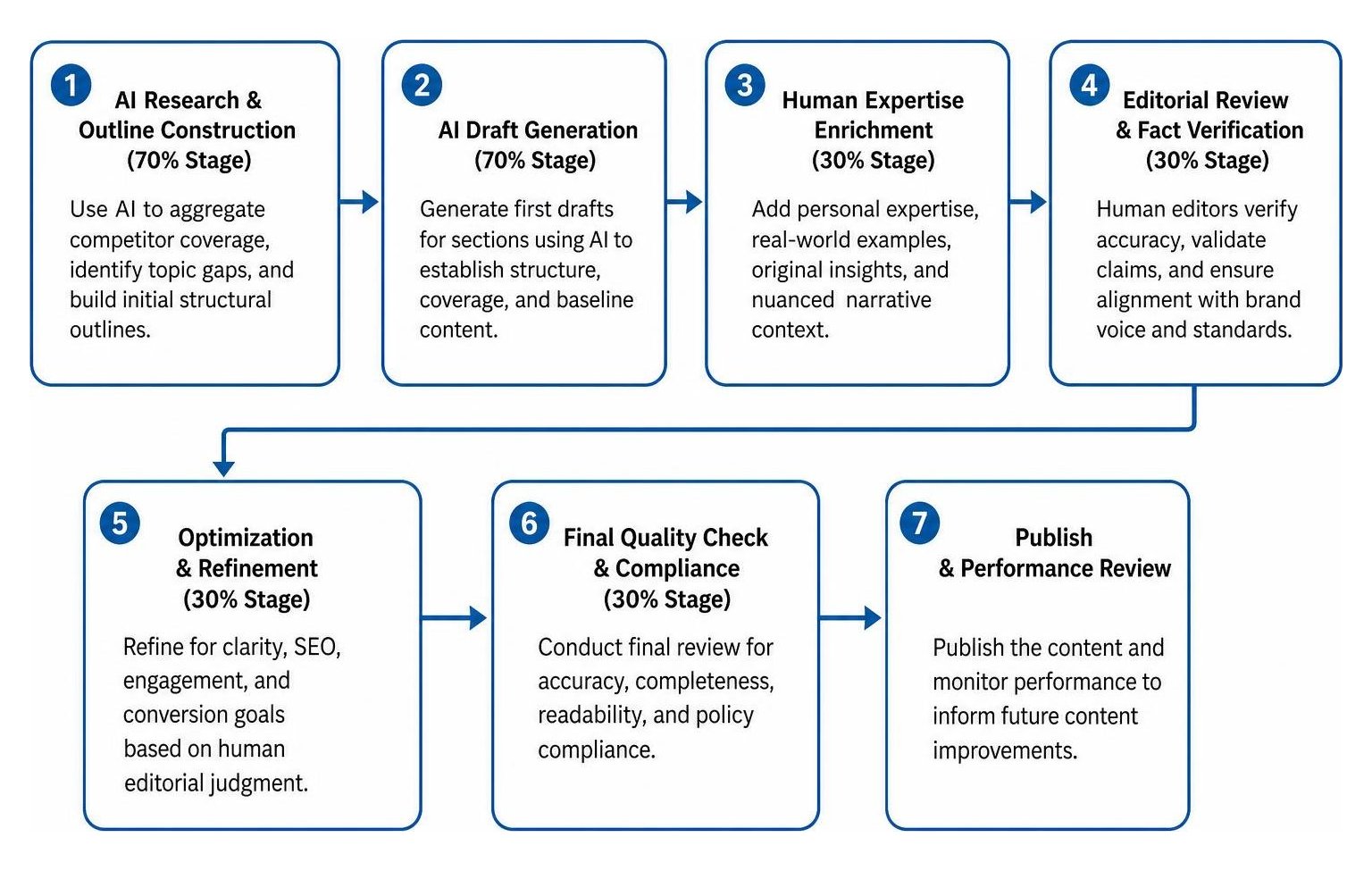
To maintain quality and avoid publishing errors, every content asset should undergo a structured review framework:
- AI Research and Outline Construction (70% Stage): Use artificial intelligence to aggregate competitor coverage, identify topic gaps, and build initial structural outlines.
- Fact-Checking and Citation Verification: Validate every statistical claim, product reference, and named entity to eliminate AI hallucinations.
- Voice and Nuance Calibration (30% Stage): Have a professional editor rewrite introductions, incorporate real business anecdotes, and remove repetitive robotic phrasing.
- Information Gain Injection: Add proprietary data points, original survey results, or expert quotes before final sign-off.
Frequently Asked Questions About AI vs. Human Content
Does Google penalize AI-generated content in organic search results?
Google does not systematically penalize content simply because it was created using automated tools. Search systems evaluate published material based on its helpfulness, relevance, originality, and adherence to E-E-A-T principles. However, search engines do penalize low-quality, mass-produced content created solely to manipulate search rankings without offering substantive value to human searchers.
Why might human content convert at higher rates than AI-generated copy?
Human copywriters excel at understanding emotional subtext, anticipating nuanced buyer objections, and presenting relatable personal narratives. Conversion copy requires empathy and strategic specificity—elements that machine algorithms, which predict statistically average word sequences, struggle to replicate without human guidance.
What is an effective AI-to-human workflow ratio for marketing teams?
An optimal operating baseline is the 70/30 workflow rule. Teams allocate roughly 70% of the production workload—such as topic clustering, initial drafting, metadata generation, and data formatting—to AI tools. The remaining 30% of effort is reserved for human strategists and editors to inject narrative voice, verify facts, integrate unique company data, and finalize conversion calls to action.
Turning Content Statistics Into Measurable Business Growth
Navigating the balance between automated scale and authentic human connection determines whether your digital marketing attracts real customers or empty traffic spikes. The data confirms that while AI provides exceptional production speed, human authority remains essential for building customer trust, reducing bounce rates, and securing conversions.
At SmallBizSEO, we implement a data-driven Velocity framework that combines modern technical precision with E-E-A-T-compliant content development. To see how these benchmarks apply across modern commerce, explore the 50 generative AI statistics every business owner should know and discover how structured content workflows drive sustainable organic revenue.