50 Generative AI Statistics Every Business Owner Should Know

Why Are Generative AI Statistics Critical for Business Owners?
Generative AI statistics matter because they reveal the clear dividing line between companies generating substantial profits from automation and those wasting capital on abandoned experiments. Understanding verified benchmarks allows business leaders to allocate budgets effectively, modernize workflows, and secure digital market share before competitors dominate automated discovery channels.
Generative AI reached 53% of the global population within three years of widespread release—expanding significantly faster than personal computers or the commercial internet. In consumer markets alone, generative tools deliver approximately $172 billion in annual economic value across everyday search, productivity, and shopping workflows.
For executive decision-makers, evaluating hard performance data is essential to avoid common implementation pitfalls:
- 1. Generative technology achieved mainstream consumer saturation faster than any previous computing revolution.
- 2. Early commercial adopters are capturing outsized efficiency gains while competitors remain stuck in unmeasured trial phases.
- 3. Business models that rely on organic web traffic must adapt immediately as AI discovery platforms reshape user behavior.
How Fast Is the Global Generative AI Market Growing and Scaling?
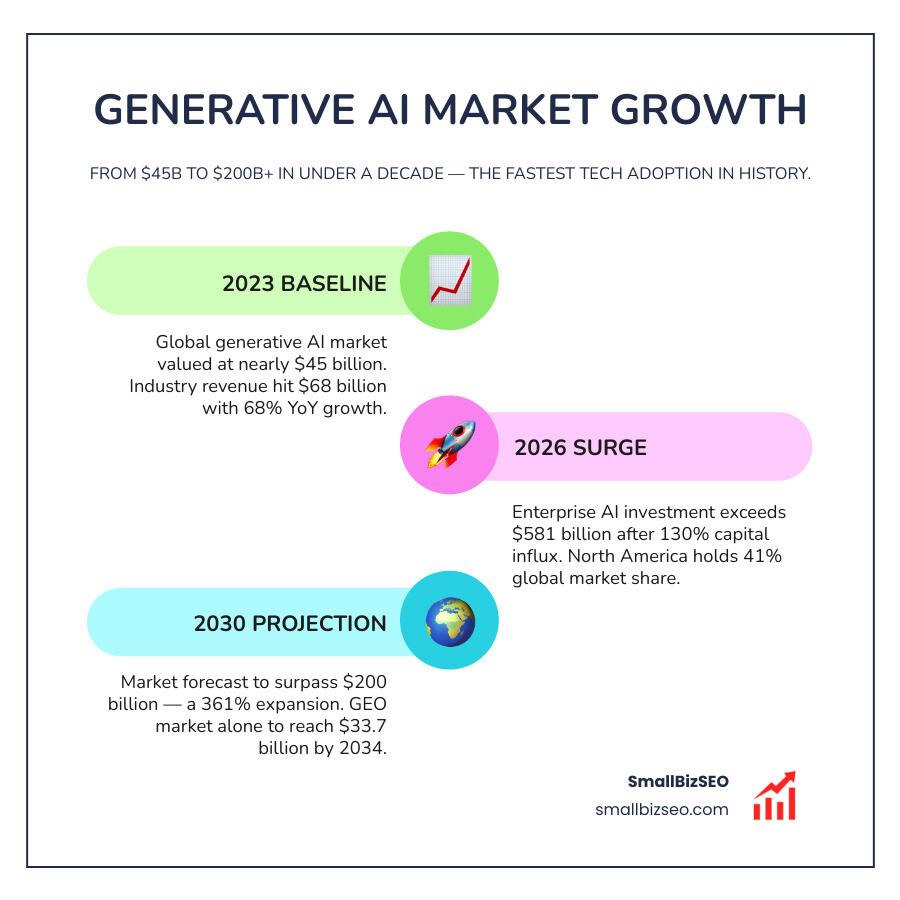
The global generative AI market is expanding at an unprecedented rate, scaling from a baseline valuation of nearly $45 billion to a projected global footprint surpassing $200 billion over a multi-year horizon—a massive 361% expansion. Total industry revenue surged past $68 billion following a 68% year-over-year jump, with enterprise software and digital infrastructure crossing the $100 billion threshold rapidly.
This rapid growth is driven by enterprise spending, where global corporate AI investments surpassed $581 billion after a 130% surge in allocated capital. North America leads the landscape with a 41% global market share, while Europe holds 26% and the Asia-Pacific region accounts for 22%.
Alongside core model development, generative search optimization is emerging as a massive commercial sector. The Generative Engine Optimization (GEO) ecosystem is projected to expand from $848 million to $33.7 billion over a ten-year span, registering a compound annual growth rate of 50.5% according to benchmark research analyzing 83,670 AI citations.
- 4. Global market valuation is on pace to surge by 361%, expanding from roughly $45 billion past $200 billion.
- 5. Industry revenue reached $68 billion in annual production value, climbing over 68% year-over-year.
- 6. Corporate AI capital allocations reached $581 billion across infrastructure and application layers.
- 7. North America commands 41% of total market revenue, followed by Europe at 26% and Asia-Pacific at 22%.
- 8. The specialized GEO market is expanding at a 50.5% compound annual growth rate toward a $33.7 billion valuation.
Where Are Market Share and Geographic Investment Concentrated?
Private capital and technical infrastructure are concentrated primarily across North America and select international innovation corridors like the United Arab Emirates, where national AI diffusion initiatives outpace standard global averages.
Funding patterns show that foundation model creators captured upward of 46% of initial private funding rounds, demonstrating high investor concentration in core infrastructure. Furthermore, quarterly enterprise spending on specialized hardware, cloud clusters, and high-performance compute arrays consistently tops $80 billion globally.
- 9. Top-tier foundation model companies captured approximately 46% of initial venture investments.
- 10. Quarterly enterprise cloud compute and infrastructure spending exceeded $80 billion to support model training and inference.
- 11. Regional diffusion indexes rank the United Arab Emirates and North America as leading global hubs for implementation velocity.
How Deep Is Generative AI Adoption Across Businesses and Demographics?
Generative AI adoption has permeated organizations of all sizes, with 88% of businesses now deploying artificial intelligence within at least one core workflow—up from 78% in earlier benchmarks. Furthermore, 71% of organizations regularly utilize generative AI tools in daily operational routines.
Small and medium-sized enterprises are adopting these tools just as quickly. Currently, 68% of small businesses use AI regularly, with 28% using automated platforms daily. This widespread deployment is fueled by executive pressure, as 64% of business owners and leaders report high urgency to integrate generative solutions into their operations.
Demographic usage reveals steady integration across age groups and backgrounds. Approximately 34.7% of millennials use generative AI tools monthly, while 70% of Gen Z users have engaged with generative platforms. A modest demographic split remains, with 59% of men reporting regular usage compared to 51% of women.
Meanwhile, autonomous agent deployments represent the next major wave of enterprise automation: 62% of organizations are experimenting with AI agents, though only 23% have successfully scaled them across production systems. Business owners can see how their peers are managing this transition by evaluating small business statistics to build realistic implementation roadmaps.
- 12. 88% of organizations now use artificial intelligence in at least one business function.
- 13. 71% of surveyed enterprises regularly employ generative AI in day-to-day operations.
- 14. 68% of small businesses use AI regularly, and 28% interact with AI tools on a daily schedule.
- 15. 64% of executive leaders express urgent pressure to incorporate generative tools into operational workflows.
- 16. 34.7% of millennials utilize generative platforms at least once per month.
- 17. 70% of Gen Z consumers have actively tested or used generative systems.
- 18. 59% of men report regular usage of generative tools compared to 51% of women.
- 19. 62% of organizations are actively testing autonomous AI agents, but only 23% have moved them into full production.
Which Business Objectives and Everyday Use Cases Drive Generative AI Adoption?
Direct information retrieval and everyday task execution drive the highest volume of AI interactions, with 68% of users employing generative interfaces to ask questions and 54% using models for structured brainstorming and ideation.
Within small and mid-sized enterprises, functional adoption is concentrated across several operational departments: marketing leads with 43% adoption, followed by customer service (36%), administrative automation (33%), data processing (32%), and automated bookkeeping (29%). Furthermore, employee enthusiasm has accelerated grassroots adoption, with 78% of knowledge workers bringing their own AI tools into the workplace.
- 20. 68% of generative platform users employ tools primarily for complex question answering and data lookup.
- 21. 54% of professional users deploy generative prompts for strategic brainstorming and outlining.
- 22. 37% of users utilize generative systems to assist with creative asset creation and image adjustments.
- 23. 43% of small businesses deploy AI across marketing and content development workflows.
- 24. 36% of small enterprises use generative bots for frontline customer support and ticketing.
- 25. 33% of businesses apply AI to routine administrative paperwork and schedule management.
- 26. 32% of operational teams leverage AI tools for internal data processing and spreadsheet management.
- 27. 29% of small businesses automate bookkeeping and receipt categorization with AI.
- 28. 78% of knowledge workers bring their own AI software into standard enterprise environments.
How Does Generative AI Reshape Workforce Productivity and Labor?
Generative AI enhances individual worker output across administrative and creative workflows, with 74% of small businesses using AI reporting measurable productivity improvements. Knowledge workers save an average of 2.2 hours weekly, while specialized marketing professionals save upward of 5 hours per week on drafting and research tasks.
These operational efficiencies translate directly into financial gains: 41% of AI-enabled small businesses report increased overall revenue, while only 2% report a revenue decline.
Across global labor markets, automation is driving an overall expansion in employment opportunities. Global workforce projections indicate that AI and related technologies will create approximately 170 million new roles while displacing 92 million legacy positions, resulting in a net gain of 78 million jobs worldwide.
However, internal workforce dynamics require significant restructuring. Approximately 38% of businesses report needing to reskill over a fifth of their staff, and 39% of core worker skill sets are expected to change. While 44% of surveyed enterprises anticipate net workforce reductions in certain routine roles over a three-year horizon, they are simultaneously expanding budgets for AI-competent talent. Teams can protect their editorial integrity during rapid production shifts by scaling AI content without sacrificing human quality.
- 29. 74% of small businesses utilizing AI platforms report clear productivity gains.
- 30. Workers save an average of 2.2 hours each week, while marketing teams recover more than 5 hours per week.
- 31. 41% of small businesses report revenue increases following AI integration, compared to just 2% experiencing decreases.
- 32. Global labor estimates project 170 million new jobs created alongside 92 million displaced, generating 78 million net new positions.
- 33. 38% of enterprise leaders anticipate reskilling more than 20% of their existing workforce.
- 34. 39% of fundamental workplace skill sets are undergoing realignment due to automated systems.
- 35. 44% of corporate leaders forecast targeted workforce reductions in routine administrative roles over a three-year window.
What Is the Critical AI Skills Gap?
The primary obstacle preventing businesses from scaling AI is a shortage of qualified internal talent capable of designing, managing, and governing automated systems.
Surveys show that 63% of employers identify the internal skills gap as their single greatest barrier to scaling artificial intelligence. In response, proactive organizations are investing heavily in education, with 98% of active small-business AI adopters running dedicated employee training programs.
- 36. 63% of executives cite internal skill shortages as the primary bottleneck blocking AI implementation.
- 37. 98% of small businesses successfully using AI provide structured upskilling opportunities for their team members.
Why Does an ROI Gap Exist Between AI High-Performers and Average Adopters?
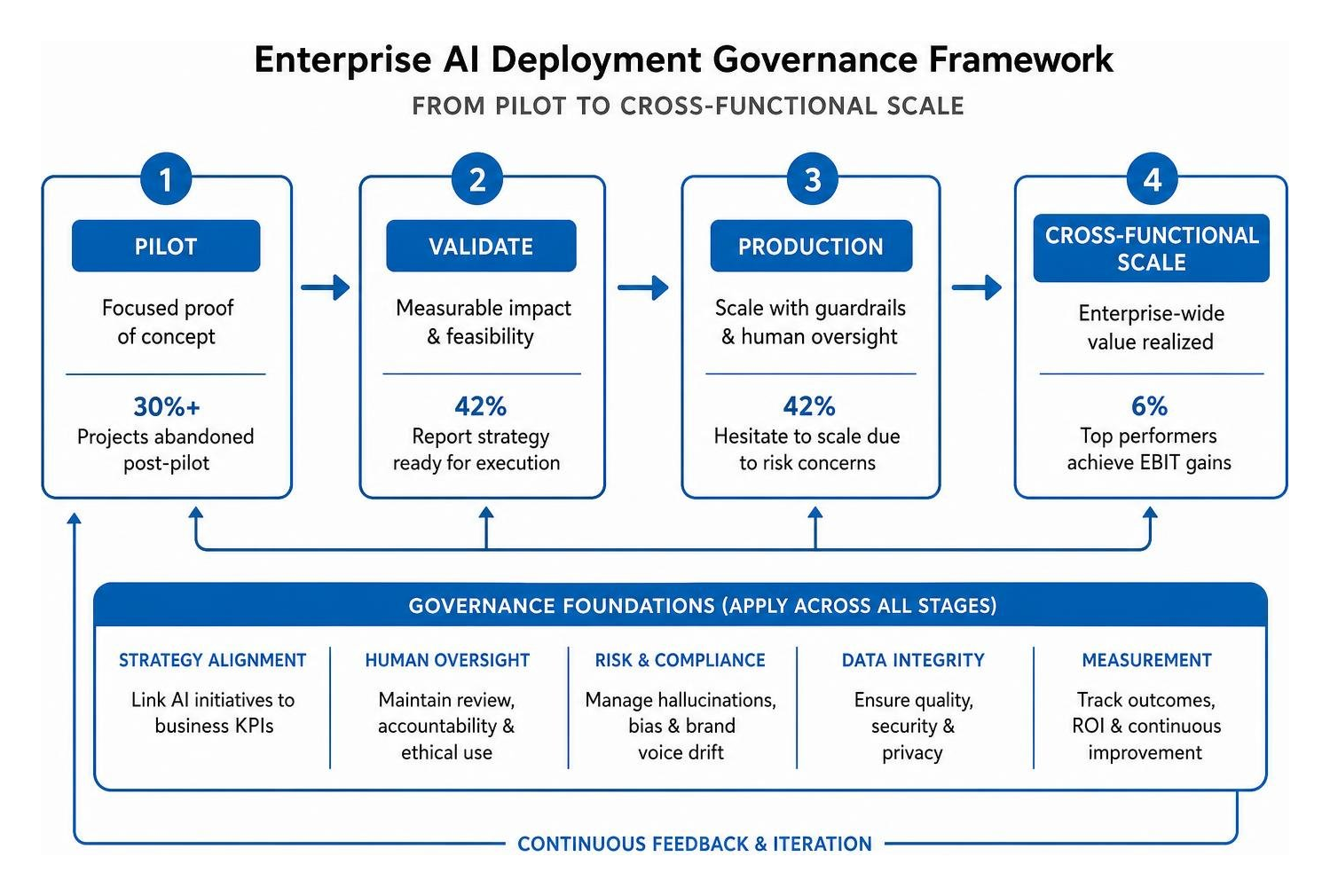
An ROI gap exists because most organizations treat generative AI as an experimental novelty rather than integrating it directly into high-impact revenue and cost workflows. Consequently, only 6% of organizations qualify as true AI high-performers that capture meaningful earnings before interest and taxes (EBIT) improvements.
Economic value remains heavily concentrated at the top: 74% of all financial value created by artificial intelligence is captured by just 20% of adopting companies. In contrast, at least 30% of generative AI projects are abandoned immediately after the initial proof-of-concept phase due to poor execution and unclear objectives.
At the executive level, only 12% of chief executives report achieving both revenue expansion and cost reduction simultaneously. Furthermore, only 42% of organizations feel their overarching strategy is prepared for comprehensive execution, and merely 1% of businesses investing in generative marketing technologies have fully recouped their upfront software costs, according to a comprehensive study on generative AI adoption.
| Performance Metric | AI High-Performers (Top 6%) | Average Adopters (Remaining 94%) |
|---|---|---|
| Share of Total AI Value Captured | 74% (Captured by top 20%) | 26% Distributed across majority |
| Simultaneous Revenue & Cost Gains | Achieved systematically | Achieved by only 12% of organizations |
| Project Completion Beyond Proof-of-Concept | >85% Scaled into production | 30%+ Abandoned post-pilot |
| Strategic Preparedness Confidence | High strategic alignment | Only 42% report strategic readiness |
- 38. Only 6% of all organizations qualify as top-tier performers achieving measurable EBIT gains from AI.
- 39. 74% of total economic value generated by AI is concentrated within the top 20% of adopting businesses.
- 40. At least 30% of generative AI pilot programs are canceled following proof-of-concept trials.
- 41. Only 12% of CEOs confirm achieving simultaneous top-line revenue growth and bottom-line cost reduction.
- 42. Just 42% of business leaders feel their organization's AI deployment strategy is fully prepared.
- 43. Only 1% of commercial brands have fully recovered their initial capital investments in specialized AI marketing software.
How Can Businesses Overcome Implementation Roadblocks and Governance Risks?
Organizations overcome implementation bottlenecks by abandoning isolated point solutions and implementing cross-departmental governance frameworks that directly connect AI automation to measurable business KPIs.
Data integrity and brand risk remain notable concerns: 42% of business leaders report hesitating to expand generative systems due to worries over model hallucinations, biased outputs, or brand voice drift. Forward-thinking operators address these concerns by examining how modern AI SEO tools operate with strict human oversight and automated fact-checking guardrails.
How Are AI Search Engines and GEO Changing Online Visibility?
Generative search engines are fundamentally transforming how consumers find and purchase products online, with 50% of consumers now using AI-powered search engines and 44% relying on conversational answers as their primary product discovery channel.
Traffic coming from AI answer engines converts exceptionally well: AI referral traffic converts at 4.4 times the rate of standard organic search. In retail and ecommerce environments, ChatGPT referral sessions convert at 15.9%, compared to just 1.76% for standard organic search results. During peak commercial shopping periods, AI-referred web traffic to retail platforms surged by 693% year-over-year.
At the same time, traditional search engine interfaces are evolving rapidly. Search engine AI Overviews trigger on 48% of tracked commercial and informational queries—a 58% year-over-year increase. This automated summary layer has caused zero-click search rates to rise from 56% to 69%.
Crucially for business owners, AI answer engines pull from sources beyond standard search rankings: only 6.82% of ChatGPT citations match top-10 traditional organic results, and 83% of all AI Overview citations originate from third-party publications and authority platforms.
- 44. 50% of consumers utilize AI-powered search interfaces, with 44% using them as their main product research tool.
- 45. AI referral visitors convert at 4.4 times the average rate of traditional organic search visitors.
- 46. ChatGPT ecommerce referral traffic achieves a 15.9% conversion rate versus 1.76% for standard organic search.
- 47. AI-referred website traffic across online retail destinations jumped 693% year-over-year.
- 48. AI Overviews now appear on 48% of tracked search queries, contributing to a rise in zero-click searches from 56% to 69%.
- 49. Only 6.82% of ChatGPT cited sources overlap with top-10 traditional organic search results.
- 50. 83% of AI citations originate from third-party websites rather than first-party brand landing pages.
How Can Businesses Optimize Content for Generative Engine Visibility (GEO)?
Businesses optimize for Generative Engine Optimization by publishing structured, authoritative content that AI models can easily parse, verify, and cite as definitive answers.
Data analysis shows that 44.2% of large language model citations are extracted directly from the first 30% of a web page's text. Incorporating verified statistics and hard figures into your copy increases the probability of an AI citation by 37%, while utilizing clean structural formatting (tables, bulleted summaries, and descriptive subheadings) boosts citation likelihood by 28% to 40%.
Comprehensive depth and topical recency are equally critical: web pages containing more than 20,000 characters earn 4.3 times more AI citations than brief articles, and 65% of automated AI crawler visits focus on content updated within the preceding 12 months. Because traditional search engine authority accounts for 77% of overall AI visibility, companies must maintain strong baseline search performance while transitioning to generative AI SEO and GEO strategies and tracking performance with LLM visibility tools.
To maximize your brand's presence across large language models, apply these structural guidelines across every major content asset:
- Structure Direct Answers Early: Place concise, definitive responses in the opening two paragraphs of every informational page.
- Include Verified Numerical Data: Back up claims with concrete statistics, data tables, and sourced benchmarks.
- Implement Clean HTML Layouts: Organize concepts using descriptive H2/H3 header tags, bullet points, and clean comparison tables.
- Maintain Regular Content Updates: Refresh legacy pages frequently to capture crawler preference for updated assets.
- Build Third-Party Digital PR: Earn coverage across industry review hubs and news publications where AI models source recommendations.
What Are the Most Frequently Asked Questions About Generative AI Statistics?
What percentage of businesses are actively using generative AI?
Currently, 88% of businesses use artificial intelligence in at least one operational function, 71% of organizations regularly utilize generative AI tools in daily workflows, and 68% of small businesses maintain routine AI operations across marketing, customer service, or data analysis.
How much higher does traffic from AI search engines convert compared to Google Organic?
Referral traffic from AI search platforms converts at 4.4 times the rate of standard organic search. In ecommerce environments, direct referral traffic from platforms like ChatGPT converts at 15.9%, compared to a 1.76% baseline conversion rate for traditional search engine traffic.
What is the biggest challenge businesses face when deploying generative AI?
The single biggest challenge is the internal talent deficit, with 63% of executives naming internal skill shortages as their top roadblock to scaling AI systems. This challenge contributes to over 30% of generative AI projects being abandoned following the proof-of-concept phase.
How Can Business Owners Capitalize on Generative AI Trends Today?
Business owners capitalize on generative AI trends by shifting from casual experimentation to building a structured digital presence optimized for both search algorithms and conversational answer engines. With AI search converting at more than four times the rate of standard organic traffic, securing brand citations inside LLM responses is essential for sustained customer acquisition.
At SmallBizSEO, we help growing brands navigate this shifting digital landscape. Our proprietary "Velocity" framework delivers data-driven technical optimization, authoritative content development, and strategic link building designed to maximize organic visibility and answer-engine inclusion. We provide transparent, automated reporting and build E-E-A-T-compliant digital authority so your business earns the citations that matter most.
Take control of your brand's digital discovery by leveraging AI SEO services or partnering with a dedicated small business SEO company to turn generative search momentum into measurable business growth.