Teaching Robots to Love You: Best Practices for Modern AI SEO

Teaching Robots to Love You: Best Practices for Modern AI SEO
Search Has Changed — Here's What AI SEO Practice Actually Means for Small Businesses
AI SEO practice is the discipline of optimizing your website so it gets discovered, understood, and cited by AI-powered search tools like Google AI Overviews, ChatGPT, Perplexity, and Gemini — not just ranked in traditional blue-link results.
Here's a quick breakdown of what it involves:
- Content structure — Write clear, direct answers that AI systems can easily extract and quote
- Authority signals — Build E-E-A-T (Experience, Expertise, Authoritativeness, Trustworthiness) so AI platforms trust your source
- Technical readiness — Make sure AI crawlers can access and read your pages
- Platform awareness — Different AI tools (ChatGPT, Gemini, Perplexity) pull from different indexes and reward different signals
- Measurement — Track brand mentions, referral traffic from AI tools, and citation frequency — not just keyword rankings
Search used to be simple: rank high, get clicks. That's no longer the full picture.
Nearly 60% of Google searches now end without a click. Users get their answer directly from an AI-generated summary and move on. ChatGPT alone handles an estimated 37.5 million search-like prompts every day. And Google's AI Overviews now surface in more than 1 in 10 searches — with 74% of problem-solving queries triggering an AI-generated response.
For small business owners, this shift is both a threat and an opportunity. If your content isn't structured for AI systems to read and cite, you become invisible — even if you've worked hard on traditional SEO. But if you adapt early, you can get featured in AI answers that your competitors haven't even thought about yet.
The good news? You don't have to throw out everything you've done. The fundamentals of good SEO — clear content, technical health, genuine authority — still matter. AI systems are just raising the bar on how those fundamentals need to be applied.
I'm Clayton Johnson, a digital PR and SEO strategist who has spent years building search visibility through content and authority signals — the exact skills at the heart of every strong AI SEO practice. In this guide, I'll walk you through exactly what's changed, what still works, and what you need to do now to stay visible as AI reshapes how people find businesses like yours.
The Evolution of Search: Transitioning to Modern AI SEO Practice
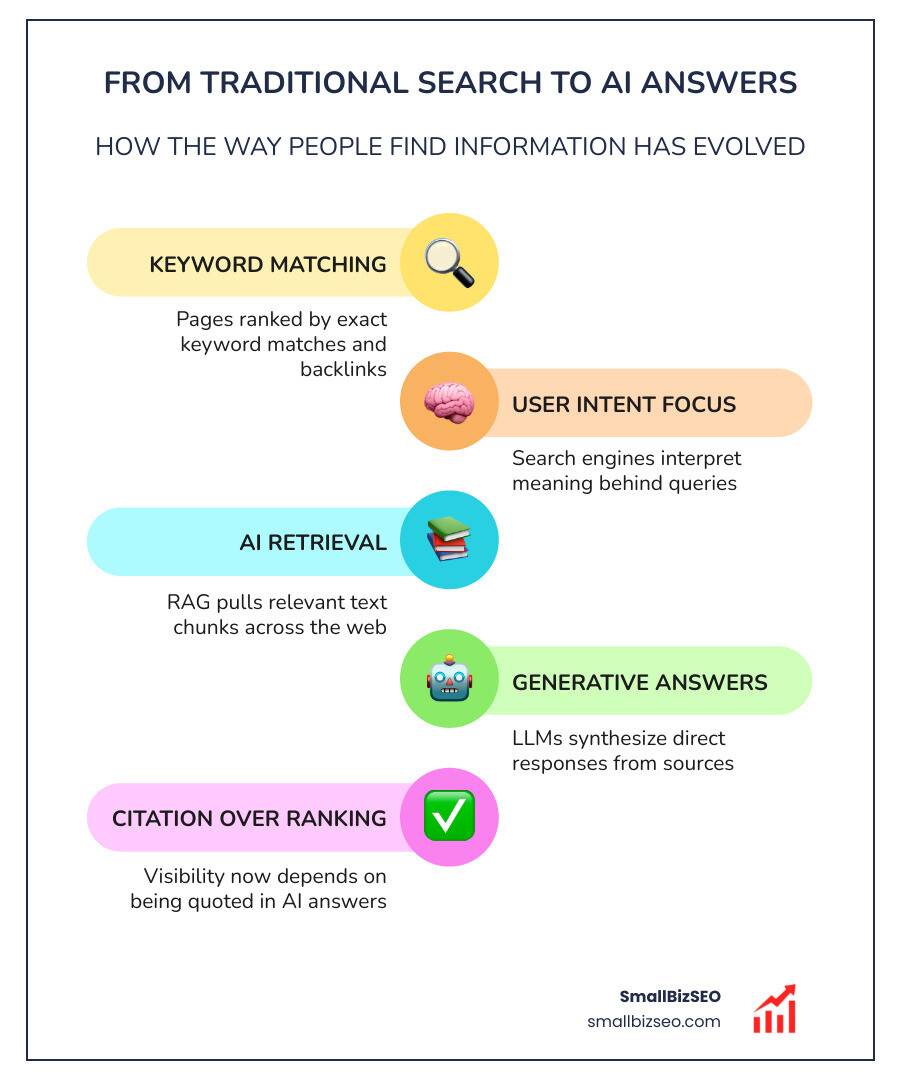
Traditional SEO historically focused on matching keywords, earning backlinks, and ranking on the first page of search results. While those elements remain valuable, modern search engines utilize Generative Engine Optimization (GEO) to synthesize answers on the fly.
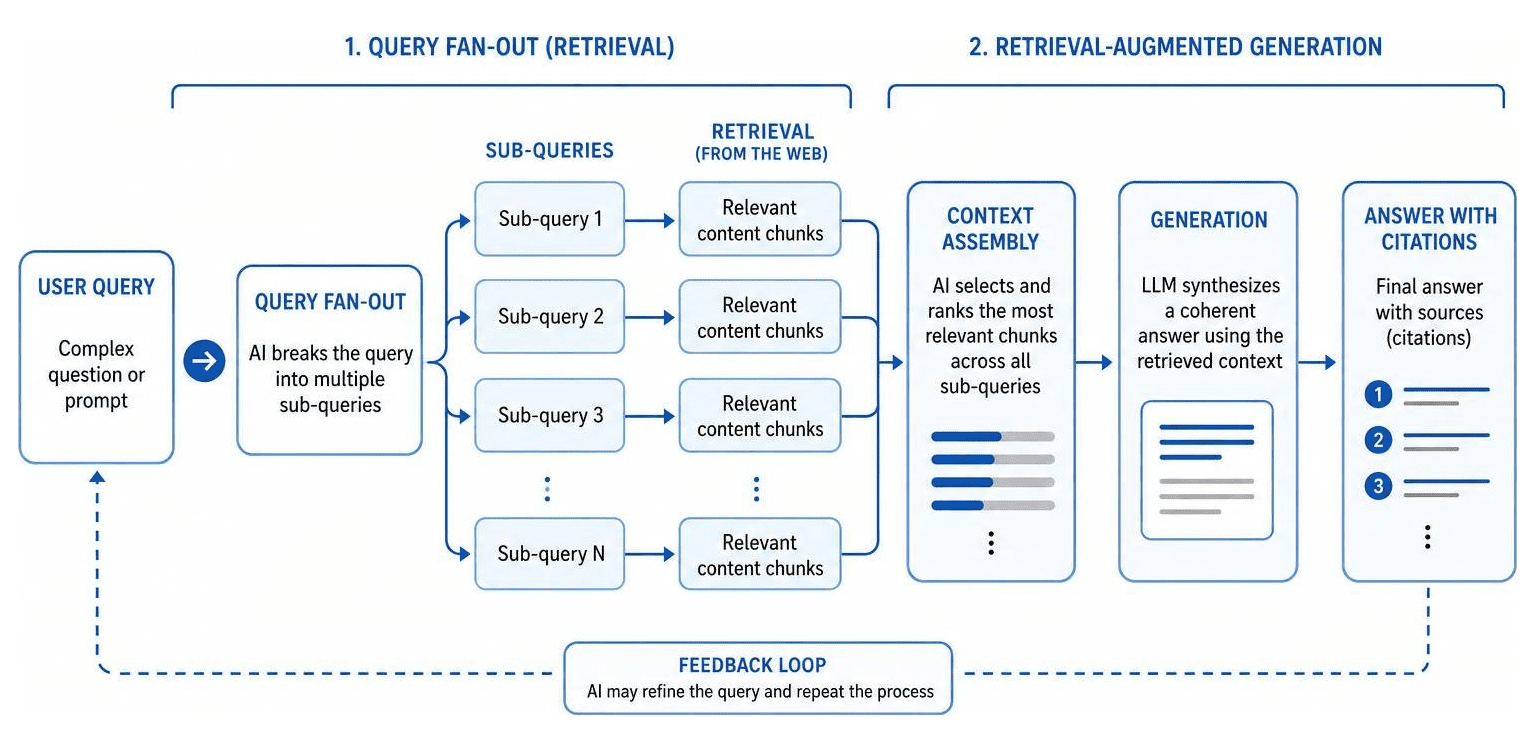
To understand this shift, we must look at how AI search engines process information. AI engines rely on Retrieval-Augmented Generation (RAG). Instead of simply pulling a list of links, the AI retrieves relevant chunks of text from across the web and uses a large language model to generate a cohesive answer.
During this process, AI engines perform what is known as query fan-out. When a user asks a complex question, the AI breaks it down into multiple concurrent sub-queries to fetch the most accurate information. If your content does not directly answer these sub-queries, you will be left out of the synthesized response. This is why adapting your approach with a comprehensive AI SEO Guide is critical for modern visibility.
Classic On-Page SEO is still the foundation of discovery, but GEO requires us to focus on how easily an AI model can extract, understand, and cite our content.
Core Pillars of AI-Driven Content Optimization
To optimize for AI engines, we must move away from generic, commodity content. AI engines prioritize high factual density and original perspectives. If your article simply summarizes what is already on the web, an AI has no reason to cite you. We must create comprehensive comparison content, original research, and detailed guides that offer genuine value.
Structuring Content for AI SEO Practice and Extractability
AI models do not read pages the way humans do; they extract semantic passages. To make your content highly extractable, use a direct-answer architecture.
Begin your sections with a clear, concise summary (under 120 words) that directly answers the user's query. Follow this with semantic HTML tags (H2s, H3s, and bulleted lists) to organize the details.
According to our ChatGPT SEO Guide, structuring your content with clear, question-based headings makes it incredibly easy for LLMs to parse and quote your pages. This goes Beyond Content Optimization and ensures your site layout is inherently machine-readable.
Building Authority and E-E-A-T Signals for LLM Citations
AI engines are highly sensitive to E-E-A-T signals. Because they must guarantee the accuracy of their generated answers, they prefer citing highly authoritative sources.
Data shows that incorporating specific authority elements can dramatically boost your visibility in AI-generated answers:
- Citing high-quality external sources provides a 40% visibility boost
- Adding precise statistics and data points offers a 37% visibility boost
- Including direct expert quotations with clear attribution adds a 30% visibility boost
To build this level of trust, you must explicitly show who wrote your content, link to their professional profiles, and reference primary sources. For a step-by-step framework on establishing these trust signals, check out our guide on How to Optimize Your Content for E-E-A-T and Build Real Search Trust.
Integrating Traditional Keyword Research with AI SEO Practice
Keyword research is no longer about finding single high-volume search terms. Instead, we must target conversational queries, long-tail questions, and user-intent buckets.
When users interact with AI, they ask complete questions like, "What is the best way to clean a commercial kitchen floor without damaging the tile?" rather than typing "commercial kitchen cleaning."
To capture these queries, we must identify the exact questions our audience is asking and map them to our content hub. Performing a thorough Keyword Gap Analysis: What It Is and How to Do It Right will help you find the conversational queries your competitors are missing, giving you an open lane to secure AI citations.
Technical Optimizations for Generative Engines
Technical SEO ensures that AI crawlers can access, parse, and render your website without friction. If your technical foundation is broken, AI bots will bypass your site entirely.

To maximize compatibility with generative engines, focus on these core technical elements:
- Server-Side Rendering (SSR): Ensure your content is fully rendered in the raw HTML. Many AI crawlers do not execute JavaScript, meaning client-side rendered pages may appear completely blank to them.
- Crawlability: Double-check your robots.txt file to ensure you are not blocking major AI agents (such as GPTBot, ClaudeBot, and Google-Extended) if you want your site to be cited in their conversational answers.
- Structured Data: Implement JSON-LD schema markup to provide explicit context to search engines.
While traditional schema helps you win rich snippets, AI-specific metadata helps engines map relationships between entities. To align your site with the latest technical standards, refer to our framework on Google SEO & GEO.
Below is a comparison of how traditional schema markup translates into critical AI-specific metadata:
| Traditional Schema Element | AI-Specific Metadata / GEO Use Case | Impact on AI Search |
|---|---|---|
| Article Schema | Speakable Schema | Identifies text segments optimized for audio and conversational playback |
| Product Schema | Merchant Center / Direct Data Pulls | Feeds real-time pricing, stock, and specs directly into transaction engines |
| Author Schema | CreativeWork / SameAs links | Links content to verified digital entities to establish E-E-A-T |
| FAQ Schema | Direct Q&A Extraction | Provides pre-structured, extractable answers for immediate AI summaries |
Platform-Specific Optimization Strategies
The AI search landscape is fragmented. Different platforms use different web indexes, crawl the web differently, and prioritize different signals. To win, we must tailor our approach to each platform.
Optimizing for Google AI Overviews and Gemini
Google's AI Overviews are powered by Gemini and rely heavily on Google's core search index. To appear in these summaries, you must rank well in traditional search results and maintain an active Google Business Profile and Merchant Center account. Google uses these systems to verify local business details and product availability. If you run an e-commerce or local business, keeping these profiles updated is non-negotiable for zero-click visibility.
Optimizing for ChatGPT and Perplexity
ChatGPT and Perplexity operate differently from Google. ChatGPT relies primarily on the Bing index, while other agentic workflows use Brave. Perplexity is a citation-first engine that prioritizes factual density, structured tables, and direct answers.
To optimize for these environments, you must ensure your content is indexed in Bing and Brave, and structure your pages so they can be easily digested by developer tools. Utilizing resources like Claude Code Skills can help you build machine-readable formats that these platforms prefer.
Measuring Performance and Tracking AI-Driven Traffic
Measuring your success in an AI-driven search world requires a shift in metrics. Traditional keyword tracking tools do not capture the dynamic, personalized nature of AI-generated answers.

Instead, we must focus on:
- Brand Mentions: How often is your business mentioned in conversational answers?
- Share of Voice: What percentage of AI-generated recommendations in your niche feature your brand?
- Referral Traffic: Track traffic coming from domains like chatgpt.com, perplexity.ai, and google.com (specifically tracking AI Overview clicks).
- LLM Citations: Monitor how often your URLs are linked as source citations in synthesized answers.
By turning this raw Data Into Traffic, we can refine our content strategy to focus on the platforms and queries that drive the highest-converting users to our site.
Frequently Asked Questions About AI SEO
Does Google penalize AI-generated content?
No. Google's official guidelines state that they reward high-quality content, regardless of how it was created. However, they strictly penalize the use of AI or automation to generate low-quality, repetitive content designed solely to manipulate search rankings. If you use AI to assist your writing, ensure it is thoroughly reviewed, fact-checked, and enhanced with unique human insights.
What is the difference between ranking and citation in AI search?
Traditional ranking refers to where your link sits on a search results page. An LLM citation occurs when an AI engine extracts a specific passage from your website, synthesizes it into a conversational answer, and directly links to your page as the source. A page ranking in position six or seven can easily win the primary citation if its content is more extractable and authoritative.
Do I need special files like llms.txt for Google AI features?
No. Google does not require special machine-readable files like llms.txt to feature your content in its generative search experiences. While some community platforms and independent AI agents use llms.txt to parse websites, Google relies entirely on its core search index and standard web standards.
Conclusion
The search landscape is changing rapidly, but businesses that adapt their AI SEO practice today will secure a massive competitive advantage. By structuring your content for extractability, building undeniable E-E-A-T signals, and maintaining a flawless technical foundation, you can ensure that both humans and robots love your website.
At SmallBizSEO, we help small businesses navigate this transition. Our data-driven "Velocity" framework delivers fast rankings and E-E-A-T-compliant growth through transparent, automated reporting. Ready to future-proof your search visibility? Explore our AI SEO Services today and let us help you lead the way in the era of AI search.