11 AI Hallucination Statistics Highlighting Critical Enterprise Risks

11 AI Hallucination Statistics Highlighting Critical Enterprise Risks
Why do AI hallucination error rates matter to businesses?
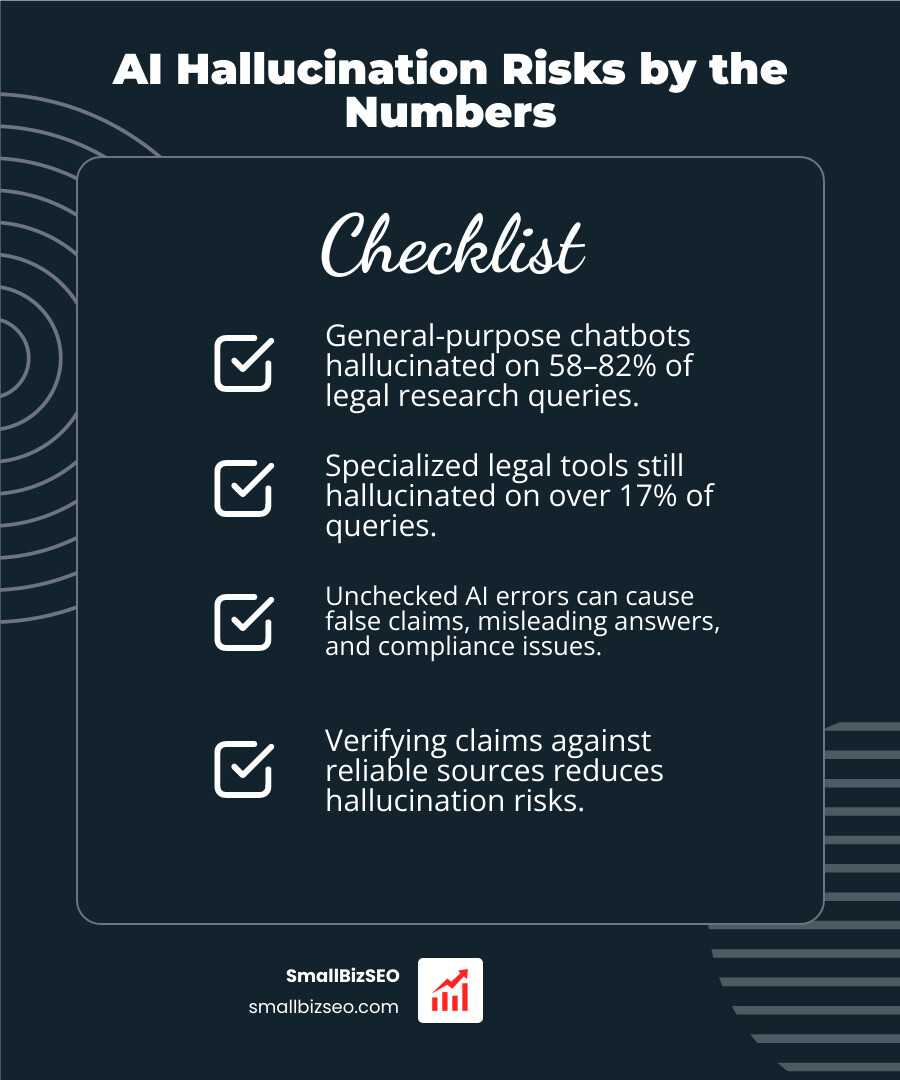
AI hallucination statistics on error rates, misinformation, and business risks show there is no single error rate for every AI tool. Results depend on the model and the task. In a study of legal research queries, general-purpose chatbots produced hallucinated answers on 58% to 82% of queries. Specialized legal tools made fewer errors, but still hallucinated on more than 17%.
An unchecked error can turn into a false claim on a website, a misleading customer answer, or a compliance problem. Checking claims against reliable sources before using or publishing them helps reduce that risk.
I'm Clayton Johnson, founder of SmallBizSEO, where I work on SEO and content built for search and AI-generated answers. I bring that focus on clear, credible information to AI Hallucination Statistics: Error Rates, Misinformation, and Business Risks.
Relevant articles related to AI Hallucination Statistics: Error Rates, Misinformation, and Business Risks:
- Consumer Trust in Artificial Intelligence: Survey Statistics and Buying Behavior
- AI Search vs. Traditional Search: Traffic, Clicks, and Conversion Benchmarks
- How Frequently Do AI Search Engines Change Their Recommendations? Citation Consistency Statistics
At its core, a large language model operates through statistical pattern matching and next-token prediction rather than genuine comprehension. When an AI generates a response, it selects the next most probable word based on training data associations. If the prompt creates ambiguity, or if the underlying training set lacks specific coverage, the model invents plausible-sounding details to satisfy the query. For teams tracking critical generative AI statistics every business owner should know, understanding these technical blind spots is essential before deploying automated workflows.
What Do AI Hallucination Statistics Reveal About Error Rates, Misinformation, and Business Risks?
Direct Answer: Documented error rates range from under 1% for basic summarization of clean text to more than 80% on complex domain-specific tasks, proving that high-stakes applications require mandatory factual verification layers.

The frequency of AI errors shifts drastically depending on task complexity, context length, and domain specialization. While standard text summarization tools often show lower baseline discrepancies, open-domain recall and specialized professional analyses present substantial error margins.
| Model Architecture / Tool Type | Benchmark / Query Type | Documented Error / Hallucination Rate | Primary Failure Mode |
|---|---|---|---|
| General-Purpose LLMs | Open-ended factual benchmarks | 22% – 94% | Ungrounded token confabulation |
| General-Purpose Chatbots | Complex legal queries | 58% – 82% | Phantom case law and fake precedent |
| Specialized Legal RAG Tools | Domain-specific legal research | 17% – 33% | Faithfulness and context retrieval errors |
| Advanced Reasoning Models | PersonQA & entity facts | 33% – 48% | Over-generation in reasoning chains |
| General LLMs on Private Data | DACH mid-market corporate profiles | 68% – 96% | Fabricated executive and company facts |
| Document-Grounded Systems | Clean, short-context summarization | 0.7% – 2.0% | Minor semantic entity drift |
Independent academic analyses, including scientific research on addressing AI hallucinations and bias, show that model drift and stochastic token selection frequently cause systems to generate false information with high confidence. When multiple autonomous AI agents pass unverified outputs to one another, these initial errors compound rapidly across the chain, eroding user confidence and consumer trust in artificial intelligence.
What Do AI Hallucination Statistics on Error Rates, Misinformation, and Business Risks Reveal About Foundation Models?
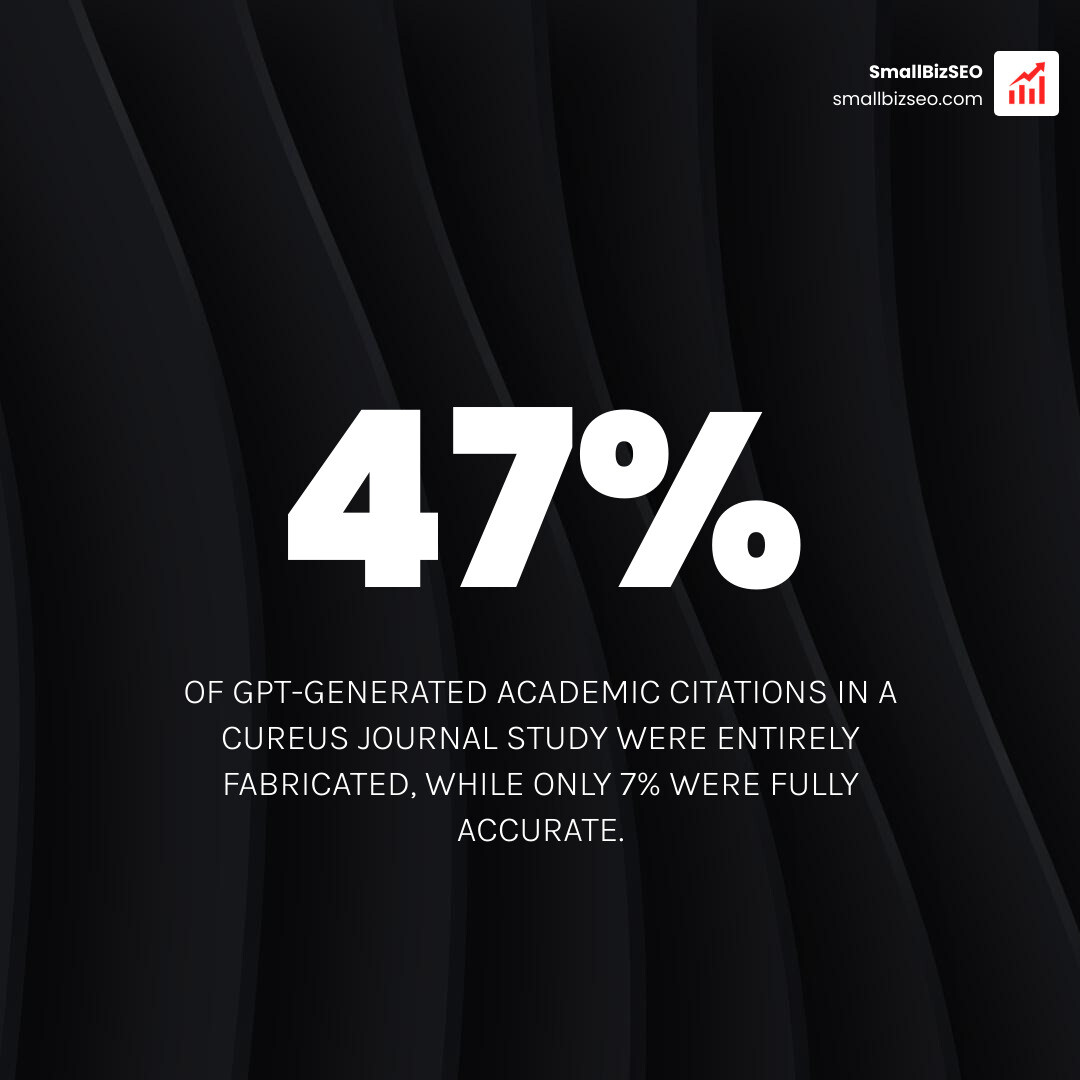
General-purpose foundation models demonstrate surprising variance across different information categories. In legal research evaluations conducted by Stanford HAI, baseline models produced inaccurate or fabricated legal assertions in 58% to 82% of responses. The medical domain faces similar challenges; a study published in the Cureus Journal of Medical Science evaluated GPT-generated academic citations and discovered that 47% were entirely fabricated, 46% referenced genuine journals but attached false information, and only 7% were fully accurate.
Recent studies establishing a conceptual framework for studying AI hallucinations highlight that complex reasoning architectures—such as OpenAI o3 and DeepSeek-R1—can actually produce higher factual error rates on specific recall tasks than simpler models. Because reasoning models output longer, multi-step chains of logic, any early miscalculation compounds across every subsequent deduction.
In corporate environments, empirical testing by maxonline across 150 mid-market companies revealed that general AI models fabricated CEO names 96% of the time, produced incorrect founding years in 78% of queries, and missed actual employee counts in 68% of cases. When organizations produce digital assets, balancing massive output with human quality is mandatory to prevent widespread factual degradation.
How Severe Is AI Misinformation Across Legal Filings, Healthcare, and Public Records?
Direct Answer: Unverified AI outputs have generated hundreds of fake court precedents, flawed public policy plans, and inaccurate medical literature citations, leading to real-world judicial sanctions and severe contract cancellations.
The real-world consequences of unverified AI outputs are documented across global court dockets and public institutions. Following the landmark Mata v. Avianca case—where attorneys were sanctioned for submitting non-existent case law produced by a chatbot—judicial oversight has escalated:
- Judicial Sanctions: Court records indicate hundreds of formal decisions addressing fabricated AI citations, with hundreds of documented cases recorded across judicial bodies.
- International Tribunals: Canadian administrative tribunals recorded over 160 formal filings containing fictitious citations across 51 separate courts, while Israeli judicial bodies documented dozens of similar submissions.
- Government Strategy Failures: A major advisory firm submitted an A$440,000 public policy report to the Australian government containing fabricated case quotes and non-existent academic references. A separate CA$1.6 million healthcare human resources plan for Newfoundland and Labrador similarly cited fabricated academic studies.
- Scientific Publishing: Analyses of competitive technical venues, including NeurIPS, revealed artificial citations embedded in peer-reviewed submissions.
In clinical decision support, the risks are particularly pronounced (Hatem et al., 2023). Fabricated medical literature identifiers (DOIs) and false clinical correlations threaten patient safety if clinicians rely on automated summaries without direct verification. In digital marketing and publishing, maintaining rigorous E-E-A-T SEO for search and data reliability ensures enterprise content remains trusted by search engines and users alike.
How Can AI Hallucinations Affect Corporate Due Diligence?
Direct Answer: Hallucinated data injects phantom assets, incorrect financial benchmarks, and false regulatory records into deal workflows, leading to valuation miscalculations, compliance penalties, and major brand damage.
Unchecked errors inside M&A data rooms and financial forecasting models create severe financial exposure:
- Transaction Valuation Losses: When deal teams rely on automated document reviews, unverified summaries can miss critical tax declarations or invent non-existent intellectual property assets, leading to multi-million-dollar post-close liabilities.
- Consulting Deliverable Errors: Research into consulting deliverables indicates that 46% of AI-generated numerical metrics are either provably incorrect or unverifiable, creating substantial errors and omissions (E&O) insurance liabilities.
- Regulatory and Governance Scrutiny: Regulatory bodies, including the SEC, enforce strict truth-in-reporting standards. Misrepresenting operational capabilities or relying on unverified datasets creates severe regulatory exposure.
- Brand and Productivity Costs: Research indicates brand damage from public AI misinformation averages $2.1 million per incident for mid-sized enterprises. Meanwhile, employees spend hours each week manually fact-checking ungrounded outputs, costing thousands of dollars per knowledge worker annually in administrative overhead.
How Can Organizations Reduce AI Hallucination Risks?
Direct Answer: Organizations can minimize AI errors by pairing retrieval-augmented generation (RAG) with deterministic calculation layers, structured confidence scoring, and structured human-in-the-loop validation workflows.
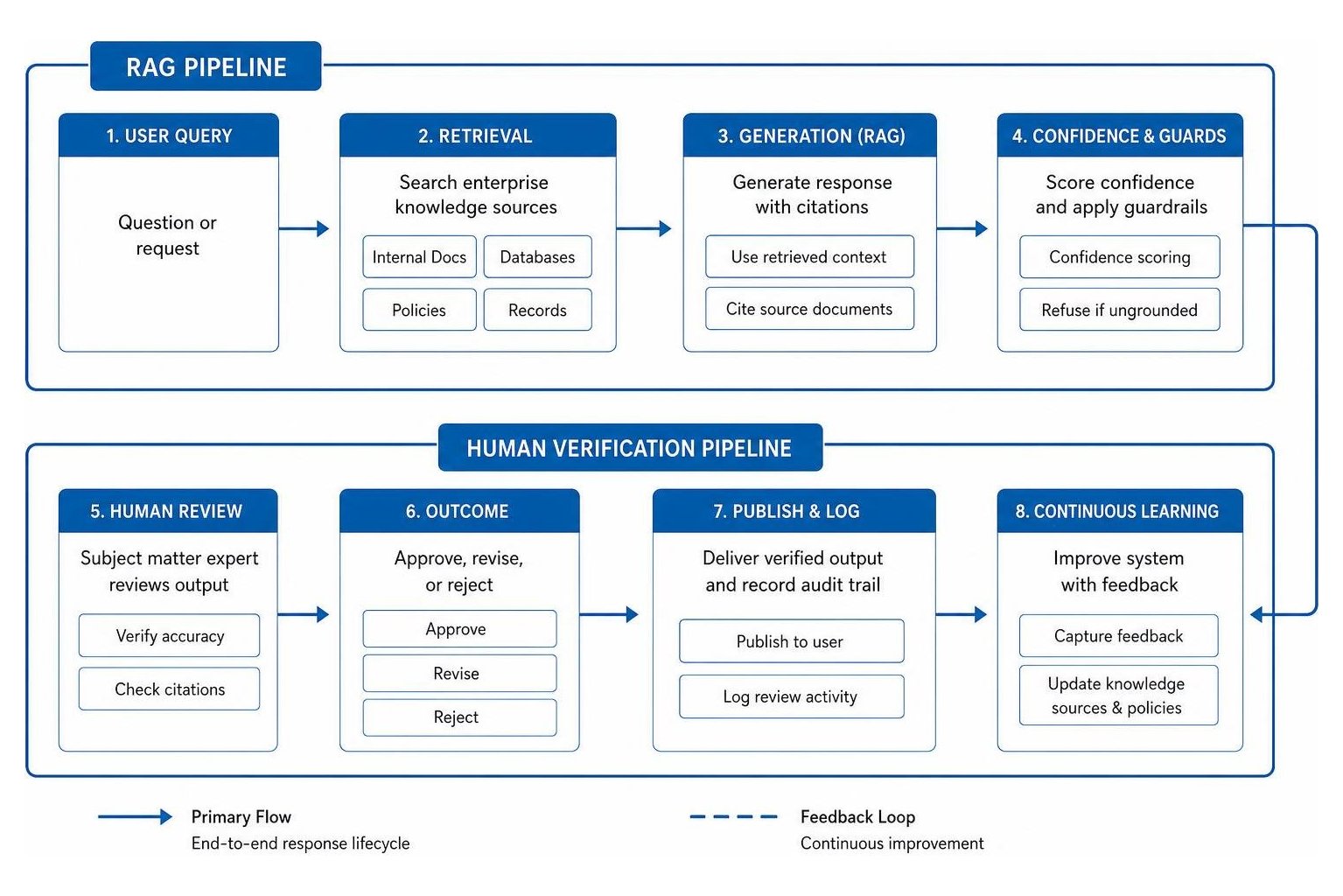
Relying purely on raw generative models creates unacceptable business liabilities. Building an enterprise verification stack requires deterministic boundaries that force systems to cite verified internal documents and refuse to answer when data is absent. Performing a comprehensive AI SEO audit helps identify where ungrounded assumptions might exist in your public-facing footprint.
What Technical and Governance Strategies Most Effectively Reduce Hallucination Rates?
Engineering robust generative pipelines requires combining technical guardrails with clear operational governance. Executive surveys show that 83% of enterprise leaders consider formal AI governance essential to sustainable automation.
To reduce factual drift, enterprise engineering teams rely on several proven controls:
- Retrieval-Augmented Generation (RAG): Grounding model prompts with relevant, verified internal documentation prevents open-ended fabrication by limiting the model's response to trusted source data.
- Explicit Abstention Conditioning: Setting system prompts to output "I do not have sufficient information" rather than guessing prevents models from confabulating when confidence drops below preset thresholds.
- Deterministic Computation Layers: Routing numerical, arithmetic, and financial queries through deterministic calculation tools rather than probabilistic text generation models ensures mathematical accuracy.
- Structured Format Constraints: Forcing outputs into strict JSON or schema-validated fields eliminates rambling conversational tangents where hallucinations most commonly emerge.
- Temperature Optimization: Lowering model temperature settings reduces token randomness for factual, compliance-heavy tasks.
How Can Enterprise Teams Build Transparent Verification and Audit Workflows?
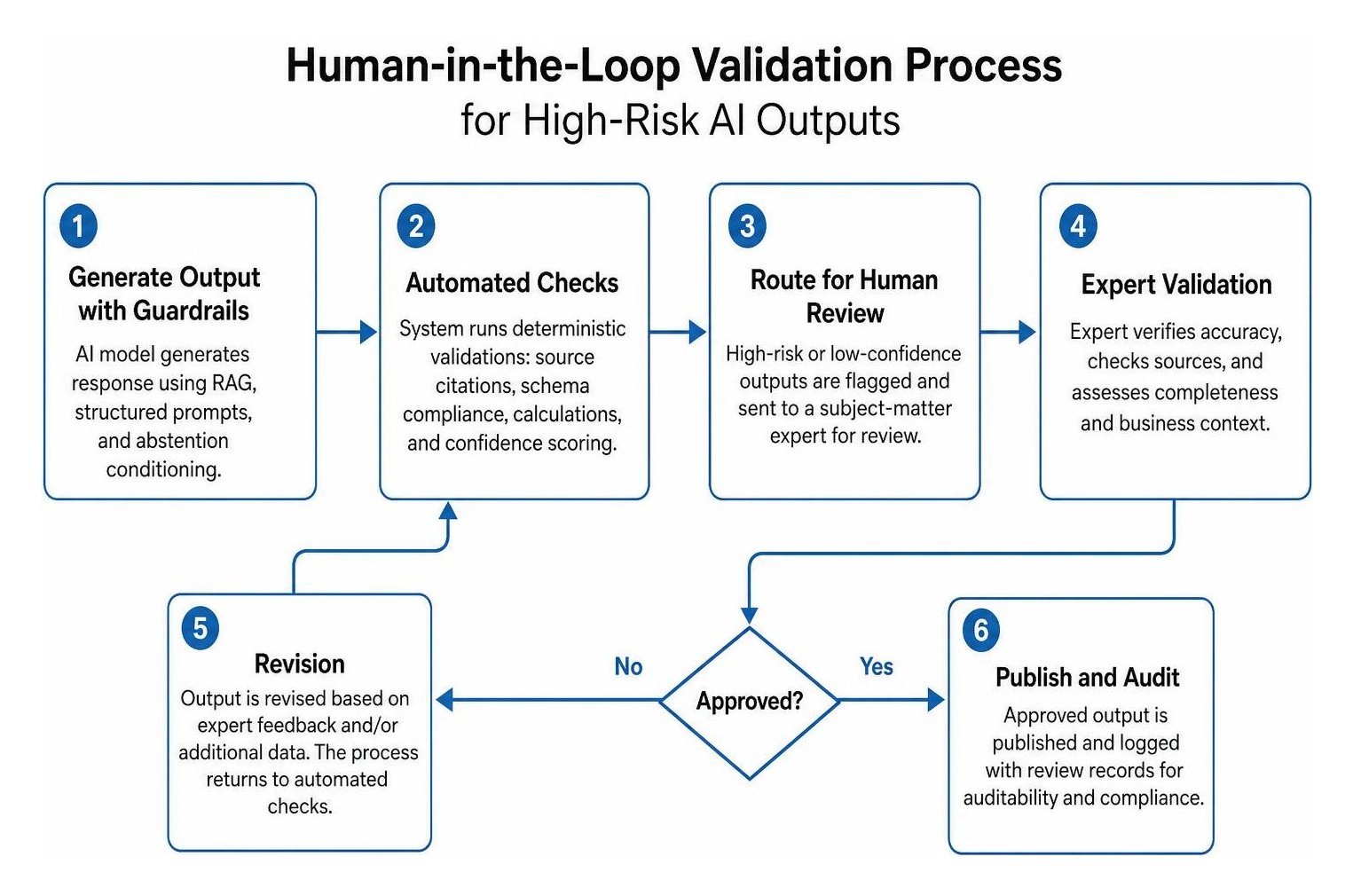
Technology alone cannot replace professional accountability. Enterprise teams must establish structured human-in-the-loop (HITL) processes where subject-matter experts review mission-critical outputs before public release or client delivery.
At SmallBizSEO, we implement strict data verification standards across all our technical and digital strategies. By combining rigorous citation checks with our specialized data-driven AI SEO services and optimization, we help organizations publish accurate, authoritative content that builds long-term industry credibility and search visibility.
Practical Steps to Protect Your Enterprise from AI Misinformation
Establishing reliable AI operations requires treating factual accuracy as an engineering discipline. Generative tools offer immense speed, but without explicit retrieval systems, deterministic checks, and human oversight, probabilistic models will inevitably fabricate facts. By measuring baseline error rates, establishing strict internal governance, and verifying every high-stakes claim against source records, your organization can leverage the efficiency of generative AI while safeguarding compliance, customer trust, and brand equity.
References
Hatem R, Simmons B, Thornton JE. "A Call to Address AI "Hallucinations" and How Healthcare Professionals Can Mitigate Their Risks.." Cureus, 2023. PMCID PMC10552880.