Why Google Trust Signals Make or Break Small Business Search Rankings

Why Google Trust Signals Make or Break Small Business Search Rankings
How can a small business put E-E-A-T SEO to work?
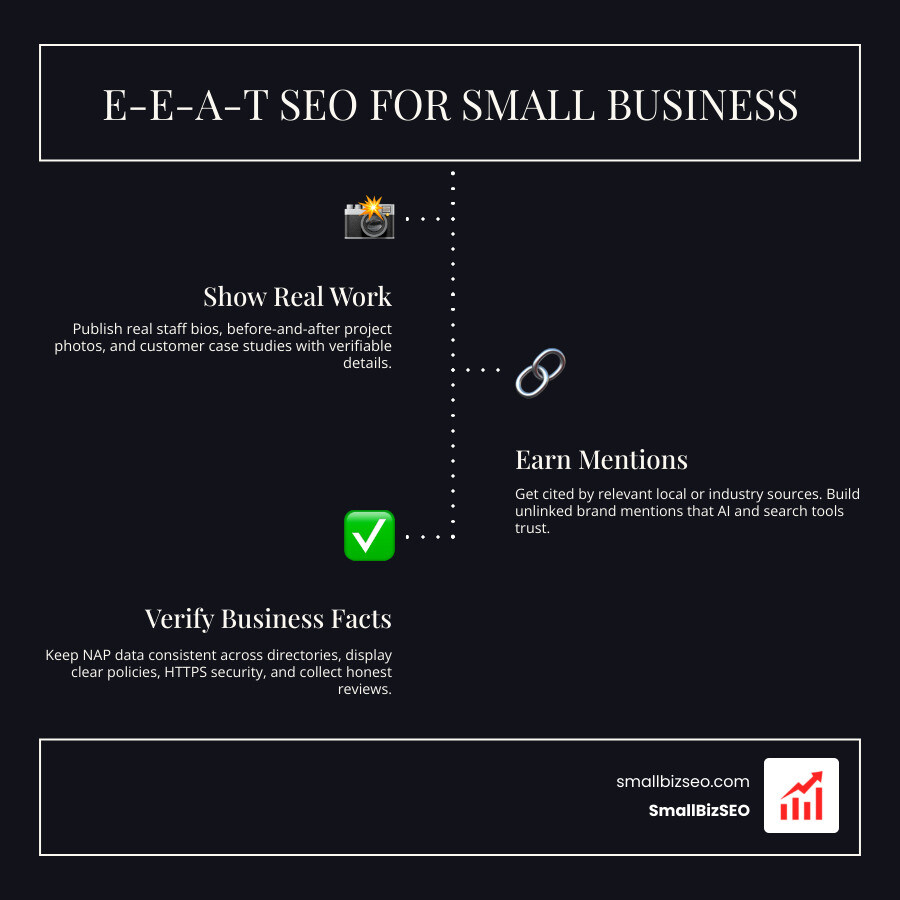
Start with proof customers can check: add real staff bios, publish photos and details from completed work, keep your contact information and policies current, and ask for honest reviews. Then earn mentions from relevant local or industry sources. Show what your business has done, not just what it claims to know.
E-E-A-T stands for experience, expertise, authoritativeness, and trustworthiness. It comes from Google's search quality guidelines, but it is not a single ranking score. Clear, verifiable information also makes it easier for people and AI search tools to understand your business.
I'm Clayton Johnson, founder of SmallBizSEO, and I help owners apply E-E-A-T SEO for small business websites through useful content and digital PR. My Answer-Ready SEO approach focuses on clear answers, evidence, and consistent business facts.
Know your E-E-A-T SEO small business terms:
- Why Getting Found Matters
- Local SEO Optimization and Small Business Growth
- Why Transparent SEO Reporting Is Non-Negotiable for Growth-Stage Founders
How to Implement E-E-A-T SEO for Small Business Sites Step-by-Step
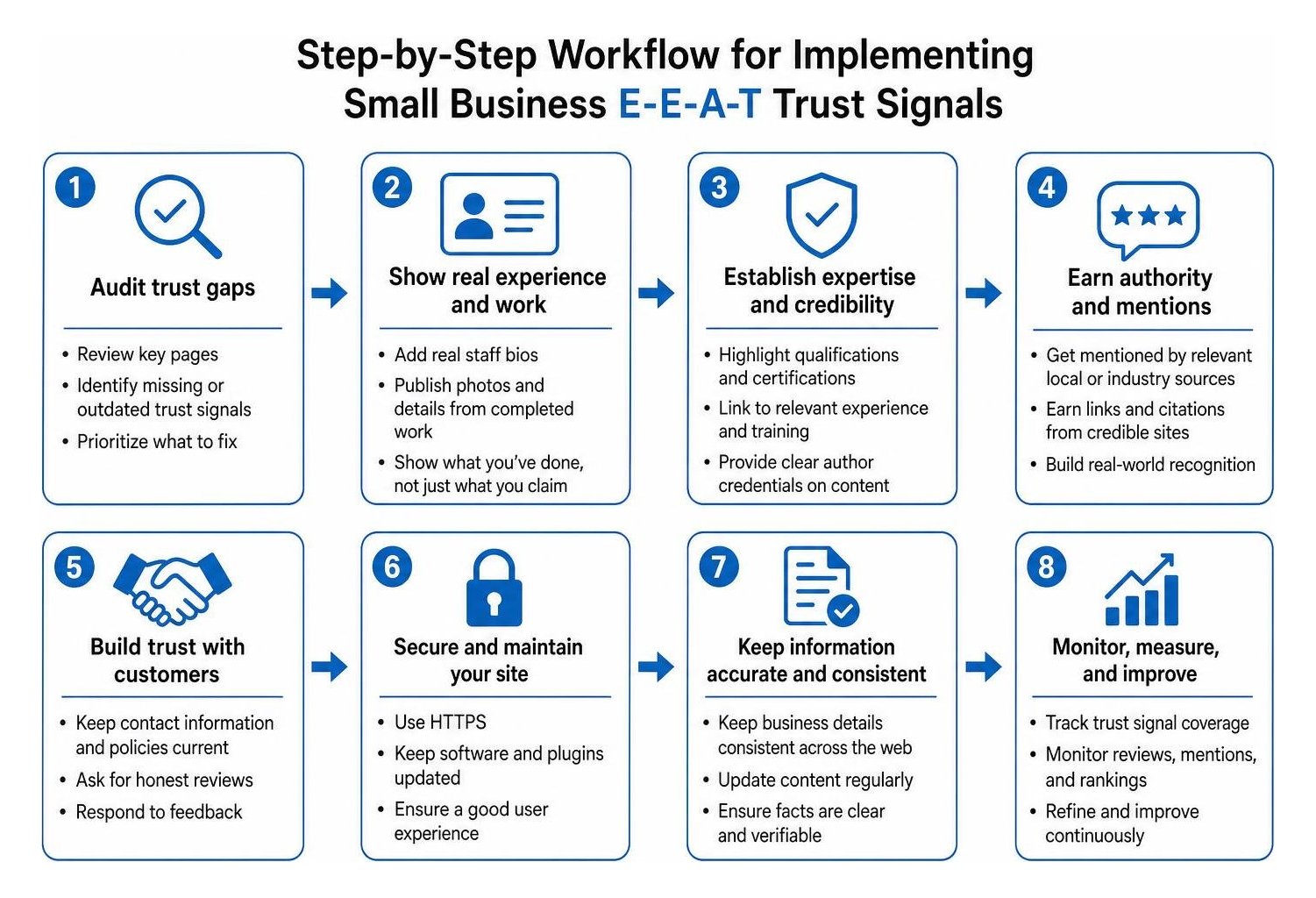
To implement E-E-A-T on your website, audit your existing pages for trust gaps, publish verifiable proof of your hands-on work, establish clear author credentials, and secure your site infrastructure. Focus on providing real-world operational receipts that automated content generators cannot copy.
Building site-wide trust requires a repeatable workflow that bridges on-page proof with off-page authority. By systematically optimizing site-wide trust signals, small brands turn their day-to-day customer interactions into search engine credibility.
What Is E-E-A-T SEO for Small Business and Why Does Google Prioritize It?
E-E-A-T stands for Experience, Expertise, Authoritativeness, and Trustworthiness. It is a quality evaluation framework used by Google's human Search Quality Raters to determine whether a web page provides helpful, reliable, and authentic value to searchers.
Search engines prioritize these signals because automated text generation has flooded the web with generic summaries. For commercial queries and Your Money or Your Life (YMYL) topics—such as legal counsel, medical guidance, pet care, or financial services—unsubstantiated claims can harm consumers. By following proven frameworks for E-E-A-T for small businesses, smaller companies can leverage real-world credibility to compete directly against massive corporate aggregators.
How Can You Prove First-Hand Experience and Deep Expertise Online?
You can prove first-hand experience by publishing original case studies, before-and-after project photos, real operational data, and transparent walkthroughs of your everyday customer solutions.
Expertise is verified through detailed author bylines, educational backgrounds, trade licenses, and industry accreditations. Instead of generic advice, share specific project constraints, tools used, and lessons learned. When optimizing content for real search trust, factual substance always wins over word count. A 600-word breakdown featuring actual project data routinely outperforms a 2,000-word generic summary.
| Content Element | Theoretical Expertise (Generic) | Proof-of-Work Experience (High E-E-A-T) |
|---|---|---|
| Author Attribution | "Admin" or anonymous team profile | Named practitioner with license numbers and direct bio |
| Visual Evidence | Stock photography and vector illustrations | Original job site photos, workshop images, or project notes |
| Problem Solving | Generic list of standard tips | Step-by-step breakdown of a specific customer challenge |
| Data & Metrics | Broad industry generalizations | Real timelines, exact measurements, and measured outcomes |
| Mistake Handling | Ignores operational friction | Explains what went wrong, constraints faced, and fixes applied |
What Are the Best Ways to Build Authority and Rock-Solid Trust?
The most effective ways to establish authority and trust are maintaining consistent business information across all web directories, securing your site with HTTPS, generating genuine customer reviews, and implementing structured schema markup.
Trust serves as the foundational anchor of the entire E-E-A-T framework. Research shows that switching to HTTPS delivers a 13% lift in search rankings, while 88% of consumers trust online reviews as much as personal recommendations. Furthermore, businesses accumulating 50 or more verified customer reviews rank noticeably higher in local search results.
To maximize these authority signals, review our comprehensive local SEO guide and consult practical industry resources like the Guide To SEO For Small Businesses. Earning 10 relevant, high-quality backlinks from respected local and industry sources will consistently outperform 100 low-quality web directory submissions.
What Common Mistakes Undermine E-E-A-T SEO for Small Business Brands?
Common mistakes that damage trust include using anonymous author bylines, relying heavily on stock photos, publishing thin AI-generated text without human review, and leaving business contact information hidden.
Failing to maintain transparent terms of service, ignoring negative customer feedback, or silently modifying older blog posts without clear update timestamps signals poor editorial accountability. Following a structured guide to improving company website performance ensures that technical trust issues never drag down your search performance.
Measuring Trust Gains and Future-Proofing for AI Search Engines
To track your credibility gains, monitor branded search impressions in Google Search Console, review incoming backlink quality, analyze customer review velocity, and test your brand presence across major AI answer engines.
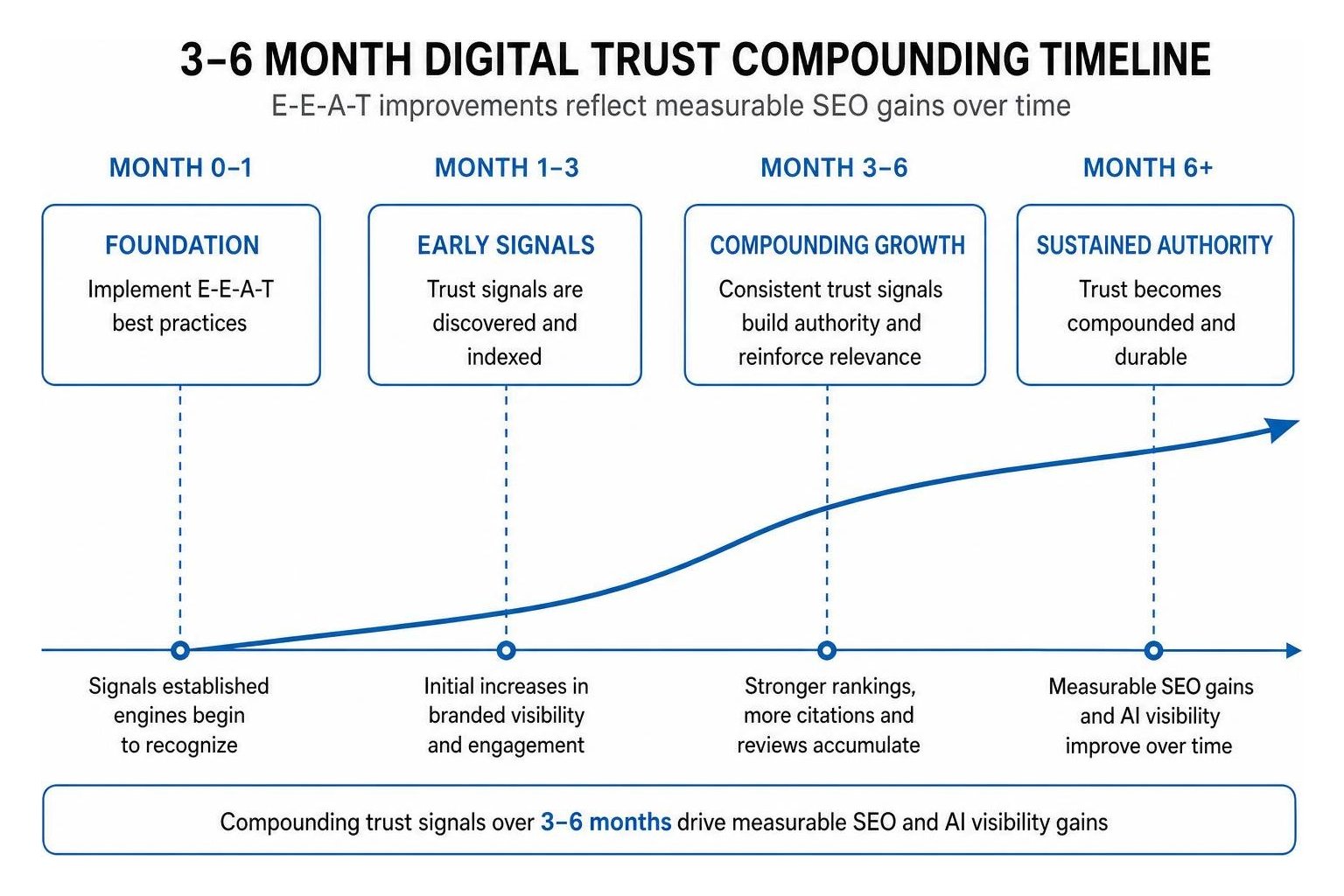
E-E-A-T improvements typically require 3 to 6 months to reflect measurable SEO gains. We manage this process using our data-driven Velocity framework within our comprehensive data-driven SEO services, ensuring small businesses maintain continuous algorithmic credibility.
Here are the essential trust-building steps to execute every quarter:
- Audit and reconcile canonical business name, address, and phone details across all major platforms.
- Update staff and founder bios with current certifications, licenses, and verified professional profiles.
- Publish at least three in-depth case studies featuring original photos, project metrics, and client challenges.
- Implement structured Schema.org markup for Organization, LocalBusiness, and Person entities.
- Solicit organic customer feedback on independent review platforms and respond professionally to all submissions.
- Secure site architecture with modern security protocols and maintain clear, accessible privacy documentation.
How Does E-E-A-T Impact Visibility in AI Overviews and Chat Search?
E-E-A-T directly dictates whether large language models and search engines cite your website as an authoritative source in AI Overviews and conversational answer interfaces.
Large AI models rely on verified web entities to minimize hallucinations. Independent studies indicate that branded web mentions share a strong correlation (0.66 to 0.71) with AI visibility across conversational search engines, substantially outperforming traditional link volume alone. Additionally, YouTube brand mentions show a 0.737 correlation with AI citation selection, underscoring the necessity of multi-channel proof.
How Do You Audit and Track Your Website's Real-World Search Authority?
You can audit your search authority by tracking branded query volume, monitoring external media mentions, verifying structured data validity, and conducting periodic incognito queries in AI answer engines.
Because Google does not issue a single public E-E-A-T metric, monitor surrogate signals:
- Branded Search Trends: Track impressions for your company name and key personnel in Google Search Console.
- Review Accumulation: Measure the steady influx of detailed, authentic customer reviews across trusted third-party sites.
- Citation Checks: Regularly prompt AI search tools with industry-specific queries to see if your brand is cited as a local solution.
- Entity Association: Verify that your structured data accurately connects your brand with relevant industry bodies and verified credentials.
Turn Your Real-World Experience Into Lasting Search Visibility
Search algorithms and AI discovery platforms reward businesses that demonstrate undeniable proof of their craft. Polish and corporate buzzwords cannot replace first-hand execution, transparent customer relationships, and verified expertise.
By embedding genuine project proof, showcasing credentialed team members, securing your technical assets, and fostering authentic client reviews, you create a defensible digital footprint that outlasts algorithm updates. Take the time to document your real-world achievements today, and establish your business as the most trusted authority in your market.