Auditing AI Research Agents: How to Verify Sources and Define True Done

How can you tell whether an AI research agent is reliable?
Knowing how to evaluate an ai research agent's sources and stopping criteria starts with two checks. First, open the sources behind its key claims: confirm each source is real, current enough for the question, and actually supports the claim. Then check why the agent stopped: it should have enough evidence to answer, stay within its time and cost limits, and flag missing or conflicting facts instead of guessing.
I'm Clayton Johnson, founder of SmallBizSEO, where I'm developing specialized AI agents for SEO and business research. That work has made the question of how to evaluate an ai research agent's sources and stopping criteria a practical concern for me: can someone check the evidence and trust the decision to stop?
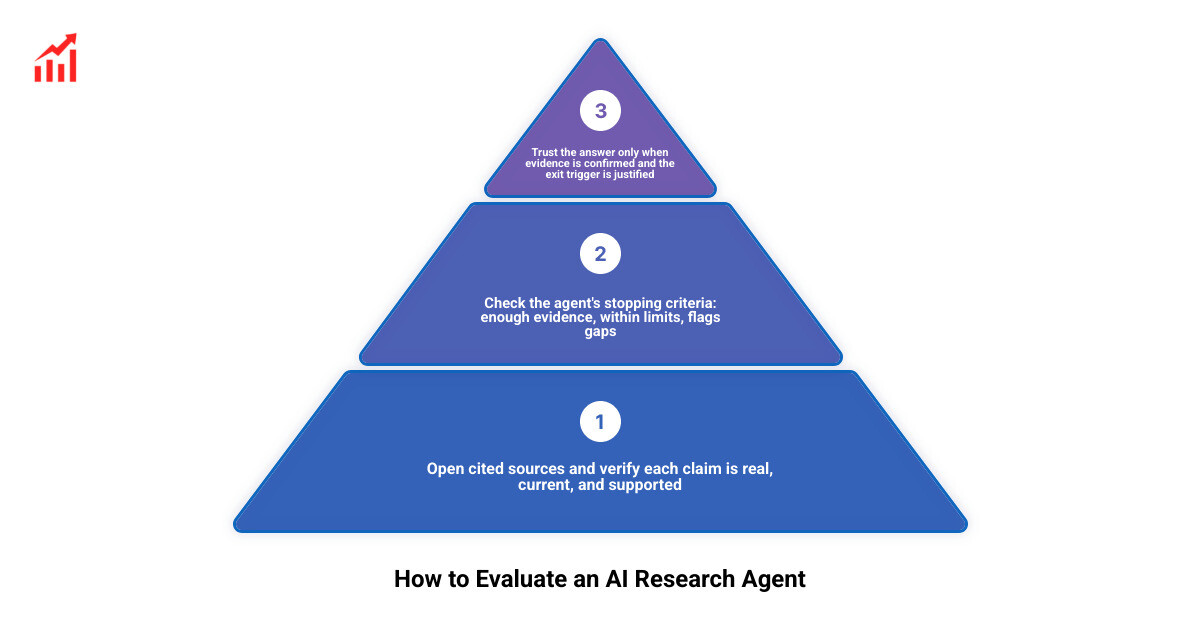
Core Framework: How should you evaluate an AI research agent's sources and stopping criteria?
To evaluate an autonomous research agent systematically, audit what it reads before auditing what it writes, then confirm its exit trigger matched verified progress rather than accidental limits.
A well-architected agent framework separates model choices from execution scaffolding. When an agent runs a multi-step investigation, its tool-calling layer executes web queries, retrieves raw pages, extracts key passages, and determines next steps. Evaluating this process requires two clear phases: auditing evidence lineage and verifying the stopping decision against a defined task contract.
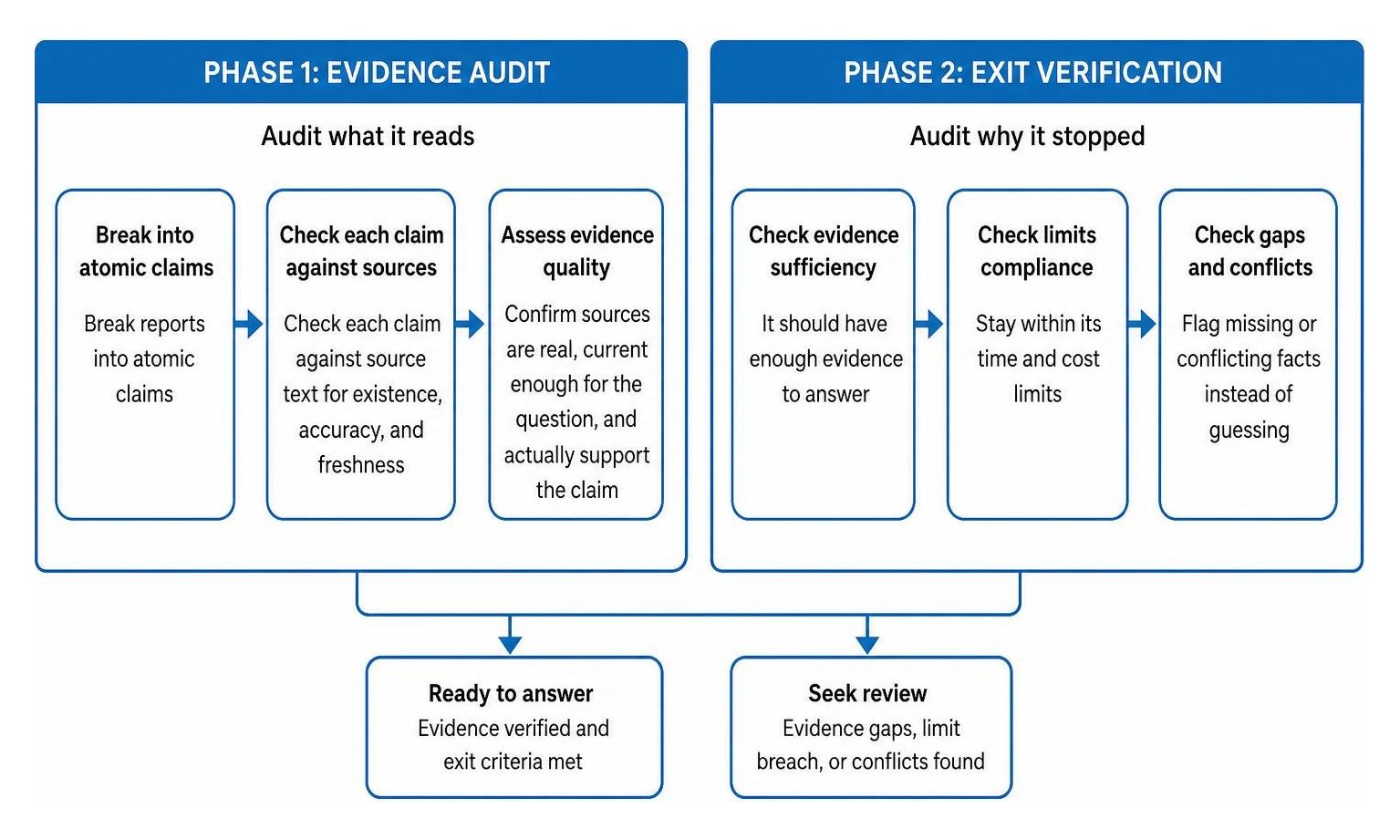
Phase 1: How can you check an AI research agent's evidence quality?
You check evidence quality by breaking reports into atomic claims and checking each claim against source text for existence, accuracy, and freshness.
When an autonomous system performs Agentic Search, its web retrieval layer selects either primary records or secondary summaries. Research shows that citation accuracy across autonomous discovery systems ranges between 40% and 80%, with fabricated URLs appearing in up to 13% of unverified runs. Following academic protocols like the Harvard Literature Review and Data Exploration Guide, teams must audit references programmatically rather than relying on language model self-checks.
Every verified assertion requires a Grounded Answer that passes four validation checks:
- Source Provenance: Verify whether the agent accessed first-party documentation, corporate regulatory filings, or authorized databases rather than SEO-shaped content aggregators.
- Link and Identifier Validation: Perform automated HTTP and DOI lookups. A citation failing to return a valid 200 status code or mismatched document metadata represents a fatal verification error.
- Claim-Level Entailment: Inspect the exact excerpt stored in the agent's context cache. The source text must explicitly support the specific metric or statement made in the final report.
- Observation Timestamps: Retain retrieval timestamps to ensure time-sensitive data reflects current facts rather than outdated cached records.
As highlighted in Princeton's survey on Emerging Trends in AI Agent Evaluation, separating model reasoning from the scaffold and retrieval layer is essential because tool choice and query structuring set the performance ceiling for the entire research run.
Phase 2: When should an AI research agent stop searching?
An AI research agent should stop searching when it hits evidence saturation, reaches diminishing returns on novelty, runs into strict budget guardrails, or detects unresolvable ambiguities.
Unlike static RAG architectures that run a single retrieval pass, an iterative LLM research loop decides dynamically whether to gather more evidence or synthesize an answer. A typical deep investigation requires 15 to 30 queries. At $0.05 per standard API query with downstream parsing, a research run costs between $1.00 and $2.00; using targeted dense-excerpt retrieval at $0.005 per query reduces that cost to roughly $0.10 to $0.20 per run.
Balancing thoroughness against operating cost places an agent along a cost-accuracy Pareto frontier, where optimal systems achieve maximum claim accuracy at minimal token expenditure.
| Stopping Trigger Type | Specific Exit Condition | Primary Risk Trade-Off |
|---|---|---|
| Evidence Saturation | Zero new unique claims extracted across three consecutive search loops | Low risk of missing data; minor added token cost |
| Diminishing Returns | Cost per newly discovered factual claim exceeds defined dollar threshold | Balances cost and depth; risks missing complex edge cases |
| Budget Governor | Hard limit hit (e.g., maximum 12 tool loops, 120 seconds, or $2.00 spend) | Eliminates runaway billing loops; can cause incomplete reports |
| Ambiguity or Safety Stop | Target entity cannot be uniquely identified or source access is restricted | Prevents hallucinations; requires human escalation path |
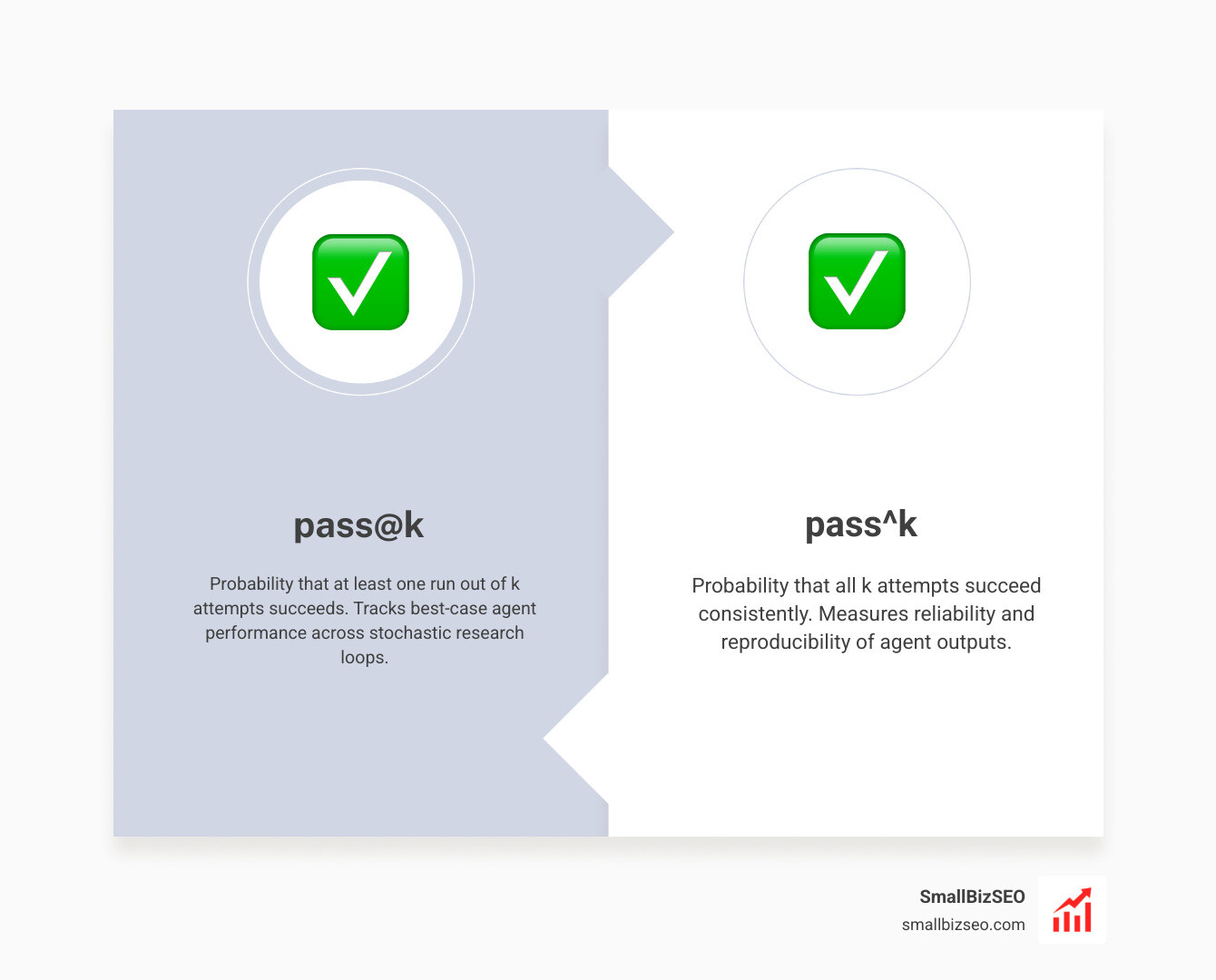
System performance should be tracked across non-deterministic runs using stochastic metrics like pass@k (the probability of at least one successful run in k attempts) alongside pass^k (the probability that all k attempts succeed consistently).
What failure modes can make an agent's answer or stopping decision unreliable?
An agent's findings become unreliable when it falls into query loops, drifts from its original research prompt, or manufactures missing evidence instead of stopping.

When an agent searches the open web, subtle system errors can degrade output quality:
- Quote-Mining and Confirmation Bias: The agent formulates biased queries designed to validate initial assumptions while ignoring contradictory evidence on reputable domains.
- Objective Drift: Over long execution horizons, intermediate findings pull the planner away from the core task contract, leading to thorough reports on irrelevant subtopics.
- Context Compaction Loss: Summarizing large volumes of text across multi-step loops can strip away essential side constraints, causing the agent to drop critical compliance or scope instructions.
- Search-Time Contamination: An agent retrieves pre-computed benchmark answers or unverified forum speculation rather than evaluating raw primary data.
- Improper AI Citation and False Resolution: When an entity cannot be identified, an unconstrained agent often invents plausible text instead of declaring a null resolution and stopping safely.
A robust harness detects these failure modes early and routes ambiguous cases to human operators rather than generating ungrounded conclusions.
How can human oversight and regression tests catch agent failures?
Human oversight catches agent failures by spot-checking high-risk assertions, while automated regression test suites evaluate task accuracy across system updates.
Deploying dependable agents requires building a golden-task evaluation suite consisting of real-world research problems with verified answers. By benchmarking agent runs against known data, teams can track task completion, tool selection accuracy, and citation validity over time. For more complex workflows, our guide to multi-step AI comparison research outlines structured benchmarking practices for iterative information gathering.
Human-in-the-loop workflows provide essential guardrails for mission-critical operations. Reviewers should focus their attention where automation uncertainty is highest:
- Validating Conflict Discrepancies: When top-tier sources provide conflicting numbers, human reviewers must resolve authority ranking.
- Verifying Edge Claims: High-impact business assertions must be confirmed against raw source excerpts before distribution.
- Auditing Null Exits: Reviewing cases where agents stopped due to ambiguous data helps refine planning prompts and query strategies.
Tracking these audits over time reduces total human review effort while keeping system reliability high.
Scaling Verified Agent Workflows in Production
Putting research agents into production requires strict harness-level guardrails, structured note stores, and ongoing trajectory evaluations to prevent performance drift.
While building autonomous research tools takes careful engineering, a properly calibrated system can complete complex due diligence in 2 to 3 minutes that would take a human analyst 4 to 6 hours. Achieving that speed without sacrificing accuracy requires enforcing strict tool budgets, isolating execution environments, and maintaining complete citation auditability across every run.
At SmallBizSEO, we build data-backed growth frameworks and automated intelligence systems through our comprehensive AI SEO services. By establishing verifiable source evaluation protocols, clear exit criteria, and robust technical tracking, businesses can deploy autonomous research agents that deliver fast, grounded, and dependable insights.