5 Steps to Verify If AI Overviews Accurately Summarize Your Content

Why Does AI Overview Accuracy Matter?
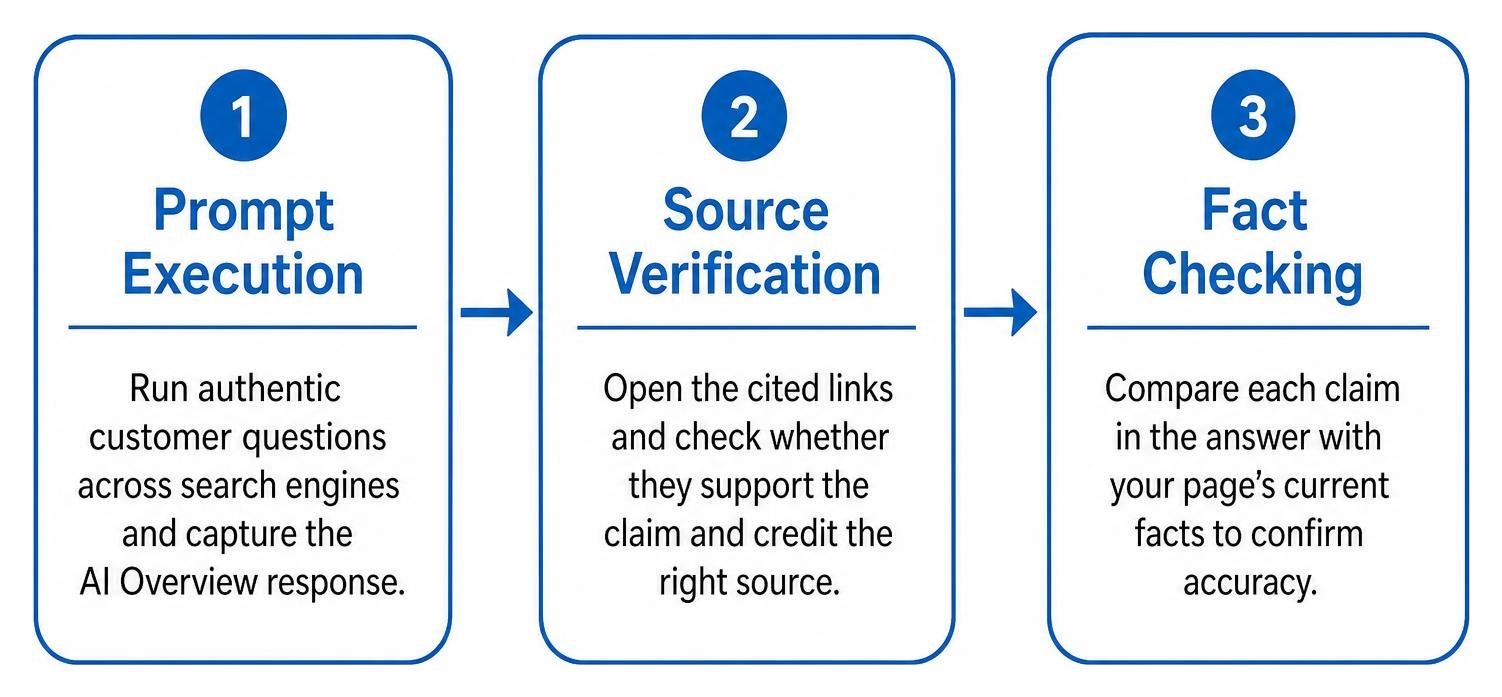
If you're wondering how to audit whether an ai overview accurately represents your page, start with a question a customer would ask. Compare each claim in the answer with your page's current facts, then open the cited links to check whether they support the claim and credit the right source.
An AI Overview can mention your business and still get a key detail wrong, such as a service you no longer offer. A short, repeatable check helps you catch errors before you rely on that answer to inform customers.
I'm Clayton Johnson, founder of SmallBizSEO, where I focus on clear website content and AI-driven search discovery. That work informs how to audit whether an ai overview accurately represents your page: check what it says, where it got the information, and whether a customer can trust it.
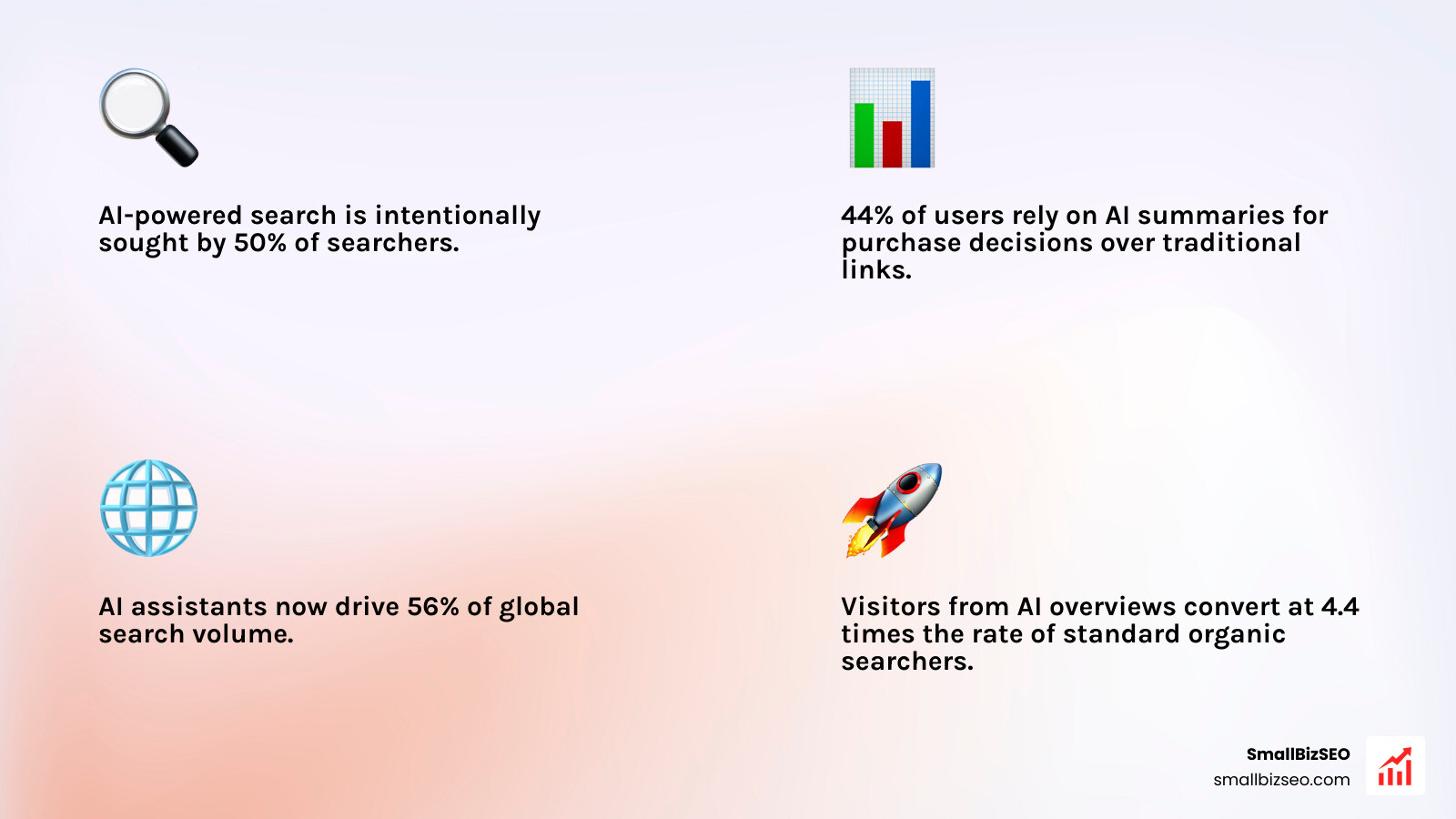
Generative summaries have fundamentally transformed consumer habits. Today, roughly half of all searchers intentionally seek out AI-powered search, with 44% relying on these synthesized answers as their primary source for purchase decisions over traditional blue links. In fact, AI assistants now account for 56% of global search volume.
When search engines display AI-generated summaries above standard listings, accuracy becomes an immediate brand reputation issue. Visitors referred through AI interfaces convert at 4.4 times the rate of standard organic searchers. However, if an automated snippet presents outdated pricing, omits core capabilities, or invents terms out of thin air, high-intent buyers leave before ever visiting your site.
Step-by-Step Framework: How Can You Audit Whether an AI Overview Accurately Represents Your Page?
To audit whether an AI Overview accurately represents your page, run authentic customer questions across search engines, evaluate the returned synthesis against your live content, and inspect the cited grounding sources.
Modern search systems rely on rag (retrieval-augmented generation) to synthesize responses from multiple live web documents. Because only 38% of citations in AI Overviews originate from classic top-10 organic search rankings, high keyword placement alone does not prevent factual distortion. Reviewing your web presence under official guidelines for AI Features and Your Website is a strong foundation, but executing a direct accuracy audit in modern ai search requires systematic evaluation.
Understanding the Stakes: How Is an Accuracy Audit Different From a Visibility Check?
An AI visibility audit measures whether your brand appears in generated summaries, while an AI accuracy audit evaluates whether the specific facts, pricing, and claims stated about your business are true.
Many brands run a baseline guide to AI SEO audit to monitor their overall ai share of voice, but presence without precision creates distinct risks. Research into Google AI overview accuracy risks highlights that generative tools frequently blend disparate data points, resulting in misattribution or flat-out hallucinations.
| Audit Dimension | AI Visibility Audit | AI Accuracy Audit |
|---|---|---|
| Primary Metric | Share of voice, presence percentage, mentions | Factual correctness, pricing truth, claim alignment |
| Data Evaluated | Brand inclusion across industry prompts | Content parity between live page and AI summary |
| Risk Detected | Invisibility and competitor dominance | Hallucinations, outdated data, brand misrepresentation |
| Core Remedy | Entity authority and off-page citations | Structured data cleanup and source-level content correction |
Common inaccuracies include:
- Direct Hallucinations: Inventing features, certifications, or office locations that do not exist.
- Temporal Mismatches: Stating legacy pricing structures or discontinued service packages as current.
- Misattribution: Assigning a competitor's terms, reviews, or policies directly to your organization.
1. How Do You Build a Buyer-Centric Prompt Set and Identify Grounding Sources?
Build an effective audit by assembling a targeted list of 10 to 20 customer questions, querying AI engines in fresh sessions, and recording every linked reference that supports the answer.
To begin, construct a comprehensive prompt set covering three core intent areas:
- Direct Brand Queries: Questions about your specific company name, leadership, exact services, and costs.
- Category Problem Queries: Questions detailing a business problem you solve within your industry without naming you directly.
- Comparative Queries: Questions asking the engine to compare your product directly against leading alternatives.
Run these queries across platforms such as google ai mode and Perplexity using incognito sessions to prevent previous account history from skewing the output.
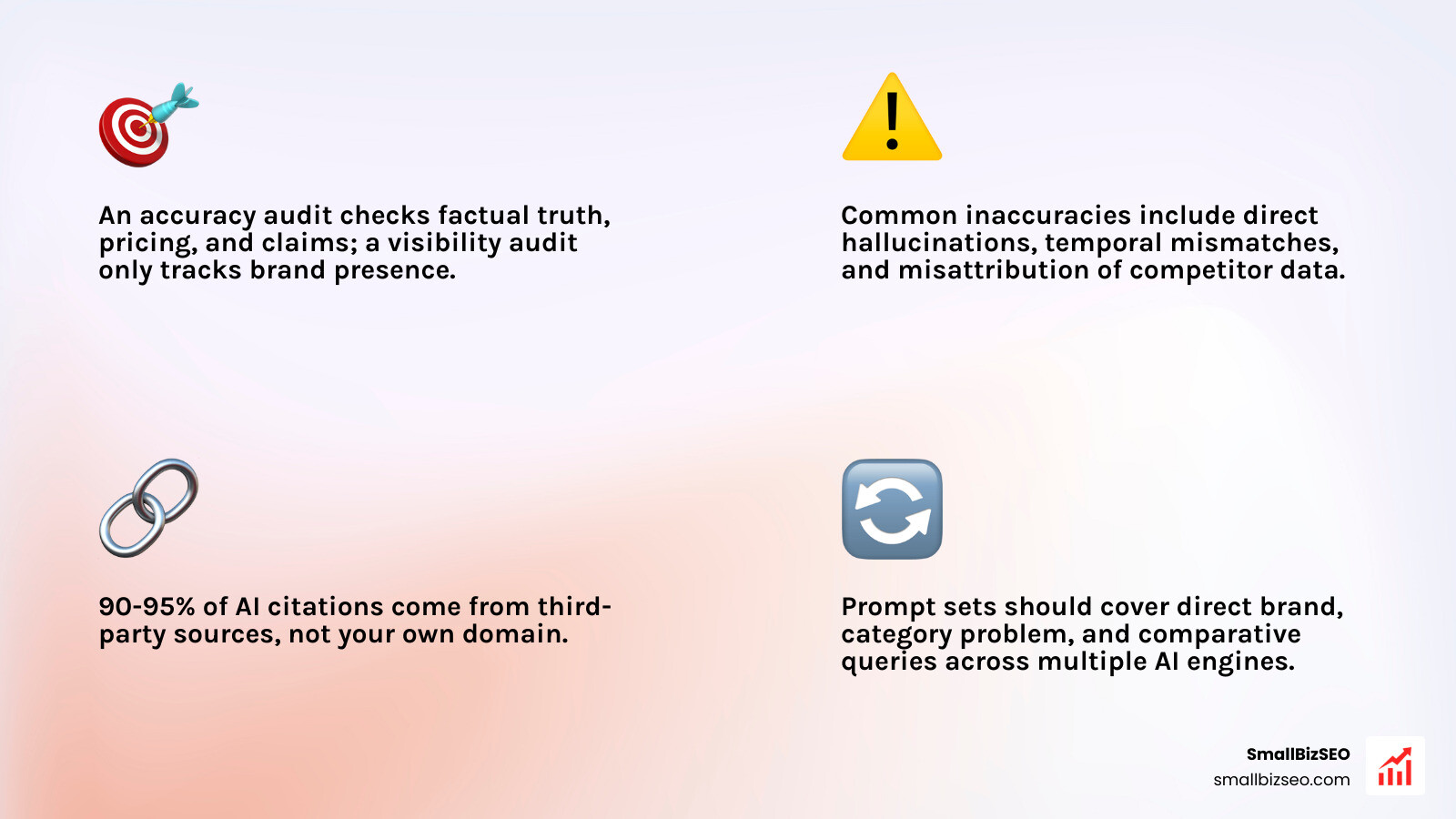
When reviewing the output, examine the grounding links. A company's own domain typically accounts for only 5% to 10% of the citations supporting an AI summary. The remaining 90% to 95% originates from third-party directories, news publications, and forum discussions. Tracking your ai citation rate alongside the exact destination of each ai citation helps pinpoint whether inaccuracies stem from your internal copy or third-party web content.
2. How Do You Verify Content Consistency and Technical Schema Integrity?
Verify factual consistency by cross-checking the AI summary's exact statements against your on-page copy, then validating that your structured data matches your visible text.
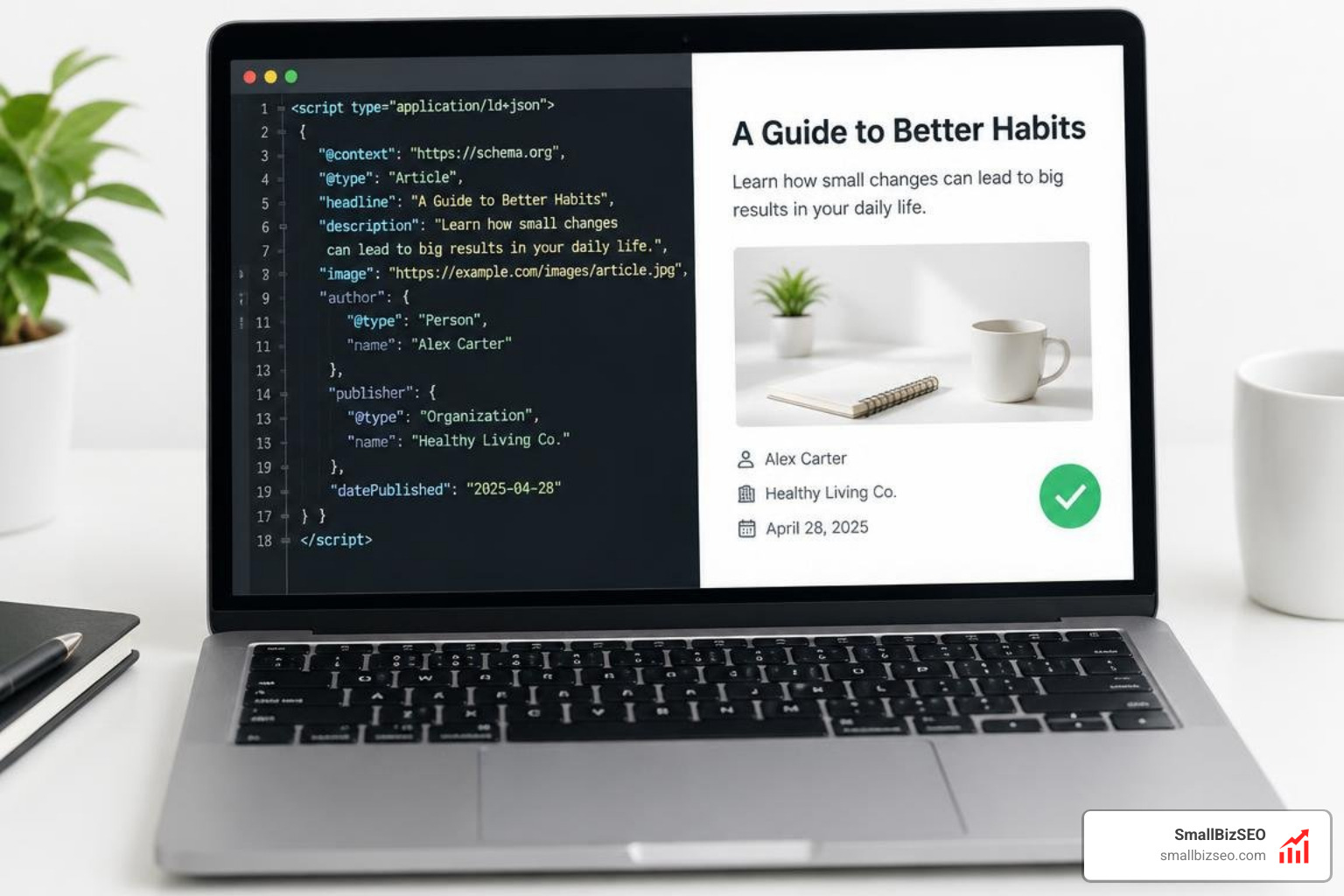
Generative engines favor clear, self-contained paragraphs that answer specific user questions directly. Formatting your core insights into answer ready content ensures crawlers extract your intended facts without misinterpreting the context.
To audit technical extractability:
- Validate Schema.org Markup: Ensure your JSON-LD structured data (including
Organization,Product, andFAQPage) precisely reflects visible page text. Discrepancies between schema attributes and on-page copy often trigger hallucinations. - Inspect Open-Source Diagnostics: Tools like the open-source semantic-integrity CLI on GitHub help audit whether your page layout remains readable, verifiable, and structurally intact for automated answer engines.
- Ensure Machine Legibility: Verify that autonomous crawlers in agentic search environments can parse your primary content without relying on client-side JavaScript clicks.
Monitoring Cadence: How Often Should You Audit AI Overview Accuracy?
Conduct manual spot-checks on your top priority prompts monthly, perform an exhaustive multi-engine audit quarterly, and re-audit immediately after major site redesigns or product updates.
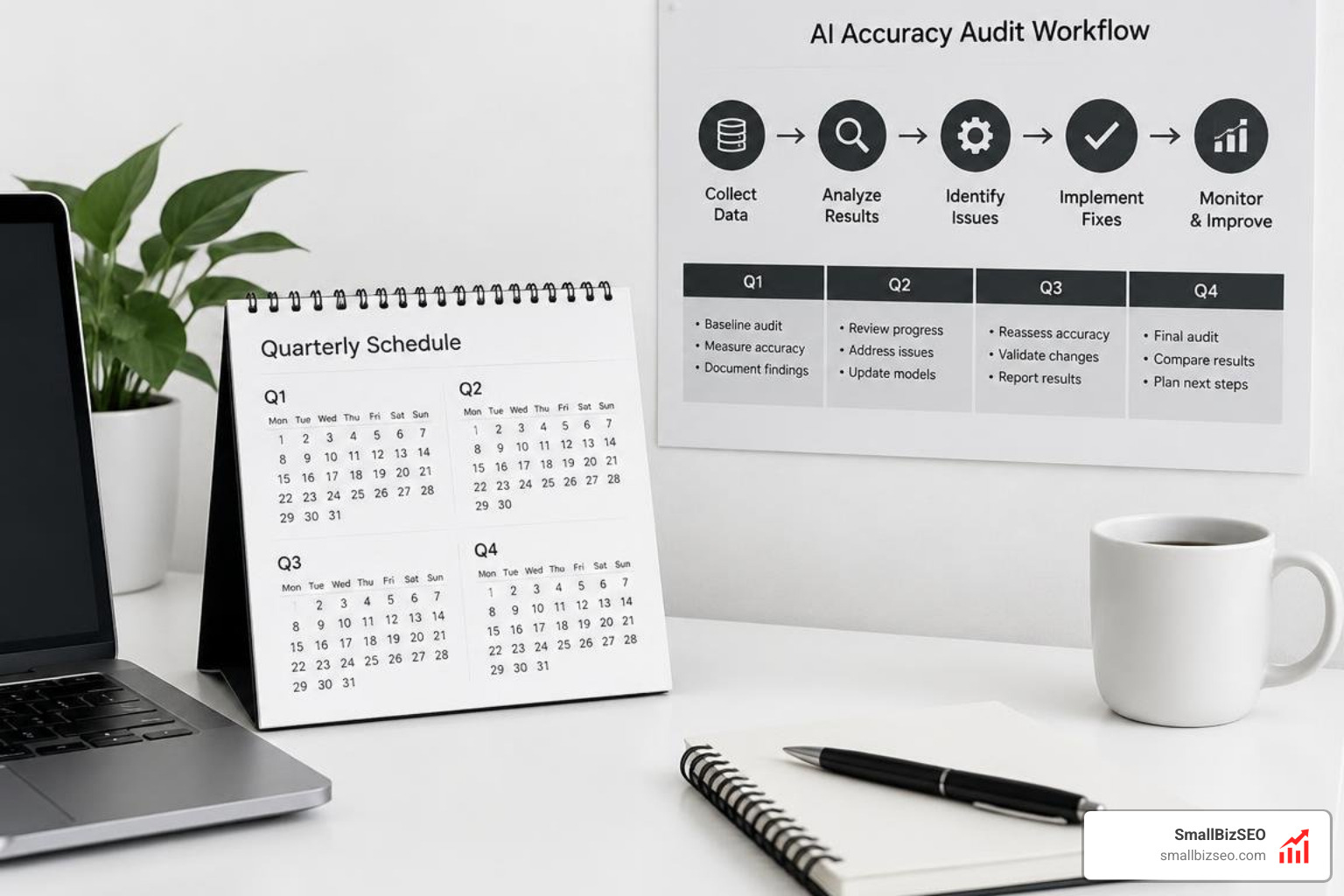
Because generative systems are non-deterministic, identical prompts rarely yield identical word-for-word summaries over time. Maintaining a recurring spreadsheet allows you to track narrative shifts and observe patterns in ai referral traffic.
We recommend structuring your recurring cadence around three triggers:
- Monthly Pulse Checks: Test 5 to 10 core commercial prompts to ensure essential pricing and service offerings remain accurate.
- Quarterly Deep Audits: Evaluate your full prompt library across multiple generative search platforms, scoring factual precision, citation sources, and competitor positioning.
- Event-Driven Reviews: Audit immediately following any rebrand, major website migration, restructuring of URL paths, or launch of new pricing tiers.
How Do You Correct Inaccuracies and Measure Business Impact?
Fix inaccuracies by updating your on-page answer blocks, correcting third-party reference sources, and measuring downstream changes in search clicks and conversions.
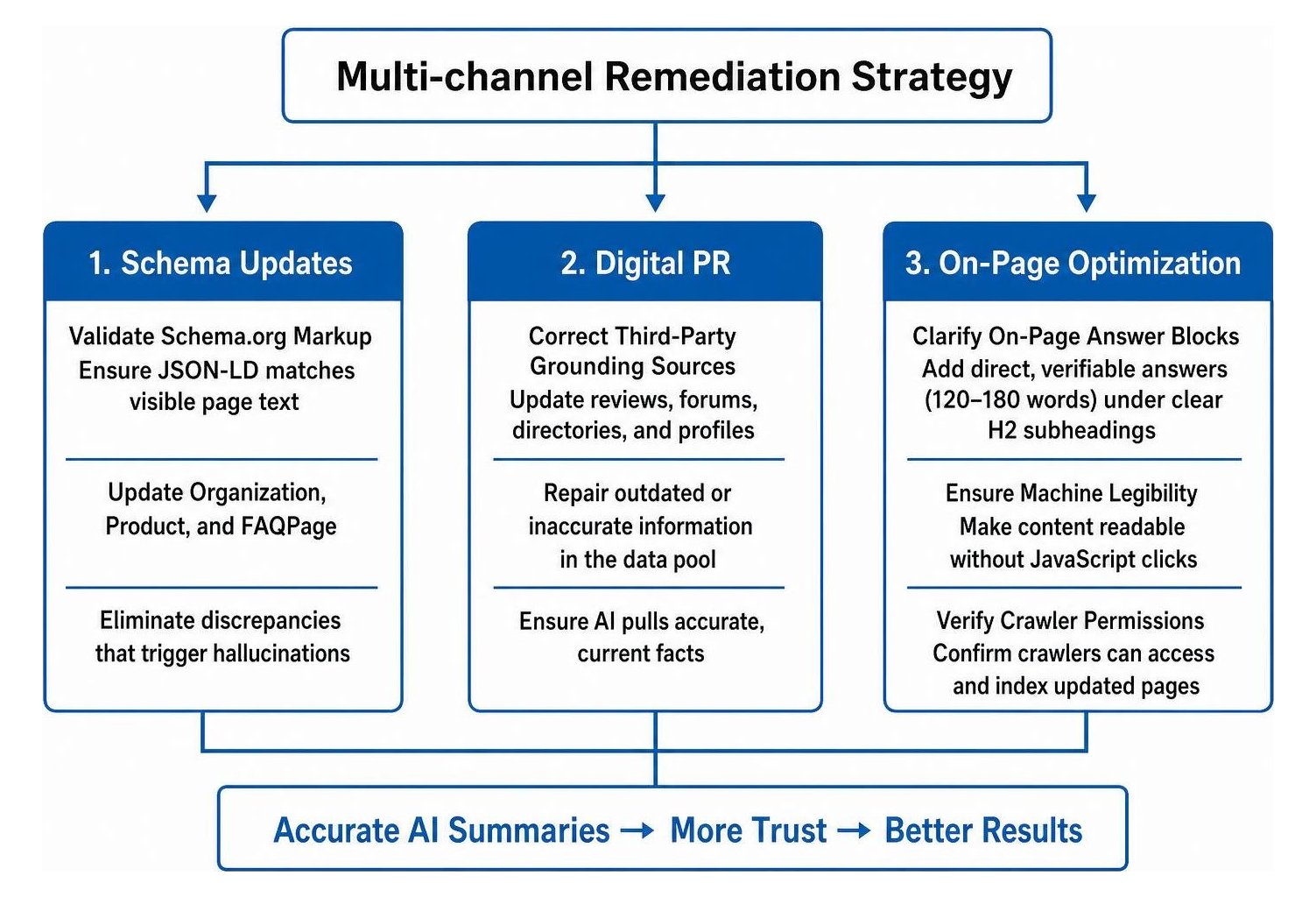
If an AI summary misrepresents your brand, follow this structured remediation plan:
- Clarify On-Page Answer Blocks: Place direct, verifiable answers within 120 to 180 words beneath clear H2 subheadings on your target page to provide an easily extractable summary.
- Correct Third-Party Grounding Sources: If the AI draws outdated information from an external review site, forum, or industry directory, update those profiles directly to repair the underlying data pool.
- Verify Crawler Permissions: Review your server rules and robots configuration to confirm that search engine crawlers can access and index your updated pages.
- Monitor Revenue and Engagement Impact: Earning accurate citations in AI summaries often produces a 35% lift in click-through rates compared to plain listings. With overall commerce seeing rapid growth in AI-attributed transactions, tracking clean conversions confirms that your corrections are driving revenue.
At SmallBizSEO, we use our data-driven Velocity framework to combine technical precision, E-E-A-T alignment, and automated reporting to keep small businesses visible and accurately represented. If you want ongoing management for your generative search presence, explore our dedicated SmallBizSEO AI Overview Auditing & Optimization Services to safeguard your brand's digital reputation.
Maintaining Long-Term Brand Precision in AI Search
Protecting how automated systems summarize your website is an ongoing editorial and technical discipline. By regularly auditing customer prompts, checking third-party grounding links, maintaining clean structured data, and resolving factual discrepancies at the source, you ensure that every AI summary directs qualified buyers to your business with confidence.