Beginner’s Guide to Keyword Content Optimization

Beginner's Guide to Keyword Content Optimization
Why Content Optimization Is the Key to Getting Found Online
Content optimization is the process of improving your website pages and blog posts so they rank higher in search engines, attract the right visitors, and turn those visitors into leads or customers.
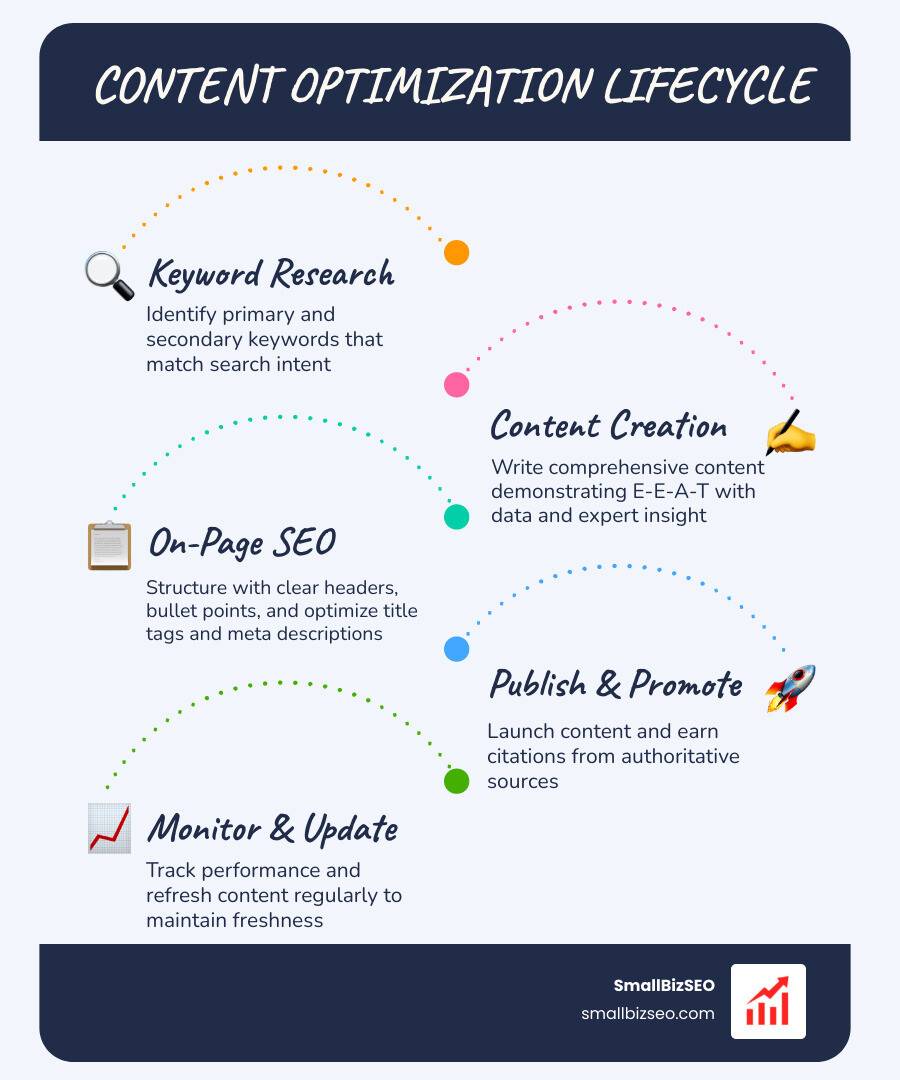
Here's a quick snapshot of what it actually involves:
- Match search intent — write content that answers what your audience is actually looking for
- Use the right keywords — include primary and related terms naturally throughout your content
- Structure for readability — use clear headings, short paragraphs, and bullet points
- Optimize on-page elements — title tags, meta descriptions, and image alt text
- Demonstrate expertise — support claims with data, expert insight, and first-hand experience
- Keep content fresh — update pages regularly so search engines and AI tools trust them
- Drive action — include clear calls to action that match where the reader is in their journey
If you're a small business owner, you've probably published content that just... sits there. No traffic. No leads. No traction.
That's not a content problem. It's an optimization problem.
Creating great content isn't enough anymore. In today's competitive search landscape, every page on your site needs to be actively tuned to perform — for Google, for AI tools like ChatGPT and Perplexity, and most importantly, for real people with real questions.
The good news? You don't need a big team or a big budget to do this well. You just need a clear process.
I'm Clayton Johnson, a digital PR and SEO specialist who has spent years helping businesses improve their search visibility through smarter content optimization — from keyword strategy to on-page structure to earning the kind of web mentions that AI tools actually cite. In this guide, I'll walk you through exactly what to do and why it works.
What is Content Optimization and Why Does It Matter?
To succeed in digital marketing, we must understand that traditional SEO and content optimization are two sides of the same coin. While technical SEO focuses on site architecture, crawlability, and schema, content optimization is about the substance of the page itself. It ensures your words are relevant, comprehensive, and structured to satisfy both search engine algorithms and human readers.
Today, this process has expanded to include Generative Engine Optimization (GEO). Search engines and AI answer engines are merging. Traditional search engines still dominate the landscape—sending roughly 199 times more traffic to websites than ChatGPT, Perplexity, Copilot, and Gemini combined. AI chatbots themselves account for only about 1% of total web traffic.
However, optimizing for AI visibility is crucial for future-proofing your brand. The way to do this isn't through shortcut hacks. AI models use retrieval-augmented generation (RAG) to pull facts from the web. Our analysis of thousands of brands shows that web mentions have a much higher correlation with AI visibility (0.664) than traditional backlinks (0.218). Brands that rank in the top tier for web mentions receive 10 times more AI citations.
By building high-quality assets, you feed both traditional search engines and AI engines. To understand how this fits into your larger marketing plan, check out this guide on Content Optimization: Your GTM Success Guide. For the technical foundation that supports these efforts, read our breakdown of On-Page SEO.
Key Parameters for Optimizing Content for SEO and AI
To satisfy search algorithms and AI systems, we must treat our content as structured data. Algorithms do not read like humans; they look for semantic patterns, topical coverage, and clear structural hierarchies.
Matching Search Intent and E-E-A-T
Every search query has an underlying motivation. To rank, your page must match this search intent. The four primary types of intent are:
- Informational: The user wants to learn something (e.g., "how to tune a guitar").
- Commercial: The user is researching options (e.g., "best acoustic guitars under five hundred dollars").
- Transactional: The user is ready to buy (e.g., "buy Yamaha FG800 online").
- Navigational: The user is trying to find a specific website.
If you target a commercial keyword with an informational blog post, search engines will likely ignore it.
Additionally, Google evaluates content using E-E-A-T guidelines: Experience, Expertise, Authoritativeness, and Trustworthiness. AI engines also prefer content with expert quotes, proprietary data, and natural writing. You can learn how to demonstrate these signals on your site by reading How to Optimize Your Content for E-E-A-T and Build Real Search Trust.
Integrating Keywords and Semantics in Content Optimization
Modern search engines use natural language processing (NLP) to understand the context of a page. This means we cannot rely solely on a single primary keyword. We must include secondary and semantically related keywords to prove topical depth.
For example, if your primary keyword is "organic dog food," semantically related terms might include "grain-free," "natural ingredients," "canine nutrition," and "dry kibble." These terms show search engines that you are covering the topic comprehensively. To discover where your competitors are outperforming you on these terms, you can perform a Keyword Gap Analysis: What It Is and How to Do It Right.
Structuring Content for Readability and AI Prompts
Readability directly impacts user engagement and conversions. In fact, a recent survey found that 43% of marketers prioritize readability to improve both SEO and conversion rates. Writing at a seventh-to-ninth-grade reading level maximizes comprehension for a general audience.
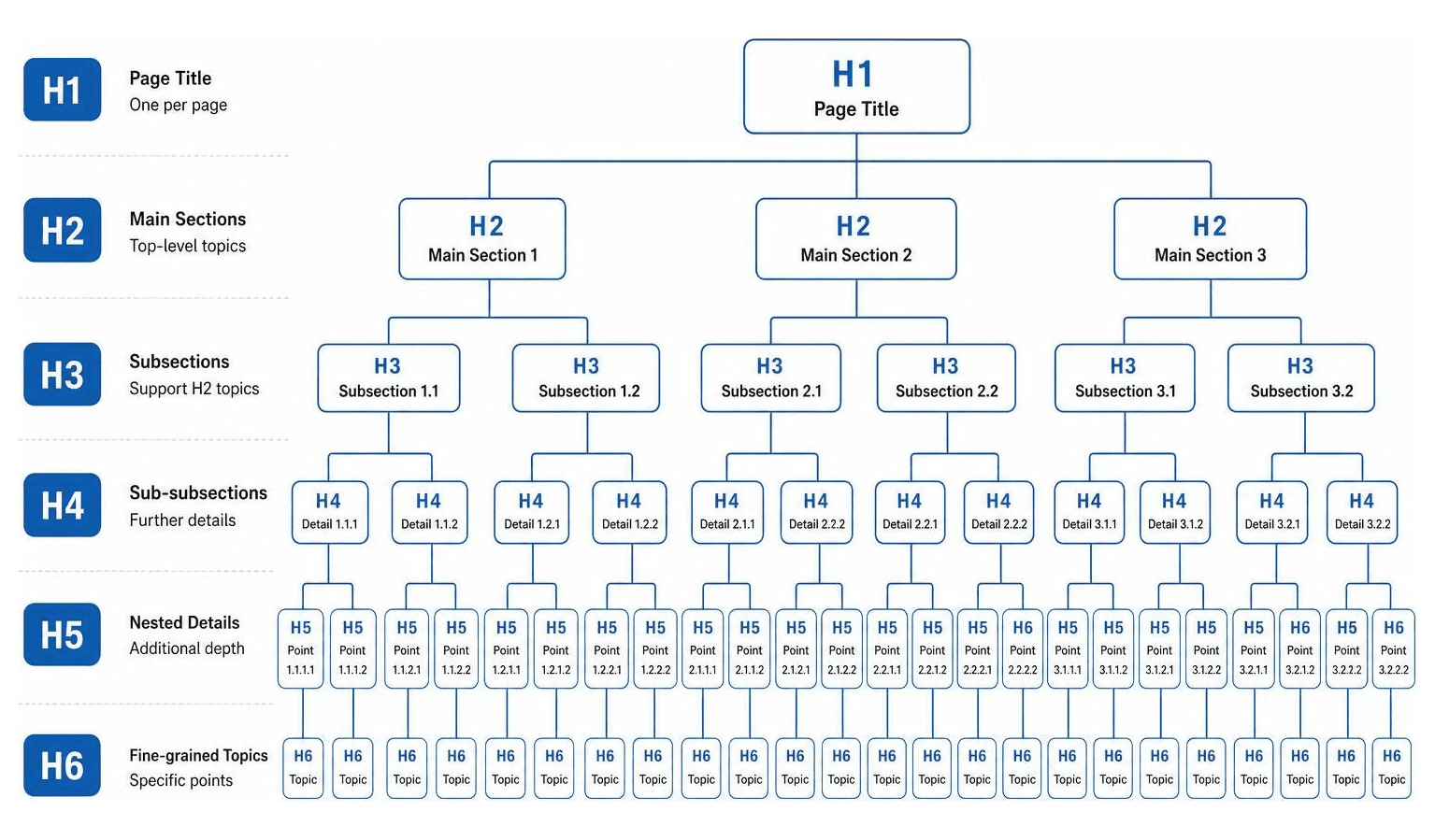
To make your content easy to parse for both humans and AI crawlers, use the Bottom Line Up Front (BLUF) method. State your main point in the first few sentences, use descriptive headers, and break up text with bullet points.
| Readability Level | Target Audience Comprehension | Average User Engagement |
|---|---|---|
| 5th - 6th Grade | Very Easy (Broadest appeal, quick scans) | High (Great for quick answers) |
| 7th - 9th Grade | Optimal (Standard consumer content) | Maximum (Balances depth and speed) |
| 10th - 12th Grade | Difficult (Technical or academic) | Moderate (Requires focused reading) |
| College Level | Very Difficult (Specialist research) | Low (Niche professional audiences) |
Advanced Tactics: SERP Features, Freshness, and Conversions
Once you have established the basics, you can apply advanced tactics to capture prominent search real estate and drive business actions.
Winning Featured Snippets and AI Overviews
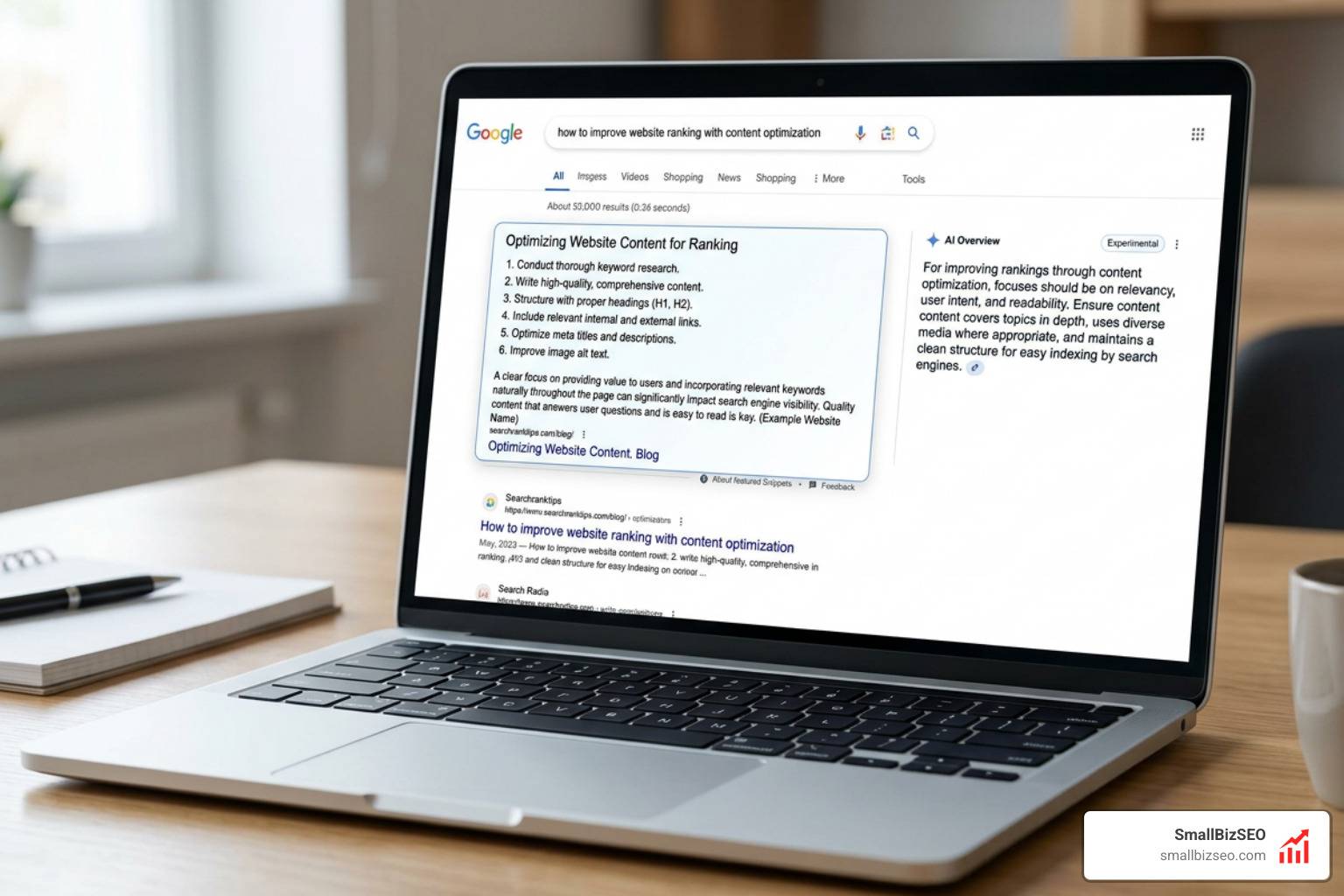
Featured snippets and AI Overviews appear at the very top of search results. To win these positions, structure your content to answer specific questions directly.
- Use Q&A Formatting: Use your H3 headers to ask a clear question, and answer it immediately in a concise paragraph of 40 to 60 words.
- Leverage Schema Markup: Add structured data to help search engines easily parse your reviews, FAQs, and product details.
- Keep Paragraphs Short: Bulleted lists and short tables are highly favored for featured snippets.
To find out which search features your site is currently eligible for, you can request a Detailed SEO Analysis.
Maintaining Freshness and Optimizing for Conversions
Search engines treat freshness as a ranking signal, and AI models have a strong preference for recent data. In fact, studies show that almost 90% of AI bot activity focuses on content published within the past three years. Regularly updating your existing pages signals reliability to both readers and algorithms.
At the same time, traffic is useless if it does not convert. Every piece of content should guide the reader to the next step. Use persuasive, benefit-driven Calls to Action (CTAs) that match where the reader is in their journey. For informational posts, offer a free guide or newsletter signup. For commercial posts, offer a product demonstration or a free consultation. To learn more about moving beyond simple traffic metrics, explore our guide on going Beyond Content Optimization.
Essential Tools and Workflows for High-Ranking Pages
Optimizing content manually across an entire website can be overwhelming. Using the right tools helps automate the process and ensures consistency.

Streamlining Your Workflow with Content Optimization Tools
Professional tools provide real-time recommendations for word count, keyword density, readability, and missing subtopics based on competitive SERP data.
- Semrush: Offers excellent real-time scoring and optimization suggestions. You can learn how to use this tool by reading about how to Enhance Your Content and Rank Higher with Semrush Content Optimizer.
- Ahrefs: Outstanding for identifying content gaps and finding keyword opportunities. If you want to learn how to leverage this data, see our guide on How to Use Ahrefs for Keyword Research Without Losing Your Mind.
- Hemingway Editor: A simple, free tool to check your reading level and eliminate unnecessary fluff.
Common Mistakes and Over-Optimization to Avoid
While optimization is essential, over-optimization can harm your rankings. Avoid these common mistakes:
- Keyword Stuffing: Forcing keywords into sentences where they do not belong. Write naturally first, then refine.
- Ignoring Mobile Users: More than half of all web traffic comes from mobile devices. Ensure your pages load quickly and are easy to read on small screens.
- Prioritizing Quantity Over Quality: Publishing ten mediocre articles will not perform as well as publishing one highly researched, authoritative asset.
If you suspect your site has been penalized or is underperforming due to these issues, you can schedule an SEO Visibility Audit to identify and correct them.
Frequently Asked Questions about Content Performance
How does content tuning differ from traditional SEO?
Traditional SEO focuses on technical, off-page, and structural elements like site speed, crawlability, and backlink profiles. Content tuning (or content optimization) focuses specifically on the substance of the page—ensuring the text answers user intent, covers semantically related topics, and is structured for maximum readability.
How often should I update my website content?
We recommend auditing your content quarterly. High-value pages that target competitive keywords should be updated at least once a year to maintain their freshness signals, especially since AI bots and search algorithms prioritize content updated within the past three years.
How does content tuning improve conversion rates?
By aligning your content with the specific search intent of the user, you attract qualified visitors who are genuinely interested in your topic. When you pair this relevance with clear, persuasive CTAs and a professional, easy-to-read layout, visitors are much more likely to take action.
Conclusion
Mastering content optimization is the most cost-effective way to turn your website into a reliable source of leads and growth. By aligning your pages with user intent, structuring them for readability, and keeping them fresh, you build authority that both Google and modern AI engines trust.
At SmallBizSEO, we help small businesses grow using our data-driven "Velocity" framework. This framework delivers fast rankings and E-E-A-T-compliant growth backed by transparent, automated reporting. If you are ready to stop guessing and start ranking, explore our SEO Content Services today.